
AC Delco 12V MME 50 Ah, Chevy Spark, Cadillac Battery

SWO

Well-Known Member
Joined
Aug 28, 2021
Threads
21
Messages
2,223
Reaction score
2,803
Location
MD, USA
Vehicles
2022 Mach E GT, 2021 Escape PHEV, 2019 F-150
Country flag
Thar is an impressive list. With that list of battery options, what else is the BCM used in?
The list looks identical to the one in my 2021 Escape PHEV (I know because I updated the battery and settings in it).
Sponsored


OWG

Well-Known Member
Joined
Oct 24, 2021
Threads
8
Messages
329
Reaction score
318
Location
MA
Vehicles
2021 MME Premium Extended Range AWD
Country flag
The list looks identical to the one in my 2021 Escape PHEV (I know because I updated the battery and settings in it).
I wonder if they interchange?
 

breeves002

Well-Known Member
First Name
Sam
Joined
Feb 21, 2021
Threads
90
Messages
1,734
Reaction score
3,593
Location
St. Louis, MO
Vehicles
2021 Mach-E GT PE
Country flag
The question is, does it matter? Do the MME modules change how they handle LVB charging (and maintenance, LVB care and feeding in general) based on an input battery size/type?
My guess is possibly. The base BMS idea is the same. The difference is it can turn the DC DC on even when the car is off.
 

kltye

Well-Known Member
Joined
May 21, 2021
Threads
20
Messages
1,105
Reaction score
1,740
Location
Chicago
Vehicles
IB MME Premium RWD
Country flag
Post a suggested model when you find one. The more options, the better!

Considering how scarce MME OEM LVB are, it sure is nice to have this first, possibly better (?) option.
Most 12v LiFePo4 batteries are sold for use in solar or marine applications, so they don't have the mounting posts that automotive 12v batteries have. Generally, 50Ah LiFePo4 batteries will physically fit in the tray (e.g., https://amperetime.com/products/ampere-time-12v-50ah-lithium-lifepo4-battery). Any ideas on how to securely mount such a battery in the tray, maybe with straps? I'm checking on the BMS for this particular battery, since I know the DC-DC converter likes to put out 15.1 volts to bulk charge the LVB.

I know shaving off ~20(?) lbs of weight and the slightly higher columbic efficiency of LiFePo4 vs AGM isn't going to help much in a 4800 lb car and its 88kWh battery pack, but I severely dislike lead acid cells of any kind just out of principle ?
 
OP
OP

louibluey

Well-Known Member
First Name
Joe
Joined
Dec 21, 2020
Threads
60
Messages
888
Reaction score
1,127
Location
NY
Vehicles
FE "Louibluey" GB
Occupation
retired
Country flag
Most 12v LiFePo4 batteries are sold for use in solar or marine applications, so they don't have the mounting posts that automotive 12v batteries have. Generally, 50Ah LiFePo4 batteries will physically fit in the tray (e.g., https://amperetime.com/products/ampere-time-12v-50ah-lithium-lifepo4-battery). Any ideas on how to securely mount such a battery in the tray, maybe with straps? I'm checking on the BMS for this particular battery, since I know the DC-DC converter likes to put out 15.1 volts to bulk charge the LVB.

I know shaving off ~20(?) lbs of weight and the slightly higher columbic efficiency of LiFePo4 vs AGM isn't going to help much in a 4800 lb car and its 88kWh battery pack, but I severely dislike lead acid cells of any kind just out of principle ?
I bet someone makes a terminal conversion kit, but there is another problem. All of our direct fit AGM batteries also have a captive lip on both ends in the long direction. On lip is captured by the front of the battery tray, the rear lip by a bolted on rail. There may be a way to strap it in, but the more mods needed make it a more difficult install.

Ford Mustang Mach-E AC Delco 12V MME 50 Ah, Chevy Spark, Cadillac Battery Screen Shot 2021-12-30 at 5.52.58 PM
Ford Mustang Mach-E AC Delco 12V MME 50 Ah, Chevy Spark, Cadillac Battery Screen Shot 2021-12-30 at 5.54.49 PM
Ford Mustang Mach-E AC Delco 12V MME 50 Ah, Chevy Spark, Cadillac Battery Screen Shot 2021-12-30 at 5.55.16 PM


Eric_C_Boston

Well-Known Member
First Name
Eric
Joined
Apr 16, 2021
Threads
63
Messages
615
Reaction score
811
Location
North Shore, MA, USA
Vehicles
2021 Ford Mustang Mach-E RWD ER
Occupation
Retired Software Engineer
Country flag
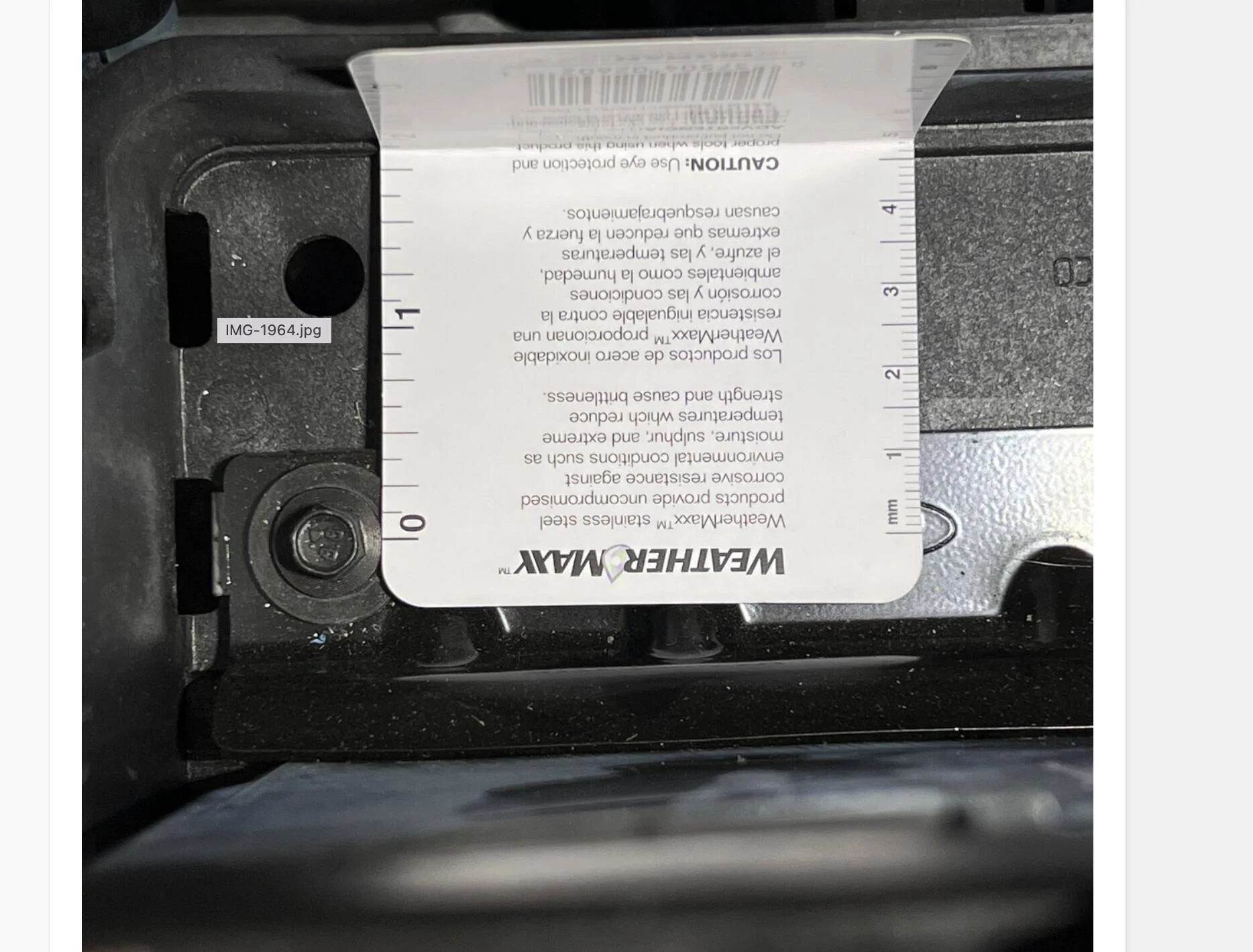
I noticed the extra 1-1/4 inch when I was doing the LVB access mod. I did some research before I found this marvelous thread.

Rock Auto specifies the Motorcraft BHAGMH3 battery for the Mach-E and mentions 35 AH, 60 minutes reserve, and 380 CCA. H3 is the DIN size. I added 1-1/4 inch to the length and figured out the holes are likely for a BXT99RT4A Group 99R battery. I am very familiar with this battery since I owned a Ford Fusion Hybrid. The BXT99RT4A does not gain you much, likely because it is not an AGM.

I will be adding some radio equipment to the Mach-E so I want a more hefty battery. I wonder if the Police versions of the Mach-E use a bigger battery, since they have more electrical demand.
 

Crilly

Well-Known Member
First Name
Dale
Joined
Dec 22, 2020
Threads
3
Messages
374
Reaction score
283
Location
Hartland, Wi
Vehicles
Livewire prius prime Mach e. In 3 weeks if it was built yesterday
Occupation
Retired
Country flag
LifepoX4 battery my not have enough juice to turn on a mache in freezing temperatures.
 

kltye

Well-Known Member
Joined
May 21, 2021
Threads
20
Messages
1,105
Reaction score
1,740
Location
Chicago
Vehicles
IB MME Premium RWD
Country flag
LifepoX4 battery my not have enough juice to turn on a mache in freezing temperatures.
I'm pretty sure LiFePo4 has a wider discharge temperature range than AGM. You can't charge it below freezing temperatures, sure, but I'm not worried about that for my usage.
 

mmap

Well-Known Member
Joined
Oct 9, 2021
Threads
5
Messages
203
Reaction score
325
Location
Maryland
Vehicles
2022 MachE Route1
Occupation
Software Guy
Country flag
SOC is usually calculated based on voltage compared to a curve for a given battery chemistry. Total capacity doesn't change the curve... so to figure out a SOC the BMS just reads the voltage and compares it to the expected curve.

So the SOC calculated by the BMS could potentially be inaccurate if you used a different type of 12v (different chemistry) without changing the BMS settings.
 
OP
OP

louibluey

Well-Known Member
First Name
Joe
Joined
Dec 21, 2020
Threads
60
Messages
888
Reaction score
1,127
Location
NY
Vehicles
FE "Louibluey" GB
Occupation
retired
Country flag
SOC is usually calculated based on voltage compared to a curve for a given battery chemistry. Total capacity doesn't change the curve... so to figure out a SOC the BMS just reads the voltage and compares it to the expected curve.

So the SOC calculated by the BMS could potentially be inaccurate if you used a different type of 12v (different chemistry) without changing the BMS settings.
That makes sense. The only other question is whether our BMS or LVB accounting system, counts coulombs delivered, as part of estimating battery life. Some do, ours may or may not.

There must be some cumulative measurements, because Ford wants the BMS reset when the 12V battery is changed out. Could be as simple as days in service, not sure.
 

noway

Well-Known Member
Joined
Jun 3, 2021
Threads
7
Messages
303
Reaction score
290
Location
Norway
Vehicles
2021 Mach-E First Edition
Occupation
Software developer
Country flag
What? Why are are anyone talking about CCA on an _electric car_ with nothing to crank? A battery with a high CCA is a much more fragile battery which is why all other applications that does not require high amps will use batteries with a low CCA. CCA is the number of amps the battery can supply in 30 seconds in serious freezing temperatures with a voltage > about 7V, it has absolute no meaning for an EV.

The 12V battery in an electric car has no use other than
1) Powering on the relay for the high voltage battery to enable DCDC regulator if the high voltage battery is completely discharged.
2) Providing backup power after a collision for locks, hazard lights, emergecy call system, airbags, etc.

All the other features are provided by the DCDC regulator. Any faults or dicharging of the 12V battery is a result of a failure of the charging system/DCDC regulator, which runs 24/7 connected or not connected, running or not running, or an actual failure in the battery itself. Putting in another battery with a high CCA but tiny fragile electrodes (almost like pieces of paper in an ICE startup battery). The most common reason for 12V ICE start batteries to fail is mechanical breakage of the electrodes. Parts of the electrodes breaks and falls to the bottom of the acid which at some point shorts out the cells when they get stuck between the cells. The lost part of electrodes results in inbalance between cells, causing overcharging of broken cells and undercharging of other cells, causing evaporation of water, causing even more damange. This is simply why we do not want the fragile high-CCA batteries in our EVs, they are just made for one single purpose, but not for what we want, which is a stable 12V source which can be constantly charged.

The BMS for 12V battery is pretty simple stuff.. charge with a set max voltage until no current flows. Thats how to detect if a lead acid battery is charged. The voltage is calculated based on battery temperature, battery chemistry and the required state of charge. There is no counting of amps or cell balancing involved like in lithium battery charging. The battery negative terminal is isolated from any load with the current sensing in series to detect the current to and from the battery. There is no battery life estimation or anything in lead acid batteries. Partially because the number of Wh a lead acid battery can deliver is not really possible to estimate in the first place, it is very dependent on the current draw and temperature. The charge voltage (100%) does not change as the electrodes starts to generate crystals.
 

kltye

Well-Known Member
Joined
May 21, 2021
Threads
20
Messages
1,105
Reaction score
1,740
Location
Chicago
Vehicles
IB MME Premium RWD
Country flag
What? Why are are anyone talking about CCA on an _electric car_ with nothing to crank? A battery with a high CCA is a much more fragile battery which is why all other applications that does not require high amps will use batteries with a low CCA. CCA is the number of amps the battery can supply in 30 seconds in serious freezing temperatures with a voltage > about 7V, it has absolute no meaning for an EV.

The 12V battery in an electric car has no use other than
1) Powering on the relay for the high voltage battery to enable DCDC regulator if the high voltage battery is completely discharged.
2) Providing backup power after a collision for locks, hazard lights, emergecy call system, airbags, etc.

All the other features are provided by the DCDC regulator. Any faults or dicharging of the 12V battery is a result of a failure of the charging system/DCDC regulator, which runs 24/7 connected or not connected, running or not running, or an actual failure in the battery itself. Putting in another battery with a high CCA but tiny fragile electrodes (almost like pieces of paper in an ICE startup battery). The most common reason for 12V ICE start batteries to fail is mechanical breakage of the electrodes. Parts of the electrodes breaks and falls to the bottom of the acid which at some point shorts out the cells when they get stuck between the cells. The lost part of electrodes results in inbalance between cells, causing overcharging of broken cells and undercharging of other cells, causing evaporation of water, causing even more damange. This is simply why we do not want the fragile high-CCA batteries in our EVs, they are just made for one single purpose, but not for what we want, which is a stable 12V source which can be constantly charged.

The BMS for 12V battery is pretty simple stuff.. charge with a set max voltage until no current flows. Thats how to detect if a lead acid battery is charged. The voltage is calculated based on battery temperature, battery chemistry and the required state of charge. There is no counting of amps or cell balancing involved like in lithium battery charging. The battery negative terminal is isolated from any load with the current sensing in series to detect the current to and from the battery. There is no battery life estimation or anything in lead acid batteries. Partially because the number of Wh a lead acid battery can deliver is not really possible to estimate in the first place, it is very dependent on the current draw and temperature. The charge voltage (100%) does not change as the electrodes starts to generate crystals.
I'm not sure if anyone is really concerned about CCAs here - the posts merely mention the specs of replacement AGMs, which still state CCAs. As for counting coulombs, the C-Max Energi (and probably the Fusion Energi) counted coulombs when charging the LVB; don't as me why, but it did that, and changing out the battery for a higher capacity was useless because of that.

For me, swapping out AGM for LiFePo4 is for weight reasons, and because I dislike the APIM/DSP modules starting up late and causing chimes to come out of the IPC when the LVB voltage is on the low side. I know it doesn't matter much, but it's just something fun for me and presumably others on this thread.
 

Kevin P

Well-Known Member
Joined
Feb 7, 2020
Threads
6
Messages
436
Reaction score
707
Location
Burlington, KY, US
Vehicles
'21 MMEGT - sold, '23 BMW i4 M50, various others
Occupation
IT
Country flag
We aren't talking about CCA. We are talking about amp-hours. The CCA is likely inconsequential. The greater amp-hours may very well helpful. The battery being discussed is physically larger, and is AGM like the original, hence the greater capacity.
 

Neilthepilot

Well-Known Member
First Name
Neil
Joined
Oct 10, 2021
Threads
1
Messages
76
Reaction score
98
Location
Pennsylvania
Vehicles
"22 MME Premium, Ram 1500, Wrangler, FR3
Occupation
Pilot
Country flag
I'm pretty sure LiFePo4 has a wider discharge temperature range than AGM. You can't charge it below freezing temperatures, sure, but I'm not worried about that for my usage.
LiFePo4 batteries also have different charging requirements. On RV's (which is where my battery knowledge comes from) your charger has different settings for Lead Acid, AGM or LiFePo4. Ford would have to update the BMS for the LiFePo4 charging. Then there is the effect of the cold on the battery output and charging.
 

kltye

Well-Known Member
Joined
May 21, 2021
Threads
20
Messages
1,105
Reaction score
1,740
Location
Chicago
Vehicles
IB MME Premium RWD
Country flag
LiFePo4 batteries also have different charging requirements. On RV's (which is where my battery knowledge comes from) your charger has different settings for Lead Acid, AGM or LiFePo4. Ford would have to update the BMS for the LiFePo4 charging. Then there is the effect of the cold on the battery output and charging.
Yes, the curve is different if you want to charge it to 100%. For the bulk charging phase, AGM and LiFePo4 have remarkably similar charging curves. Most 12v LiFePo4 packs are sold with a BMS included, so it just needs more than ~12.6 volts from the LVB BMS to charge. Also, cold weather output on an AGM is laughably worse than LiFePo4; internal resistance of AGM is terrible compared to LiFePo4.

I've run small-scale solar with LiFePo4 and AGM; AGM doesn't hold a candle to it. I am aware that charging below freezing is virtually impossible with most LiFePo4, but like I said, I'm not concerned with that for my purposes. And I'm not recommending everyone go out and get one.
Sponsored


Top