
dbsb3233

Well-Known Member
First Name
TimCO
Joined
Dec 30, 2019
Threads
56
Messages
10,100
Reaction score
11,965
Location
Colorado, USA
Vehicles
2021 Mustang Mach-E FE, 2025 Porche Macan Electric
Occupation
Retired
Country flag
Seeing mid threes isn’t uncommon for me at 65 mph (which is posted highway speed limit around here). I run minimal climate on my daily commute(different when the wife’s in the car), and the drive is pretty flat. Almost 80 of my 83 mile drive is highway. Colder temps have dropped me into the low threes at 65. Of course there are exceptions, like wind and such that push me into the high twos.
The lighter weight of the SR battery should help some too, relative to my heavier ER.
Sponsored


dtonn

Well-Known Member
Joined
Apr 5, 2022
Threads
2
Messages
48
Reaction score
26
Location
Arizona
Vehicles
Chrysler 300s, Mach E Premium AWD ER
Country flag
Thank you for taking he time and effort to post this--you did a great job. Additionally, you convinced me further to drive like a grandma on long trips--a cold grandma.
Hmmm, I think it makes me want to drive fast and warm, and accept 10 more minutes at the next charger... I don't know....my ER AWD has not arrived yet so maybe my opinion will vary once I actually DO a road trip. ;)
 

drg1012

Active Member
First Name
Dave
Joined
Mar 10, 2022
Threads
3
Messages
42
Reaction score
59
Location
Colorado
Vehicles
2022 MME Premium
Occupation
Mechanical Engineer
Country flag
The lighter weight of the SR battery should help some too, relative to my heavier ER.
This is one of those things that we absolutely know to be true- we've been told this about cars our entire lives - but actually doesn't apply to a vehicle with regenerative braking. In a car with friction brakes, all of your kinetic energy, which is proportional to mass, is converted to heat when you brake and is lost. In a vehicle with regenerative braking, most of your kinetic energy is returned to the battery (there is a small loss since the motor and charging circuits have losses), but weight has almost no effect on efficiency in an EV.
 

drg1012

Active Member
First Name
Dave
Joined
Mar 10, 2022
Threads
3
Messages
42
Reaction score
59
Location
Colorado
Vehicles
2022 MME Premium
Occupation
Mechanical Engineer
Country flag
Speed - I was really surprised at the impact speed has on consumption.
Not at all surprising. The actual physics tell us that power required increases with the cube of speed - i.e. going twice as fast requires 8x power. Since you expend that power over a shorter time, energy increases with the square of speed - you need 4x power to go twice as fast. It's not exact for our cars since there is a base load to power the vehicle that is independent of speed, but at higher speeds the base load is small compared to the power required to push the car through the air so the square relationship is a pretty good approximation. As an example going 66 mph requires 21% more energy than going 60 mph (10% faster, 1.1*1.1 = 1.21, i.e. 21% more energy).
 

dbsb3233

Well-Known Member
First Name
TimCO
Joined
Dec 30, 2019
Threads
56
Messages
10,100
Reaction score
11,965
Location
Colorado, USA
Vehicles
2021 Mustang Mach-E FE, 2025 Porche Macan Electric
Occupation
Retired
Country flag
This is one of those things that we absolutely know to be true- we've been told this about cars our entire lives - but actually doesn't apply to a vehicle with regenerative braking. In a car with friction brakes, all of your kinetic energy, which is proportional to mass, is converted to heat when you brake and is lost. In a vehicle with regenerative braking, most of your kinetic energy is returned to the battery (there is a small loss since the motor and charging circuits have losses), but weight has almost no effect on efficiency in an EV.
Regen helps get some of it back (the normally wasted energy from friction braking), but no, more weight definitely takes more net energy to move. Put 900 lbs of people and luggage in a Mach-E, or a 1500 lb load in the bed of a Lightning, and MPK will drop. Just not quite as much as it would drop with no regen.


Darkenmage

Well-Known Member
First Name
Manny
Joined
Oct 8, 2022
Threads
28
Messages
206
Reaction score
111
Location
Texas
Vehicles
Mach E GT AWDe and Honda Insight
Occupation
Semi Retired
Country flag
I've been recording driving data for the last couple of months and finally got around to putting it all together so I can look at it today and thought I would share. I really wish this stuff was available through the app or vehicle, but oh well! I was most curious about battery consumption as a function of speed and temperature. I live in NY where we have some pretty decent swings in temp and I drive 166 miles round trip on weekdays(yeah, 83 miles one way... thank Ford for BlueCruise). When I bought Buzz, chargers were always available at the university, and free of charge. Well, there has been a major increase in plug in hybrids and other EVs on campus, so it's been a race to the chargers recently. So I have really needed to pay close attention to my efficiency. Wish I would've anticipated this when I bought it, I would've splurged on the extended range. Anyway, here's what I recorded and a really high level analysis of the data! I have not done any proper statistical analysis, just a quick visual tonight.

Vehicle is a '21 Select, AWD, SR(useable 68 kWh).

I used % battery consumed and calculated my own kWh consumed and mi/kWh. I felt like % consumed would be most reliable. I do have several other datapoints that I was recording. I'll attach the excel file at the end in case you're interested (sorted by speed, but not recorded like that. I did it for the average calculations). Sorry non-Americans, the data is all in mph and F°. I have recorded 45 trips, 83 miles each, of the exact same drive. Terrain is relatively flat.

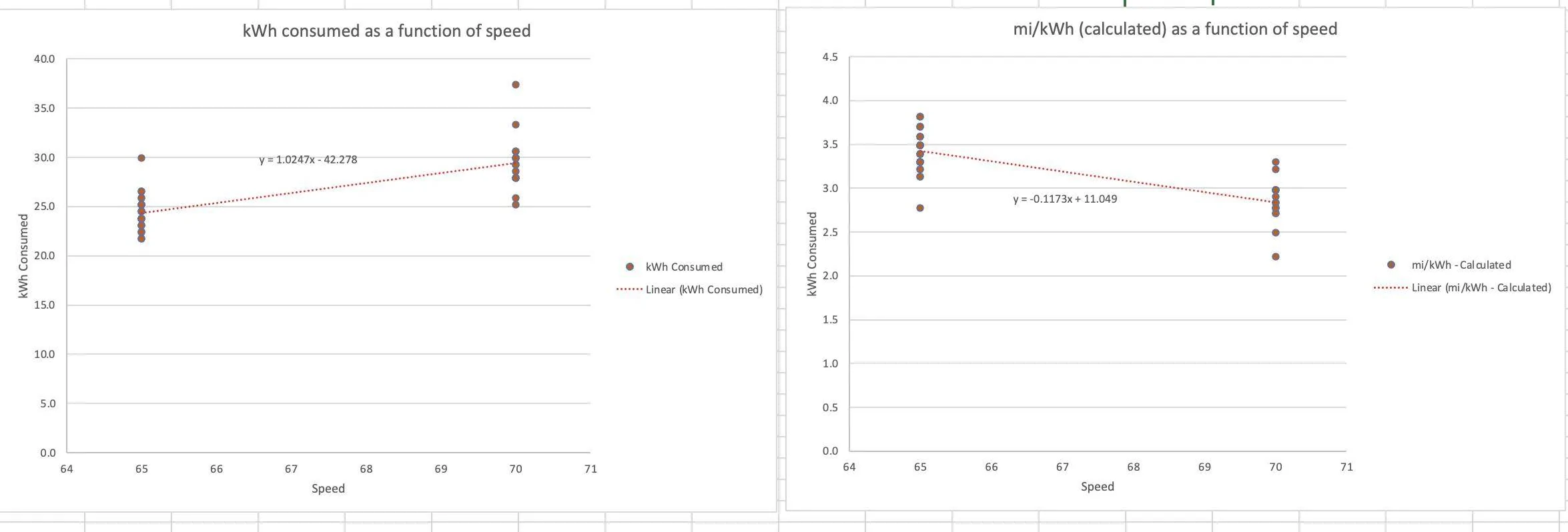
Speed - I was really surprised at the impact speed has on consumption. Obviously, the data is a little confounded by outside temp, but I was hoping to wash that out with repeats and randomization. The difference between 65 mph and 70 mph is huge! I should get ~40 miles more per full charge by doing 65mph, 3.4 mi/kWh vs. 2.8 mi/kWh. I found that really surprising! So yeah, on my daily commute, I am that guy doing 65 mph... ?

1670730484434.png


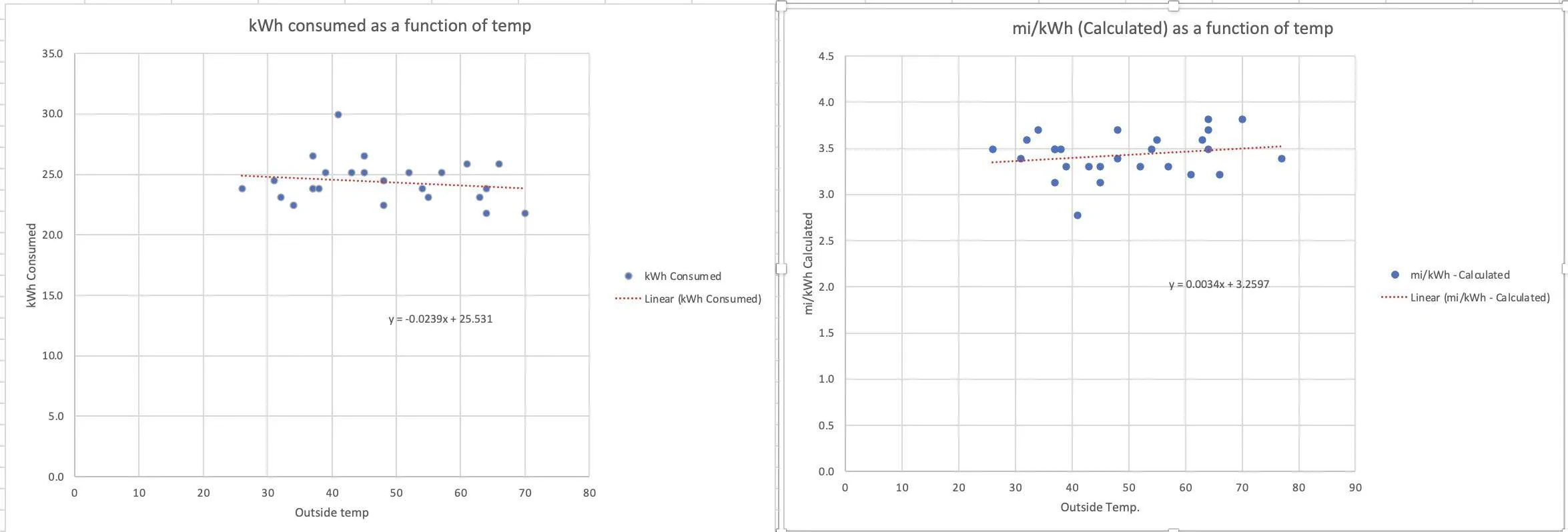
Outside Temp -This was a shock, considering what I've heard, but outside temperature doesn't seem to to be as significant of a factor in efficiency as I expected. The slope between 30 and 70 (F) is pretty minor. Though, we have colder days coming, and I don't expect it to be a linear relationship. Anyway, I used minimal climate on my trips. Again, hoping repeats and randomization will give it validity.

Here's the graph of the data at 65 mph
1670731167024.png


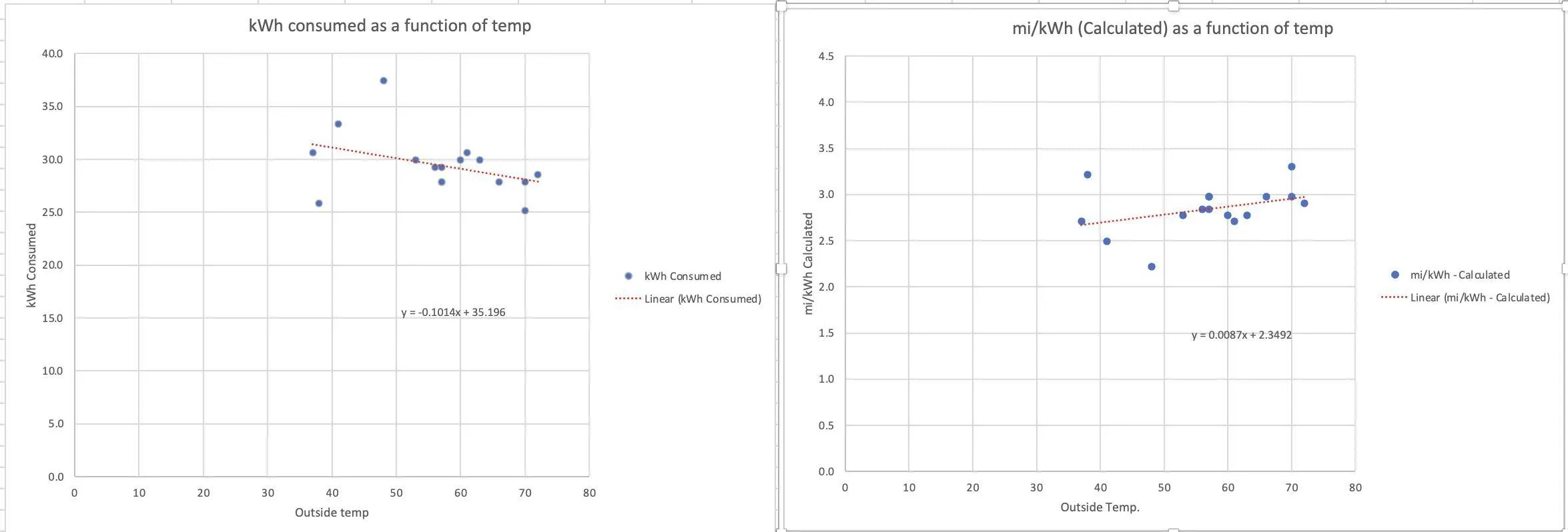
And here it is at 70 mph.
1670731319602.png


It does look like the efficiency could be a bit more compromised by temperature at higher speeds. Could just be coincidence though.

Yeah, so take a look. Tell me what you think. I'd be interested to hear your thoughts! I plan to keep recording, so I may send an update in another couple of months.

@Ford Motor Company , How about making this data available to us! I'd love to see it!
Wow, TY for this. In my 2 months of experience on my 2022 GT, your data supports the fact that SPEED more than anything else REALLY impacts range. I am a bit of a lead foot, to the consternation of my wife. I need to learn to drive much slower. We made a trip during Turkey week to Virgina and it averaged 35-38 during the night and my GT was parked outside during the whole time. The lower temps did not put a big dent on range at all. Other than the icon that says my battery is cold, had no issues but my lead foot.
 

dbsb3233

Well-Known Member
First Name
TimCO
Joined
Dec 30, 2019
Threads
56
Messages
10,100
Reaction score
11,965
Location
Colorado, USA
Vehicles
2021 Mustang Mach-E FE, 2025 Porche Macan Electric
Occupation
Retired
Country flag
Not at all surprising. The actual physics tell us that power required increases with the cube of speed - i.e. going twice as fast requires 8x power. Since you expend that power over a shorter time, energy increases with the square of speed - you need 4x power to go twice as fast. It's not exact for our cars since there is a base load to power the vehicle that is independent of speed, but at higher speeds the base load is small compared to the power required to push the car through the air so the square relationship is a pretty good approximation. As an example going 66 mph requires 21% more energy than going 60 mph (10% faster, 1.1*1.1 = 1.21, i.e. 21% more energy).
I don't think the math is quite right on that. Depends greatly on the drag coefficient, which varies greatly from vehicle to vehicle based on it's aerodynamics (especially at higher speeds).

It does use more energy to go faster, of course, but it's not 21% more energy for every 10% faster. Using your numbers, that would mean another 21% more energy to go 72.9 MPH vs 66 MPH. And another 21% more than that to go 79.86 MPH.

That would mean 77% more energy to go 80 MPH vs 60. That's way more differential than it really takes. Similarly, if you work that down the other way, 21% less energy for every 10% reduction in speed would get you up into 7+ MPK pretty quickly at even just 35 MPH. And that's not the case either.

For the same elevation, temperature, wind, and driving style, MPK typically ranges from somewhere in the neighborhood of 3.5 at 40 MPH down to around 2.5 at 80 MPH in my MME 4x.
 

ca_jon

Active Member
First Name
Jon
Joined
May 15, 2022
Threads
0
Messages
39
Reaction score
24
Location
San Diego
Vehicles
2022 Mustang Mach-E Performance
Country flag
I've been recording driving data for the last couple of months and finally got around to putting it all together so I can look at it today and thought I would share. I really wish this stuff was available through the app or vehicle, but oh well! I was most curious about battery consumption as a function of speed and temperature. I live in NY where we have some pretty decent swings in temp and I drive 166 miles round trip on weekdays(yeah, 83 miles one way... thank Ford for BlueCruise). When I bought Buzz, chargers were always available at the university, and free of charge. Well, there has been a major increase in plug in hybrids and other EVs on campus, so it's been a race to the chargers recently. So I have really needed to pay close attention to my efficiency. Wish I would've anticipated this when I bought it, I would've splurged on the extended range. Anyway, here's what I recorded and a really high level analysis of the data! I have not done any proper statistical analysis, just a quick visual tonight.

Vehicle is a '21 Select, AWD, SR(useable 68 kWh).

I used % battery consumed and calculated my own kWh consumed and mi/kWh. I felt like % consumed would be most reliable. I do have several other datapoints that I was recording. I'll attach the excel file at the end in case you're interested (sorted by speed, but not recorded like that. I did it for the average calculations). Sorry non-Americans, the data is all in mph and F°. I have recorded 45 trips, 83 miles each, of the exact same drive. Terrain is relatively flat.

Speed - I was really surprised at the impact speed has on consumption. Obviously, the data is a little confounded by outside temp, but I was hoping to wash that out with repeats and randomization. The difference between 65 mph and 70 mph is huge! I should get ~40 miles more per full charge by doing 65mph, 3.4 mi/kWh vs. 2.8 mi/kWh. I found that really surprising! So yeah, on my daily commute, I am that guy doing 65 mph... ?

1670730484434.png


Outside Temp -This was a shock, considering what I've heard, but outside temperature doesn't seem to to be as significant of a factor in efficiency as I expected. The slope between 30 and 70 (F) is pretty minor. Though, we have colder days coming, and I don't expect it to be a linear relationship. Anyway, I used minimal climate on my trips. Again, hoping repeats and randomization will give it validity.

Here's the graph of the data at 65 mph
1670731167024.png


And here it is at 70 mph.
1670731319602.png


It does look like the efficiency could be a bit more compromised by temperature at higher speeds. Could just be coincidence though.

Yeah, so take a look. Tell me what you think. I'd be interested to hear your thoughts! I plan to keep recording, so I may send an update in another couple of months.

@Ford Motor Company , How about making this data available to us! I'd love to see it!
Thanks this is interesting. I've had my SR/RWD for two months and am getting significantly better miles/kWhr than I'm seeing here. Two reasons that immediately come to mind is the less weight I'm carrying around because of only one motor, and the other is that in Southern Cal, the lowest temps I've driven in thus far are mid 40's.

Having said that, after 2,200 miles on the odomoter, I've averaged 3.7 miles/kWhr. And that includes a large proportion of freeway driving. Just took a roundtrip from San Diego to LA, with cruise control set to 70 or 71 the whole time, with exception of stop and go traffic in the last 30 minutes of the trip and also got 3.7 miles/kWhr for the trip (measured by kWhr used). One reason I get this kind of mileage is that as this is my second EV, I'm very good at maximizing regen miles from one pedal driving. I've found that one skill results in significantly better range.
 

drg1012

Active Member
First Name
Dave
Joined
Mar 10, 2022
Threads
3
Messages
42
Reaction score
59
Location
Colorado
Vehicles
2022 MME Premium
Occupation
Mechanical Engineer
Country flag
Regen helps get some of it back (the normally wasted energy from friction braking), but no, more weight definitely takes more net energy to move. Put 900 lbs of people and luggage in a Mach-E, or a 1500 lb load in the bed of a Lightning, and MPK will drop. Just not quite as much as it would drop with no regen.
You have a slight increase in rolling resistance and a slight loss due to less than perfect motor and charging efficiencies. The difference is very, very small.

Let's put some numbers to it. Kinetic energy is 0.5*mass*velocity*velocity. The ER battery pack weights about 300 lbs/136 kg more than the SR battery. So the additional kinetic energy from the added battery at 45 mph = 0.5*136kg*20m/s*20m/s=27600 Joules = .007665 kwh. Assuming 5% of that energy is lost in motor and charging inefficiencies, every time you break from 45 mph to a full stop, that extra 300 lbs of mass causes you to lose 0.0004 kwh of energy. If you in your normal trip make a full stop from 45 mph to 0 about 20 times, that extra weight caused you to waste .008 kwh. I think we can assume that is the noise in terms of overall efficiency....
 
Last edited:

drg1012

Active Member
First Name
Dave
Joined
Mar 10, 2022
Threads
3
Messages
42
Reaction score
59
Location
Colorado
Vehicles
2022 MME Premium
Occupation
Mechanical Engineer
Country flag
I don't think the math is quite right on that. Depends greatly on the drag coefficient, which varies greatly from vehicle to vehicle based on it's aerodynamics (especially at higher speeds).

It does use more energy to go faster, of course, but it's not 21% more energy for every 10% faster. Using your numbers, that would mean another 21% more energy to go 72.9 MPH vs 66 MPH. And another 21% more than that to go 79.86 MPH.

That would mean 77% more energy to go 80 MPH vs 60. That's way more differential than it really takes. Similarly, if you work that down the other way, 21% less energy for every 10% reduction in speed would get you up into 7+ MPK pretty quickly at even just 35 MPH. And that's not the case either.

For the same elevation, temperature, wind, and driving style, MPK typically ranges from somewhere in the neighborhood of 3.5 at 40 MPH down to around 2.5 at 80 MPH in my MME 4x.
It has exactly nothing to do with the drag coefficient. The drag force in absolute terms is dependent on the drag coefficient (i.e. lbs of drag). The drag in relative terms always increases with the square of velocity, as shown by the drag equation: R = ½ρCAv2 - where R is the drag, ρ is the density of the medium you're moving through, C is the drag coefficient, A is the frontal area, and v2 (don't know how to do a superscript on this forum) is the velocity squared. C changes your drag, but the relationship is always the square of velocity. As I mentioned, the relationship is not exact in our case because the car is always using a base load to power the electronics, regardless of your speed. But as a first order approximation, you can assume that energy increases with the square of velocity.
 
Last edited:

j1mb0b

Member
Joined
Jul 16, 2022
Threads
0
Messages
12
Reaction score
5
Location
HB, CA
Vehicles
2022 MME GT, 2023 MME Premium RWD
Country flag
It has exactly nothing to do with the drag coefficient. The drag force in absolute terms is dependent on the drag coefficient (i.e. lbs of drag). The drag in relative terms always increases with the square of velocity, as shown by the drag equation: R = ½ρCAv2 - where R is the drag, ρ is the density of the medium you're moving through, C is the drag coefficient, A is the frontal area, and v2 (don't know how to do a superscript on this forum) is the velocity squared. C changes your drag, but the relationship is always the square of velocity. As I mentioned, the relationship is not exact in our case because the car is always using a base load to power the electronics, regardless of your speed. But as a first order approximation, you can assume that energy increases with the square of velocity.
Just to add to this, it only applies at speed where you get turbulent flow. At low speed, the air flow over the car is laminar and drag is linear with velocity.
 

dbsb3233

Well-Known Member
First Name
TimCO
Joined
Dec 30, 2019
Threads
56
Messages
10,100
Reaction score
11,965
Location
Colorado, USA
Vehicles
2021 Mustang Mach-E FE, 2025 Porche Macan Electric
Occupation
Retired
Country flag
Just to add to this, it only applies at speed where you get turbulent flow. At low speed, the air flow over the car is laminar and drag is linear with velocity.
Absolutely, and that's where we care about range. Few people care about whether they're getting 270 vs 230 miles of range when driving the kids to school 3 miles from home at 35 MPH. Where we care is taking a road trip across 4 states on interstate highways at 75 MPH, trying to safely make it between charging stations.

Aerodynamics have a big impact on that. Even just a headwind can easily drop mileage another 10% or more.
 

Tom L

Well-Known Member
First Name
Tom
Joined
Nov 5, 2021
Threads
7
Messages
391
Reaction score
418
Location
Chippewa Falls, WI
Vehicles
2018 Honda Clarity
Occupation
Retired
Country flag
Not at all surprising. The actual physics tell us that power required increases with the cube of speed - i.e. going twice as fast requires 8x power. Since you expend that power over a shorter time, energy increases with the square of speed - you need 4x power to go twice as fast. It's not exact for our cars since there is a base load to power the vehicle that is independent of speed, but at higher speeds the base load is small compared to the power required to push the car through the air so the square relationship is a pretty good approximation. As an example going 66 mph requires 21% more energy than going 60 mph (10% faster, 1.1*1.1 = 1.21, i.e. 21% more energy).
That’s what I thought! Something like that.
 

drg1012

Active Member
First Name
Dave
Joined
Mar 10, 2022
Threads
3
Messages
42
Reaction score
59
Location
Colorado
Vehicles
2022 MME Premium
Occupation
Mechanical Engineer
Country flag
Just to add to this, it only applies at speed where you get turbulent flow. At low speed, the air flow over the car is laminar and drag is linear with velocity.
True, but flow is considered turbulent at a Reynolds number of 4000. For cars moving through air at sea level, that occurs before you hit 1 mph. So for all intents and purposes, flow around our MachEs is always turbulent and the quadratic relationship applies for the entire operating regime.
 

AzCoronaDog

Well-Known Member
First Name
Jeff
Joined
Feb 26, 2021
Threads
7
Messages
236
Reaction score
511
Location
Scottsdale, AZ
Vehicles
'12 Porsche 911 Cabriolet, '21 MME, '17 Yukon XL
Country flag
I've been recording driving data for the last couple of months and finally got around to putting it ...
Thank you for sharing! I have been wondered about speed vs efficiency too, great stats.

My wife does a 90 mile round trip commute, about 60% freeway 40% surface streets, and we have been averaging 3.3 mpkWh. From my research, I was expecting more like 3, so this was a pleasant surprise. For the few times I have checked it, there is very little variation per trip. (Except on the rare occasion she lets me drive it, then it gets 2.5 - 2.8 mpkWh, but I'm having more fun!)
Our weather here in AZ is pretty optimal for an EV, and I don't see the high heat of the summer having much affect, being that we run AC most of the year anyway.
She claims she is doing about 80 mph for at least 1/2 of the freeway part, so I suppose we could do much better. But using the HOV lane, you kind of have to go with the flow or risk making your fellow commuters very unhappy!
My time of use EV electric rate at night is only $0.0575 pkWh, so it looks like it would only save a few cent a day on her commute for her to slow down. But great info to have if I ever find myself low on charge and getting nervous.
Sponsored


Top