
- Joined
- Oct 4, 2022
- Threads
- 26
- Messages
- 1,303
- Reaction score
- 1,175
- Location
- SE US
- Vehicles
- 2022 PB F150, MME GTPE

- Banned
- #46
2nd most of this.While I don’t share the need for this personally…I also know for some people it is a must have - and is one of the reasons that they don’t jump in.
https://cleantechnica.com/2024/02/1...ing-to-chase-the-electric-vehicle-blues-away/
As I have stated in the thread. I don’t need to rely on any public charging with a car that has a 250 mile range, however, I also do know that for some people it is critical requirement.
Personally I think the best answer in 2024 is for people that need a longer range occasionally is a serial plug in that has 80-100 miles of range on battery power but can then drive across the country like any other gas powered car. There are none of them on the market today, but I think that would be the best of all worlds for people who mostly could use an EV but occasionally need a road trip car.
I think that it is clear that in 2024 a BEV will Not work for everyone in all circumstances. I have also stated that many households only need one car to do the long range driving and one of the vehicles can be a BEV. I also think that it is unlikely that both vehicles are needed for long distance driving at the same time, but everyone’s circumstances are different.
I do think that most households can have one BEV today- but also know there are many reasons that people get what they get.
As a lifelong “car guy” I have just found the overall daily driving experience of an EV is just better for daily use transportation. Fun to drive, quiet and quick, as well as efficient and better for the environment too.
I still have some toys…but for daily use-I won’t ever go backwards.
my 2¢.
Today, if someone can't charge at home or work, a BEV makes very little sense.
Despite some suggesting a BEV doesn't require significant lifestyle changes, that's just false. 400 mile highway speed / range, combined with competent charging curves significantly change the compromises that need to be made, but very few EVs come anywhere close to this capability and the ones that can slot into this capability typically have a price tag. It also varies by state when it comes to DCFC charging rates. If the cost per mile to charge is on par with gasoline (ie: no at-home charging), having an EV makes zero practical sense while having a significant price premium to be inconvenienced.
Despite the claimed efficiency advantage EVs offer, well I calculated the thermal energy needed to charge my MME and it's less thermally efficient than my hybrid F150 as I pointed out in this post. That's comparing the MME, which is a rather compact SUV to a leveled F150 on 34" LT tires with much higher drag. My MME consumes 56lbs of coal to go 100 miles at 2.4 m/kWh which is maybe a 70mph speed. The route to my sister's often yields results that is less than 2.2m/kWh with about half of the journey at 75mph while the rest is 65mph or below with some stop and go mixed in as well as speeds for at least 1/3 of the trip at speeds ranging from 40-55 mph.
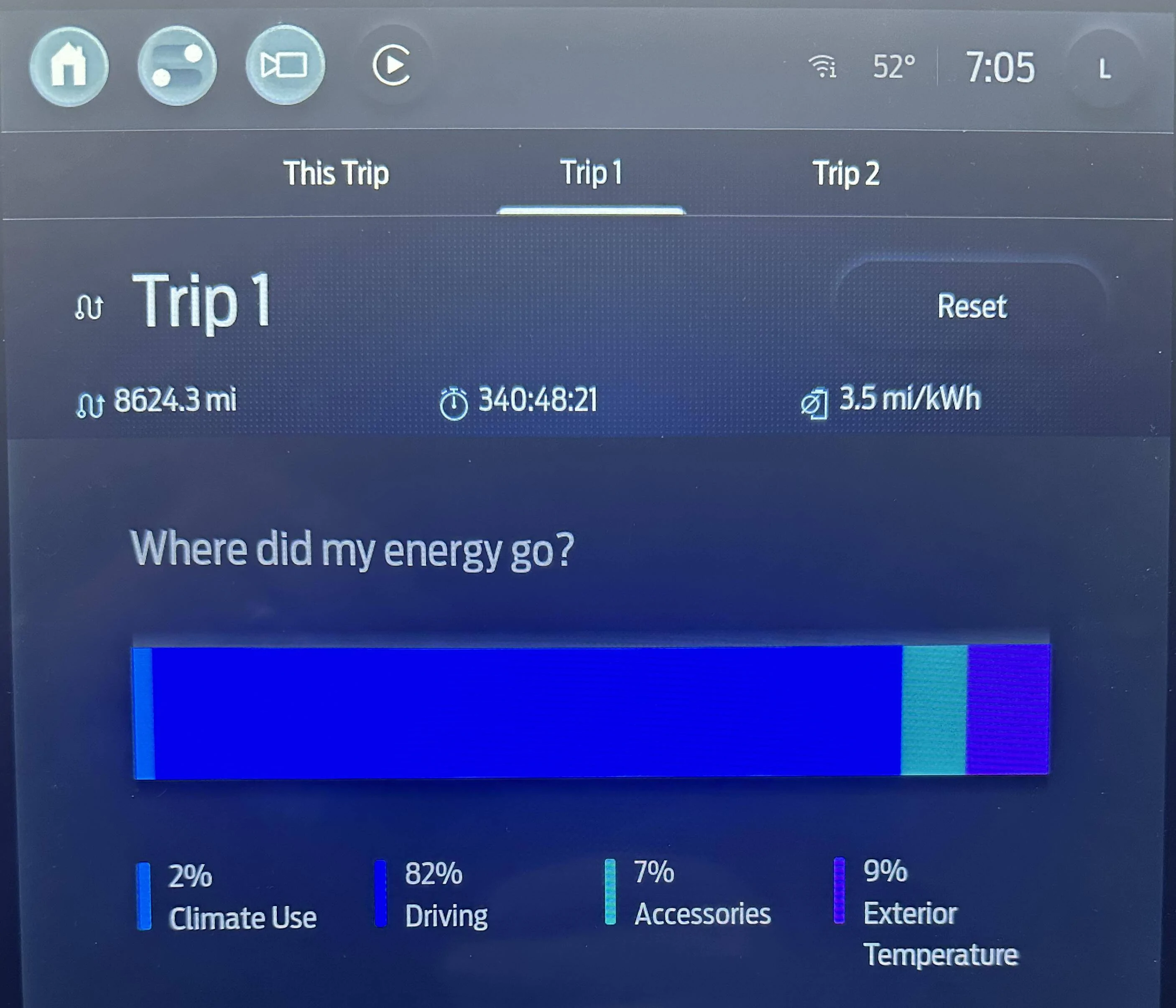
By all means, screen shot your trips 1&2, and lifetime. Quite curious to see a MME get a 3m/kWh lifetime. Mine is sitting at 2.2 with 20k miles on it.Is it though? Depends where you get it, doesn't it? Here in the SF Bay Area the average rate of electricity is 35 cents/kWh. Right this very moment it's 46 cents/kWh at Tesla's closest Supercharger to where I am in Daly City, and it's peak time, that's the highest rate today, later in the evening it goes to 28 cents/kWh. So a full charge on a Mach E is $41.86 (in theory) to go 273 miles (averaging 3 miles/kWh). That same distance in a vehicle of similar size assuming 25 mpg, and $4.50/gallon, would be $49.14.
Batteries will eventually make sense. Current mainstream batteries leave much to be desired. Once 500wh/Kg becomes common place as well as 5c charging rates, things will be much different. If the MME could achieve that, on a 500kW charger, in around 14 minutes at 2.4m/kWh, 270 miles of range could be added. Tesla v4 superchargers should be able to deliver that (the actual charging hardware, not the v4 posts that are popping up).I guess I’m in the minority here, but I just don’t have a love affair with batteries as a technology. I really hope we come up with something better.
For now, they’re a niche use case and you have to be willing to live with the downsides.
Sponsored