
Faulty math article on EV v ICE

KevinS

Well-Known Member
Joined
Oct 11, 2021
Threads
34
Messages
1,515
Reaction score
2,831
Location
Maryland
Vehicles
2021 Mach-E (sold), 2023 Ioniq 6 SEL
Country flag
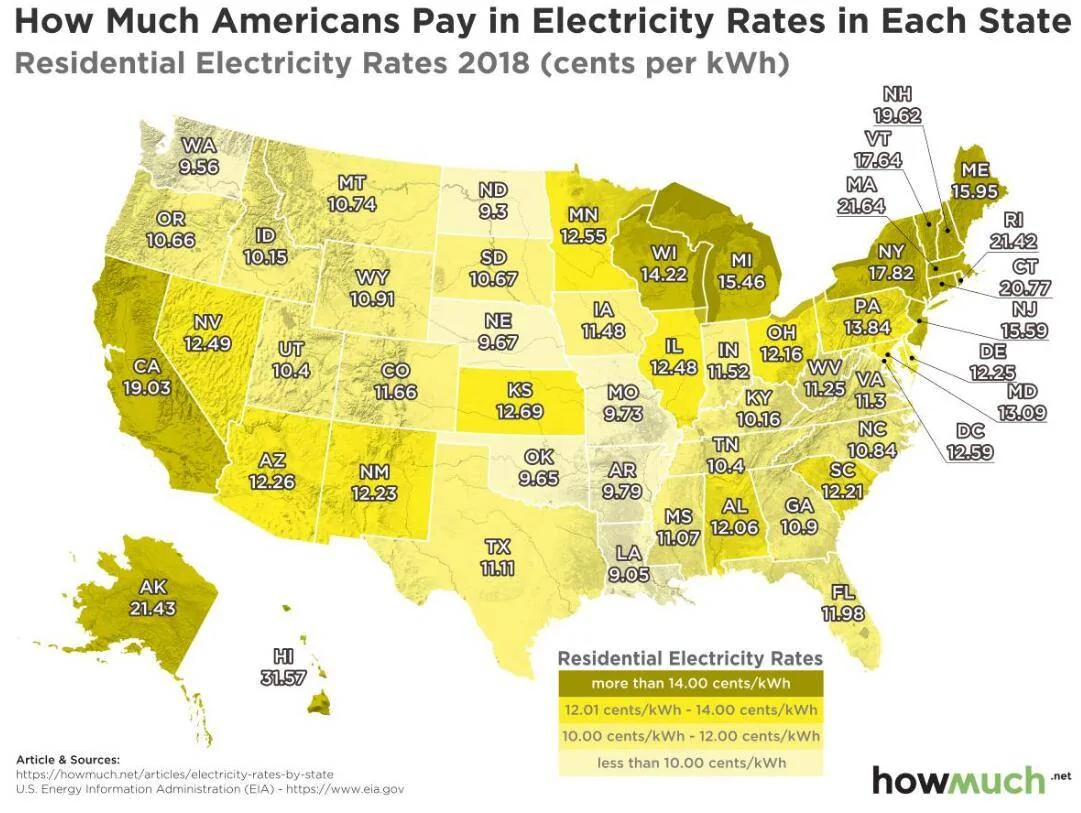
There are blue areas of the country where that is the going rate....
Name a few... aside from obvious answers such as CA (where gas is also more expensive than elsewhere.)
Sponsored


Nklem

Well-Known Member
First Name
Norm
Joined
May 20, 2021
Threads
105
Messages
1,318
Reaction score
1,699
Location
Coast of Maine
Vehicles
Subaru Solterra
Occupation
Mechanical Engineer
Country flag
Name a few... aside from obvious answers such as CA (where gas is also more expensive than elsewhere.)
Delivered rates in New Hampshire is .36/kWH, Maine is .30/kWH and going up, CT is .32/kWH, MA depends on supplier, but they can be $0.40/kWh (I know one friend at 0.47/kWh)...Long Island NY is up there as well. Add in taxes and fees and ouchie. In Maine there is a 5.5% sales tax on electric power....foolish.
 

KevinS

Well-Known Member
Joined
Oct 11, 2021
Threads
34
Messages
1,515
Reaction score
2,831
Location
Maryland
Vehicles
2021 Mach-E (sold), 2023 Ioniq 6 SEL
Country flag
Delivered rates in New Hampshire is .36/kWH, Maine is .30/kWH and going up, CT is .32/kWH, MA depends on supplier, but they can be $0.40/kWh (I know one friend at 0.47/kWh)...Long Island NY is up there as well. Add in taxes and fees and ouchie.
Well that sucks. I honestly did not realize utility rates were that high in NE... almost twice the national average!

Thanks for the info (you too Blue Highway.)
 

Guss-E 2021

Well-Known Member
First Name
Pierre
Joined
Aug 12, 2021
Threads
67
Messages
1,895
Reaction score
2,327
Location
New Hampshire
Vehicles
2022 Mach-E Prem AWD ER
Occupation
Compliance Specialist
Country flag
Sigh. Kicking and screaming into the electric age. It goes beyond "it costs this many more or less cents per mile..." blah blah blah. BEVs:
  • Less traffic noise
  • Better air quality
  • No "mystery" fluids on your garage floor or mixing with run off into the water table
  • Less maintenance
  • Option to "refuel" in your pajamas (if you go to the gas station in pj's, I don't want to know)
Oh and yah, I also spend way less on electricity to charge my car than to fuel one up.

I have a 1,340 sq. ft. home. My last electric bill was $239. That includes charging my car AND window AC units. Filling my Acura would run me $160-$180/month. Boom!


GreaseMonkey

Well-Known Member
First Name
Steve
Joined
Oct 3, 2021
Threads
21
Messages
3,237
Reaction score
5,178
Location
Chicago, IL
Vehicles
24 Mach-E GT
Country flag
Sigh. Kicking and screaming into the electric age. It goes beyond "it costs this many more or less cents per mile..." blah blah blah. BEVs:
  • Less traffic noise
  • Better air quality
  • No "mystery" fluids on your garage floor or mixing with run off into the water table
  • Less maintenance
  • Option to "refuel" in your pajamas (if you go to the gas station in pj's, I don't want to know)
Oh and yah, I also spend way less on electricity to charge my car than to fuel one up.

I have a 1,340 sq. ft. home. My last electric bill was $239. That includes charging my car AND window AC units. Filling my Acura would run me $160-$180/month. Boom!
But the tire plastic particles and brake dust ??‍♂
 

GreaseMonkey

Well-Known Member
First Name
Steve
Joined
Oct 3, 2021
Threads
21
Messages
3,237
Reaction score
5,178
Location
Chicago, IL
Vehicles
24 Mach-E GT
Country flag
I exclusively DCFC and pay $0.25/ kWh using EVgo. If I were charging at home, my cost would be $0.08. Last couple years I paid an average of $0.12 per kWh delivered to my condo. However, I recently switched to a “market based” pricing where prices change dynamically every five minutes and shaved 33% off my average electricity cost. The savings are more dramatic given that my consumption during winter is 11x that of summer (thanks to floor to ceiling windows and baseboard resistance heating).

Moral of the story: you have options to lock Time of Use, market-based, or other advantaged rates if you are not lazy or have an anti-EV agenda.
 

superdave80

Well-Known Member
First Name
David
Joined
Aug 18, 2022
Threads
5
Messages
1,334
Reaction score
2,029
Location
Santa Rosa, CA
Vehicles
2022 Mach E Select SR RWD
Country flag
When this 'study' came up a while back, I dug into their methodology and was able to figure out how they came to such a high rate for EV charging costs: They included some questionable extra costs.

1. Road taxes for EVs. This is NOT a fueling cost for EVs. When I register my vehicle, I pay the same amount whether I put 1 kwh into my car or 1,000 kwh. If states go to a per mile annual fee (which they should), or you want to do total cost of ownership, then we can talk about including this.

2. Home charger cost. This is fair to add, but the amount they added was crazy high. I think they included a home charger AND wiring costs, but then only amortized it over five years. Even if you think my home charger is going to wear out every five years, I'm not going to need a new 220V line every five years (even assuming I needed one installed in the first place). This one ended up adding about 40% to the overall 'fueling' costs for an EV, which is how they were able to make ICE and EVs look similar in fueling costs.

It's complete BS. If you use mostly L2 charging, you are saving on fuel costs vs. a typical ICE.
 

BMT1071

Well-Known Member
First Name
Mike
Joined
Mar 21, 2021
Threads
65
Messages
3,197
Reaction score
4,377
Location
Glendale, AZ
Vehicles
21 MME SR RWD, 23 MME GTPE
Occupation
EV Technical Trainer
Country flag

VegasWeezy

Well-Known Member
First Name
Brian
Joined
Apr 24, 2022
Threads
4
Messages
153
Reaction score
197
Location
Las Vegas
Vehicles
2022 Premium MME ER RWD in Space White
Occupation
Accountant
Country flag
I'm basing this on my usage, with facts for the month of July. I'm not considering anything from the article here. Just based on my personal usage:

In July I charged at home:

1,157 kWh at a cost of $152 for a distance in the R1T of 2572 miles.

Therefore I paid on average .13 for each kWh and got about 2.22 kW/mi which = $5.85 per 100 miles.

So based on my math significantly less from the article.

However -

If I were to have charged in the public using EA rates of .48 kW I would have paid $21.61 per 100 miles. Significantly higher than the article.

I think the point I'm trying to make is that it could be higher, it could be lower it could be about right. There are a lot of people, who live in apartments for example, who must charge in public. It very well could be that those people have to pay more. If you're on PG&E California rates you could be paying upwards to $0.53 kW.
Doing the same for me over June and July, but including charging costs at home, at dealership, EA stations and a hotel stay:

689 kWh (including charging losses) for a distance of 2,035 miles. My actual cost was $86 because of free charging at the dealership and hotel, and still having my free 250kWh from Ford. Assuming I paid actual EA costs at their stations, ChargePoint costs at the hotel and home charging cost at the dealership, this would have been $198.

Therefore I paid an actual $0.13 for each kWh and a theoretical $0.29, got 2.96mi/kWh and would have had:
$4.25 per 100 miles actual cost with the freebies
$9.71 per 100 miles theoretical cost with the blended rate
$16.23 per 100 miles with strictly $0.48 EA cost (which also shouldn't be representative of anything because if you were doing only DCFC, then you would pay the $4/month and charge at $0.36/kWh)

Gas costs here are $4.19 per gallon for regular unleaded. So even if you were getting 35mpg, 100 miles would cost you $11.97

As others have mentioned though, energy rates and gas prices can vary greatly depending on where you are in the country. But for me, EV is much cheaper than ICE.
 

Nklem

Well-Known Member
First Name
Norm
Joined
May 20, 2021
Threads
105
Messages
1,318
Reaction score
1,699
Location
Coast of Maine
Vehicles
Subaru Solterra
Occupation
Mechanical Engineer
Country flag
Well that sucks. I honestly did not realize utility rates were that high in NE... almost twice the national average!

Thanks for the info (you too Blue Highway.)
Yes It truly sucks living here and being an all EV household. Part of the the reason it is so high is our T & D charges. Solar arrays can connect to the Grid for free and Solar Owners get a free ride with No T & D to export and none to import from the grid when the sun does not shine. Even if they bought into an array 100 miles away. They get a free ride, free metering and just a customer charge of like $7.50 per month. All of their burden is put on the normal rate payers. Also our power component is brokered and bid/awarded by the PUC/goverment of our State. You can imagine, Wholesale power is 6.7cents /kWh and the State PUC says we should pay 16.5 cents (Hmm who are we subsidizing). Its criminal.

I just bought two Vespa's, 79 MPG.... for the nice days.
 
Last edited:

Mirak

Banned
Banned
Joined
Oct 8, 2020
Threads
111
Messages
3,754
Reaction score
6,166
Location
Kansas
Vehicles
"Sonic" 2021 MME Grabber Blue First Edition
Country flag
The article links to a press release on the study. If you read down to the bottom of the press release - which is not the study itself, which I cannot find - you will find their “approach:”

Approach

Since 2021, Anderson Economic Group has calculated four categories of costs for fueling EVs and ICE vehicles using benchmarks that represent real-world U.S. driving conditions, including:

  1. The cost of underlying energy (gas, diesel, electric)
  2. State excise taxes charged for road maintenance
  3. The cost to operate a pump or charger
  4. The cost to drive to a fueling station (deadhead miles)
For ICE vehicles, state excise taxes and cost of pump are embedded in the retail fuel price. Calculations for each segment reflect the cost per 100 purposeful miles, after considering the cost of driving to a commercial gasoline or electric charging station if not charging at home.

The methodology and data sources are described in Real World Costs of Fueling EVs and ICE Vehicles, Second Edition, Anderson Economic Group, 2022.
As practical consumers, our calculations are quite simple: the cost we pay at the “pump” - whether that is our gas station for a comparably-sized ICE (Ford Edge), our utility bill at home, or DCFC - per mile.

It sounds like this group is factoring other things. But I can’t even say what because I can’t see their data or math.
Sponsored


Top