Heat pump in new models?

kltye

Well-Known Member
Joined
May 21, 2021
Threads
19
Messages
1,100
Reaction score
1,733
Location
Chicago
Vehicles
IB MME Premium RWD
Country flag
Why does people still believe heat pumps not working efficiently in cold environments? Almost all heat pumps nowadays have operational temperature down to below -30 degrees Celsius, which is, cold. It usually (when above -20, which is almost always) has an efficiency factor of 3-5, or in other words: it creates a lot more heat for the same amount of energy it would take to heat up the ordinary elements in the current Mach E.

I have heat pumps at home and have seen the effect of those cars that has it - it REALLY does make a difference.
Because Americans are unable to update their knowledge from the '80s and are forever stuck with thinking "new stuff = bad" unless it came out four decades ago.
Sponsored


woody

Well-Known Member
Joined
Sep 27, 2020
Threads
0
Messages
865
Reaction score
712
Location
CO
Vehicles
'19 Chevy Bolt, '25 Chevy Equinox
Country flag
That's not a heat pump ... but I think the car already does that today.

A heat-pump is basically an air-conditioner with a reversing valve. For normal AC, the cool air blows inside and the warm air blows outside. The reversing valve flips that.

BUT (and this is where I think people get all over-hyped over heat-pumps) ... heat-pumps are only efficient in a limited range of temps. In freezing temps they don't work well enough to warm the cabin and you need some form of supplemental heating.

The temp range where heat pumps work well isn't particularly cold. And yes we lose range in cold temps ... but these are only mildly cold temps where you aren't losing that much range. When the temps get really cold ... and the range loss is more severe -- that's where heat pumps don't work well at all.

This is why I think people over-hype heat-pumps.

Tesla's don't _just_ have heat pumps but you'd think that's all they do when you read the hype. They use heat pumps ALONG WITH other methods of heating.
We heat our home w/ a heat pump. (home is 100% electric, 2 EVs; provide more electricity(kWhs)/year than we consume via our solar array). No combustion used for energy.
It is 100% efficient down to 4⁰F. Loses some efficiency thereafter - down to 80% efficient at -13⁰F.
We have a 10kW heat kit which can be set at different temperatures. Ex.: set to -5⁰F for 50% (5kW) and 100% (full 10 kW) at -13⁰F. Or the temperatures you choose. (have not had the heat kit kick in yet, but there is an arctic cold front moving in....)
It works great here (we do not see -13⁰F very often). We have been using ours 4+ years now.
Heat pumps have been around a long time, but if you ask most HVAC guys (fewer over time) they will tell you heat pumps do not work (as described above).
 

dpnelson

Well-Known Member
Joined
Dec 4, 2023
Threads
2
Messages
45
Reaction score
65
Location
Virginia
Vehicles
Ford Fusion, Mach E soon?
Country flag
Ford updated their thermal system as a running change some time last year, so maybe that's what this is referring to. In the interview I saw, they talked about streamlining and replacing rubber hoses with plastic. They didn't mention a heat pump. I doubt they'd go to the expense of adding one without publicizing it. It's possible they added or improved the ability to route hot coolant returning from the motors to help heat the battery and cabin.
 

Peugfan

Well-Known Member
Joined
Jan 26, 2021
Threads
1
Messages
219
Reaction score
231
Location
Minnesota
Vehicles
2017 Linc MKX, 2021 MME Prem 4EX Infinite Blue
Country flag
According to the service manual for 21 Mach E it does have the ability to share the heat from the motor coolant loop with the HVAC but it has the wording “if available” in the description of the operation. Seems to me they somehow need to source the heat pump from a tempered air source rather than just cold outside air. I started listening to a video of the explanation of the Tesla system but got lost…apparently there are 20+ modes of operation. I need to go back and watch the whole video.
 

Dr Obnxs

Well-Known Member
First Name
Matt
Joined
Dec 30, 2020
Threads
3
Messages
181
Reaction score
215
Location
Woodside, CA
Website
www.drobnxs.com
Vehicles
21 MME, 65 Mustang Too Many to List!
Occupation
Physicist
Country flag
That's not a heat pump ... but I think the car already does that today.

A heat-pump is basically an air-conditioner with a reversing valve. For normal AC, the cool air blows inside and the warm air blows outside. The reversing valve flips that.

BUT (and this is where I think people get all over-hyped over heat-pumps) ... heat-pumps are only efficient in a limited range of temps. In freezing temps they don't work well enough to warm the cabin and you need some form of supplemental heating.

The temp range where heat pumps work well isn't particularly cold. And yes we lose range in cold temps ... but these are only mildly cold temps where you aren't losing that much range. When the temps get really cold ... and the range loss is more severe -- that's where heat pumps don't work well at all.

This is why I think people over-hype heat-pumps.

Tesla's don't _just_ have heat pumps but you'd think that's all they do when you read the hype. They use heat pumps ALONG WITH other methods of heating.
https://electrek.co/2024/01/08/four-heat-pump-makers-successful-sub-zero-prototypes-us/


SFC

Member
Joined
Nov 9, 2021
Threads
0
Messages
21
Reaction score
30
Location
US
Vehicles
GT
Country flag
The temp range where heat pumps work well isn't particularly cold. And yes we lose range in cold temps ... but these are only mildly cold temps where you aren't losing that much range. When the temps get really cold ... and the range loss is more severe -- that's where heat pumps don't work well at all.
That's not really accurate and hasn't been for a long time. It is a myth that's repeatedly perpetuated though. My buddy just replaced his furnace with an air-source heat pump and it only needs auxiliary heating when it drops below -13F.

The Tesla heat pump appears to work to ~0F based on independent testing. I don't think they've ever actually published any information on what the specs are.
 

TheVirtualTim

Well-Known Member
First Name
Tim
Joined
Oct 11, 2020
Threads
26
Messages
1,366
Reaction score
2,469
Location
Dearborn, MI
Vehicles
‘21 Mach-E First Edition, ‘23 Mach-E GT Performance
Country flag
That's not really accurate and hasn't been for a long time. It is a myth that's repeatedly perpetuated though. My buddy just replaced his furnace with an air-source heat pump and it only needs auxiliary heating when it drops below -13F.

The Tesla heat pump appears to work to ~0F based on independent testing. I don't think they've ever actually published any information on what the specs are.
Can you point me to a technical article? Everytime I hear stories like this, it's always anecdotal "I know someone who..." .... and then I go dig for technical articles and they all say the same thing; works great in the "sweet spot" of 50-65°F, still works well at temps above 40°F, works ... but not nearly as well at temps down in the 30°'s but above freezing, and ... BELOW freezing, they struggle.

The system relies on the fact that if you compress a gas (any gas) it heats up. If you decompress a gas it cools down. So the trick, is to super-compress the gas (so much that it condenses into a liquid) and now you have a hot (or very warm) liquid ... which you then run through a radiator to to cool the liquid. And if you do this INSIDE the home (or car) you'll be able to get some warm air out of it. Then you pump the now cooler liquid outside, and allow it to re-expand back to a gas -- where it becomes very cold -- hopefully colder than the outside air so that the gas technically "warms up" a little.

But therein lies the rub ... what if the outside air is COLDER than the difference you get from the condensed state to the gas state? What if the temperature differential from the "cold" state to the "warm" state isn't enough such that the "warm" liquid inside the home is able to be warmer than the inside air temperature you are trying to attain? And last ... what if it is only _barely_ warmer such that you have to run it for very long periods of time (and using significant energy) to achieve negligible gains in temperature on the inside -- to the point that it would be better to give up and use something else?

There are other problems. Since cold surfaces tend to attract condensation ... if the outside evaporator reaches sub-freezing temps, then the humidity in the air will condense, freeze, and block the flow of air through the evaporator -- which also ruins the performance of the system. To fix this, you have to melt the ice and you do that by reversing the system. But now you're spending energy to melt ice outside instead of warm the car inside.

When I look for technical articles to back up the claims that heat pumps work effectively and are better than resistive heaters at sub-zero temps ... I cannot find them. But I can find plenty of anecdotal stories where people make that claim.
 

Just Lurking

Well-Known Member
First Name
Paul
Joined
Dec 31, 2022
Threads
8
Messages
635
Reaction score
599
Location
Washington
Vehicles
2022 Mach-E GT
Country flag
Can you point me to a technical article? Everytime I hear stories like this, it's always anecdotal "I know someone who..." .... and then I go dig for technical articles and they all say the same thing; works great in the "sweet spot" of 50-65°F, still works well at temps above 40°F, works ... but not nearly as well at temps down in the 30°'s but above freezing, and ... BELOW freezing, they struggle.
There's tons of info out there. I suggest searching for "cold climate heat pumps." Historically it's been Asian manufacturers leading the charge on cold climate heat pumps, though other companies are working on catching up.

Here are some links to get you started:

High-level overview: https://www.consumerreports.org/hea...s-actually-work-in-cold-climates-a4929629430/

Slightly technical: https://www.mitsubishicomfort.com/articles/keep-warm-this-winter-inverter-technology-for-any-climate

More technical [note the EVI diagram and compare to the prose description from Mitsubishi]: https://www.arcticheatpumps.com/evi-dc-inverter-for-heat-pumps.html

More details on EVI: https://www.copeland.com/documents/...ssors-technical-information-en-gb-4215484.pdf

Hope that helps.
 

RT1 MME266

Well-Known Member
First Name
Tony
Joined
Aug 24, 2022
Threads
6
Messages
55
Reaction score
40
Location
Falls Church, Virginia
Vehicles
2022 MME RT1
Country flag
Heat pump will extend range in most cases it is more efficient in generating heat to resistive heater. Heat pump. Conventional electric resistance heaters have a COP of 1.0 meaning it takes one watt of electricity to deliver the heat equivalent of one watt. Air-source heat pumps generally have COPs of 2 to 4, meaning they deliver 2 to 4 times more energy than they consume. As the inlet temperature increases from the ground, the COP will also increase. This is simply as the compressor does not have to work as hard, as the inlet temperature increases, to reach the required outlet temperature. Resistive heater is cheap, and simple and instance heat, but not efficient. that's reason that you can buy portable heater with heating element for $20. 1 kWh will give you exactly about 3412 BTU. Heat pump with COP 2 will give you about twice BTU.
 

Chainspell

Well-Known Member
First Name
Erich
Joined
Aug 7, 2021
Threads
7
Messages
249
Reaction score
303
Location
Sacramento, CA
Vehicles
'21 Premium 4X, '23 GTPE
Country flag
Can you point me to a technical article? Everytime I hear stories like this, it's always anecdotal "I know someone who..." .... and then I go dig for technical articles and they all say the same thing; works great in the "sweet spot" of 50-65°F, still works well at temps above 40°F, works ... but not nearly as well at temps down in the 30°'s but above freezing, and ... BELOW freezing, they struggle.

The system relies on the fact that if you compress a gas (any gas) it heats up. If you decompress a gas it cools down. So the trick, is to super-compress the gas (so much that it condenses into a liquid) and now you have a hot (or very warm) liquid ... which you then run through a radiator to to cool the liquid. And if you do this INSIDE the home (or car) you'll be able to get some warm air out of it. Then you pump the now cooler liquid outside, and allow it to re-expand back to a gas -- where it becomes very cold -- hopefully colder than the outside air so that the gas technically "warms up" a little.

But therein lies the rub ... what if the outside air is COLDER than the difference you get from the condensed state to the gas state? What if the temperature differential from the "cold" state to the "warm" state isn't enough such that the "warm" liquid inside the home is able to be warmer than the inside air temperature you are trying to attain? And last ... what if it is only _barely_ warmer such that you have to run it for very long periods of time (and using significant energy) to achieve negligible gains in temperature on the inside -- to the point that it would be better to give up and use something else?

There are other problems. Since cold surfaces tend to attract condensation ... if the outside evaporator reaches sub-freezing temps, then the humidity in the air will condense, freeze, and block the flow of air through the evaporator -- which also ruins the performance of the system. To fix this, you have to melt the ice and you do that by reversing the system. But now you're spending energy to melt ice outside instead of warm the car inside.

When I look for technical articles to back up the claims that heat pumps work effectively and are better than resistive heaters at sub-zero temps ... I cannot find them. But I can find plenty of anecdotal stories where people make that claim.
We replaced our furnance with a Bosch heat pump last year. At 30F outside we are still getting 100F air coming out of the registers, so indoor coil temp is even higher than that. You can find the exact specs here.

Relevant info from spec sheet:

Operating Range
Cooling 15-125 °F
Heating -4-86 ° F

Looking at the spec table, at -4F a 48kBTU/hr (4 ton) model is still at 33kBTU/hr capacity and pulling 4.24 kW. At 32F it's at 44kBTU/hr and pulling 3.91 kW.

1BTU = 0.2931 Wh = 0.0002931 kWh

So well below freezing at -4F in 1 hour you have used 4.24 kWh and gained 9.67 kWh (33kBTU) of heat = 228% efficient vs. electric resistive heater.

At 32F in 1 hour your have used 3.91 kW and gained 12.9 kWh (44kBTU) of heat = 329% efficient vs. the resistive heater.

You are 100% correct it will eventually freeze up when running at these temps due to condensation freezing on the coils, which are even colder than ambient air. The defrost cycle as you said puts it back into AC mode, stops the outdoor fan, and simultaneously runs aux heat. It only takes ~5 minutes to melt the ice and does this about once per hour. Because aux heat is running, there is only a small drop in air temp during the defrost. What is neat about the defrost is since the coils are still hot after defrost, once it reverses back into heating mode a lot of that extra heat is reclaimed back (since the heat was not blown away by the stopped fan.) The only heat lost was the energy required to melt off the ice.

Can this translate to vehicles where everything is scaled down? I would guess so, but perhaps not to the same degree. But in practice a heat pump is still far more efficient than resistive heat even well below freezing temps!
 

kltye

Well-Known Member
Joined
May 21, 2021
Threads
19
Messages
1,100
Reaction score
1,733
Location
Chicago
Vehicles
IB MME Premium RWD
Country flag
Can you point me to a technical article? Everytime I hear stories like this, it's always anecdotal "I know someone who..." .... and then I go dig for technical articles and they all say the same thing; works great in the "sweet spot" of 50-65°F, still works well at temps above 40°F, works ... but not nearly as well at temps down in the 30°'s but above freezing, and ... BELOW freezing, they struggle.

The system relies on the fact that if you compress a gas (any gas) it heats up. If you decompress a gas it cools down. So the trick, is to super-compress the gas (so much that it condenses into a liquid) and now you have a hot (or very warm) liquid ... which you then run through a radiator to to cool the liquid. And if you do this INSIDE the home (or car) you'll be able to get some warm air out of it. Then you pump the now cooler liquid outside, and allow it to re-expand back to a gas -- where it becomes very cold -- hopefully colder than the outside air so that the gas technically "warms up" a little.

But therein lies the rub ... what if the outside air is COLDER than the difference you get from the condensed state to the gas state? What if the temperature differential from the "cold" state to the "warm" state isn't enough such that the "warm" liquid inside the home is able to be warmer than the inside air temperature you are trying to attain? And last ... what if it is only _barely_ warmer such that you have to run it for very long periods of time (and using significant energy) to achieve negligible gains in temperature on the inside -- to the point that it would be better to give up and use something else?

There are other problems. Since cold surfaces tend to attract condensation ... if the outside evaporator reaches sub-freezing temps, then the humidity in the air will condense, freeze, and block the flow of air through the evaporator -- which also ruins the performance of the system. To fix this, you have to melt the ice and you do that by reversing the system. But now you're spending energy to melt ice outside instead of warm the car inside.

When I look for technical articles to back up the claims that heat pumps work effectively and are better than resistive heaters at sub-zero temps ... I cannot find them. But I can find plenty of anecdotal stories where people make that claim.
A quick search on YouTube for "low temperature air source heatpump" yielded this video: . The real meat of the view starts around 6:40.

Anecdotal evidence also works in this instance because there are lots of people who aren't freezing in winter while using their heat pumps, without using a ton of energy. Add that to actual testing done with Teslas equipped with heat pumps showing efficiency increases, I think you can see how there isn't a heat pump conspiracy here.


Ford Mustang Mach-E Heat pump in new models? 1705083008475


(https://en.wikipedia.org/wiki/Sealioning)
 

SpaceEVDriver

Well-Known Member
Joined
Aug 26, 2021
Threads
71
Messages
2,651
Reaction score
4,774
Location
Arizona
Vehicles
2022 CA Route 1 AWD, ER; 2023 Lightning Lariat ER
Occupation
Planetary Science
Country flag
We replaced our furnance with a Bosch heat pump last year. At 30F outside we are still getting 100F air coming out of the registers, so indoor coil temp is even higher than that. You can find the exact specs here.

Relevant info from spec sheet:

Operating Range
Cooling 15-125 °F
Heating -4-86 ° F

Looking at the spec table, at -4F a 48kBTU/hr (4 ton) model is still at 33kBTU/hr capacity and pulling 4.24 kW. At 32F it's at 44kBTU/hr and pulling 3.91 kW.

1BTU = 0.2931 Wh = 0.0002931 kWh

So well below freezing at -4F in 1 hour you have used 4.24 kWh and gained 9.67 kWh (33kBTU) of heat = 228% efficient vs. electric resistive heater.

At 32F in 1 hour your have used 3.91 kW and gained 12.9 kWh (44kBTU) of heat = 329% efficient vs. the resistive heater.

You are 100% correct it will eventually freeze up when running at these temps due to condensation freezing on the coils, which are even colder than ambient air. The defrost cycle as you said puts it back into AC mode, stops the outdoor fan, and simultaneously runs aux heat. It only takes ~5 minutes to melt the ice and does this about once per hour. Because aux heat is running, there is only a small drop in air temp during the defrost. What is neat about the defrost is since the coils are still hot after defrost, once it reverses back into heating mode a lot of that extra heat is reclaimed back (since the heat was not blown away by the stopped fan.) The only heat lost was the energy required to melt off the ice.

Can this translate to vehicles where everything is scaled down? I would guess so, but perhaps not to the same degree. But in practice a heat pump is still far more efficient than resistive heat even well below freezing temps!
Agreed.

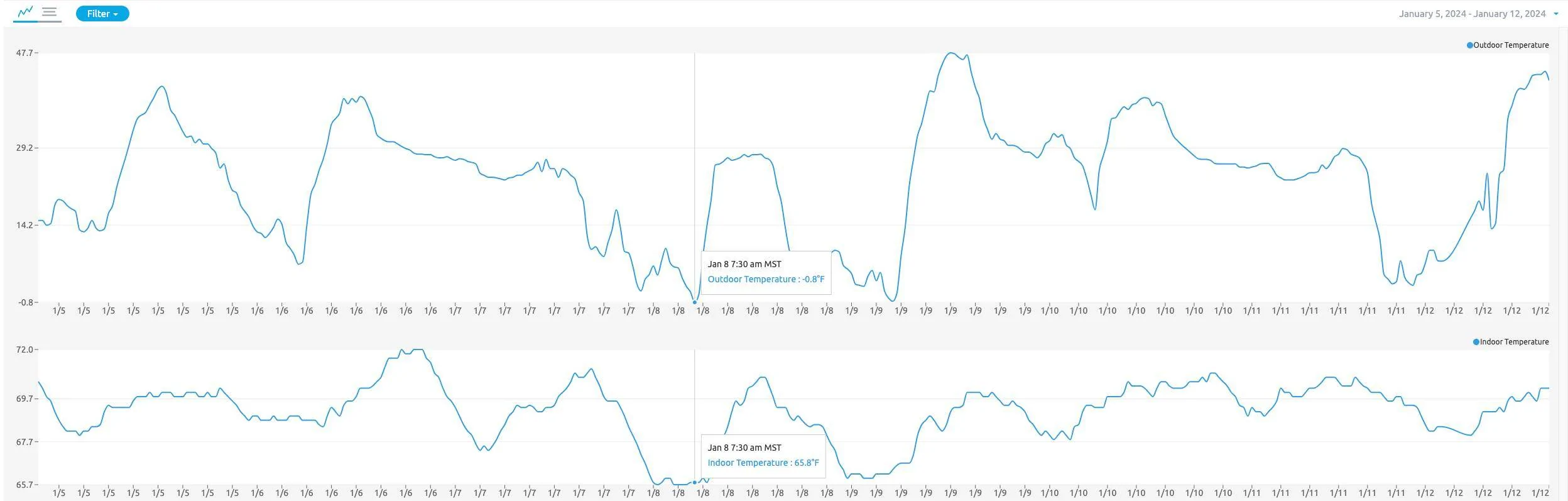
My heat pump doesn't even run aux heat on defrost cycle. It's also our cooler, so it's programmed to just use some of the heat from the house to defrost the coil. This cools the house down a bit, but it's far less expensive than running aux heat, which I have locked out until/unless the house interior temperature reaches 35 ºF.

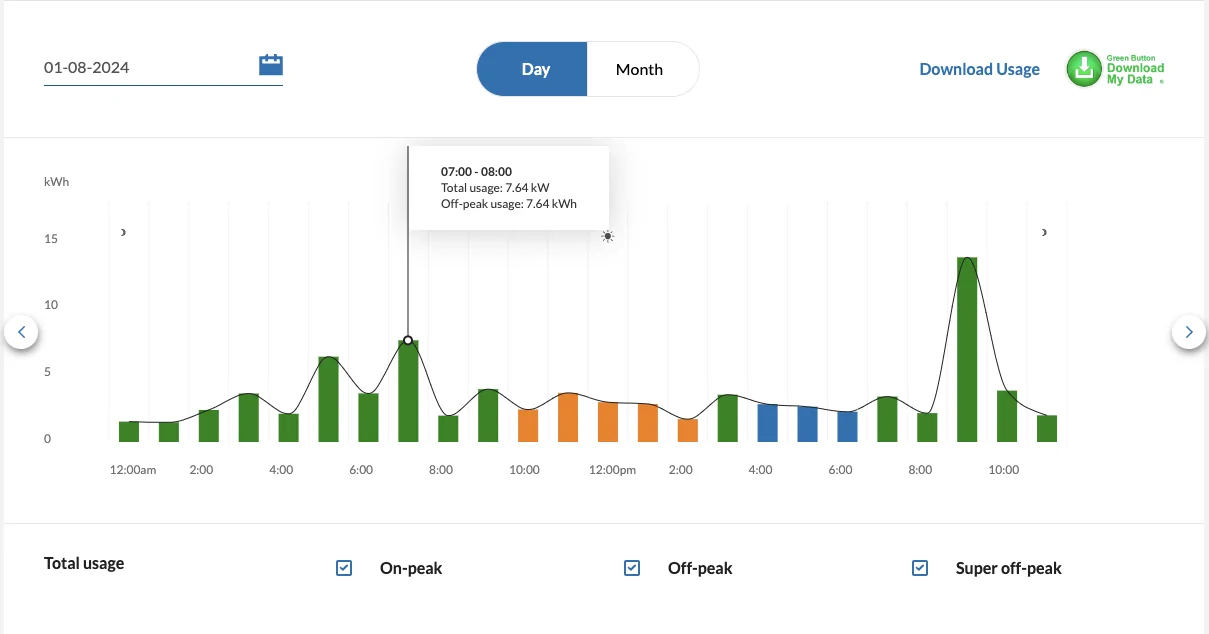
These graphs are from the past day and a half from our weather station, with a sensor inside the house and a sensor outside. The temperature in the morning of 8 January dropped below 0 ºF while the interior of the house stayed at ~65 ºF, which is our thermostat setting. The outside temperature dropped to below 0 again in the morning of 9 January. The house insulation isn't enough to keep it at a constant temperature of ~65 degrees, which can be seen in the day-night cycle.

Ford Mustang Mach-E Heat pump in new models? Screenshot 2024-01-12 at 3.21.54 PM


And our energy use did go up a bit during the same 7-8 AM time period, but that's also when we make breakfast (resistive heaters for the coffee machine and stove, and microwave use). The larger spike around 9:00 PM is the Mustang pulling 11 kW to charge and warm up the battery for the night.

Ford Mustang Mach-E Heat pump in new models? Screenshot 2024-01-12 at 3.29.33 PM
 

devmach-e

Well-Known Member
First Name
David
Joined
Sep 8, 2021
Threads
1
Messages
2,021
Reaction score
2,476
Location
SF Bay Area
Vehicles
2022 Premium RWD ER, 2016 Toyota Highlander Hybrid
Occupation
Unix Sysadmin
Country flag
I think because it varies so much depending on the application. A pool heater that's a heat pump can only get so much warmer than the ambient temp, whereas a gas heater can get as hot as you would ever need.
I have a heat pump water heater for my house. It has no trouble getting up to 138F. Sure, the recovery rate isn't as good as the old gas water heater it replaced, but we have yet to run out of hot water in a household of 4 adults.
 

Schox

Well-Known Member
First Name
Thomas
Joined
Jan 18, 2023
Threads
5
Messages
132
Reaction score
106
Location
Norway
Vehicles
2 x 2022 MME LR/ER AWD
Country flag
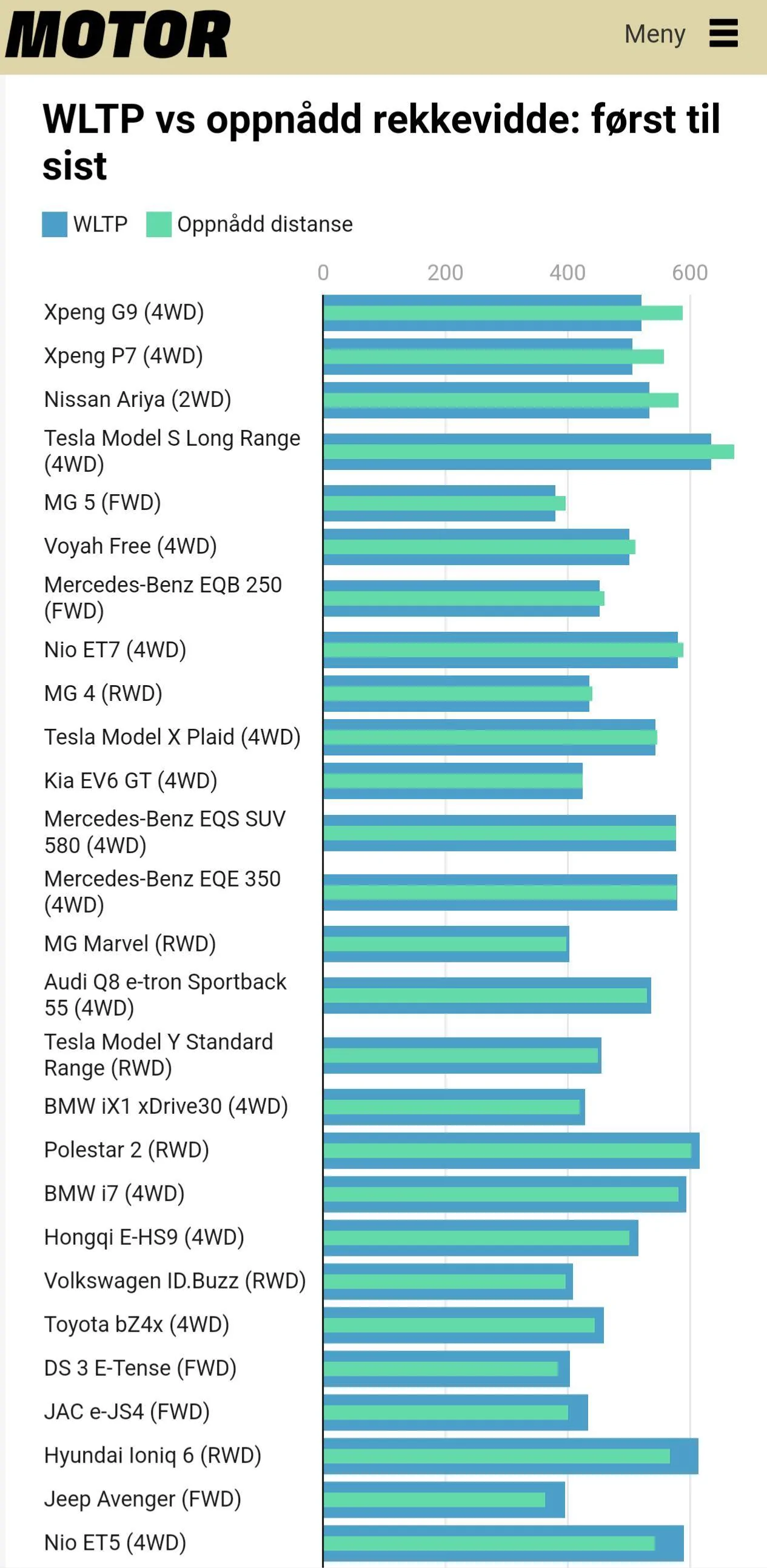
The ranges in Europe are based on the WLTP standard, the US is based on EPA. EPA is optimistic but it could be achieved if you drove the EPA cycle (think slow) The WLTP figures can't really be achieved in the real world. Take 25% off that figure for warm weather range.
WLTP is optimistic - but real world independent testing has achieved WLTP range+ in normal traffic - it's not simulated - but need careful driving - and no stops. Norwegian "summer"?

Also the MME over perform in the same test, but not in the graph under.

Ford Mustang Mach-E Heat pump in new models? 1000004512

Blue is WLTP - green is reached distance.
Speed is an important factor, and Norwegian speed limits are quite low (mostly 80 km/h ≈ 50Mph)

(The summer test was conducted in the first week of June, with temperatures around 20 degrees Celsius in the lowlands and between 10 and 15 degrees Celsius in the mountains.
How we test: We conduct the test with a selection of current cars every six months, winter and summer, on the same route: A loop through Oslo, up Rv4 to Gjøvik, from there E6 up to Hjerkinn, then east and around Rondane over Venabygdsfjellet, down to Ringebu and up E6 again. The cars are driven at the speed limit until they are empty. The drivers, who are all experienced, are required to use regeneration actively and intelligently. They should drive in eco-mode, and refrain from using driver assistance systems, autopilot, and adaptive cruise control.)

The result for MME; (tested 2021)
Mustang Mach-E AWD WLTP 540km - range in test 551,9km
Mustang Mach-E RWD WLTP 610km - range in test 617,9km

For the winter test - the MME get less penalty for the lacking heat pump than other EVs - but cars with heat pump (generally) have less penalty.
 

Jimrpa

Well-Known Member
First Name
Jim
Joined
Sep 10, 2020
Threads
297
Messages
9,526
Reaction score
12,862
Location
Wayne, PA
Vehicles
2021 Infinite Blue Premium Mustang Mach E ER AWD
Occupation
Retied (formerly tried to herd highly technical, independent cats)
Country flag
Why does people still believe heat pumps not working efficiently in cold environments? Almost all heat pumps nowadays have operational temperature down to below -30 degrees Celsius, which is, cold. It usually (when above -20, which is almost always) has an efficiency factor of 3-5, or in other words: it creates a lot more heat for the same amount of energy it would take to heat up the ordinary elements in the current Mach E.

I have heat pumps at home and have seen the effect of those cars that has it - it REALLY does make a difference.
I have a high-end heat pump that’s about 5 years old. I assure you it struggles below about 30 and kicks in the auxiliary heating. Below 20, it kicks in both auxiliary and emergency heating. They’re great for the southeastern US, but mid-Atlantic and north, they’re essentially heat pump assisted electric resistance heaters.
Sponsored


Top