
Home Charging Poll: How much power?

Home Charging Poll: How much power

  • I have DCFC at home

    Votes: 0 0.0%
  • L2/240V: 80A charger, 100A circuit

    Votes: 0 0.0%

  • Total voters
    233

VaderMachE

Well-Known Member
First Name
Robert
Joined
Feb 9, 2021
Threads
18
Messages
282
Reaction score
596
Location
Ohio
Vehicles
Fusion Hybrid, Mustang Mach E! (Shadow Black)
Occupation
Supervisor
Country flag
You know what that hole under the cable reel is for - right?
Yep...this was right after electrician finished. But thanks for noticing.
Sponsored


phidauex

Well-Known Member
First Name
Sam
Joined
Dec 8, 2020
Threads
17
Messages
967
Reaction score
1,843
Location
Colorado
Vehicles
2021 MachE 4EX, 2006 Prius, 1997 Tacoma
Occupation
Renewable Energy Engineer
Country flag
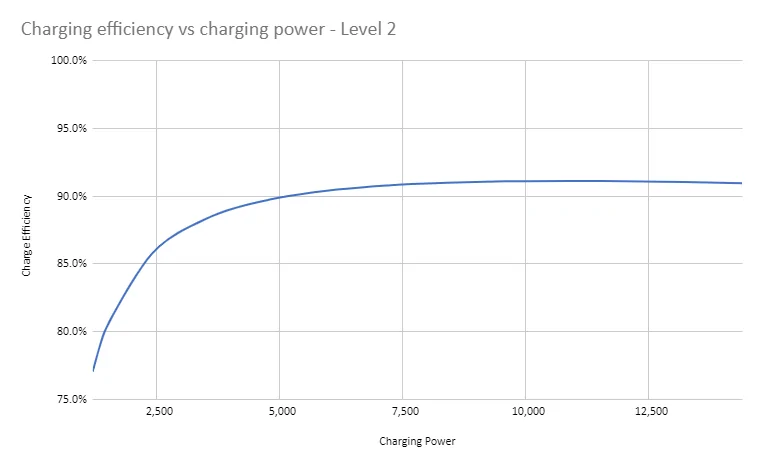
To the question of what charge power is most efficient at home, the trick is that you have three types of energy loss during charging - fixed losses (running the controls and communication systems), linear variable losses (losses that increase gradually) and exponential losses (losses that increase rapidly). The sum of all these losses means that in most power conversion equipment you have a maximum efficiency that is somewhere near the upper levels of the power range, but not at the top or bottom.

Here is a quick Google Sheet showing an example for an ER battery:


Ford Mustang Mach-E Home Charging Poll: How much power? 1622677611104


I'm guessing on nearly all the values. I think they are reasonable guesses based on my knowledge of similar systems, but they are WAGs all the same. If anyone knows more, or has an example from a similar vehicle, I'll update the sheet.

The short answer is that for the internal charger, depending on the constant losses and the charger efficiency, the peak efficiency is probably around 40-50A, which is convenient given the size of most EVSEs.

Lower charge powers mean less thermal losses, but your constant losses become a larger component of your consumption, reducing total efficiency. Higher charge powers spread out your constant losses, but the thermal losses really start piling up.

Given that battery degradation below 0.20C is very low, I think that the difference between 0.08C and 0.11C is negligible from a degradation perspective. Technically 0.08 would be less degradation, but you are really in the noise at those low charge rates.

There are a few subtle dynamics I'm missing here such as the sensitivity of charger efficiency to power, the constant cooling losses varying with power and duration, etc., but the overall shape of the curve should be illustrative.

For me, this means that I'll probably charge at my EVSE's maximum, though I might lower it a bit if my utility starts a demand charge program that increases my costs if I charge at a higher rate. This also suggests that going to a very low power (10-20A) to "trickle charge" is probably not a good proposition for total consumption, the charge efficiency down there is not very good at all.
 
OP
OP
ChasingCoral

ChasingCoral

Well-Known Member
First Name
Mark
Joined
Feb 3, 2020
Threads
502
Messages
14,318
Reaction score
28,678
Location
Maryland
Vehicles
2021 GB E4X FE, 2022 F-150 Lightning Lariat ER
Occupation
Retired oceanographer
Country flag
OP
OP
ChasingCoral

ChasingCoral

Well-Known Member
First Name
Mark
Joined
Feb 3, 2020
Threads
502
Messages
14,318
Reaction score
28,678
Location
Maryland
Vehicles
2021 GB E4X FE, 2022 F-150 Lightning Lariat ER
Occupation
Retired oceanographer
Country flag
Here's the other charger poll.


Top