
OK to charge when battery has 40-50 percent left back to 80% ?

ARK

Well-Known Member
Joined
Aug 21, 2020
Threads
45
Messages
2,938
Reaction score
4,297
Location
Los Angeles
Vehicles
'21 Premium SR AWD
Country flag
Only thing I would add here that hasn’t been said about being cautious with maintaining battery health is look how a cell phone feels in terms of battery capacity after two years. For me, the experience has often been that it feels like the phone has a real hard time holding a charge.

Yet Apple introduced a feature a couple of years ago that shows your phone battery health - not sure if there is an Android equivalent, I haven’t had an Android phone in close to a decade.

Anyway, on an old iPhone, what feels like a significantly compromised battery still can show something like 87%+ true battery max capacity.

So part of my caution is, while on paper the differences may appear small, a difference of true max capacity of 95% versus 90%, or 90% versus 85% and so forth, may be more noticeable than we may think despite what the numbers reasonably suggest.
Sponsored


 

RickMachE

Well-Known Member
Joined
Jul 1, 2021
Threads
267
Messages
17,897
Reaction score
27,849
Location
SE MI
Vehicles
2022 Mach-E Premium 4X, 2022 Lightning Lariat ER
Country flag
As I understand it it there are two real no-nos with charging. Don't charge to 100% with a rapid charger (the car won't let you do this in any case). Don't leave the car in your garage for days charged at 100%. If you're not going to use the car for a week or two (eg: going on holiday) leave it charged around 50%.
There is no issue charging the car to 100% at home overnight if you are driving it the next morning.
No to the bolded statement.

Ford specifically says 30 days. Not a week or two, not days, 30 days.

Leaving your car charged to 100% for 2 weeks is just fine.

You can increase the battery life by maintaining the state of charge below 100%. When you park your vehicle for an extended period of 30 days or more, we recommend the battery state of charge be at approximately 50%.
 

agoldman

Well-Known Member
Joined
Jan 23, 2020
Threads
54
Messages
3,006
Reaction score
2,482
Location
Charleston, SC
Vehicles
2024 Mach E GT vapor blue- perf pack-alloy wheels
Country flag
There have been recent studies that show that battery derogation is exaggerated.
 

ZuleMME

Well-Known Member
First Name
Zule
Joined
Apr 23, 2021
Threads
10
Messages
1,018
Reaction score
1,487
Location
Denver, CO
Vehicles
21' Job1 P4X MME, 22' MYP
Occupation
Implementation Engineer
Country flag
There have been recent studies that show that battery derogation is exaggerated.
It's your $20k+ bet to make as you wish. Maybe bet on black?
 

Mach1E

Well-Known Member
Joined
Sep 5, 2021
Threads
93
Messages
10,508
Reaction score
13,293
Location
Florida
Vehicles
69 Mach 1, 11 GT, 21 GTPE- sold, 24 Taycan 4S, 20 F type R
Country flag
Only thing I would add here that hasn’t been said about being cautious with maintaining battery health is look how a cell phone feels in terms of battery capacity after two years. For me, the experience has often been that it feels like the phone has a real hard time holding a charge.

Yet Apple introduced a feature a couple of years ago that shows your phone battery health - not sure if there is an Android equivalent, I haven’t had an Android phone in close to a decade.

Anyway, on an old iPhone, what feels like a significantly compromised battery still can show something like 87%+ true battery max capacity.

So part of my caution is, while on paper the differences may appear small, a difference of true max capacity of 95% versus 90%, or 90% versus 85% and so forth, may be more noticeable than we may think despite what the numbers reasonably suggest.
This isn’t a cell phone battery.

But just for giggles, let me make sure I’m understanding this logic:

Fear- People don’t want to lose battery capacity years from now.

Solution- Use less battery capacity now.

?


Makes about as much sense as hiding something where you can’t find it…….. because you are afraid of losing it.


ZuleMME

Well-Known Member
First Name
Zule
Joined
Apr 23, 2021
Threads
10
Messages
1,018
Reaction score
1,487
Location
Denver, CO
Vehicles
21' Job1 P4X MME, 22' MYP
Occupation
Implementation Engineer
Country flag
This isn’t a cell phone battery.

But just for giggles, let me make sure I’m understanding this logic:

Fear- People don’t want to lose battery capacity years from now.

Solution- Use less battery capacity now.

?


Makes about as much sense as hiding something where you can’t find it…….. because you are afraid of losing it.
No, the actual message I'd like to convey is use what you need now to ensure you can use the most later. IF you need it, charge to it. If your daily commute is 40 miles did you really need 90%? 100%?
 

ARK

Well-Known Member
Joined
Aug 21, 2020
Threads
45
Messages
2,938
Reaction score
4,297
Location
Los Angeles
Vehicles
'21 Premium SR AWD
Country flag
This isn’t a cell phone battery.

But just for giggles, let me make sure I’m understanding this logic:

Fear- People don’t want to lose battery capacity years from now.

Solution- Use less battery capacity now.

?


Makes about as much sense as hiding something where you can’t find it…….. because you are afraid of losing it.
Yes, it is the same basic tech. It is effectively a giant cell phone battery that we have, they are both lithium ion.

The rules are different with other battery types, like lithium iron phosphate batteries that seem to be coming for cheaper EVs, but lithium ion in your Mach-E and your smartphone is the same core tech.

And this isn’t about fear. I agree with @ZuleMME, use what you need.

But if you don’t need to use it, then your default stance might as well be the method that maximizes battery life.

And practically, for owners that don’t drive a ton each day, the better method is to not charge your battery beyond 90% if you don’t need it (ideally 80%), and then let it drop low before recharging.

For the average non-GT owner, if you’re on the couch and realize your Mach-E is at 62% and you think ‘I should get up and plug in to charge to 90%’ - don’t bother.

For the average non-GT owner coming home every day after driving 20 miles total for their commute and going for the charging cable, don’t bother, it’s not a Plug-In Hybrid with 30 miles all electric range, you can go straight inside, let it sit at 55% charge, you’ll come home tomorrow with 48% charge.
 

SpaceEVDriver

Well-Known Member
Joined
Aug 26, 2021
Threads
71
Messages
2,651
Reaction score
4,774
Location
Arizona
Vehicles
2022 CA Route 1 AWD, ER; 2023 Lightning Lariat ER
Occupation
Planetary Science
Country flag
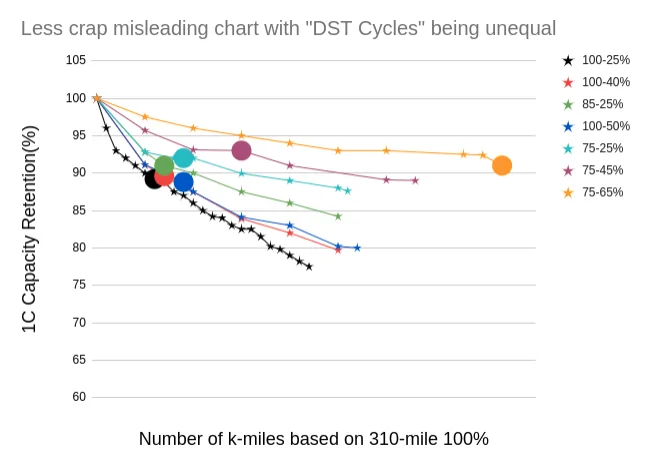
So….. 3700 cycles is a million miles?

I think your math is wrong.

The mileage/cycle will be different for each line on that chart. Part of the reason the chart is deceptive!

Use the Orange line for example. It’s only charging 10% per cycle. So 27 miles.

So after 5,000 “cycles,” it’s gone 135,000 miles.

The black line (worst) is charging 75% per cycle, so 202.5 miles. After 5000 cycles, it will have traveled over 1 million miles! No wonder it has worse degradation!

The chart should be based on MILES driven and time, not based on uneven charging cycles!

Edit: I googled “DST cycle” and this article says pretty much the same thing. It also is unclear if this is even a car battery they’re comparing. Doesn’t seem so:

https://accubattery.zendesk.com/hc/...-Battery-Degradation-for-Cell-Life-Assessment

Double edit:

Tesla nerds figured out the same thing I did and normalized the chart for mileage:
https://teslamotorsclub.com/tmc/thr...art-made-less-crappy-you-know-the-one.165387/

CA97C2D9-EFD6-4B8C-9B51-A6817269DFFE.png
Also this and most charts like this are based on a 1C discharge rate: 1 hour to discharge the battery completely from 100% to 0%. I don't discharge my battery at a 1C discharge rate. It takes me 2.5 hours to drop from about 100% to about 50% (50% discharge over 2.5 hours) while driving on the highway. Thats something like a 0.2C discharge rate. That's far, far more gentle on the battery than these studies.

Almost all of the lab studies of lithium battery lifetimes are based on accelerated discharge rates because they can't afford to run real lifetime studies (5, 10, 20 year lifetime studies).

More recent studies show that the improved discharge rates (closer to 0.5C) still underestimate lifetime by about 50%. That is, the lifetime charts with the better discharge rates are still predicting half the battery lifetime that real world use sees.

Similarly, lifetime studies of storage of these batteries are often accelerated by running them at 50 degrees celsius (or higher, instead of a more reasonable 25-30 celsius).

Basically if we didn't have thermal management or charge management (like the Leaf), we would see degradation similar to the plots people like to show, and that's what the Leaf's battery has experienced. But with the Mustang (and most modern BEVs), which has both active thermal management and active charge protection, we can reasonably expect to get around 10-20 years of use before we see anything like the charts' predictions of 20% capacity loss.
 

Mach1E

Well-Known Member
Joined
Sep 5, 2021
Threads
93
Messages
10,508
Reaction score
13,293
Location
Florida
Vehicles
69 Mach 1, 11 GT, 21 GTPE- sold, 24 Taycan 4S, 20 F type R
Country flag
Yes, it is the same basic tech. It is effectively a giant cell phone battery that we have, they are both lithium ion.

The rules are different with other battery types, like lithium iron phosphate batteries that seem to be coming for cheaper EVs, but lithium ion in your Mach-E and your smartphone is the same core tech.

And this isn’t about fear. I agree with @ZuleMME, use what you need.

But if you don’t need to use it, then your default stance might as well be the method that maximizes battery life.

And practically, for owners that don’t drive a ton each day, the better method is to not charge your battery beyond 90% if you don’t need it (ideally 80%), and then let it drop low before recharging.

For the average non-GT owner, if you’re on the couch and realize your Mach-E is at 62% and you think ‘I should get up and plug in to charge to 90%’ - don’t bother.

For the average non-GT owner coming home every day after driving 20 miles total for their commute and going for the charging cable, don’t bother, it’s not a Plug-In Hybrid with 30 miles all electric range, you can go straight inside, let it sit at 55% charge, you’ll come home tomorrow with 48% charge.
It’s not a cell phone battery. And that’s a good thing.

I’ve never had an iPhone battery last 8 years……. And they won’t.

And yes, this is about fear. Some People seem actually afraid to charge to 100%.

I do agree that it’s probably best to not charge to 100% if you don’t need to.

My post was kinda a joke, but there is some truth in there.
 

Chuck518

Active Member
First Name
Chuck
Joined
Aug 31, 2021
Threads
8
Messages
38
Reaction score
4
Location
Ray Brook, NY 12977
Vehicles
Ford Mustang Mach-e
Country flag
remember that the mache has a 99 kw battery pack that only allows 88 to be used (92 for 2022), so 90% is really closer to 80 of the full battery pack
Does that 99KwH figure refer to the Extended Range battery, or the smaller one?
 

rcechinel

Well-Known Member
First Name
Rod
Joined
Dec 30, 2021
Threads
9
Messages
855
Reaction score
870
Location
Atlanta
Vehicles
2022 Mach-E Premium ER AWD
Occupation
Tech
Country flag
When you park your vehicle for an extended period of 30 days or more, we recommend the battery state of charge be at approximately 50%.
But plugged in limited to 50% or run it to 50%, park, and don't plug it in?
 

RickMachE

Well-Known Member
Joined
Jul 1, 2021
Threads
267
Messages
17,897
Reaction score
27,849
Location
SE MI
Vehicles
2022 Mach-E Premium 4X, 2022 Lightning Lariat ER
Country flag
But plugged in limited to 50% or run it to 50%, park, and don't plug it in?
Stated pretty clearly in the manual:

Storage State of Charge
You can increase the battery life by
maintaining your state of charge below
100%. When you park your vehicle for an
extended period of 30 days or more, we
recommend your battery be at an
approximately 50% state of charge.
Storing your vehicle's high voltage battery
at higher states of charge is less favorable
than storing at lower states of charge.
Note: To achieve this state of charge for
storage, you can drive your vehicle down to
50% and set a charge limit for your location.
See Setting the Charging Schedule and
Preferences (page 164).
 
Last edited:


Top