
80% charge or 90% charge for daily use?

ARK

Well-Known Member
Joined
Aug 21, 2020
Threads
45
Messages
2,938
Reaction score
4,297
Location
Los Angeles
Vehicles
'21 Premium SR AWD
Country flag
If you're that worried, instead of guessing, spend $25 on a OBDII reader and check it for yourself once every few months and compare it to the rule of thumb. Or subscribe to Recurrent Auto (it's free) and get a monthly battery health report.
Absolutely not, I’d die a little on the inside if my Mach-E told me its battery battery was at 99.5% or worse.

Like getting killed in a video game and finding out your super epic gear is slightly, permanently dinged.

Ignorance is bliss.
 

DevSecOps

Well-Known Member
First Name
Todd
Joined
Sep 22, 2021
Threads
69
Messages
4,764
Reaction score
11,624
Location
Sacramento, CA
Vehicles
'21 Audi SQ5 / '23 Rivian R1T / '23 M3P
Occupation
CISO
Country flag
Like getting killed in a video game and finding out your super epic gear is slightly, permanently dinged.
A little gold with the repair NPC will easily get your gear back to 100%.

But back on topic... How old is your car now? We can do the math and you don't even have to look.
 
  • Haha
Reactions: ARK


Larry Paul

Well-Known Member
First Name
Larry
Joined
Aug 27, 2021
Threads
24
Messages
929
Reaction score
1,051
Location
Southern California
Vehicles
MME-GTPE, Sunbeam Tiger w1970 Boss302, 2002Rav4EV
Country flag
Seriously - you all act like you're gonna get an extra 100 miles out of a battery if you only charge to 80% when getting below 40%. You might get an extra 0.25 miles a year if you're lucky.

Average battery degradation has been studied intensively by companies like GEOTAB, Recurrent Auto etc. Basing your claims on YouTuber's comments and wannabe battery engineers is not a good look. They are just another Joe Bob, on the internet, with an opinion. While sure, charging habits might affect battery degradation, the question should be; by how much, and do I care?

Per the studies (1) age of battery and high temperatures are more detrimental to battery health than operating at high or low SOC, followed by DCFC after that. SOH studies by range were also crowdsourced here (2) but per study #1 are irrelevant to degradation.

The rule of thumb is every 3 months of battery age = 0.5% degradation to SOH% (per a study of 6k batteries - cited)

Using my vehicle as an example:

Battery Age: 13.305 mo
Estimated SOH: 97.7825%
Actual SOH: 97.5% (note: the MME only reports in .5% increments, so could be higher)

Difference in miles = 0.84 miles (@ 3mi/kW average)

So, me who DCFCs at least 100kW a week, nightly charges to 90/100% and never thinks twice about my battery health has lost an extra 0-0.84 miles in 13 months for doing so. I'll go with my continued, plug in and forget about it, attitude for less than a mile a year.

I think everyone here is crazy for thinking that all these different charging schemes will actually do something noticeable over your ownership of the vehicle. To be clear, I'm not claiming that there's no way to improve the battery life. Simply, the quantity of savings is minuscule and within margins of error. Y'all need to put it in perspective especially given that you have no control over the 2 most detrimental factors to battery degradation. In actuality, driving the car more is probably your best bang for buck since time is not on your side.

If you're that worried, instead of guessing, spend $25 on a OBDII reader and check it for yourself once every few months and compare it to the rule of thumb. Or subscribe to Recurrent Auto (it's free) and get a monthly battery health report.

Other things that can reduce your millage by 0.84 miles: Eating too many twinkies, aftermarket wheels, aftermarket spoilers, different tires, your dog in the car, temp changes, turning up the heater, the wind, passengers. You get the point, I hope.
While I really appreciate Todd's detailed response and his perspective, I do not interpret the "rule of thumb" data the same way. It also does not come close to matching my experience or understanding. (My wife and I have driven more than 338,000 miles on battery power on 6 different factory built plug-in vehicles since January of 1999 (5 BEV, 1 EREV). We still drive several days per week our 2002 Rav4EV that has 20 year old NiMh batteries and has about 80% of the capacity since new.)

What I can say is every EV design is unique. Each vehicle has a different BMS (Battery Management System) that controls charging rates and monitors temperatures and health. Every EV has a different cooling approach/capabilities to keeping the batteries at a more optimal temperature for charging and discharging. The temperature environments that the battery lives in also has a big impact. How you treat the battery also makes a massive difference from my experience. E.g.: Not charging to full or draining the pack to empty will make a big difference. When you charge, at what rate you charge makes a big difference and there are many other variables too.

Please note I am not speaking about a generic or average EV. We own and a specific car (Mach E GT Performance for the relevant part of the discussion). We also treat the battery pack thoughtfully.

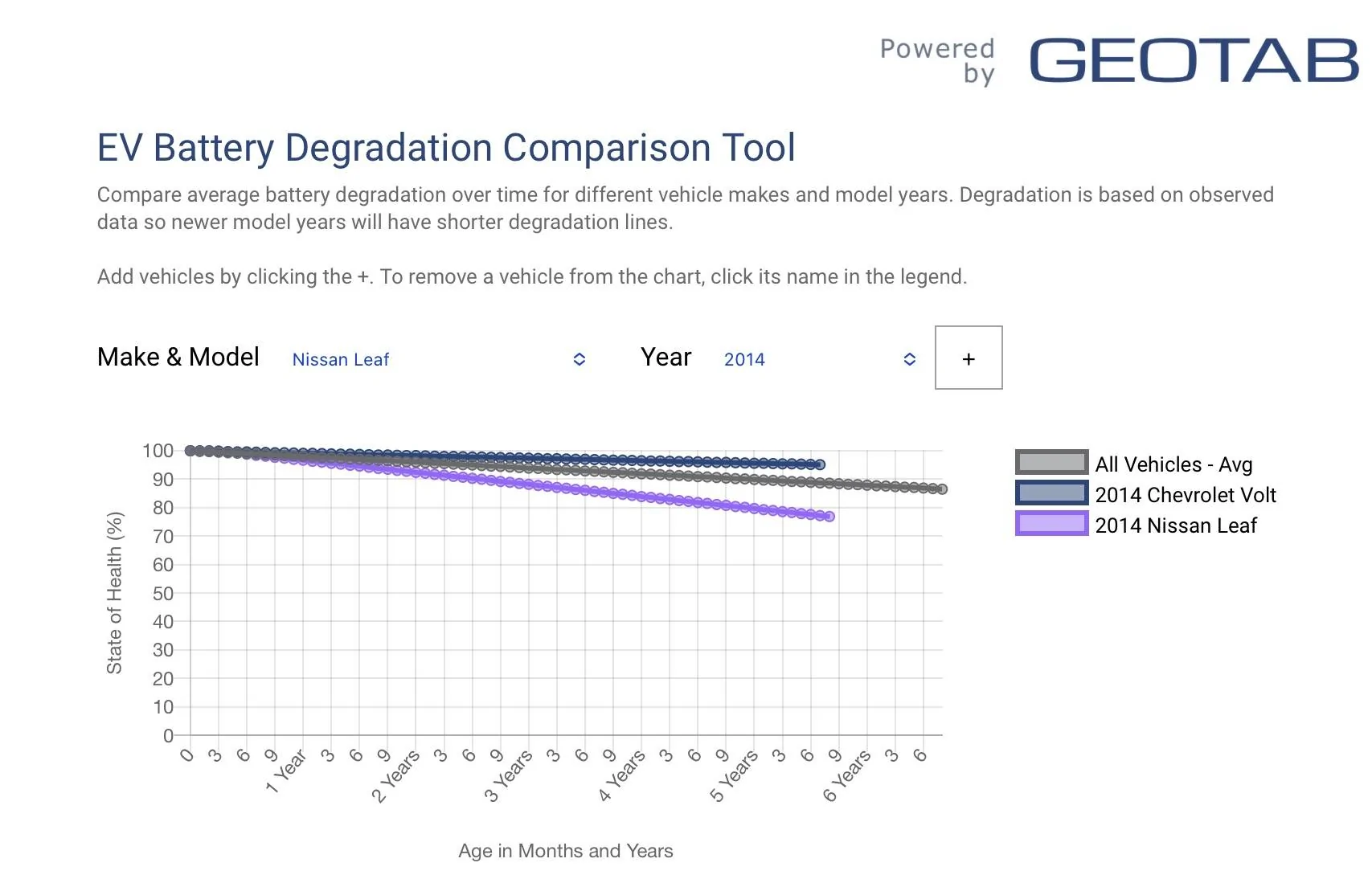
Looking at the data from GEOTAB (from the link that Todd sent) if you drill down and look at specific examples you can see that the average generic degradation rate is quite different when compared to the two examples I added: A 2014 Chevy Volt and a 2014 Nissan Leaf.

The chart still shows the All Vehicles - average. You can see from the screen shot below that there is not one curve, but each car has a significantly different degradation curve.

Ford Mustang Mach-E 80% charge or 90% charge for daily use? GeoTav EV battery data


Both cars use LiOn battery technology. The 2014 Nissan Leaf came with a 24kWh battery pack. The 2014 Volt had a 16.5kWh battery pack, but there is massive difference between the two vehicles that goes way beyond just the pack size.

The 2014 Leaf uses an air cooled battery pack and the user can use all 24kWh. The rated range (when new) was rated at 84 miles. Many people had to use the majority of the pack for daily driving.

The 2014 Volt uses a liquid cooled battery pack - but the car can only access about 10.7kWh of the pack. The Range Extended EV has a rating of 38 miles before the gasoline powered generator kicks in and maintains the battery charge state until the car until it is recharged at a EVSE. On a 2014 Volt, the BMS will typically only charge the vehicle to around 89% SOC, and it will typically prevent the battery from being pulled down below 24%. Chevy did a great deal of engineering on the thermal management on the pack design as well as limiting the max and min SOC.

The data from the chart shows while the "average" EV over a 6.5 year span has a total degradation of 1.708% per year (I think that this matches the data from the post @ with a total of 11.1% over the 6.5 years). But when you compare that to a 2014 Nissan Leaf, that degrades at significantly higher average rates of 3.554% per year (with a drop of 23.1% over the same 6.5 year period). On the other hand a 2014 Chevy Volt saw a degradation of 0.754% per year (4.9% loss over the same 6.5 year period).

Semi OT: There was one Volt that has had an extraordinary history:
https://insideevs.com/news/334835/t...meter-with-no-noticeable-battery-degradation/

I will also add my nearly 10 year old 2013 Chevy Volt with more than 80K miles has spent 91.8% of our driving on grid/solar recharged battery power has seen degradation at what I estimate is about 0.85% average range loss per year.

It is all too early to tell as our Mach E vehicles don't have enough miles or history yet, however, from what I can tell the majority of people don't think much about battery life/degradation, however, the people on this thread DO care or at at least interested in. Some people will do more than others to maintain maximum battery life, others will do nothing about it and don't change any behavior. My experience tells me that the things that we do make a big difference to the overall useable battery life of the pack.

I am going to do everything to extend the battery life, but I also throughly enjoy driving the car too. Perhaps the advanced BMS in the MME has improved everything that much more and what I am doing is not critical. I intend to keep the car for the next 20 years and I will continue to enjoy occasional spirited driving, but the MME has more than enough range for me to start with a 70% SOC every day and not typically pulling it down below 40%. I think with advanced BMS and also treating the batteries with best practices, I am optimistic that I can achieve my goal of keeping the car with minimal degradation for the next 20 years on the original pack.

Todd could be 100% correct, however, my experience and understanding leads me to a different conclusion.

Just my 2 cents from my perspective.
 
Last edited:

DevSecOps

Well-Known Member
First Name
Todd
Joined
Sep 22, 2021
Threads
69
Messages
4,764
Reaction score
11,624
Location
Sacramento, CA
Vehicles
'21 Audi SQ5 / '23 Rivian R1T / '23 M3P
Occupation
CISO
Country flag
@Larry Paul let me reiterate that I said many times that battery degradation is something that can be improved by different charging schemes however it's so minuscule that the stress and coordination of charging isn't worth the time and effort. For my rule of thumb I used 0.5% as an average, I didn't pick a singular car from the list as that's would be easily argued as "well that's not an MME" and likely someone would say I was picking a vehicle that favored my argument. Also, this isn't my first EV. I've been driving them for years myself. In fact, my last EV I charged to 100% every single night and never noticed a change in 3 years.

In your examples the difference is most definitely the cooling capabilities of the battery. Heat is second most impacting factor for a battery SOH behind age. If you plan on keeping the MME for 20 years you should be driving the crap out of it, otherwise your degradation is wasted on it being parked in a garage.

All these charging schemes are really a waste of time for the benefit and it's been proven that the gains are barely noticeable and within margin of error. Your balding tires are probably worse on range than charging to 90% nightly. Let's not forget that the manual says 90% nightly.

All that being said, different priorities in life is likely what it comes down to. I don't have the time to spend wondering if I have enough charge for any of the places I need to go on a daily basis. Most people here are retired and maybe monitoring their car battery is more fun that reading the paper in their rocker. Maybe one day that'll be me but until then the car was meant to be driven, so I drive it. 24k miles in 11 months. People who put 1000 miles a year on this car are doing FAR more damage to the battery than any possible charge scheme.

I've always been told that on an ICE vehicle it's bad to let the fuel get under a 1/4 tank. Well let me tell you I never once filled up above a 1/4 tank and never once in all my driving years did I lose a fuel pump.
 
Last edited:

TTT

Well-Known Member
First Name
Tom
Joined
Aug 13, 2021
Threads
4
Messages
260
Reaction score
313
Location
SoCal
Vehicles
DMC-12, 75 Monza, 17 Volt, 22 MMe Prem. ordered
Occupation
Imagineer
Country flag
Larry's post feels like a more realistic way of looking at it...

The United Nations says life expectancy is 72.6 years... Should we all plan our retirement and 401k based on that generic average? Obviously we can do better by drillng down to where we live, gender, habits, health history, genetics, and a whole host of variables - and in the end the doctors will tell you what we now know - eat right, don't smoke and get some exercise.

In EV terms there are parallels - Don't buy a car with an air cooled battery, don't overheat the battery if you live in a hot climate, avoid DC Fast charging, keep the level between (pick your own numbers here) 35 and 75 percent as much as practical, and so on.

You cannot argue that there will always be statistics that can be gathered that will present trends, there will be averages, and half the time you will beat the average and half the time you will not. How you treat your car will have a lot to do with which group you are in. I can tell you this though - in 20 years you can compare the health of Larry's battery (a thoughtfully cared for battery which has been used but not unnecessarily abused/a battery with buffer margins built in and a thoughtful BMS versus the cars with air cooled batteries versus the highly popular brand that encourages owners to beat their batteries to a pulp by trying to wring impossible ranges out of the pack and then fast charging them constantly as though it was good for the car (not naming names Elon), and I think you'll find Larry is absolutely in better shape despite the other cars having had their battery packs replaced at least once in that time period. 20 year old rav 4 with a factory battery going strong - hard to argue with that.

If you are on an Options Lease and returning the car in another 2 years, you may not care, but the same people who change their oil, and transmission fluid, rotate their tires, and put new belts on their cars today at reasonable intervals, are the EV owners of tomorrow who will treat their batteries as Larry thoughtfully describes.

That said - if you need to take a road trip - go ahead and fill her up... it's like that occasional cheeseburger on cheat day - it's not going to kill you. You may just go down to 72.5999 years.
 

TTT

Well-Known Member
First Name
Tom
Joined
Aug 13, 2021
Threads
4
Messages
260
Reaction score
313
Location
SoCal
Vehicles
DMC-12, 75 Monza, 17 Volt, 22 MMe Prem. ordered
Occupation
Imagineer
Country flag

Larry Paul

Well-Known Member
First Name
Larry
Joined
Aug 27, 2021
Threads
24
Messages
929
Reaction score
1,051
Location
Southern California
Vehicles
MME-GTPE, Sunbeam Tiger w1970 Boss302, 2002Rav4EV
Country flag
@Larry Paul let me reiterate that I said many times that battery degradation is something that can be improved by different charging schemes however it's so minuscule that the stress and coordination of charging isn't worth the time and effort. For my rule of thumb I used 0.5% as an average, I didn't pick a singular car from the list as that's would be easily argued as "well that's not an MME" and likely someone would say I was picking a vehicle that favored my post. Also, this isn't my first EV. I've been driving them for years myself.

In your examples the difference is most definitely the cooling capabilities of the battery. Heat is second most impacting factor for a battery SOH behind age.

If you plan on keeping the MME for 20 years you should be driving the crap out of it, otherwise your degradation is wasted on it being parked in a garage.

My point stands that all these charging schemes are really a waste of time for the benefit and it's been proven that the gains are barely noticeable and within margin of error. Your balding tires are probably worse on range than charging to 90% nightly. Let's not forget that the manual says 90% nightly.

Different priorities in life is likely what it comes down to. I don't have the time to spend wondering if I have enough charge for any of the places I need to go on a daily basis. The car was meant to drive, so I drive it. 24k miles in 11 months.
While I don't drive as much as you do, I assure you that it is not "parked in the garage." It is our primary set of wheels we use on a daily basis. We love driving it. I just plan to enjoy it for decades to come with as many miles that I need to put on it.

It replaced our 2017 Chevy Bolt EV and we drove that about 1200 miles per month on average over a 55 month period. That number was significantly lower than it would have been if Covid had not occurred. In a "post Covid" world and life changing, since we got our MME in May, we have driven an average of about 1050 miles per month. We don't drive it any more or less because of the 20 year plan. I enjoy occasional spirited driving too, but most of the time I am just in traffic. At this point I virtually always run the HVAC system. I guess I would have to say I don't baby the car and I don't beat on the car (for more than the occasional romp on the accelerator). I have only used DCFC once when I was out of town and I typically charge at 7.2kWh over night when the rates are down as well as the temps.

Ford "recommends" 90%-true. That is because they trying to protect the warranty to 100K miles and a 90% reported SOC (it is lower due to reserve power) is what they think will get them there and not piss people off. Most people don't want to hear, don't charge it to full daily or "you can't charge it to full daily."

In addition to surviving the warranty period, Ford also want to sell new cars and replacement packs too...so they recommend 90%. That does not mean that is the best for the pack.

I am confident that what I am doing based on my experience will make a significant difference to the battery degradation curve on my car and most importantly, it has never inconvenienced me to charge to a lower SOC. I will use DCFC if I need it, but I don't expect to ever need it for my daily use, but if I do run into an issue there is so much infrastructure that I can count on, I will take my chance on starting my day at 70% SOC every morning.
 

DYohn

Well-Known Member
First Name
David
Joined
Jul 3, 2021
Threads
34
Messages
1,521
Reaction score
2,578
Location
Valley of the Sun
Vehicles
2021 Mach E Premium Ex
Country flag
By the way if I was worried about battery life degradation I would not have purchased another electric car. It's a moot point to me. If it degrades in any significant way then it does and I'll trade the vehicle.
 

Larry Paul

Well-Known Member
First Name
Larry
Joined
Aug 27, 2021
Threads
24
Messages
929
Reaction score
1,051
Location
Southern California
Vehicles
MME-GTPE, Sunbeam Tiger w1970 Boss302, 2002Rav4EV
Country flag
Re:
@
OK, but we are talking about batteries. How is your Rav4 battery holding up after 20 years?

As I reported...my 20 year old Rav with 20 year old batteries can get about 80% of the original range of the car from when I purchased it from the show room floor in 2002. But I have to point out that is a different battery chemistry (NiMh) and totally different BMS system...and unfortunately with air cooled batteries.
 

DevSecOps

Well-Known Member
First Name
Todd
Joined
Sep 22, 2021
Threads
69
Messages
4,764
Reaction score
11,624
Location
Sacramento, CA
Vehicles
'21 Audi SQ5 / '23 Rivian R1T / '23 M3P
Occupation
CISO
Country flag
Larry's post feels like a more realistic way of looking at it...

The United Nations says life expectancy is 72.6 years... Should we all plan our retirement and 401k based on that generic average? Obviously we can do better by drillng down to where we live, gender, habits, health history, genetics, and a whole host of variables - and in the end the doctors will tell you what we now know - eat right, don't smoke and get some exercise.

In EV terms there are parallels - Don't buy a car with an air cooled battery, don't overheat the battery if you live in a hot climate, avoid DC Fast charging, keep the level between (pick your own numbers here) 35 and 75 percent as much as practical, and so on.

You cannot argue that there will always be statistics that can be gathered that will present trends, there will be averages, and half the time you will beat the average and half the time you will not. How you treat your car will have a lot to do with which group you are in. I can tell you this though - in 20 years you can compare the health of Larry's battery (a thoughtfully cared for battery which has been used but not unnecessarily abused/a battery with buffer margins built in and a thoughtful BMS versus the cars with air cooled batteries versus the highly popular brand that encourages owners to beat their batteries to a pulp by trying to wring impossible ranges out of the pack and then fast charging them constantly as though it was good for the car (not naming names Elon), and I think you'll find Larry is absolutely in better shape despite the other cars having had their battery packs replaced at least once in that time period. 20 year old rav 4 with a factory battery going strong - hard to argue with that.

If you are on an Options Lease and returning the car in another 2 years, you may not care, but the same people who change their oil, and transmission fluid, rotate their tires, and put new belts on their cars today at reasonable intervals, are the EV owners of tomorrow who will treat their batteries as Larry thoughtfully describes.

That said - if you need to take a road trip - go ahead and fill her up... it's like that occasional cheeseburger on cheat day - it's not going to kill you. You may just go down to 72.5999 years.
So you're going to compare a physical life to a material object? My grandfather always said, I'm going to eat to enjoy food, and if I die because of it, at least I lived a happy life.

Your mentality is one of the reasons that we don't have a higher percentage of EV adoption. People don't want to get out a calculator to figure out if they have enough charge to get where they are going tomorrow. We buy material things, such as cars, as a tool to our daily lives. We want them to work without effort. Sure maintenance is maintenance, but that's once a year for most people, it's not a daily chore. If you tell someone on the fence about EVs that they have to keep the battery within certain percentages and calculate their routes you lose them.

Everyone is entitled to do whatever the hell they want, but I'm willing to bet money that after 3 years ownership my reduction in range per mile driven will be less than or equal to someone who drove less and babied the battery. I'll take the stress free option.
Sponsored

 
Last edited:
  • Like
Reactions: ARK


Top