
Stop Safely Now (HVBJB): Mach-E Owners Biggest Fear - Facts and Info Thread

Jimrpa
Well-Known Member
- First Name
- Jim
- Joined
- Sep 10, 2020
- Threads
- 297
- Messages
- 9,546
- Reaction score
- 12,873
- Location
- Wayne, PA
- Vehicles
- 2021 Infinite Blue Premium Mustang Mach E ER AWD
- Occupation
- Retied (formerly tried to herd highly technical, independent cats)

Unless it’s a 0% loan. In that case, any kind of payment deferral is stupid ?I appreciate you jumping in--a deferment would make more (financial) sense from a loan company. In fact, it would be a brilliant financial move for them--act like you're getting a "favor" but the loan company is actually making more money in the end on interest!
Jimrpa
Well-Known Member
- First Name
- Jim
- Joined
- Sep 10, 2020
- Threads
- 297
- Messages
- 9,546
- Reaction score
- 12,873
- Location
- Wayne, PA
- Vehicles
- 2021 Infinite Blue Premium Mustang Mach E ER AWD
- Occupation
- Retied (formerly tried to herd highly technical, independent cats)
So I have what I’m sure is a stupid question: if DCFC events could be a contributing cause to these failures, as some expect, why is ford continuing to push out “improvements” to the DCFC experience, which essentially equate to pushing more electrons into the battery in a shorter period of time, which in turn means a hotter HVBJB? Is it because only the DC charging contactors are in use during DCFC events (I thought the other contactors were as well?)
Mach-Lee
Well-Known Member
- First Name
- Lee
- Joined
- Jul 16, 2021
- Threads
- 262
- Messages
- 11,366
- Reaction score
- 25,029
- Location
- Wisconsin
- Vehicles
- 2022 Mach-E Premium AWD
- Occupation
- Sci/Eng
If you're talking about the DCFC OTAs going out, those are for charger compatibility. They don't change the speed of charging. Some models of DCFC didn't work with the Mach-E, they are fixing that.So I have what I’m sure is a stupid question: if DCFC events could be a contributing cause to these failures, as some expect, why is ford continuing to push out “improvements” to the DCFC experience, which essentially equate to pushing more electrons into the battery in a shorter period of time, which in turn means a hotter HVBJB? Is it because only the DC charging contactors are in use during DCFC events (I thought the other contactors were as well?)
aimetti
New Member
- First Name
- Dan
- Joined
- Sep 29, 2022
- Threads
- 0
- Messages
- 1
- Reaction score
- 1
- Location
- CT
- Vehicles
- 2021 mustang mache gt performance
Joined the forum today after finding this thread. Wifes 21 GT Performance is at ford for almost 2 weeks doing not much. Parts on order with no timeline. Seems to be same issue that everyone else has. Powertrain malfunction , high voltage battery warning.
zakth
Active Member
- First Name
- Jai
- Joined
- Feb 17, 2022
- Threads
- 8
- Messages
- 42
- Reaction score
- 15
- Location
- USA
- Vehicles
- 2023 Mustang Mach-E GT eAWD ER
- Occupation
- Engineer
Finally heard from my BEV Agent today. She did tell me that the part is on nation-wide backorder and that she would do her best to escalate so that the part gets to the dealer once they can get their hands on one.

jsteach
Well-Known Member
- First Name
- John
- Joined
- Feb 13, 2021
- Threads
- 21
- Messages
- 434
- Reaction score
- 504
- Location
- yorba linda, CA
- Vehicles
- 24 MME GT Eruption green ,2017 Honda accord touring v-6
- Occupation
- Retired. 40 year automotive/ service
Bev Team called yesterday and will be working with dealership for troubleshooting and then expediting parts when ordered. Asked if needed loaner car and said that dealer provided, then offer to pay all fuel charges with reimbursement while MME is in the shop.
mwtechy
Well-Known Member
- First Name
- Nic
- Joined
- Apr 2, 2021
- Threads
- 3
- Messages
- 167
- Reaction score
- 122
- Location
- Midwest USA
- Vehicles
- 2014 Mustang v6, 2021 Mustang MachE Premium AWD Ex
At least in my state outside factors the dealership cannot control like delays in shipping or backorder of parts isn't covered under the time limit for lemon law. They have to actually be trying to fix it for 30 days. You might want to check with a lawyer.You guys are fortunate; the only way I get any update is if I text the dealership and then it’s VERY limited info. Phone calls never get picked up and go to voicemail that end up with no return call and I’ll be darned if I’m going to chase Ford BEV Customer Care to get information.
Between this and the previous repair, I only need 10 more days to start the Lemon Law process.
Pinto should have been the name they resurrected…..
pr3dict
Well-Known Member
- Joined
- Mar 17, 2022
- Threads
- 5
- Messages
- 89
- Reaction score
- 46
- Location
- New Jersey
- Vehicles
- 2020 x3 M40i , 2020 Tundra, 2022 Mach-E GT
How did people get in touch with the BEV team? I would love to have the gas covered. My wife drives 80 miles a day and going from the EV back to gas has definitely been annoying. Just about two weeks also now without the parts or car.Bev Team called yesterday and will be working with dealership for troubleshooting and then expediting parts when ordered. Asked if needed loaner car and said that dealer provided, then offer to pay all fuel charges with reimbursement while MME is in the shop.
jsteach
Well-Known Member
- First Name
- John
- Joined
- Feb 13, 2021
- Threads
- 21
- Messages
- 434
- Reaction score
- 504
- Location
- yorba linda, CA
- Vehicles
- 24 MME GT Eruption green ,2017 Honda accord touring v-6
- Occupation
- Retired. 40 year automotive/ service
Call 800-392-3673.How did people get in touch with the BEV team? I would love to have the gas covered. My wife drives 80 miles a day and going from the EV back to gas has definitely been annoying. Just about two weeks also now without the parts or car.
Ask for the BEV team. When they answer and don't know what that is then hang up and try again. BEV team member will call back 24-48 hours later.

cyberman
Well-Known Member
- First Name
- Nick
- Joined
- Mar 13, 2022
- Threads
- 3
- Messages
- 51
- Reaction score
- 34
- Location
- Preston, United Kingdom
- Vehicles
- 2022 Mustang Mach E AWD SR
- Occupation
- Retired

You were right in thinking that DCFC connects using a positive contactor and a negative contactor and that these are in series with the main battery positive contactor and the main battery negative contactor. There is a terrific YouTube video by Professor John Kelly of Weber State University in which he shows and explains every component of the HVBJB. See here:So I have what I’m sure is a stupid question: if DCFC events could be a contributing cause to these failures, as some expect, why is ford continuing to push out “improvements” to the DCFC experience, which essentially equate to pushing more electrons into the battery in a shorter period of time, which in turn means a hotter HVBJB? Is it because only the DC charging contactors are in use during DCFC events (I thought the other contactors were as well?)
I think the evidence from the threads detailing HVBJB failures is that DCFC is not really a major cause of failure but rather sustained high speed is the top suspect. My own spreadsheet calculation of Road Load shows 10kW sustained power to cruise at 50mph but 30kW at 80mph. For a battery voltage of, say, 380V, that is 26A and 79A respectively. However, a DCFC at 100kW will push 263A of current. So the numbers don't really back up the real life experiences of those folks who have had HVBJB failure.
OP
OP
DevSecOps
Well-Known Member
- First Name
- Todd
- Joined
- Sep 22, 2021
- Threads
- 69
- Messages
- 4,764
- Reaction score
- 11,624
- Location
- Sacramento, CA
- Vehicles
- '21 Audi SQ5 / '23 Rivian R1T / '23 M3P
- Occupation
- CISO
- Thread starter
- #1,332
Your numbers are WAYYYY off. I suggest you do some digging around on the forum as all of the amperage data is provided in a number of places. The MME GT can get up to 1100 amps while in motion and DCFC will max at about 450amps but the 300s is where it holds for most of a charge.I think the evidence from the threads detailing HVBJB failures is that DCFC is not really a major cause of failure but rather sustained high speed is the top suspect. My own spreadsheet calculation of Road Load shows 10kW sustained power to cruise at 50mph but 30kW at 80mph. For a battery voltage of, say, 380V, that is 26A and 79A respectively. However, a DCFC at 100kW will push 263A of current. So the numbers don't really back up the real life experiences of those folks who have had HVBJB failure.
cyberman
Well-Known Member
- First Name
- Nick
- Joined
- Mar 13, 2022
- Threads
- 3
- Messages
- 51
- Reaction score
- 34
- Location
- Preston, United Kingdom
- Vehicles
- 2022 Mustang Mach E AWD SR
- Occupation
- Retired
I have inserted some of the numbers here. The amps required for steady cruising at any given speed don't depend strongly on the model of Mach E. These numbers are for an AWD SR vehicle. The main factor as speed rises is the aerodynamic drag on the car which will be very similar for all models. Of course, when accelerating or climbing there will be additional power required and therefore higher amps flowing.Your numbers are WAYYYY off. I suggest you do some digging around on the forum as all of the amperage data is provided in a number of places. The MME GT can get up to 1100 amps while in motion and DCFC will max at about 450amps but the 300s is where it holds for most of a charge.
See the section for DCFC. Models like the GT can charge up to 150kW which is 395A at 380V. You mention observations of 450A. If the battery voltage at a low SoC was something like 333V then 450A would deliver 150kW. Does anyone have measurements of battery voltage versus SoC?
See the section on Maximum Power. The published maximum power of the GT is 358kW which, at a battery voltage of 380V, will require 942A of current. With a low SoC battery at 333V that would require 1075A which ties in with the observation of current values up to 1100 amps. Remember, however, that the HVBJB contains inline fuses rated at 630A for the rear motor and 350A for the front motor = 980A total. Of course, no fuse blows at its rated value but 1100A is 7.5% over the total rated fused current.
It would be interesting to know if the program logic of the inverters and the DCFC controller compensate for the different battery voltage at different SoC and allow more amps to flow at lower battery voltage than at higher battery voltage and so maintain the same maximum power.
| Speed, xdot | mph | m / s | F road / lbf | F road / N | P road / W | P road / kW | Efficiency / miles per kWh | Amps / A |
0 | 0 | 32 | 142 | 0 | 0.0 | 0 | ||
10 | 4.470272687 | 38 | 168 | 752 | 0.8 | 13.3 | 2 | |
20 | 8.940545373 | 48 | 212 | 1896 | 1.9 | 10.5 | 5 | |
30 | 13.41081806 | 61 | 273 | 3664 | 3.7 | 8.2 | 10 | |
40 | 17.88109075 | 79 | 352 | 6291 | 6.3 | 6.4 | 17 | |
50 | 22.35136343 | 101 | 448 | 10008 | 10.0 | 5.0 | 26 | |
60 | 26.82163612 | 126 | 561 | 15051 | 15.1 | 4.0 | 40 | |
70 | 31.29190881 | 156 | 692 | 21652 | 21.7 | 3.2 | 57 | |
80 | 35.76218149 | 189 | 840 | 30045 | 30.0 | 2.7 | 79 | |
90 | 40.23245418 | 226 | 1006 | 40462 | 40.5 | 2.2 | 106 | |
100 | 44.70272687 | 267 | 1189 | 53138 | 53.1 | 1.9 | 140 | |
110 | 49.17299955 | 312 | 1389 | 68306 | 68.3 | 1.6 | 180 | |
| DCFC | DCFC rate / kW | |||||||
50 | 132 | |||||||
115 | 303 | |||||||
150 | 395 | |||||||
| Maximum power | ||||||||
| Mach E RWD SR | 198 | 521 | ||||||
| Mach E AWD SR | 198 | 521 | ||||||
| Mach E RWD ER | 216 | 568 | ||||||
| Mach E AWD ER | 258 | 679 | ||||||
| Mach E GT | 358 | 942 | ||||||
| Mach E GTPE | 358 | 942 |
dtbaker61
Well-Known Member
- First Name
- Dan
- Joined
- May 11, 2020
- Threads
- 126
- Messages
- 4,822
- Reaction score
- 4,525
- Location
- santa fe,nm
- Website
- www.envirokarma.org
- Vehicles
- MME (delivered 2/26/21), DIY eMiata BEV
- Occupation
- Solar Sales/install
New development on my car. It got finally towed to the dealer today and at the end of the day they called me that everything was fine. They did all updates en that was it. I was (still am) very suspicious about this but what can i do ? Everything drives fine now. So maybe it was a bogus warning. Anyway i am currently charging dc to 80% and about to drive 80 miles so wish me luck.
clearing codes and doing software updates is NOT a fix.
Insist that they initiate HVBJB remove/replace, order the part, and let you know when they can schedule the replacement.

mkhuffman
Well-Known Member
- First Name
- Mike
- Joined
- Nov 19, 2020
- Threads
- 29
- Messages
- 6,878
- Reaction score
- 9,512
- Location
- Virginia
- Vehicles
- 2025 Rivian R1T Tri-Max, Jeep GC-L, VW Jetta
Theory vs. reality. My car is regularly pulling 100-300 Amps on the highway. I am not sure how 79 Amps at 80 mph is even possible, unless you are going downhill. In my trip below, I never exceeded 80 mph.I have inserted some of the numbers here. The amps required for steady cruising at any given speed don't depend strongly on the model of Mach E.
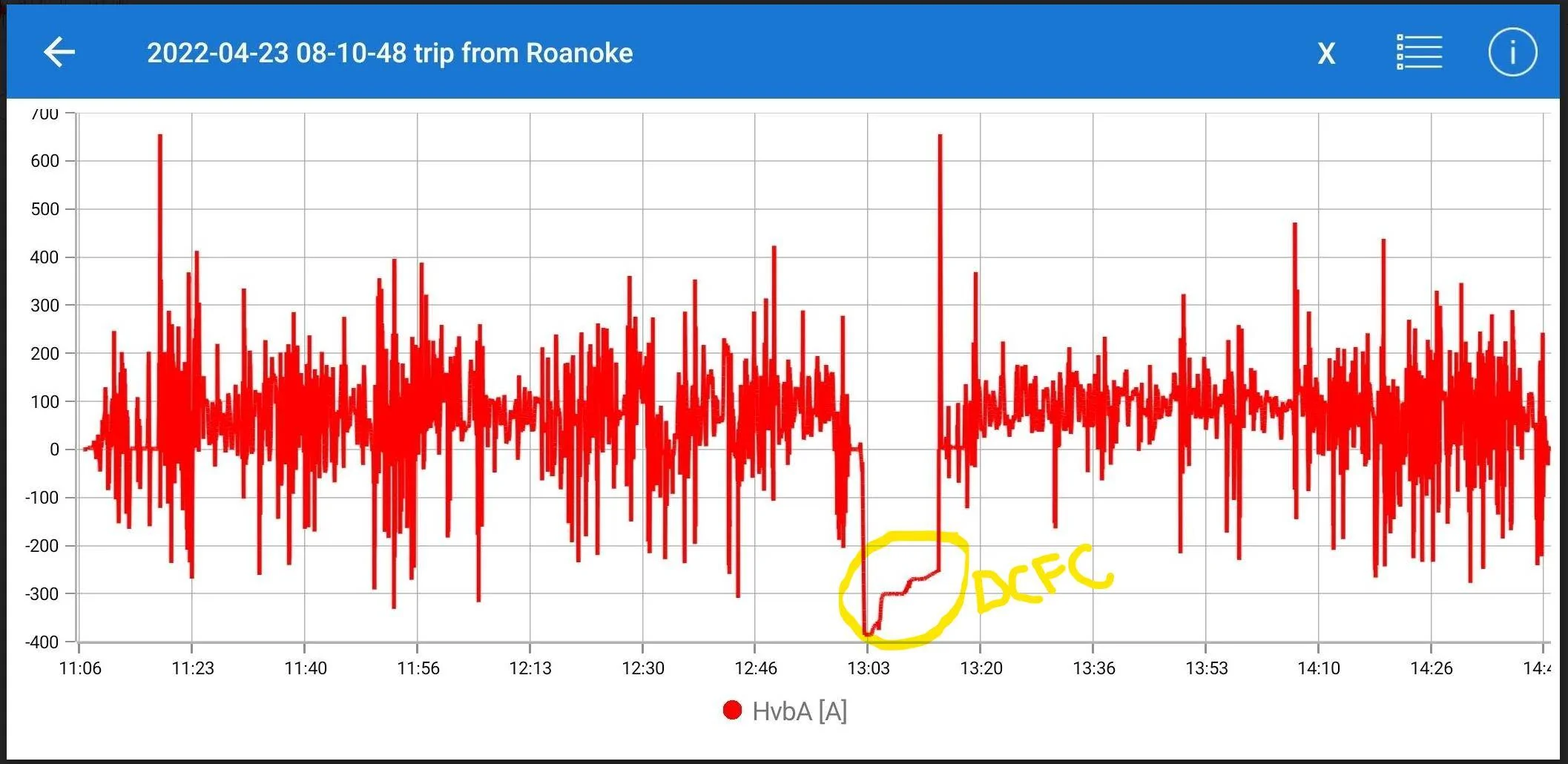
That said, many of the HVBJB failures have occurred at 400+ Amps, some much higher. I wonder if some cars require more current than others due to variations in motor production (or something else)? It would be interesting to see some MME owners who have had the failure post their trip
HVB Amps graph so we can compare it to mine to see if they look similar or are different.
Sponsored


