
NACS Adapter Now Available + Ford EV Owners Can Now Charge on Tesla Superchargers in U.S., Canada! 🙌



Jiji
Well-Known Member
- First Name
- Rick
- Joined
- Jul 26, 2021
- Threads
- 24
- Messages
- 495
- Reaction score
- 642
- Location
- Finger Lakes
- Vehicles
- 2022 Mustang Mach-E GT 2024 F-150 Lightning

Clean eating, works wonders.Wow, you are old.
And I suppose you are an expert on indoor air quality and climate change mitigation? I for one would wish you could just chill out and not make everything a government conspiracy to take away your gas appliances.Anyway, I don't mind scientific advancement. What I don't like is being ordered by politicians to replace something I think is better than the replacement.
Thanks for the offer to stay on topic, we all should keep a laser focus on everything Mach-E, Ford, EVs, and charging infrastructure.

mkhuffman
Well-Known Member
- First Name
- Mike
- Joined
- Nov 19, 2020
- Threads
- 29
- Messages
- 6,878
- Reaction score
- 9,512
- Location
- Virginia
- Vehicles
- 2025 Rivian R1T Tri-Max, Jeep GC-L, VW Jetta
I agree.Thanks for the offer to stay on topic, we all should keep a laser focus on everything Mach-E, Ford, EVs, and charging infrastructure.
devmach-e
Well-Known Member
- First Name
- David
- Joined
- Sep 8, 2021
- Threads
- 1
- Messages
- 2,028
- Reaction score
- 2,480
- Location
- SF Bay Area
- Vehicles
- 2022 Premium RWD ER, 2016 Toyota Highlander Hybrid
- Occupation
- Unix Sysadmin
The need for supplemental heat largely depends upon where you live and the equipment you install. Our friends to the north seem to have no trouble with cold climate heat pumps providing heat with no backup. Even with temperatures down to -20F. I have no backup heat and have had no trouble keeping the house warm. Then again, I do live in area where it rarely gets below 33F overnight.Correct; equipment will not be ripped out on Jan 1, 2030. New construction will require the use of electric HVAC as well as all replacement HVAC equipment sold for existing dwellings. That kinda sucks if you don't have a big enough panel for supplemental 230V heat strips.
devmach-e
Well-Known Member
- First Name
- David
- Joined
- Sep 8, 2021
- Threads
- 1
- Messages
- 2,028
- Reaction score
- 2,480
- Location
- SF Bay Area
- Vehicles
- 2022 Premium RWD ER, 2016 Toyota Highlander Hybrid
- Occupation
- Unix Sysadmin
Or you just get a cold climate heatpump rated for -10F.The obvious backup for heat pumps in new construction is a propane gas fireplace. This is what we did in the country (no natural gas available). We used it when we needed it, or when wife wanted a pretty fire. We considered a wood stove, but twice as expensive (mostly for the chimney).
devmach-e
Well-Known Member
- First Name
- David
- Joined
- Sep 8, 2021
- Threads
- 1
- Messages
- 2,028
- Reaction score
- 2,480
- Location
- SF Bay Area
- Vehicles
- 2022 Premium RWD ER, 2016 Toyota Highlander Hybrid
- Occupation
- Unix Sysadmin
We have a 125A feed. All we had to do was add a subpanel, move the electric oven breaker to the new panel, and the heat pump HVAC and WH breakers went in the new panel. The WH hardly ever uses it's 4500W resistive elements. Maybe 6 times in 9 months. Most of the time it pulls about 400W. Heat pump pulls about 3800W when running.That's the plan when my gas furnace dies. However I may have to spend $$ to get my circuit upgraded from 100 amps to 200 amps to handle a heat pump HAVC and/or water heater. Which PGE quoted as $10k to upgrade the circuit.
The best thing we did 24 years ago when we first moved into this house was to rip out the 80A fuse panel and replace it with a 125A circuit breaker panel. Panel is in the garage, but the main breaker and meter is just on the side of the outside wall. I seem to recall the cost being about $3500, but that included cleaning up a lot of crappy wiring in the house (still had knob and tube wiring), adding GFCIs, putting in grounded plugs where needed, and some other work.
devmach-e
Well-Known Member
- First Name
- David
- Joined
- Sep 8, 2021
- Threads
- 1
- Messages
- 2,028
- Reaction score
- 2,480
- Location
- SF Bay Area
- Vehicles
- 2022 Premium RWD ER, 2016 Toyota Highlander Hybrid
- Occupation
- Unix Sysadmin
There's your difference: CCA. But it's not the same as having different rates for TOU-D where you live versus where your friends live. You and them have the same basic PG&E rate. Take a closer look at your bill.They have the same plans available as I do, except their rates for every plan is lower than what mine is. They don't have a Community Choice Aggregation, but I do and am enrolled, which brings my overall cost down by about $0.01/kwh.
So basically their TOU-D plan rates are lower than the same TOU-D rates in my area by a significant margin.
On my PG&E bill for EV2-A (and I have solar too under NEM 2.0), I am charged roughly 53 cents for peak, 51.3 cents for partial peak, and 34.5 cents for off-peak. However, because my community participates in CCA, and uses a third-party clean energy supplier (PCE), I get a generation credit for the PG&E part of the bill. Which ends up being wee bit cheaper, by about 1.8 cents per kWh. This most recent bill saved me $15 versus what PG&E would've charged me.
ChehRob
Well-Known Member
- First Name
- Rob
- Joined
- Aug 24, 2023
- Threads
- 13
- Messages
- 964
- Reaction score
- 571
- Location
- Seattle WA
- Vehicles
- MME Premium AWD Ext. Range (Job2)
- Occupation
- ret
In cold climates it is not unknown to lose power for a several hours, occasionally more. To be prepared and to keep plumbing from freezing you need an alternative to electricity.
thenew3
Well-Known Member
- Joined
- Mar 12, 2023
- Threads
- 8
- Messages
- 516
- Reaction score
- 358
- Location
- Central Coast CA
- Vehicles
- BMW X7, BMW X3, MME Premium 4X
When I pull up TOU-D plan it shows $0.45 - $0.46/kwh. When they pull it up it shows $0.36/kwh.There's your difference: CCA. But it's not the same as having different rates for TOU-D where you live versus where your friends live. You and them have the same basic PG&E rate. Take a closer look at your bill.
On my PG&E bill for EV2-A (and I have solar too under NEM 2.0), I am charged roughly 53 cents for peak, 51.3 cents for partial peak, and 34.5 cents for off-peak. However, because my community participates in CCA, and uses a third-party clean energy supplier (PCE), I get a generation credit for the PG&E part of the bill. Which ends up being wee bit cheaper, by about 1.8 cents per kWh. This most recent bill saved me $15 versus what PG&E would've charged me.
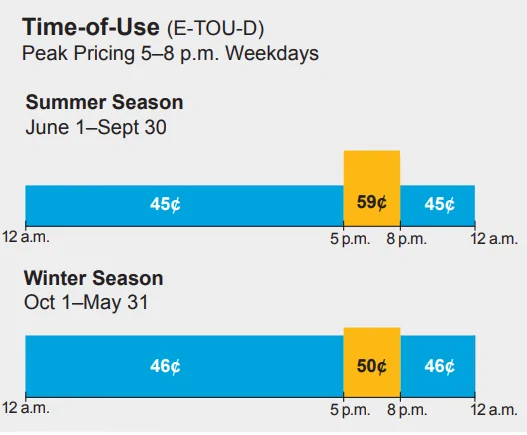
I've gone through the cost analyzer tool with PGE. Doesn't matter which plan we look at, the overall annual cost (based on past 2 year usage) is within $50-$75 on all plans. So not a major difference regardless of which plan.
The point is, PGE utility prices are very high compared to rest of country. Does it still make sense to drive EV? Maybe. Gas is also high (most stations around here are hovering around the $6/gallon mark).
I'm on the Tiered plan with PGE which is $0.42/kwh Tier 1, $0.53/kwh Tier 2. Tier 1 is set so low that everyone basically exceeds it within the first week of the billing cycle, so the majority of the billing cycle is Tier 2 pricing. My CCE rates are about $0.01/kwh lower than PGE, so that brings it down to $0.52/kwh most of the month. Still super high.
I'm co-workers pay $0.07/kwh, they leave all their lights, AC, computers etc on all the time. I'm turning as much off as I can to try to keep my utility bill manageable.
$500-$600/month for electricity & natural gas is crazy. And that's with us working from home so we don't need to charge the MME all that much. and keeping our thermostat at 60 - 64 degrees in the winter. (no AC in the house so doesn't matter in the summer).
Just Lurking
Well-Known Member
- First Name
- Paul
- Joined
- Dec 31, 2022
- Threads
- 8
- Messages
- 635
- Reaction score
- 599
- Location
- Washington
- Vehicles
- 2022 Mach-E GT

Or a whole-house battery backup, which is admittedly very expensive and not cost-effective for most people.In cold climates it is not unknown to lose power for a several hours, occasionally more. To be prepared and to keep plumbing from freezing you need an alternative to electricity.
For people in cold climates who don't have a backup power source, I imagine certain precautions have to be taken to leave the home unoccupied during the winter. Shutting off water to the house and then draining some of the water out of the faucets should be sufficient in most cases, I'd imagine?
devmach-e
Well-Known Member
- First Name
- David
- Joined
- Sep 8, 2021
- Threads
- 1
- Messages
- 2,028
- Reaction score
- 2,480
- Location
- SF Bay Area
- Vehicles
- 2022 Premium RWD ER, 2016 Toyota Highlander Hybrid
- Occupation
- Unix Sysadmin
Kinda sounds like your friends have CARE.When I pull up TOU-D plan it shows $0.45 - $0.46/kwh. When they pull it up it shows $0.36/kwh.

I've gone through the cost analyzer tool with PGE. Doesn't matter which plan we look at, the overall annual cost (based on past 2 year usage) is within $50-$75 on all plans. So not a major difference regardless of which plan.
The point is, PGE utility prices are very high compared to rest of country. Does it still make sense to drive EV? Maybe. Gas is also high (most stations around here are hovering around the $6/gallon mark).
I'm on the Tiered plan with PGE which is $0.42/kwh Tier 1, $0.53/kwh Tier 2. Tier 1 is set so low that everyone basically exceeds it within the first week of the billing cycle, so the majority of the billing cycle is Tier 2 pricing. My CCE rates are about $0.01/kwh lower than PGE, so that brings it down to $0.52/kwh most of the month. Still super high.
I'm co-workers pay $0.07/kwh, they leave all their lights, AC, computers etc on all the time. I'm turning as much off as I can to try to keep my utility bill manageable.
$500-$600/month for electricity & natural gas is crazy. And that's with us working from home so we don't need to charge the MME all that much. and keeping our thermostat at 60 - 64 degrees in the winter. (no AC in the house so doesn't matter in the summer).
Yeah, I've gone through the rate analysis tool, multiple times. PG&E/PCE initially switched me to EM-TOU when E6 finally went away. I subsequently moved to EV2-A. EV2-A is the cheaper of the plans available, but just like you, only about $30 difference between the highest and lowest plan.
I charge using the overnight rates of 34.4 cents a kWh. Assuming I get 3 miles a kWh, and after factoring in charging losses, that basically comes out to be about 12.6 cents a mile to drive the Mach-E. With gas at $5 a gallon here, and driving our other car, a 2016 Highlander Hybrid which gets about 25 MPG, that's 20 cents a mile. Even if I take the average cost of electricity for the house at 42 cents a kWh (dividing total bill by kWh used), it comes out to be 15.4 cents a mile. Still cheaper than the Highlander.
Yes, PG&E rates suck. For both gas and electric.
thenew3
Well-Known Member
- Joined
- Mar 12, 2023
- Threads
- 8
- Messages
- 516
- Reaction score
- 358
- Location
- Central Coast CA
- Vehicles
- BMW X7, BMW X3, MME Premium 4X
I highly doubt it. As I understand, CARE is for low income folks. My friend makes about 4x what I make.Kinda sounds like your friends have CARE.
I'm looking forward to the end of my solar lease so I can get a bigger system and not have to buy from PGE anymore.
Spike
Well-Known Member
'I highly doubt it. As I understand, CARE is for low income folks. My friend makes about 4x what I make.
I'm looking forward to the end of my solar lease so I can get a bigger system and not have to buy from PGE anymore.
In my job, I talk to people about their electrical usage. You would be surprised how often people cheat the CARE program. Kind of gross really how many people I see that clearly should not qualify for CARES, on CARES.

dbsb3233
Well-Known Member
- First Name
- TimCO
- Joined
- Dec 30, 2019
- Threads
- 56
- Messages
- 10,100
- Reaction score
- 11,965
- Location
- Colorado, USA
- Vehicles
- 2021 Mustang Mach-E FE, 2025 Porche Macan Electric
- Occupation
- Retired
I remember when this thread was about the NACS adapter. ?
AhardFSU
Well-Known Member
- First Name
- Antonio
- Joined
- Apr 10, 2022
- Threads
- 3
- Messages
- 777
- Reaction score
- 730
- Location
- Riverview
- Vehicles
- 2022 Mustang Mach E
Hey! Did any see the video from Mach E Vlog where they used the NACS adapter twice on a road trip? Yeah good video about the NACS adapter. Check it out. I for one can’t wait to get my NACS adapter. I even ordered one from A2Z which I will hopefully get before I head out on a trip in mid April.
Sponsored
Similar threads

- Replies
- 6
- Views
- 1,128


- Replies
- 608
- Views
- 71,643

- Replies
- 106
- Views
- 43,333


- Replies
- 35
- Views
- 11,426
