
2023.5+ Cooling System Redesign and Larger 7 kW Heater

SWO

Well-Known Member
Joined
Aug 28, 2021
Threads
21
Messages
2,222
Reaction score
2,802
Location
MD, USA
Vehicles
2022 Mach E GT, 2021 Escape PHEV, 2019 F-150
Country flag
and still no heat pump ....
You always hear people say this, but I've never seen any significant increase in efficiency in a direct comparison. Even if it's 3x more efficient in a best case scenario (above freezing), that is only going to equal a little over 1kw in an hour. Even at 3mi/kwh (likely closer to 2mi/kwh if it's cold), that's peanuts.

And for that small gain in range, you get a much more complex system (look at all the Teslas with no heat a couple years ago).

https://teslamotorsclub.com/tmc/thr...d-like-many-others-vcfront_a531-error.317515/

https://www.consumerreports.org/car...faulty-heat-pump-loss-of-heating-a5384954255/
Sponsored


Spacey

Well-Known Member
Joined
Mar 10, 2023
Threads
16
Messages
417
Reaction score
319
Location
UK
Vehicles
Mustang Mach E
Country flag
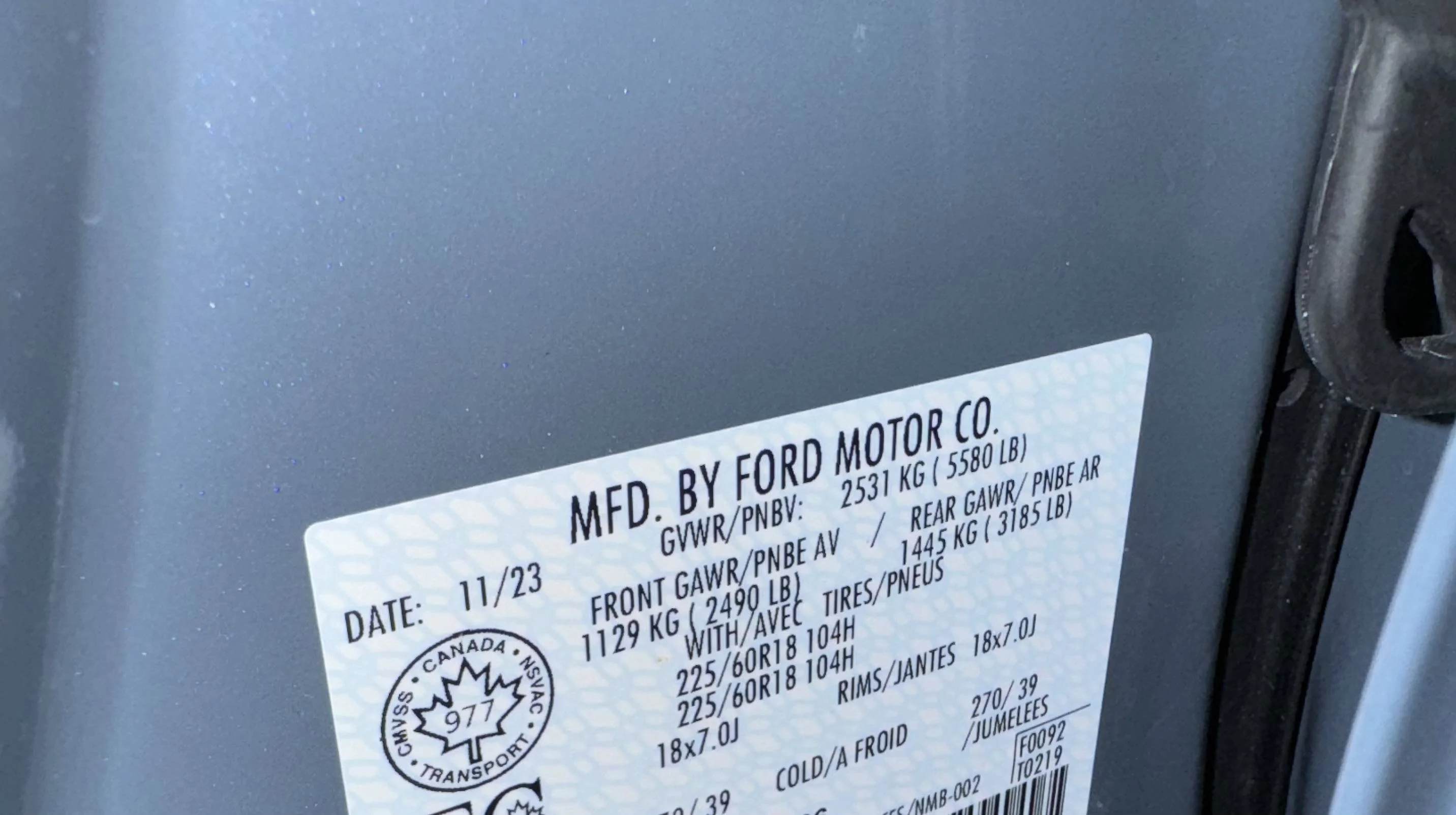
Open the drivers door and it is one of the stickers on the lower right. Not the one with the tire pressures, the manufacturer label. Looks like this:

IMG_0515.jpeg
We don't get that sticker in the UK either so it's a guessing game when the car is manufactured.
 

redgrandam

Well-Known Member
First Name
Jay
Joined
Feb 23, 2024
Threads
15
Messages
230
Reaction score
241
Location
Southwestern Ontario, Canada
Vehicles
2023 Mach E Select
Country flag
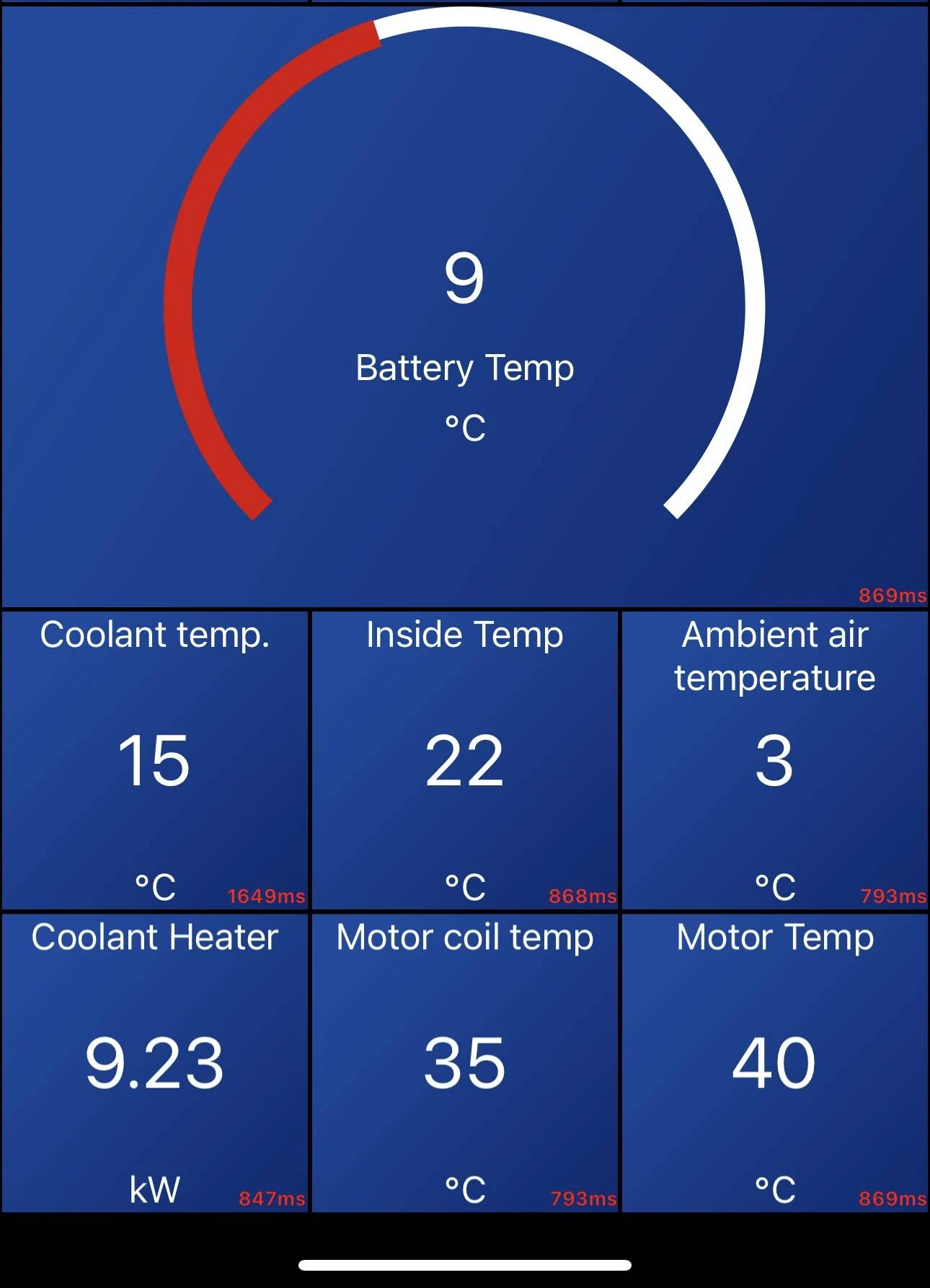
maybe this will answer a bit about the motor heating the battery. I was on the highway for about 20 mins. The motor temp (bottom right which is the motor inverter temp sensor) was right at 21C. It wasn’t changing.

I was about 15 km from a charger. I put it in the navigation. As soon as I did the coolant heater came on and the motor temp increased rapidly. Within a few minutes it was up to 50C.

Ford Mustang Mach-E 2023.5+ Cooling System Redesign and Larger 7 kW Heater IMG_0569


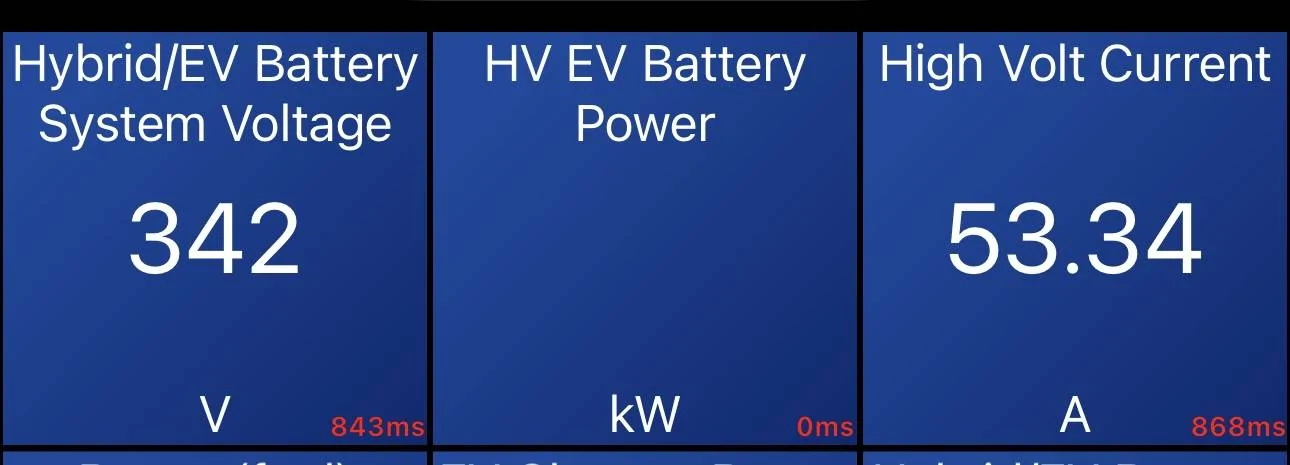
Side note. I still can’t get the battery power level to work. I got it to show 18kw almost all the time but that wasn’t right. The HV current always seems to show around 55A which is also wrong and I think the current reading is the cause of the issue. Anyone have any suggestions on this?
Ford Mustang Mach-E 2023.5+ Cooling System Redesign and Larger 7 kW Heater IMG_0569
 

AKgrampy

Well-Known Member
First Name
Mike
Joined
Jan 29, 2022
Threads
7
Messages
3,523
Reaction score
3,592
Location
Fairbanks, Alaska
Vehicles
Ford Expedition, Ford F-150, Mach E GT
Occupation
Retired
Country flag
Makes me wish I had a 3 year Option plan versus 4 but I will just have to be patient! I was warm enough this winter and even drove it below -20F but the extra 2kW would be appreciated!


Mathington

Well-Known Member
Joined
Jul 6, 2021
Threads
20
Messages
882
Reaction score
868
Location
Canada
Vehicles
Mach-E Premium SR AWD
Country flag
I was asked to make a post about the changes made to the thermal systems in 2023.5 models and later. They include:
  • PTC heater was upgraded from 5 kW to 7 kW (nominal continuous output, peak output may be slightly higher in some situations)
    • New LFP pack is more sensitive to cold temps and requires more heating than NCM
  • Glycol cooling is now a single system with three combined circuits rather than two separate systems (single coolant bottle instead of two coolant bottles)
  • Addition of two 5-port valves allow excess heat to be utilized for battery heating (rather than being wasted)
  • Removal of one coolant pump on base AWD models
  • New on-board AC charger from a different supplier, has different hookup locations
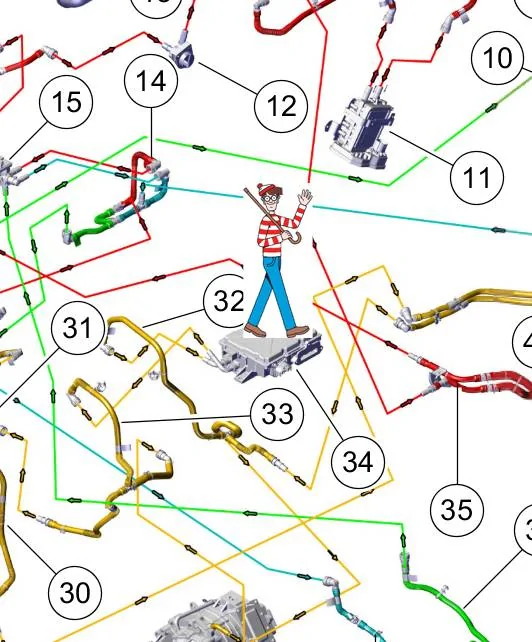
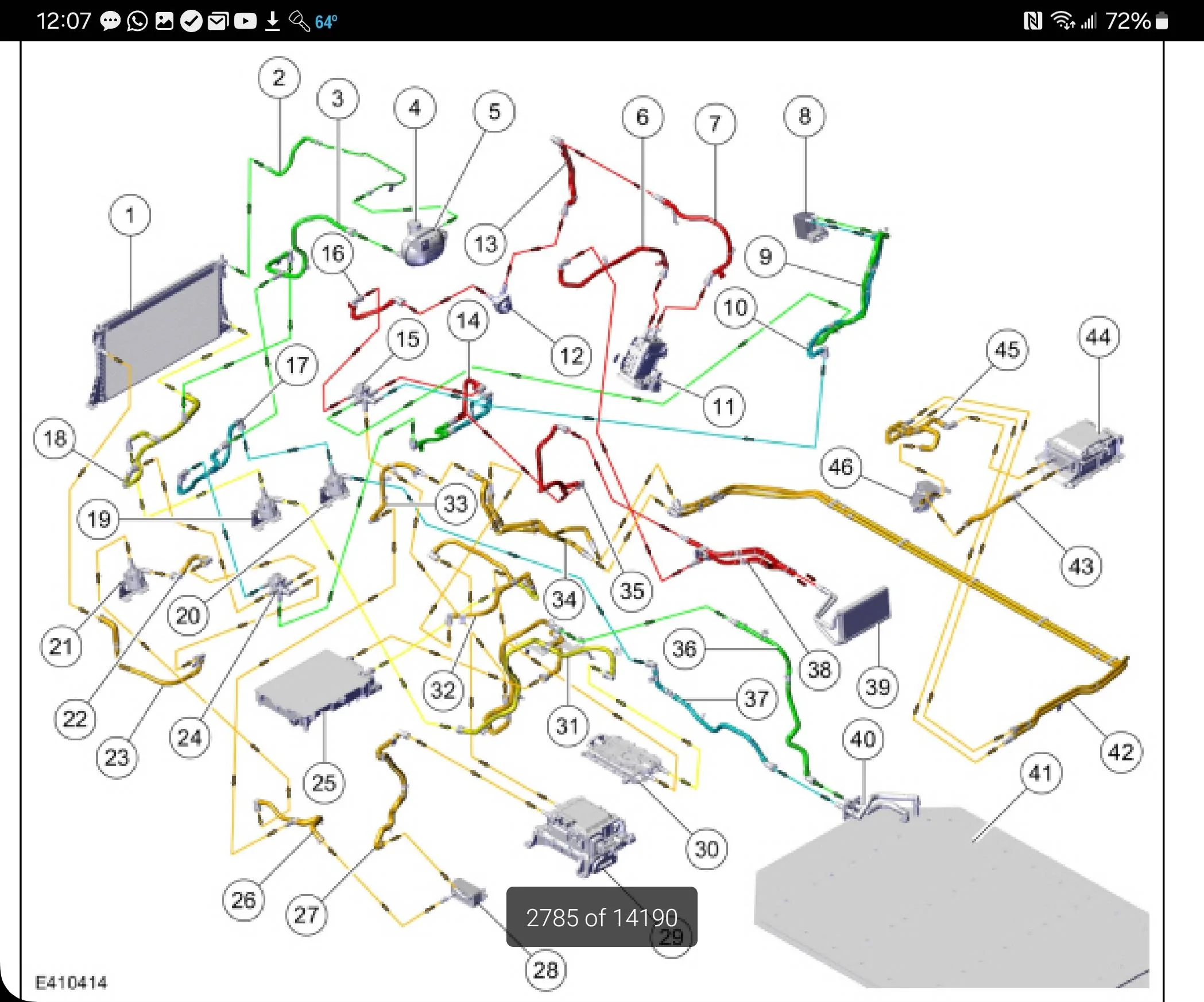
Here's what the new cooling system looks like. Warning, these might give you a headache if you're not an engineer that deals with complex systems.

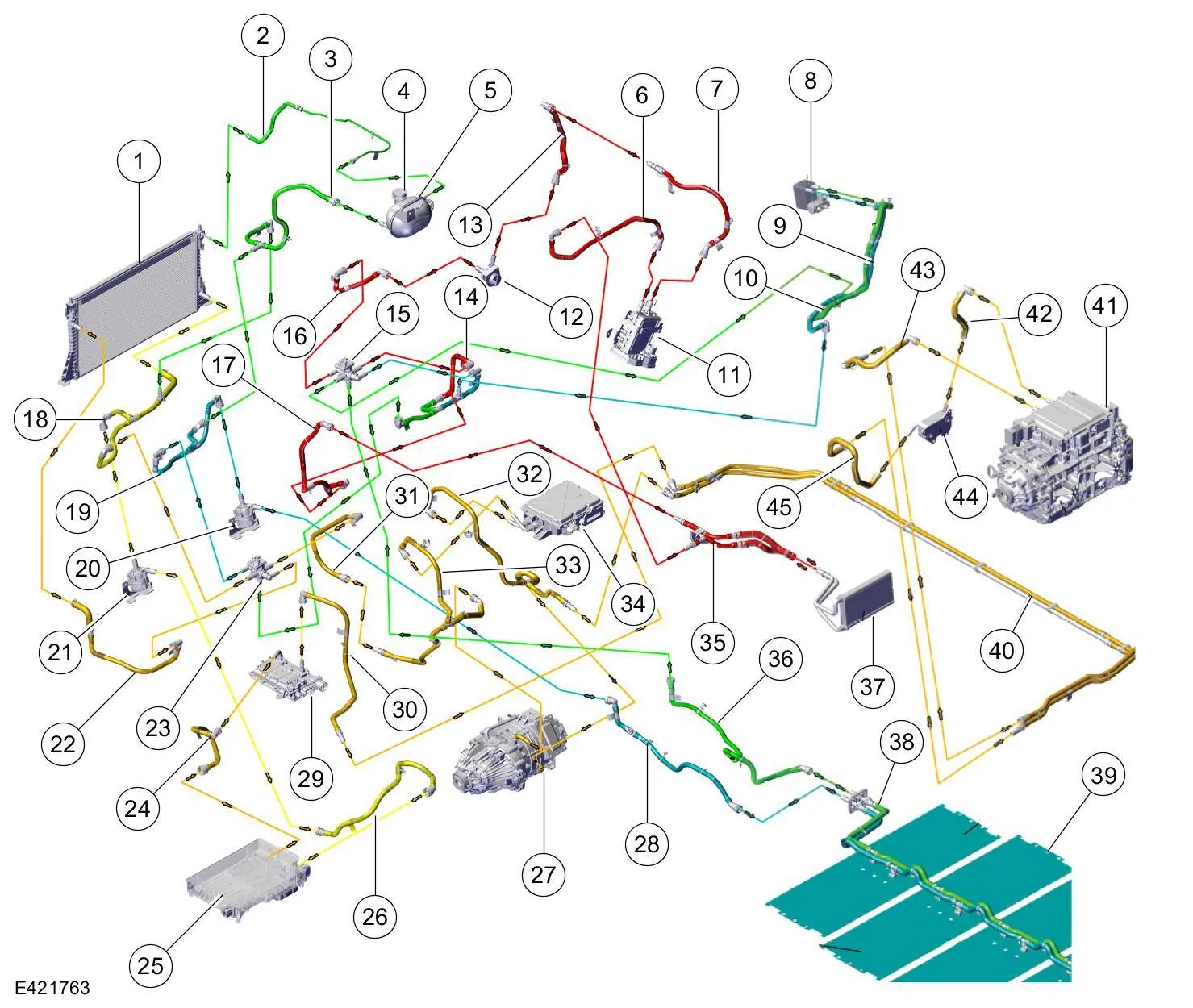
Base AWD:

2024 Mach-E Cooling system.png


1 — Radiator
2 — Radiator vent hose
3 — Degas bottle lower hose
4 — Degas bottle cap
5 — Degas bottle
6 — Cabin coolant heater outlet hose
7 — Cabin coolant heater inlet hose
8 — High voltage battery coolant cooler
9 — High voltage battery coolant cooler inlet hose
10 — High voltage battery coolant cooler outlet hose
11 — Cabin coolant heater
12 — Cabin heater coolant pump
13 — Cabin heater coolant pump outlet hose
14 — High voltage battery coolant diverter valve inlet hose
15 — High voltage battery coolant diverter valve
16 — Cabin heater coolant pump inlet hose
17 — Heater core outlet hose
18 — Radiator lower hose
19 — High voltage battery coolant pump inlet hose
20 — High voltage battery coolant pump
21 — Motor electronics coolant pump
22 — Radiator upper hose
23 — High voltage battery radiator coolant diverter valve
24 — DC/DC inlet hose
25 — SOBDM (Secondary On-Board Diagnostic Control Module A)
26 — SOBDM inlet hose
27 — Front electric drive assembly
28 — High voltage battery coolant inlet hose
29 — DC/DC (Direct Current/Direct Current converter control module)
30 — DC/DC outlet hose
31 — High voltage battery radiator coolant diverter valve inlet hose
32 — Secondary inverter system controller [SOBDMB] inlet hose
33 — Secondary inverter system controller [SOBDMB] outlet hose
34 — Secondary inverter system controller [SOBDMB (Secondary On-Board Diagnostic Control Module B)]
35 — Heater core hose assembly
36 — High voltage battery coolant outlet hose
37 — Heater core
38 — High voltage battery coolant hose assembly
39 — High voltage battery plates
40 — Rear electric drive assembly lower coolant hose assembly
41 — Inverter system controller [SOBDMC (Secondary On-Board Diagnostic Control Module C)]
42 — Inverter system controller [SOBDMC] outlet hose
43 — Inverter system controller [SOBDMC] inlet hose
44 — Rear electric drive assembly oil cooler
45 — Rear electric drive assembly oil cooler outlet hose
Note: I figured these out, not Ford. There may be errors.

Cabin heat: 11, 6, 35, 37, 35, 17, 14, 15, 16, 12, 13, 7
Motor/Electronics cooling: 1, 18, 21, 26, 25, 24, 29, 30, 40, 43, 41, 42, 44, 45, 40, 32 [(34, 33),(27, 33)], 23, 22
Battery heat: 11, 6, 35, 37, 14, 23, 19, 20, 28, 38, 39, 38, 36, 15, 16, 12, 13, 7
Battery cool: 8, 9, 14, 23, 19, 20, 28, 38, 39, 38, 36, 15, 10
Waste heat to battery: 25, 24, 29, 30, 40, 43, 41, 42, 44, 45, 40, 32 [(34, 33),(27, 33)], 23, 19, 20, 28, 38, 39, 38, 36, 15, 14, 23, 18, 21, 26
Waste heat to battery + cabin: 25, 24, 29, 30, 40, 43, 41, 42, 44, 45, 40, 32 [(34, 33),(27, 33)], 23, 19, 20, 28, 38, 39, 38, 36, 15, 16, 12, 13, 7, 11, 6, 35, 37, 35, 17, 14, 23, 18, 21, 26

Cabin heat, Battery cool, and Motor/Electronics cooling should be able to operate simultaneously and independently of each other since they have their own pumps. Such as while DC charging.

It is now a single system with one coolant bottle (4). Larger PTC heater is shown (11). The key addition was a pair of 5-port valves (15 and 23) that allows coolant to flow to many destinations. The left 5-port (23) is focused on motor electronics cooling and battery heating/cooling. The right 5-port (15) is focused on cabin heating and coolant chilling. There are three loops within the system that can be combined or separated by the 5-port valves. These loops are the high voltage battery circuit, cabin heater circuit, and a powertrain electronics circuit.

A huge improvement here is the utilization of waste heat generated by the motor electronics and charger. On first-generation Mach-E's, the waste heat from AC charging and the motors/inverters can only be dissipated to the radiator. This heat is effectively lost to the surroundings. The new design allows the charger/motor waste heat to be sent to the battery pack instead of the radiator. This can provide a huge improvement to battery temperatures in winter conditions, and also opens up the possibility of heating the battery pack with the motors instead of the PTC heater for additional output (like Tesla and Rivian do). This should also increase the efficiency of the vehicle in cold conditions.

In the old design, 10% of the energy you use for charging is completely wasted. If you AC charge all night, the motors and radiator will be warm. This heat will quickly dissipate to the surroundings while driving. With the new design, this 10% of energy can be used to warm up the battery pack for free. Therefore in the morning you will have a warm battery pack, which means more range and less energy used for departure time preconditioning.

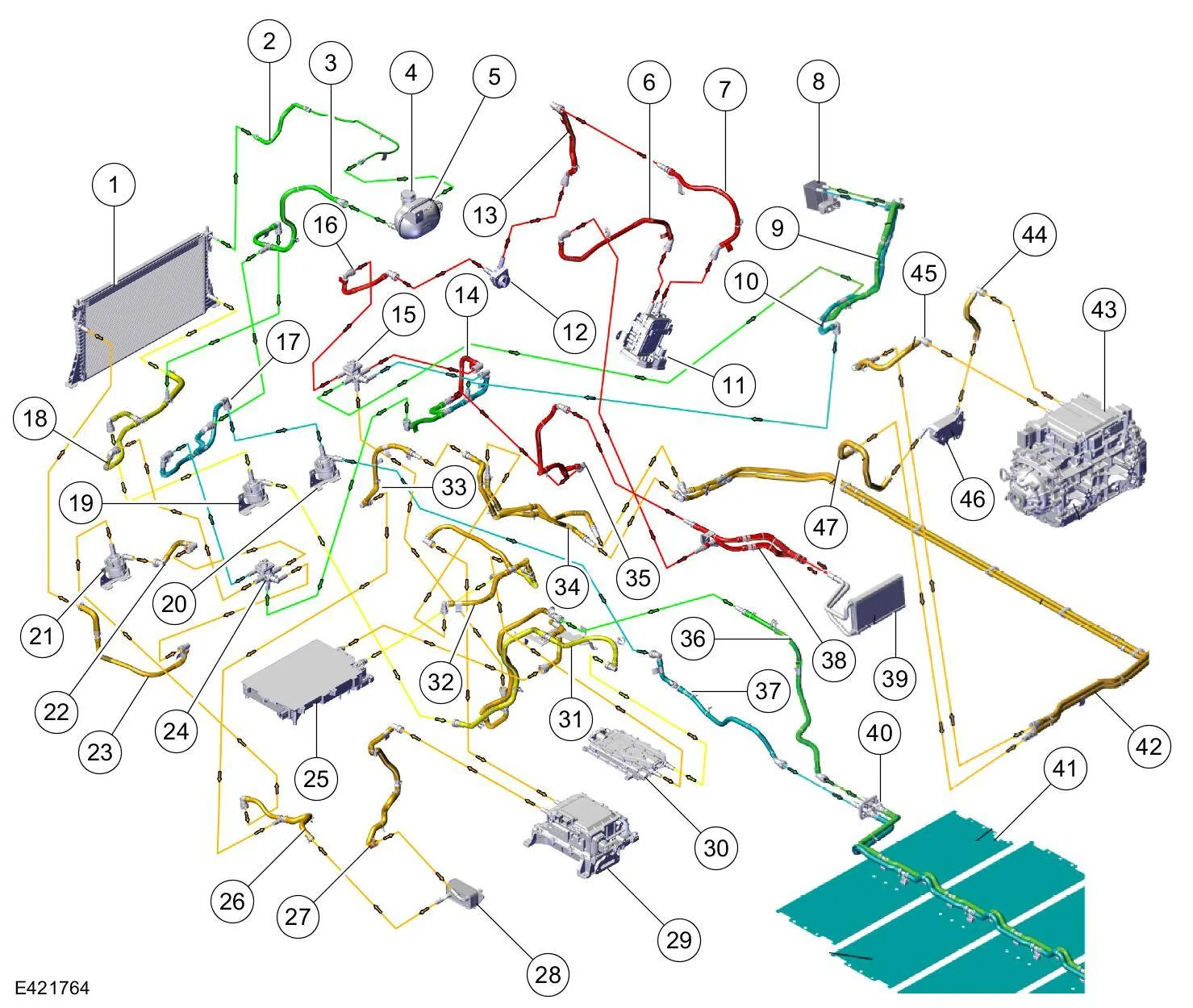
GT:

2024 Mach-E GT cooling system.png


1 — Radiator
2 — Radiator vent hose
3 — Degas bottle lower hose
4 — Degas bottle cap
5 — Degas bottle
6 — Cabin coolant heater outlet hose
7 — Cabin coolant heater inlet hose
8 — High voltage battery coolant cooler
9 — High voltage battery coolant cooler inlet hose
10 — High voltage battery coolant cooler outlet hose
11 — Cabin coolant heater
12 — Cabin heater coolant pump
13 — Cabin heater coolant pump outlet hose
14 — High voltage battery coolant diverter valve inlet hose
15 — High voltage battery coolant diverter valve
16 — Cabin heater coolant pump inlet hose
17 — High voltage battery coolant pump inlet hose
18 — Radiator lower hose
19 — Motor electronics coolant pump
20 — High voltage battery coolant pump
21 — Motor electronics coolant pump - GT
22 — Motor electronics coolant pump - GT outlet hose
23 — Radiator upper hose
24 — High voltage battery radiator coolant diverter valve
25 — SOBDM (Secondary On-Board Diagnostic Control Module A)
26 — Front electric drive assembly oil cooler outlet hose
27 — Front electric drive assembly oil cooler inlet hose
28 — Front electric drive assembly oil cooler
29 — Secondary inverter system controller [SOBDMB (Secondary On-Board Diagnostic Control Module B)]
30 — DC/DC (Direct Current/Direct Current converter control module)
31 — DC/DC inlet hose
32 — Secondary inverter system controller [SOBDMB] inlet hose
33 — Rear electric drive assembly coolant outlet hose
34 — Rear electric drive assembly coolant hose assembly
35 — Heater core outlet hose
36 — High voltage battery coolant outlet hose
37 — High voltage battery coolant inlet hose
38 — Heater core hose assembly
39 — Heater core
40 — High voltage battery coolant hose assembly
41 — High voltage battery plates
42 — Rear electric drive assembly lower coolant hose assembly
43 — Inverter system controller [SOBDMC (Secondary On-Board Diagnostic Control Module C)]
44 — Inverter system controller [SOBDMC] outlet hose
45 — Inverter system controller [SOBDMC] inlet hose
46 — Rear electric drive assembly oil cooler
47 — Rear electric drive assembly oil cooler outlet hose

The GT functions similar to the base AWD, but with one additional cooling pump (21) added for the larger front motor.

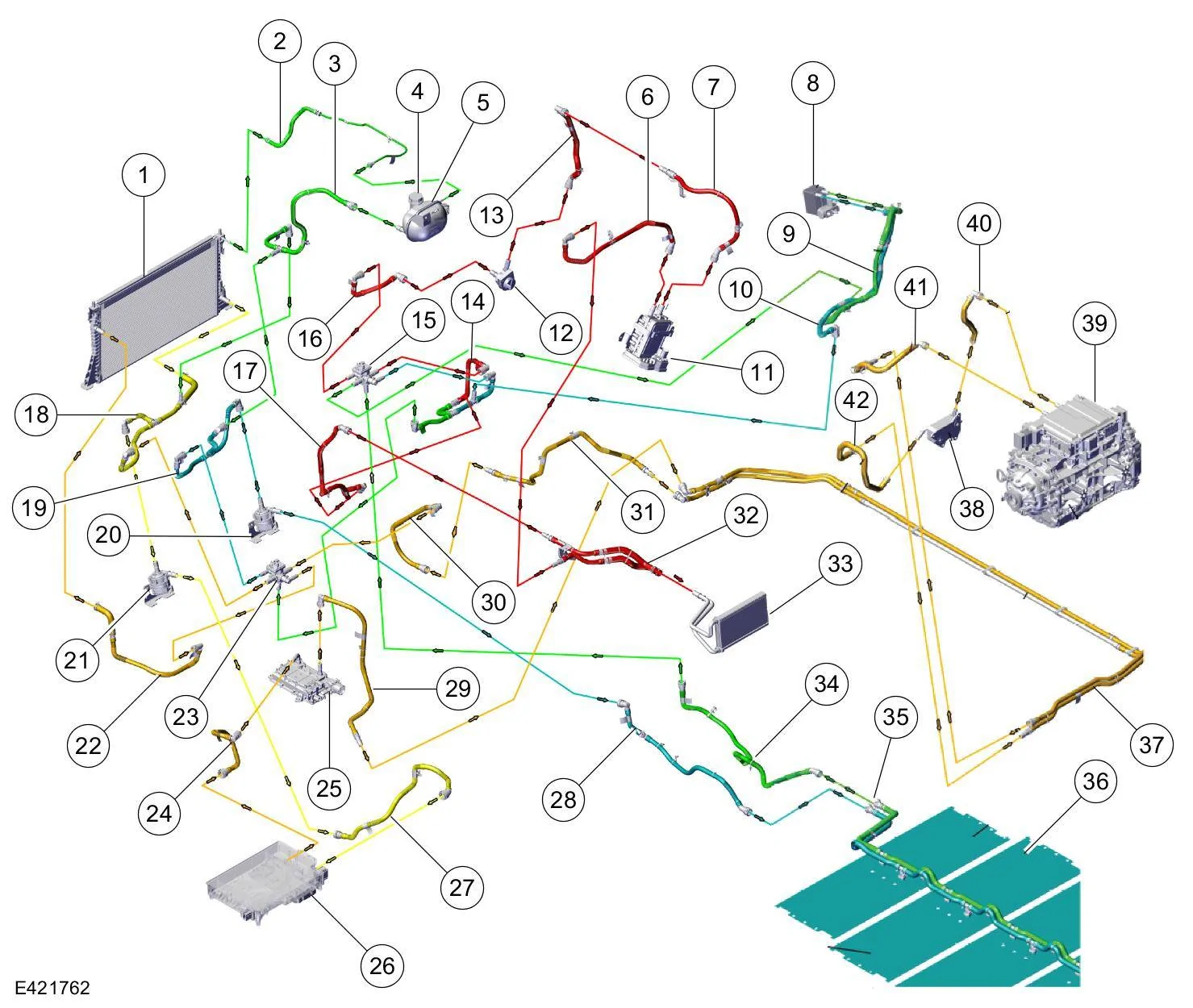
RWD:

2024 Mach-E RWD cooling system.png


1 — Radiator
2 — Radiator vent hose
3 — Degas bottle lower hose
4 — Degas bottle cap
5 — Degas bottle
6 — Cabin coolant heater outlet hose
7 — Cabin coolant heater inlet hose
8 — High voltage battery coolant cooler
9 — High voltage battery coolant cooler inlet hose
10 — High voltage battery coolant cooler outlet hose
11 — Cabin coolant heater
12 — Cabin heater coolant pump
13 — Cabin heater coolant pump outlet hose
14 — High voltage battery coolant diverter valve inlet hose
15 — High voltage battery coolant diverter valve
16 — Cabin heater coolant pump inlet hose
17 — Heater core outlet hose
18 — Radiator lower hose
19 — High voltage battery coolant pump inlet hose
20 — High voltage battery coolant pump
21 — Motor electronics coolant pump
22 — Radiator upper hose
23 — High voltage battery radiator coolant diverter valve
24 — DC/DC inlet hose
25 — DC/DC (Direct Current/Direct Current converter control module)
26 — SOBDM (Secondary On-Board Diagnostic Control Module A)
27 — SOBDM inlet hose
28 — High voltage battery coolant inlet hose
29 — DC/DC outlet hose
30 — High voltage battery radiator coolant diverter valve inlet hose
31 — Rear electric drive assembly coolant outlet hose
32 — Heater core hose assembly
33 — Heater core
34 — High voltage battery coolant outlet hose
35 — High voltage battery coolant hose assembly
36 — High voltage battery plates
37 — Rear electric drive assembly lower coolant hose assembly
38 — Rear electric drive assembly oil cooler
39 — Inverter system controller [SOBDMC (Secondary On-Board Diagnostic Control Module C)]
40 — Inverter system controller [SOBDMC] outlet hose
41 — Inverter system controller [SOBDMC] inlet hose
42 — Rear electric drive assembly oil cooler outlet hose

RWD is extremely similar to base AWD, just without the branch in the loop for the front motor.

Old Coolant Systems for comparison

5-port Coolant Diverter Valve:

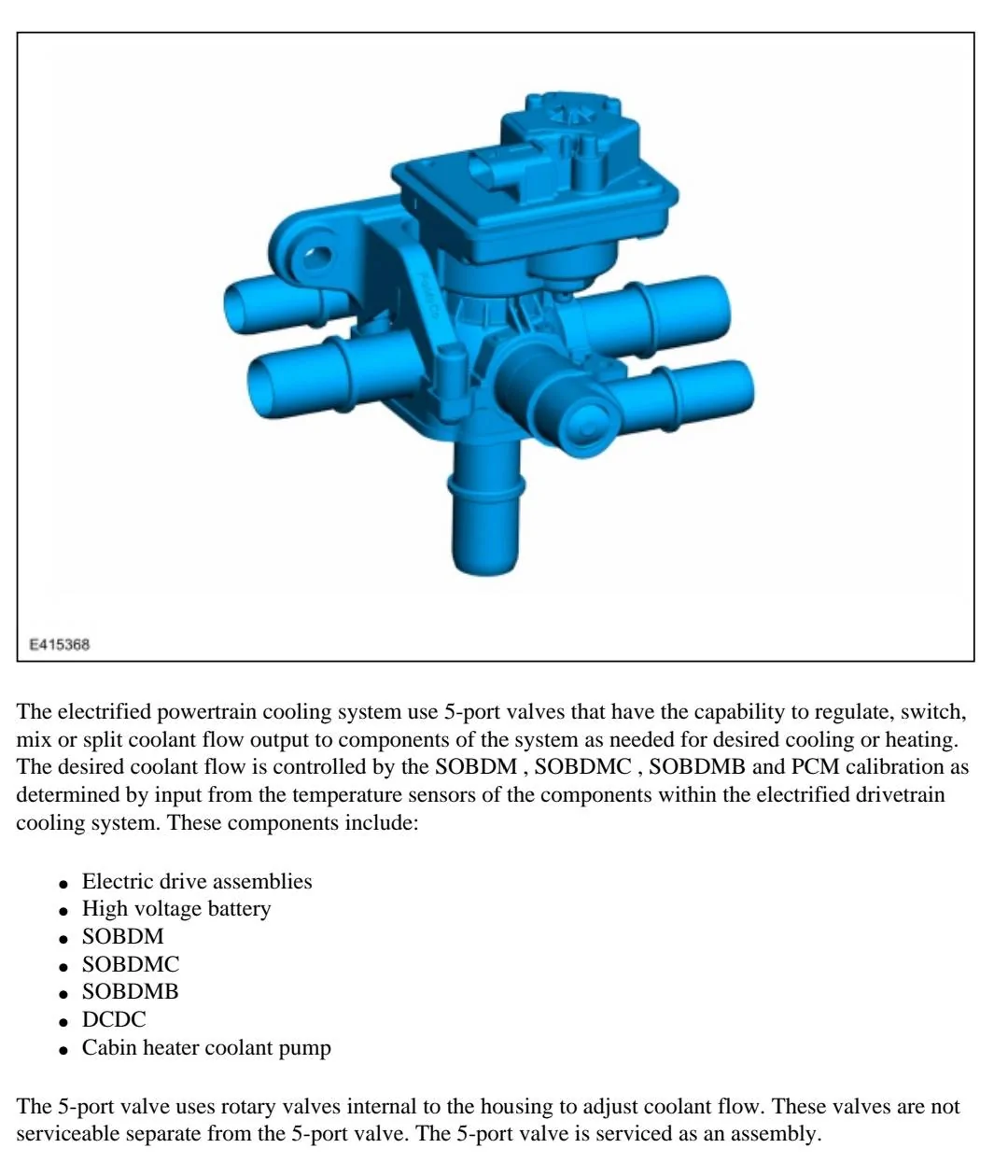
Mach-E 5-way valve.jpeg


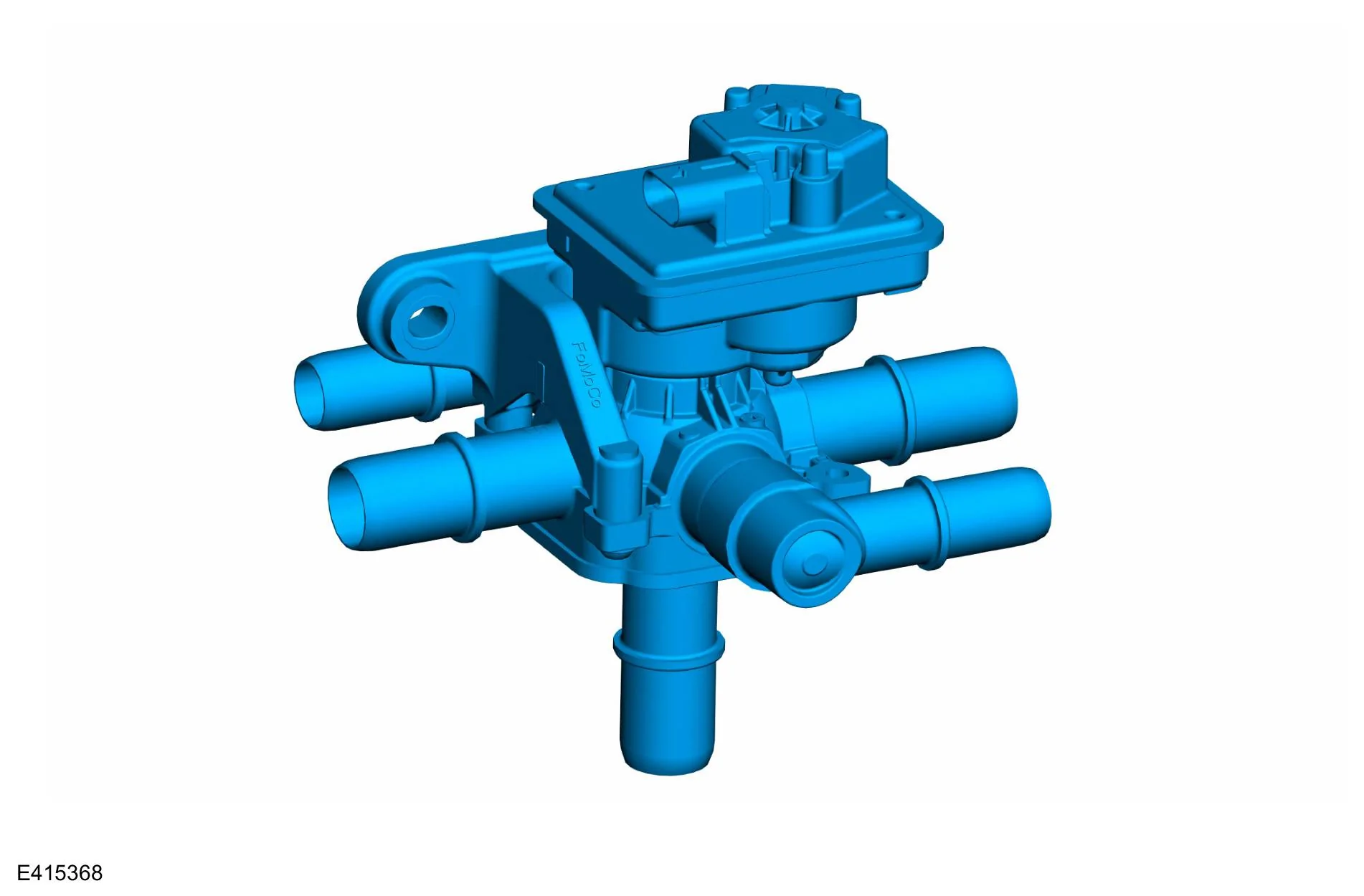
The electrified powertrain cooling system use 5-port valves that have the capability to regulate, switch, mix or split coolant flow output to components of the system as needed for desired cooling or heating. The desired coolant flow is controlled by the SOBDM , SOBDMC , SOBDMB and PCM calibration as determined by input from the temperature sensors of the components within the electrified drivetrain cooling system. These components include:
  • Electric drive assemblies
  • High voltage battery
  • SOBDM
  • SOBDMC
  • SOBDMB
  • DCDC
  • Cabin heater coolant pump
The 5-port valve uses rotary valves internal to the housing to adjust coolant flow. These valves are not serviceable separate from the 5-port valve. The 5-port valve is serviced as an assembly.

7 kW PTC Cabin Heater:

Mach-E Heater.jpeg


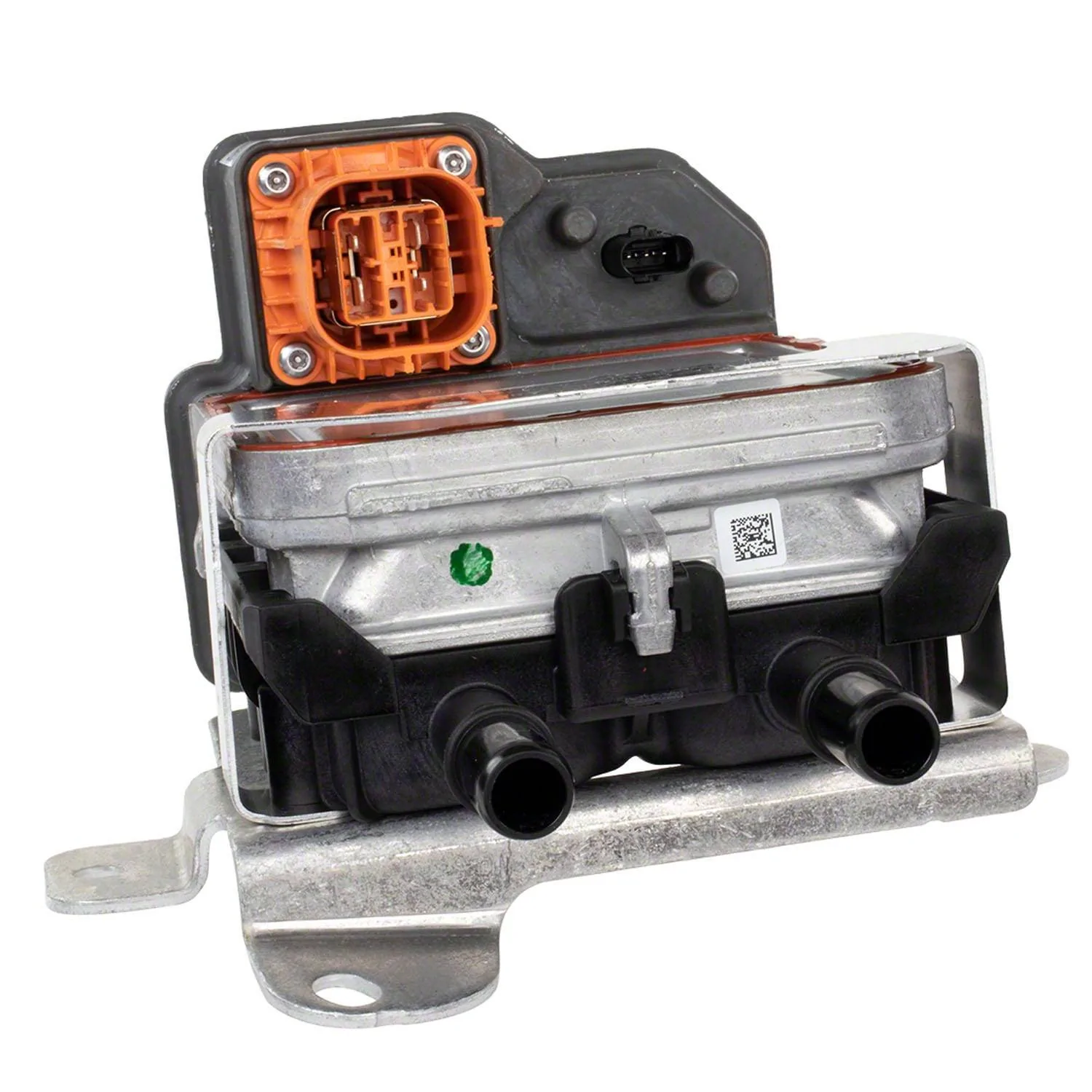
The heater is thicker than before.

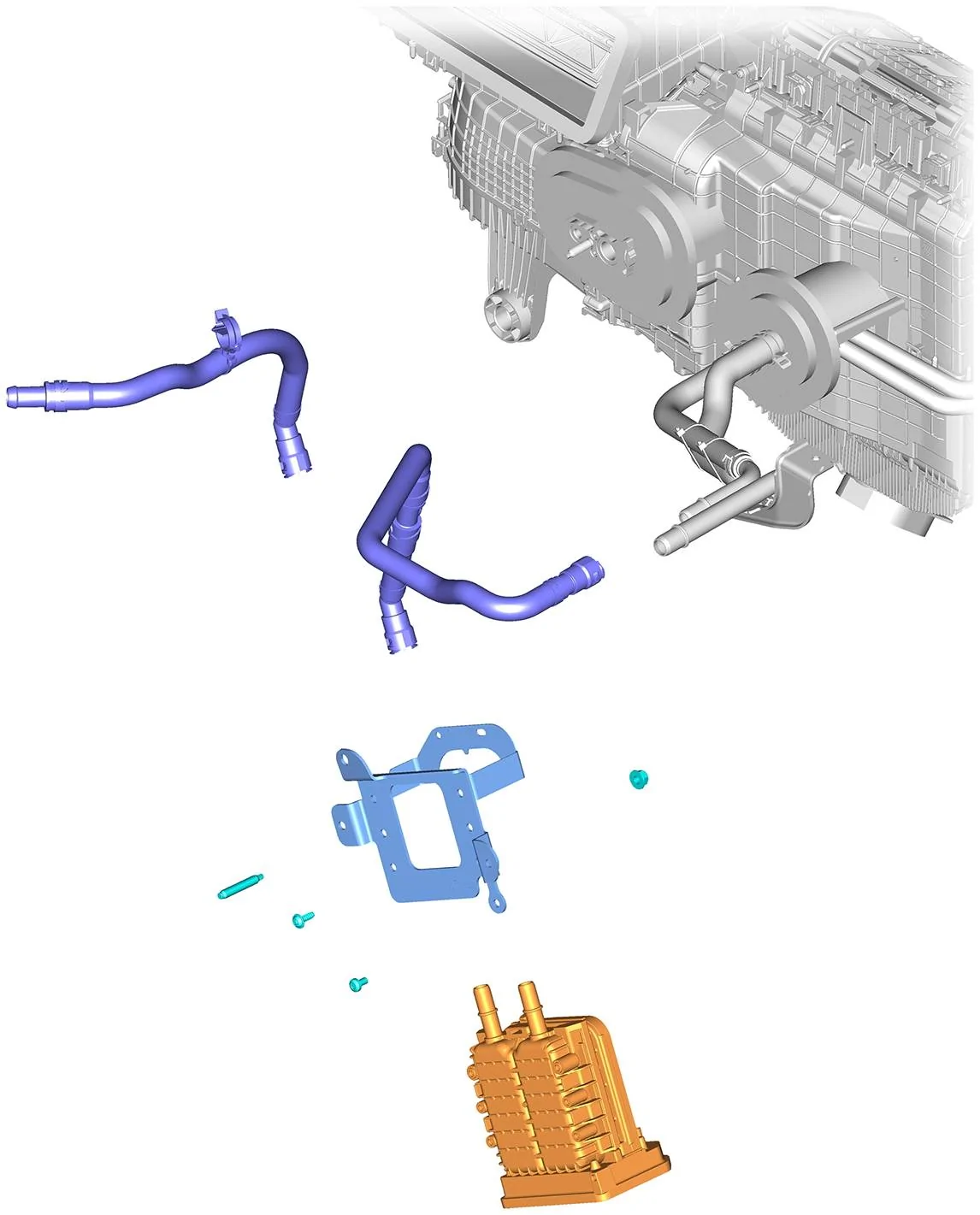
Heater Core.jpeg


The positive temperature coefficient (PTC) cabin heater has been increased in size from 5 kW to 7 kW, providing 40% more heat output. The previous 5 kW models ran out of heat around 0ºF (-18ºC), the larger heater should hopefully allow the Mach-E to have heat down to -28ºF (-33ºC). It will also speed up battery heating times as well.

Note: 7 kW is the nominal heat output while cabin heating. PTC heaters can output more than nominal power in some situations, such as during battery heating with colder return temps (perhaps 8 kW). The output may briefly peak above 10 kW when first cycled on. But this is still considered a 7 kW nominal heater.

And before someone asks, I don't think the new heater can be retrofitted. It's physically larger and may not fit in old plumbing design. There will likely be issues with software control as well.
Great post, thank @Mach-Lee ! Nice to see Ford iterating more quickly and improving the overall experience for customers. The 2024 Lightning is supposed to have a heat pump, I wonder if that will come to late 2024 March-E as well.
 

zvez

Banned
Banned
First Name
chris
Joined
Dec 31, 2020
Threads
13
Messages
2,441
Reaction score
2,344
Location
ga
Vehicles
2023 GT PE Carbonized Grey with Nite Pony package
Occupation
retired
Country flag
this is a great post. I'm wondering on my 23.5 mach e gt. if these changes account for the pump sound I hear when the car is running and ambien temps are low (in the 40-50s range). It doesn't run when the temp is above that say 60 degrees. I swear in the 2.5 years I had my 21 standard range premium I don't recall hearing it.
 

Earlofsandwich

Well-Known Member
First Name
Nick
Joined
Jun 15, 2022
Threads
2
Messages
173
Reaction score
88
Location
Canada
Vehicles
Mach E Select AWD
Country flag
i wonder if this is a small step to the full redesign for the NACS port. I am sure that most people are curious as to why not a heat pump. I bet with the complete redesign of the charging infrastructure will allow them to design a heat pump system from the ground up. It will be interesting to see how much different the NACS version will be from the CCS version both internal and external.
 

Snakebitten

Well-Known Member
Joined
Mar 1, 2024
Threads
0
Messages
2,262
Reaction score
3,777
Location
Coastal Texas
Vehicles
2023.5 Mach-E
Country flag
Sure enough.
I have a build date of July 20th and looked into the Factory Service Manual based on the VIN.

Sure enough, 1 degas bottle and the layout you included.

Ford Mustang Mach-E 2023.5+ Cooling System Redesign and Larger 7 kW Heater 1000021971


Along with the 5 port valves.

Ford Mustang Mach-E 2023.5+ Cooling System Redesign and Larger 7 kW Heater 1000021973
 

VegStang

Well-Known Member
First Name
Leo
Joined
Jan 30, 2020
Threads
5
Messages
1,268
Reaction score
1,367
Location
Silicon Valley
Vehicles
Volvo C40 Recharge, 2023 MME
Occupation
Artist, animal rights activist
Country flag
Great post. You can tell the 2023.5 models from outside the vehicle (I believe) by looking at the charge door- it has a dimple where you are supposed to press to open it. I noticed that, but didn't realize on Saturday when I picked my new one up that there were differences beyond the battery chemistry. Mine was produced in June. :rolleyes: This forum is very valuable, unless you stop paying attention after awhile ?‍♂
 

Thunderbuck

Well-Known Member
First Name
Brett
Joined
Feb 7, 2020
Threads
9
Messages
447
Reaction score
665
Location
Whitehorse, Yukon
Vehicles
2023 Mustang Mach-E Premium
Occupation
IT Tech
Country flag
With you here. They could really save a lot of energy here while still keeping it toasty / cold when needed. Let me remind you that most heat pumps nowadays works well to as low as -20C, and often it is functional down to -30C (albeit at less efficiency).
I get that this isn't a "real" heat pump, but being able to share motor coolant with the battery provides some of the functionality you'd get with full-fledged heat pump.
 

Shayne

Well-Known Member
Joined
Aug 9, 2020
Threads
18
Messages
3,824
Reaction score
2,738
Location
Northern Ontario Canada
Vehicles
2021 MME4x Prem
Occupation
Retired
Country flag
You always hear people say this, but I've never seen any significant increase in efficiency in a direct comparison. Even if it's 3x more efficient in a best case scenario (above freezing), that is only going to equal a little over 1kw in an hour. Even at 3mi/kwh (likely closer to 2mi/kwh if it's cold), that's peanuts.

And for that small gain in range, you get a much more complex system (look at all the Teslas with no heat a couple years ago).

https://teslamotorsclub.com/tmc/thr...d-like-many-others-vcfront_a531-error.317515/

https://www.consumerreports.org/car...faulty-heat-pump-loss-of-heating-a5384954255/
Musk baulked on installing heat pumps in tesla's for the longest time also. He did give in but maybe it was all about peer pressure ;). I dress for up north and have no major problems with the HVAC to date. When it hits the cold temps when the range falls and you need all the range you can get it is too cold for it to work well anyway. Two heaters one to keep the batteries toasty and one for the cab I would opt in for however.

You can tell the 2023.5 models from outside the vehicle (I believe) by looking at the charge door- it has a dimple where you are supposed to press to open it. I noticed that, but didn't realize on Saturday when I picked my new one up that there were differences beyond the battery chemistry. Mine was produced in June. :rolleyes: This forum is very valuable, unless you stop paying attention after awhile ?‍♂
Same port door with same latch just a dimple added? Signals transition or just blink? That would also be a good tell.
 

MME Farmer

Well-Known Member
First Name
Tim
Joined
Feb 14, 2022
Threads
43
Messages
298
Reaction score
139
Location
Mn
Vehicles
2026 nautilus, 2021 GTPE, 2026 F350, 2017 F150, 05 trailb, 04 PT, 94 Dod 2500
Occupation
Farmer
Country flag
I was asked to make a post about the changes made to the thermal systems in 2023.5 models and later. They include:
  • PTC heater was upgraded from 5 kW to 7 kW (nominal continuous output, peak output may be slightly higher in some situations)
    • New LFP pack is more sensitive to cold temps and requires more heating than NCM
  • Glycol cooling is now a single system with three combined circuits rather than two separate systems (single coolant bottle instead of two coolant bottles)
  • Addition of two 5-port valves allow excess heat to be utilized for battery heating (rather than being wasted)
  • Removal of one coolant pump on base AWD models
  • New on-board AC charger from a different supplier, has different hookup locations
Here's what the new cooling system looks like. Warning, these might give you a headache if you're not an engineer that deals with complex systems.

Base AWD:

2024 Mach-E Cooling system.png


1 — Radiator
2 — Radiator vent hose
3 — Degas bottle lower hose
4 — Degas bottle cap
5 — Degas bottle
6 — Cabin coolant heater outlet hose
7 — Cabin coolant heater inlet hose
8 — High voltage battery coolant cooler
9 — High voltage battery coolant cooler inlet hose
10 — High voltage battery coolant cooler outlet hose
11 — Cabin coolant heater
12 — Cabin heater coolant pump
13 — Cabin heater coolant pump outlet hose
14 — High voltage battery coolant diverter valve inlet hose
15 — High voltage battery coolant diverter valve
16 — Cabin heater coolant pump inlet hose
17 — Heater core outlet hose
18 — Radiator lower hose
19 — High voltage battery coolant pump inlet hose
20 — High voltage battery coolant pump
21 — Motor electronics coolant pump
22 — Radiator upper hose
23 — High voltage battery radiator coolant diverter valve
24 — DC/DC inlet hose
25 — SOBDM (Secondary On-Board Diagnostic Control Module A)
26 — SOBDM inlet hose
27 — Front electric drive assembly
28 — High voltage battery coolant inlet hose
29 — DC/DC (Direct Current/Direct Current converter control module)
30 — DC/DC outlet hose
31 — High voltage battery radiator coolant diverter valve inlet hose
32 — Secondary inverter system controller [SOBDMB] inlet hose
33 — Secondary inverter system controller [SOBDMB] outlet hose
34 — Secondary inverter system controller [SOBDMB (Secondary On-Board Diagnostic Control Module B)]
35 — Heater core hose assembly
36 — High voltage battery coolant outlet hose
37 — Heater core
38 — High voltage battery coolant hose assembly
39 — High voltage battery plates
40 — Rear electric drive assembly lower coolant hose assembly
41 — Inverter system controller [SOBDMC (Secondary On-Board Diagnostic Control Module C)]
42 — Inverter system controller [SOBDMC] outlet hose
43 — Inverter system controller [SOBDMC] inlet hose
44 — Rear electric drive assembly oil cooler
45 — Rear electric drive assembly oil cooler outlet hose
Note: I figured these out, not Ford. There may be errors.

Cabin heat: 11, 6, 35, 37, 35, 17, 14, 15, 16, 12, 13, 7
Motor/Electronics cooling: 1, 18, 21, 26, 25, 24, 29, 30, 40, 43, 41, 42, 44, 45, 40, 32 [(34, 33),(27, 33)], 23, 22
Battery heat: 11, 6, 35, 37, 14, 23, 19, 20, 28, 38, 39, 38, 36, 15, 16, 12, 13, 7
Battery cool: 8, 9, 14, 23, 19, 20, 28, 38, 39, 38, 36, 15, 10
Waste heat to battery: 25, 24, 29, 30, 40, 43, 41, 42, 44, 45, 40, 32 [(34, 33),(27, 33)], 23, 19, 20, 28, 38, 39, 38, 36, 15, 14, 23, 18, 21, 26
Waste heat to battery + cabin: 25, 24, 29, 30, 40, 43, 41, 42, 44, 45, 40, 32 [(34, 33),(27, 33)], 23, 19, 20, 28, 38, 39, 38, 36, 15, 16, 12, 13, 7, 11, 6, 35, 37, 35, 17, 14, 23, 18, 21, 26

Cabin heat, Battery cool, and Motor/Electronics cooling should be able to operate simultaneously and independently of each other since they have their own pumps. Such as while DC charging.

It is now a single system with one coolant bottle (4). Larger PTC heater is shown (11). The key addition was a pair of 5-port valves (15 and 23) that allows coolant to flow to many destinations. The left 5-port (23) is focused on motor electronics cooling and battery heating/cooling. The right 5-port (15) is focused on cabin heating and coolant chilling. There are three loops within the system that can be combined or separated by the 5-port valves. These loops are the high voltage battery circuit, cabin heater circuit, and a powertrain electronics circuit.

A huge improvement here is the utilization of waste heat generated by the motor electronics and charger. On first-generation Mach-E's, the waste heat from AC charging and the motors/inverters can only be dissipated to the radiator. This heat is effectively lost to the surroundings. The new design allows the charger/motor waste heat to be sent to the battery pack instead of the radiator. This can provide a huge improvement to battery temperatures in winter conditions, and also opens up the possibility of heating the battery pack with the motors instead of the PTC heater for additional output (like Tesla and Rivian do). This should also increase the efficiency of the vehicle in cold conditions.

In the old design, 10% of the energy you use for charging is completely wasted. If you AC charge all night, the motors and radiator will be warm. This heat will quickly dissipate to the surroundings while driving. With the new design, this 10% of energy can be used to warm up the battery pack for free. Therefore in the morning you will have a warm battery pack, which means more range and less energy used for departure time preconditioning.

GT:

2024 Mach-E GT cooling system.png


1 — Radiator
2 — Radiator vent hose
3 — Degas bottle lower hose
4 — Degas bottle cap
5 — Degas bottle
6 — Cabin coolant heater outlet hose
7 — Cabin coolant heater inlet hose
8 — High voltage battery coolant cooler
9 — High voltage battery coolant cooler inlet hose
10 — High voltage battery coolant cooler outlet hose
11 — Cabin coolant heater
12 — Cabin heater coolant pump
13 — Cabin heater coolant pump outlet hose
14 — High voltage battery coolant diverter valve inlet hose
15 — High voltage battery coolant diverter valve
16 — Cabin heater coolant pump inlet hose
17 — High voltage battery coolant pump inlet hose
18 — Radiator lower hose
19 — Motor electronics coolant pump
20 — High voltage battery coolant pump
21 — Motor electronics coolant pump - GT
22 — Motor electronics coolant pump - GT outlet hose
23 — Radiator upper hose
24 — High voltage battery radiator coolant diverter valve
25 — SOBDM (Secondary On-Board Diagnostic Control Module A)
26 — Front electric drive assembly oil cooler outlet hose
27 — Front electric drive assembly oil cooler inlet hose
28 — Front electric drive assembly oil cooler
29 — Secondary inverter system controller [SOBDMB (Secondary On-Board Diagnostic Control Module B)]
30 — DC/DC (Direct Current/Direct Current converter control module)
31 — DC/DC inlet hose
32 — Secondary inverter system controller [SOBDMB] inlet hose
33 — Rear electric drive assembly coolant outlet hose
34 — Rear electric drive assembly coolant hose assembly
35 — Heater core outlet hose
36 — High voltage battery coolant outlet hose
37 — High voltage battery coolant inlet hose
38 — Heater core hose assembly
39 — Heater core
40 — High voltage battery coolant hose assembly
41 — High voltage battery plates
42 — Rear electric drive assembly lower coolant hose assembly
43 — Inverter system controller [SOBDMC (Secondary On-Board Diagnostic Control Module C)]
44 — Inverter system controller [SOBDMC] outlet hose
45 — Inverter system controller [SOBDMC] inlet hose
46 — Rear electric drive assembly oil cooler
47 — Rear electric drive assembly oil cooler outlet hose

The GT functions similar to the base AWD, but with one additional cooling pump (21) added for the larger front motor.

RWD:

2024 Mach-E RWD cooling system.png


1 — Radiator
2 — Radiator vent hose
3 — Degas bottle lower hose
4 — Degas bottle cap
5 — Degas bottle
6 — Cabin coolant heater outlet hose
7 — Cabin coolant heater inlet hose
8 — High voltage battery coolant cooler
9 — High voltage battery coolant cooler inlet hose
10 — High voltage battery coolant cooler outlet hose
11 — Cabin coolant heater
12 — Cabin heater coolant pump
13 — Cabin heater coolant pump outlet hose
14 — High voltage battery coolant diverter valve inlet hose
15 — High voltage battery coolant diverter valve
16 — Cabin heater coolant pump inlet hose
17 — Heater core outlet hose
18 — Radiator lower hose
19 — High voltage battery coolant pump inlet hose
20 — High voltage battery coolant pump
21 — Motor electronics coolant pump
22 — Radiator upper hose
23 — High voltage battery radiator coolant diverter valve
24 — DC/DC inlet hose
25 — DC/DC (Direct Current/Direct Current converter control module)
26 — SOBDM (Secondary On-Board Diagnostic Control Module A)
27 — SOBDM inlet hose
28 — High voltage battery coolant inlet hose
29 — DC/DC outlet hose
30 — High voltage battery radiator coolant diverter valve inlet hose
31 — Rear electric drive assembly coolant outlet hose
32 — Heater core hose assembly
33 — Heater core
34 — High voltage battery coolant outlet hose
35 — High voltage battery coolant hose assembly
36 — High voltage battery plates
37 — Rear electric drive assembly lower coolant hose assembly
38 — Rear electric drive assembly oil cooler
39 — Inverter system controller [SOBDMC (Secondary On-Board Diagnostic Control Module C)]
40 — Inverter system controller [SOBDMC] outlet hose
41 — Inverter system controller [SOBDMC] inlet hose
42 — Rear electric drive assembly oil cooler outlet hose

RWD is extremely similar to base AWD, just without the branch in the loop for the front motor.

Old Coolant Systems for comparison

5-port Coolant Diverter Valve:

Mach-E 5-way valve.jpeg


The electrified powertrain cooling system use 5-port valves that have the capability to regulate, switch, mix or split coolant flow output to components of the system as needed for desired cooling or heating. The desired coolant flow is controlled by the SOBDM , SOBDMC , SOBDMB and PCM calibration as determined by input from the temperature sensors of the components within the electrified drivetrain cooling system. These components include:
  • Electric drive assemblies
  • High voltage battery
  • SOBDM
  • SOBDMC
  • SOBDMB
  • DCDC
  • Cabin heater coolant pump
The 5-port valve uses rotary valves internal to the housing to adjust coolant flow. These valves are not serviceable separate from the 5-port valve. The 5-port valve is serviced as an assembly.

7 kW PTC Cabin Heater:

Mach-E Heater.jpeg


The heater is thicker than before.

Heater Core.jpeg


The positive temperature coefficient (PTC) cabin heater has been increased in size from 5 kW to 7 kW, providing 40% more heat output. The previous 5 kW models ran out of heat around 0ºF (-18ºC), the larger heater should hopefully allow the Mach-E to have heat down to -28ºF (-33ºC). It will also speed up battery heating times as well.

Note: 7 kW is the nominal heat output while cabin heating. PTC heaters can output more than nominal power in some situations, such as during battery heating with colder return temps (perhaps 8 kW). The output may briefly peak above 10 kW when first cycled on. But this is still considered a 7 kW nominal heater.

And before someone asks, I don't think the new heater can be retrofitted. It's physically larger and may not fit in old plumbing design. There will likely be issues with software control as well.
Hopefully some smart engineer will come up with a way to make it fit the old ones. That way we could hopefully eliminate one of the three boo boos made on an otherwise very excellent car.
 

VegStang

Well-Known Member
First Name
Leo
Joined
Jan 30, 2020
Threads
5
Messages
1,268
Reaction score
1,367
Location
Silicon Valley
Vehicles
Volvo C40 Recharge, 2023 MME
Occupation
Artist, animal rights activist
Country flag
It appeared to be just the dimple added, same door/latch. The one I noticed Saturday was built in Oct, not sure about the ones when I first noticed that change right after Feb 21st, but no doubt they were built after July.

Same port door with same latch just a dimple added? Signals transition or just blink? That would also be a good tell.
 

ArthurDOB

Well-Known Member
First Name
Arthur
Joined
Dec 16, 2022
Threads
24
Messages
1,303
Reaction score
1,359
Location
Twin Cities West Metro, Minnesota
Vehicles
Mach-e Premium AWD STD Range (Delivered 5/22/23)
Occupation
High School Teacher
Country flag
Look at the build month on the door jamb sticker. I think the changeover was July. So 07/2023 or later on the sticker?
Darn! April '23 build. Just missed it! We got a reprieve from the usual cold this year, so I guess I'll find out next year how my car performs in the cold.
Sponsored


Top