
20-30 years for EV transition?

Opa

Well-Known Member
First Name
Bob
Joined
Nov 11, 2023
Threads
11
Messages
184
Reaction score
121
Location
Huntsville Al
Vehicles
2023 Mach E GT
Occupation
Happily retired 😊
Country flag
So I was there in person (economic club event / auto show preview) and can tell you his remarks did not land well with the crowd or the press. Perhaps VW needs 20-30 years, others not so long. He admitted that VW company has zero hybrids in the US (working on it!). He was pretty defensive about his company’s position in China and its ability to compete with BYD.

I liked the ID.Buzz, but am very skeptical of this super high demand he’s expecting. Reminds me of Farley tooling the MME plant to 300k units.

Here’s something else that Mr Di Si (in the white suit in the middle of winter) was bragging about: EA deployment of 108+ chargers (yes, that’s right, all fixed now).

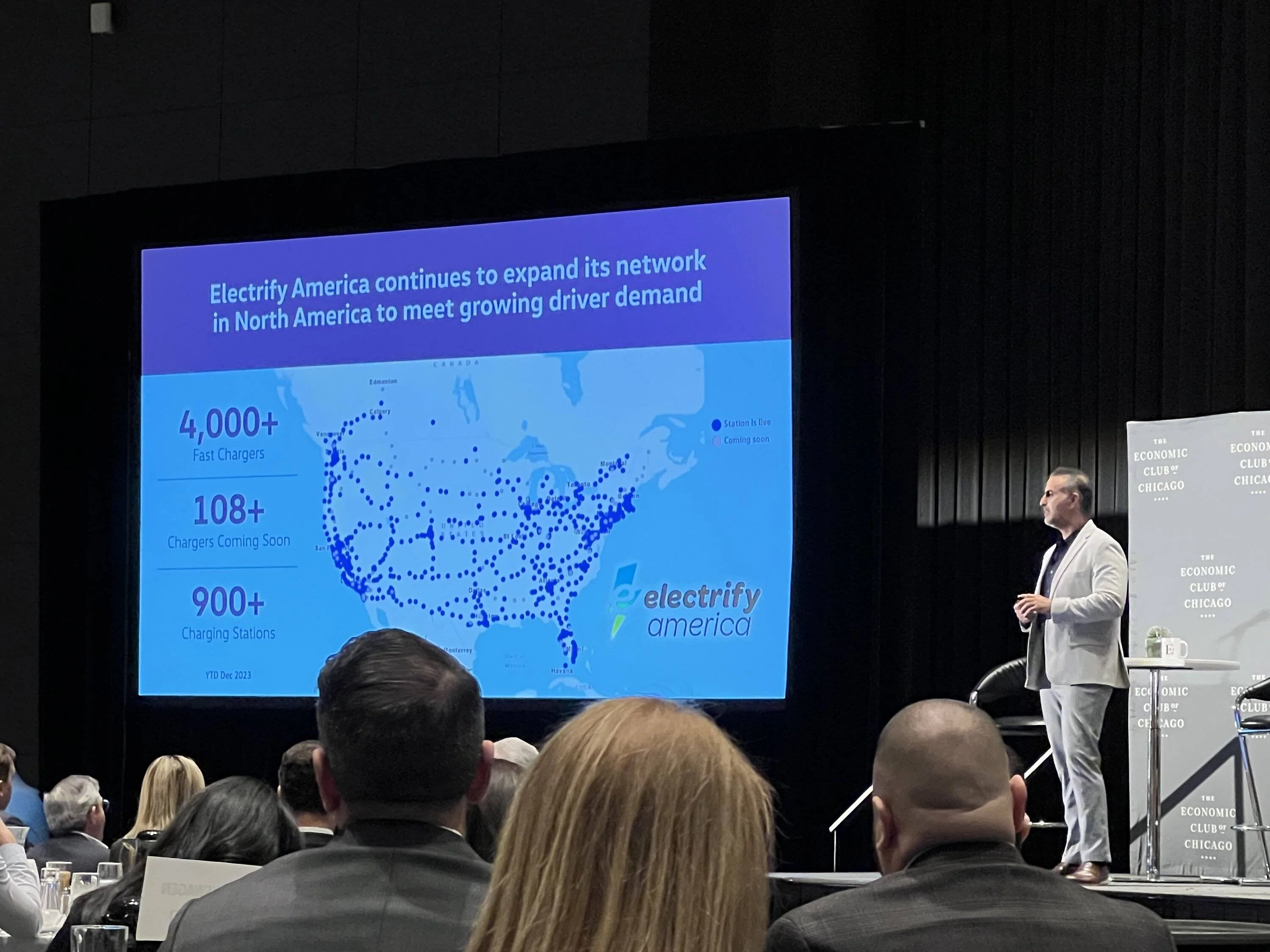
IMG_2911.jpeg
So VW, USA tells us it's going to be 20 or 30 years for EV transition (whatever that timeframe means) yet out of the other side of his mouth he is bragging about Electrify America deployment across the USA the irony of which is EA was founded because of "Dieselgate", and VW was forced to invest $2 billion in creating Electrify America ?).
Sponsored


voxel

Well-Known Member
First Name
Nelson
Joined
Sep 6, 2021
Threads
27
Messages
2,032
Reaction score
1,858
Location
Altamonte Springs, FL
Vehicles
22 Mach-E 4X, 23 GC Limited
Occupation
Software Engineer
Country flag
Not to knock Hybrids, but they have to carry both technologies and have more complexity than ICE or EV. The transition to EV is happening now and I think VW is late to the game on Hybrids.

How long the transition takes is anyone's guess. Outside factors like oil prices, taxes, government policy, etc. will play a big part in how long it takes and it will be different in every country. All else equal, I believe there will be another step-up wave in a year or two as folks get more comfortable with their friend's EVs and EVs gain range and faster charging capabilities.
IMO the PHEVs are simpler than the pure-gas start-stop drivetrains implemented by Jeep and other carmakers that have a secondary 12V or 48V battery and crazy logic to decide when to shutdown the engine, etc.

EPA fleet emission rules have made modern non-hybrid ICE drivetrains overly complex - turbos, start-stop tech, secondary battery, secondary starter motor, etc. Turbos require warming up phase and cooling phase and more frequent oil changes.

PHEVs don't have alternators, don't need the secondary battery for start-stop, can power HVAC without the engine, can heat up the engine or battery with either power source (see RAV4 Prime). You could drive purely in electric with an PHEV until you hard accelerate, drive on the highway, or drive in sub-freezing temps. The engine is just a heating course or a long-range trip powertrain only.

If anything we will realize mating a NA engine (non turbo) with an electric motor is probably the simplest and most reliable design. Dump the unreliable complex turbos. Dump the secondary starter + battery. Look how reliable the Prius + Prius Prime + RAV4 Prime are... they have very basic engines and electric motors all meshed together with a planetary gear.
 

GreaseMonkey

Well-Known Member
First Name
Steve
Joined
Oct 3, 2021
Threads
21
Messages
3,262
Reaction score
5,208
Location
Chicago, IL
Vehicles
24 Mach-E GT
Country flag
So VW, USA tells us it's going to be 20 or 30 years for EV transition (whatever that timeframe means) yet out of the other side of his mouth he is bragging about Electrify America deployment across the USA the irony of which is EA was founded because of "Dieselgate", and VW was forced to invest $2 billion in creating Electrify America ?).
Yes. Exactly. Please keep in mind he is a divisional CEO. These guys are not empowered to break news. They are incentivized to stay away from them.
 
  • Love
Reactions: Opa

Larry Paul

Well-Known Member
First Name
Larry
Joined
Aug 27, 2021
Threads
24
Messages
929
Reaction score
1,051
Location
Southern California
Vehicles
MME-GTPE, Sunbeam Tiger w1970 Boss302, 2002Rav4EV
Country flag
I suggest get rid of the planetary gearset all together and market a pure serial hybrid. No PHEV, just a high-effeciency ICE driving a generator with a small EV battery for braking load shed and peak power needs.
Agreed...and that generator can be optimized to operate two different speeds-nominal for cruising on the highway or at higher speeds for peak demands that one might experience on steep hills. We don't need to make an ICE that is designed to operate from idle to 6000 RPM.
 

Blue highway

Well-Known Member
First Name
Steve
Joined
Oct 15, 2021
Threads
5
Messages
2,700
Reaction score
4,249
Location
Oregon
Vehicles
Mach E Premium SR RWD
Country flag
So I was there in person (economic club event / auto show preview) and can tell you his remarks did not land well with the crowd or the press. Perhaps VW needs 20-30 years, others not so long. He admitted that VW company has zero hybrids in the US (working on it!). He was pretty defensive about his company’s position in China and its ability to compete with BYD.

I liked the ID.Buzz, but am very skeptical of this super high demand he’s expecting. Reminds me of Farley tooling the MME plant to 300k units.

Here’s something else that Mr Di Si (in the white suit in the middle of winter) was bragging about: EA deployment of 108+ chargers (yes, that’s right, all fixed now).

IMG_2911.jpeg
ahhh you see... that is the problem... those dots on the map are the broken EA chargers


OP
OP
Mach1E

Mach1E

Well-Known Member
Joined
Sep 5, 2021
Threads
93
Messages
10,509
Reaction score
13,295
Location
Florida
Vehicles
69 Mach 1, 11 GT, 21 GTPE- sold, 24 Taycan 4S, 20 F type R
Country flag
Looking at an apples to apples comparison at the batteries (not the structure, electronics and cooling) My 2002 Rav4EV has batteries that weighs around 989 lbs and only has 26.8 kWh of useable storage (NiMh). This was about 0.8 gallons of gasoline equivalent.

The extended range pack on a MME weighs in at 880 lbs of batteries and holds 91kWh of usable storage. That is the equivalent of 2.7 gallons of gasoline.

For my needs the existing charging rate and range is plenty for my (and truly for most peoples) needs (even if they don't realize it). Advances will continue to improve with lighter batteries giving more range and faster speeds enabling more and more people to adapt to a BEV.

I suspect there will be a growing number of other choices of vehicles that use an electric motor exclusively for propulsion but will offer for people that need more, both range extended driving (generators) as well as larger capacities and faster charging over the next 3-30+ years.

Keep in mind that EVs are just at the early part of the "early adopters" phase on the Rogers technology adaption curve.

https://whatfix.com/blog/technology-adoption-curve/

Many more advancements will come.
Based on efficiency and range actually traveled, I would say the Mach E battery is more equivalent to 10 gallons of gas. But that weighs 60 lbs.

We are in the early adoption (of this phase of electric cars), but unfortunately batteries have been developing as long as gas engines. I’m afraid they won’t get significantly better when it comes to energy density. Even if we double energy density and half charging times still too heavy and too slow.
 
OP
OP
Mach1E

Mach1E

Well-Known Member
Joined
Sep 5, 2021
Threads
93
Messages
10,509
Reaction score
13,295
Location
Florida
Vehicles
69 Mach 1, 11 GT, 21 GTPE- sold, 24 Taycan 4S, 20 F type R
Country flag
IMO the PHEVs are simpler than the pure-gas start-stop drivetrains implemented by Jeep and other carmakers that have a secondary 12V or 48V battery and crazy logic to decide when to shutdown the engine, etc.

EPA fleet emission rules have made modern non-hybrid ICE drivetrains overly complex - turbos, start-stop tech, secondary battery, secondary starter motor, etc. Turbos require warming up phase and cooling phase and more frequent oil changes.

PHEVs don't have alternators, don't need the secondary battery for start-stop, can power HVAC without the engine, can heat up the engine or battery with either power source (see RAV4 Prime). You could drive purely in electric with an PHEV until you hard accelerate, drive on the highway, or drive in sub-freezing temps. The engine is just a heating course or a long-range trip powertrain only.

If anything we will realize mating a NA engine (non turbo) with an electric motor is probably the simplest and most reliable design. Dump the unreliable complex turbos. Dump the secondary starter + battery. Look how reliable the Prius + Prius Prime + RAV4 Prime are... they have very basic engines and electric motors all meshed together with a planetary gear.
Honestly I don’t care how complex or simple it is if it gets the job done efficiently and reliably.

People seem to equate simplicity with reliability and unfortunately that hasn’t been the case for BEVs. Same goes for the cost of repairs.
 

Larry Paul

Well-Known Member
First Name
Larry
Joined
Aug 27, 2021
Threads
24
Messages
929
Reaction score
1,051
Location
Southern California
Vehicles
MME-GTPE, Sunbeam Tiger w1970 Boss302, 2002Rav4EV
Country flag
Based on efficiency and range actually traveled, I would say the Mach E battery is more equivalent to 10 gallons of gas. But that weighs 60 lbs.

We are in the early adoption (of this phase of electric cars), but unfortunately batteries have been developing as long as gas engines. I’m afraid they won’t get significantly better when it comes to energy density. Even if we double energy density and half charging times still too heavy and too slow.
I guess I don't know what you mean by too slow. I am fine with a 32A EVSE as well as a 20A EVSE. It always charges enough.

As to gasoline conversion the GGE (gas per gallon to energy). 33.7kW has the same energy as a gallon of gasoline.

https://en.wikipedia.org/wiki/Gasol...n,tests simulating varying driving conditions.

https://energyeducation.ca/encyclopedia/Miles_per_gallon_gasoline_equivalent

https://epact.energy.gov/fuel-conversion-factors

It is just that an internal combustion engine uses very little of the potential energy to actual drive the vehicle. Most of it is lost in heat.

None of these include the amount of energy it takes to make the energy. (extracting crude, transpiration of crude, refining the crude, then transporting the refined fuel. or the cost in coal mining, solar panel production, grid losses etc).

You could look at gas to electricity in other terms as well (aka Cost), but from a science standpoint of energy, 33.7kW is the widely accepted amount of energy in 1 gallon of gasoline.
 

azerik

Well-Known Member
First Name
Erik
Joined
Jan 8, 2023
Threads
79
Messages
4,545
Reaction score
4,557
Location
Chandler/Flagstaff, AZ
Vehicles
'21 Spacey Prem4x, '21 RX450H, 13 Focus EV
Occupation
DevSecNetOps, General PITA
Country flag
We sure he wasn't saying it'll take EA 20 to 30 years to build a reliable network?
At 100'ish chargers a year, he might be on to something,
 
OP
OP
Mach1E

Mach1E

Well-Known Member
Joined
Sep 5, 2021
Threads
93
Messages
10,509
Reaction score
13,295
Location
Florida
Vehicles
69 Mach 1, 11 GT, 21 GTPE- sold, 24 Taycan 4S, 20 F type R
Country flag
I guess I don't know what you mean by too slow. I am fine with a 32A EVSE as well as a 20A EVSE. It always charges enough.

As to gasoline conversion the GGE (gas per gallon to energy). 33.7kW has the same energy as a gallon of gasoline.

https://en.wikipedia.org/wiki/Gasoline_gallon_equivalent#:~:text=The ratings are based on,tests simulating varying driving conditions.

https://energyeducation.ca/encyclopedia/Miles_per_gallon_gasoline_equivalent

https://epact.energy.gov/fuel-conversion-factors

It is just that an internal combustion engine uses very little of the potential energy to actual drive the vehicle. Most of it is lost in heat.

None of these include the amount of energy it takes to make the energy. (extracting crude, transpiration of crude, refining the crude, then transporting the refined fuel. or the cost in coal mining, solar panel production, grid losses etc).

You could look at gas to electricity in other terms as well (aka Cost), but from a science standpoint of energy, 33.7kW is the widely accepted amount of energy in 1 gallon of gasoline.
Too slow is the time to charge on the road. Until it’s as fast as gasoline refueling, it’s a compromise.

As far as energy goes, yes, familiar with kW conversion, but like we both said, inefficiency of gas engines means we need more fuel.

If you want to go 300 miles, you need about a 100 kWh battery or 10 gallons of gas.

That’s why I’m using 10 gallons as the equivalent. You aren’t getting far on 3 gallons.

Energy it takes to make the energy is a whole other thing, but less important to the discussion at hand.
 

Hammered

Banned
Banned
Joined
Oct 4, 2022
Threads
26
Messages
1,303
Reaction score
1,175
Location
SE US
Vehicles
2022 PB F150, MME GTPE
Country flag
There's a huge untapped market for hybrids of all shapes / sizes. In service vehicles like F250-F550 it makes loads of sense. They often add gas burning generators / air compressors / and other PTO powered accessories that could all be handled by a 30-50kWh battery / HV system.

Typical ICE engine development is HUGE R&D costs over the life of the engine. There's a few more exotic engine technologies that have higher efficiency, especially when made to run at a static 'charging' speed, but aren't too good at the broad RPM range needed for typical transmissions. The RAM REV is going to be the first vehicle to enter the market using a system that makes sense with the only exception being the engine choice. Which it's clear why they're using the ICE that they are (cuz R&D of new engines is $$$) and it seems more likely that they're hoping to 'test' the market with it comfortably slotting into 'goodnuff'.

At this point Ford, GM, and whoever else wants to join should partner in making at least 1 high-efficiency exotic ICE that'd work in ranger sized trucks / SUVs up to 1 ton size vehicles. The whole idea of magically going from ICE to pure BEV was a dumb move, not based on any logic what so ever. Even with unlimited $ to burn, there's a shortage of manpower, manufacturing base, and of course, resources. I can't believe that through all of the huge auto companies and govt in general that there wasn't at least 1 intelligent person to stand up and rightfully proclaim how little sense any of the current automotive trends/pushes make. The amount of time and money chasing something that was never practical to begin with, while simultaneously ignoring the hard facts of the matter is just mind boggling. The whole hydrogen push is another example of pure nonsense waste.
 

Larry Paul

Well-Known Member
First Name
Larry
Joined
Aug 27, 2021
Threads
24
Messages
929
Reaction score
1,051
Location
Southern California
Vehicles
MME-GTPE, Sunbeam Tiger w1970 Boss302, 2002Rav4EV
Country flag
Too slow is the time to charge on the road. Until it’s as fast as gasoline refueling, it’s a compromise.

As far as energy goes, yes, familiar with kW conversion, but like we both said, inefficiency of gas engines means we need more fuel.

If you want to go 300 miles, you need about a 100 kWh battery or 10 gallons of gas.

That’s why I’m using 10 gallons as the equivalent. You aren’t getting far on 3 gallons.

Energy it takes to make the energy is a whole other thing, but less important to the discussion at hand.
Agree-that is a separate topic, but need to state it before someone takes my comments out of context.

So you are trying to compare it to a vehicle that gets 30MPG, and you often need to drive 300 miles in a day. (thus 10 gallons to go 300 miles).

My comments are:

I am fairly confident that 90% of all vehicles don't get driven over 150 miles on any given day and the vast majority of them only go less than 50 miles on a typical day. Perhaps that number is 70% or whatever the number, That is what the EV is made to replace-today.

I agree with you today that if your use case is driving a vehicle often that goes 300 miles in a day, I would say an electric is probably not what I would recommend for daily use at least in 2024-and probably not that much different in 2029 if that is your must have priority...or schedule more time or purchase a new car that has quicker charging capability. The Hyundai/Kia/Genesis vehicles and Porsche vehicles certainly far exceed the MME DCFC rates.

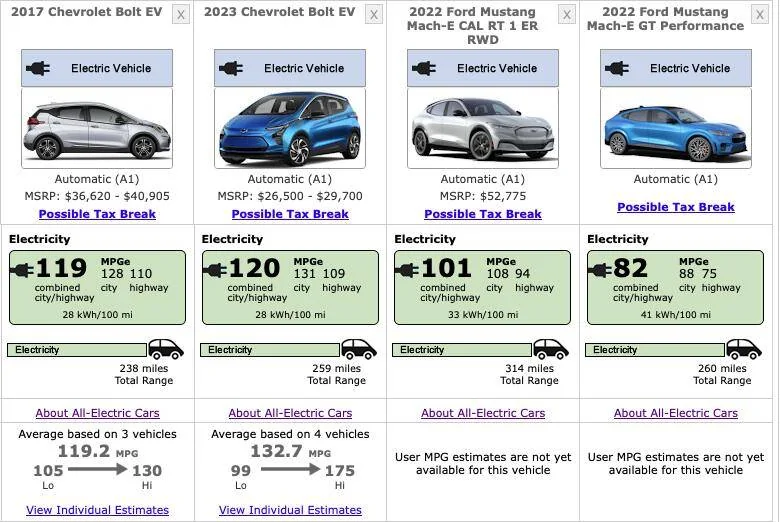
From an energy standpoint if we used 100kW to go 300 miles, that is actually 111 MPGe. That is better than the MME is rated.

Here is data from www.fueleconomy.gov/


Ford Mustang Mach-E 20-30 years for EV transition? Screenshot 2024-02-13 at 2.18.01 PM


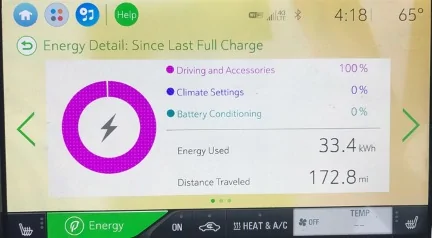
My 2017 Chevy Bolt far exceeded the EPA rating of 119MPGe. I used a conservative 33.4kWh, but in the mild weather of Southern California the car estimated that with a typical driving split of 40% freeway/60% city driving I would often get more than 170MPGe on our Bolt. I think typically I got around 150MPGe but would often see something like this.

Ford Mustang Mach-E 20-30 years for EV transition? 1707862486216


Internal combustion engines are just terribly inefficient but gasoline engines are terrible at using energy to drive the wheels of the vehicles, but gas is plentiful.

I know you don't agree with my opinion: But, my observations over the past 25 years is most people can use at least one EV at the slow charging rates at their homes for their daily use not only without any inconvenience at all but far more conveniently as they never go out of the way to go to a gas station and spend 5-10 minutes filling up at $$$ several times per month. For most people they just don't need to have every vehicle they own be able to drive 300 miles without stopping.

My wife has not needed to pump gas for over 21 years and for commuting I have not used gasoline in town for years. Even the last 5 business trips I took I rented EV's. I did spend a total of 20 minutes at DCFC charging stations for those 5 trips in total, but that was less than I would have spent in both time and also far less money if I were renting a gas car. I really like never having to go out of my way to top off on a rental or ever on my commuting.

With all of that said, for the rare occasions that I were to take a road trip, I will likely rent a gas car, but I don't see any need to have a gas vehicle for daily commuting with an EV that has a 250+ mile range. I suspect that the vast majority would also be fine with that as they don't typically drive 300 miles in a day-almost ever. For that-you could rent a gas car if you don't have time (but what I do is take an airplane) or if I road trip in a car, I will take a break every several hundred miles at a restaurant on a road trip while the car refills too.
 

ctenidae

Well-Known Member
First Name
Alex
Joined
Jan 19, 2022
Threads
37
Messages
1,403
Reaction score
1,852
Location
Stamford, CT
Vehicles
DMG GT; Taycan, Q7, Sienna Hybrid
Occupation
Solver of problems
Country flag
Hybrids are more complex, but the end results serves most people’s needs.

This is, to me, the linchpin. EV's don't yet serve most people's needs. That changes in 2 waya- either tech and infrastructure develop to make EVs fit perfectly where ICE does now, or people's needs change to fit what EVs can do.

Both can, will, and need to happen. EVs will never be great for people with 60 mile commutes in subzero weather and only commercial chargers. Either build out more infrastructure (workplace or home charging) or get housing to adapt (location, charging access) and the use case widens greatly. So far US policy, funded by VW's malfeasance, has been to build out infrastructure. I can only imagine what an uproar pro-EV housing policy would cause!

I do find it peculiar, now I think of it, that VW is so far behind on EVs, considering Dieselgate and all.
 

Gloff

Well-Known Member
First Name
Sean
Joined
Mar 26, 2021
Threads
6
Messages
340
Reaction score
581
Location
San Francisco
Website
www.serramonteford.com
Vehicles
2024 F150 Lightning, 2023 Mach E Extended Range, 2007 Mini Cooper Cab,
Occupation
Sales Manager
Country flag
Too slow is the time to charge on the road. Until it’s as fast as gasoline refueling, it’s a compromise.

As far as energy goes, yes, familiar with kW conversion, but like we both said, inefficiency of gas engines means we need more fuel.

If you want to go 300 miles, you need about a 100 kWh battery or 10 gallons of gas.

That’s why I’m using 10 gallons as the equivalent. You aren’t getting far on 3 gallons.

Energy it takes to make the energy is a whole other thing, but less important to the discussion at hand.
Compared to Gas, yeah, it's slower, but is a 15 min charge time to go 75 miles unreasonable? I don't think so, certainly if I've already traveled 100 miles or more. The issue is not purely the charge time, people stop on long trips for breaks/food/water/waste disposal etc.... This argument is tired. You don't need to make a bunch of lifestyle changes to accommodate a modern EV. There are a small percentage of people where a 250 mile range EV would be impractical from a pure range perspective. If you want to talk about urban home charging and apartments, that's a reasonable argument, but it's not about range or recharge times, it's about access.

The issue is, in my opinion, two fold:
Charging infrastructure. Not enough DC chargers in enough of the right places. Tesla has done a reasonable job with this, but had a 10 year head start.

Lack of education of the end user. These forum users all know how DC charging works, and how to best manage our charging. How many times have you been at a DC station where someone doesn't know to stop at 80%, or doesn't know that the cables the charger has only support 80kW even though the advertised rate is 150+kW? Tying into point one, gasoline infrastructure is highly regulated, all of the nozzles are the same size, flow rates are measured, etc... None of that exists in DC charging, its the wild west.

Electrify America has no real interest in reliable infrastructure. The way I see it, at some point, DC charging will have to get regulated and existing infrastructure converted to whatever that ends up being. Now that NACS is the defacto standard going forward, I'd like to see more Tesla charging infrastructure, they're doing a much better job of actually managing it in addition to building it.
Sponsored


Top