800v vs 400v Architecture

Mathington

Well-Known Member
Joined
Jul 6, 2021
Threads
20
Messages
882
Reaction score
868
Location
Canada
Vehicles
Mach-E Premium SR AWD
Country flag
Until recently, I never thought about this but one very factor that should be considered for both 400v and 800v architectures is the amperage that the charger can deliver. @OutofSpecKyle recently mentioned in on of his videos or the InsideEVs podcast that there are 150kW and 350kW chargers that supply limited amps but really high volts. So if the car can't take advantage of the higher wattage, they will charge slower than a 350kW charger that could support higher amps (400+) then neither car would charge at their highest rate.

It had never occurred to me to check the amperage rating on the charger before as I always assumed it would max out based on whatever the kW the charger was. This could explain why I saw some less than favorable charging rates on 150kW and 350kW chargers despite my battery temperature warm enough.
Sponsored

 

kltye

Well-Known Member
Joined
May 21, 2021
Threads
19
Messages
1,100
Reaction score
1,733
Location
Chicago
Vehicles
IB MME Premium RWD
Country flag
Thanks! I was referring to the 12kw cliff. Last time I brought my car in I was told it wasn't eligible for the update. Maybe I'll try again.
Oh! I somehow assumed from your statement of "2021 cars" as Job 1 cars. It depends on when your car was built - I don't think Job 2 cars are eligible for 21P22 (yet?).
 

Billyk24

Well-Known Member
First Name
William
Joined
Nov 29, 2019
Threads
116
Messages
2,307
Reaction score
1,295
Location
PA
Vehicles
Ford C-Max Energi, Premium Mach-E ordered
Country flag
Then there is the issue of new chargers via governmental grants of being no fastr than 62.5kW. This is the story in Michigan for the past two years despite Michigan being the home state where the Federal head of Transportation lives. Can we really make use of 800v battery packs when government grants for chargers redult in 50 and62.5kW rates,?
 

Socalsp3

Well-Known Member
Joined
Oct 29, 2021
Threads
27
Messages
650
Reaction score
667
Location
CA
Vehicles
Ioniq 5, Mach E
Country flag
With my Ioniq 5 I regularly charge 18-80% in 20 mins on a 150 kw EA station and average about 165 kw the entire time. Haven't tried the 350 kw charger yet but I'm sure I can get 10-80% in 18 mins as
1) Most owners here would say there are not enough 400v stations presently. There are probably 1000x times more 400v than 800v stations. Finding an 800v station is like hitting the lottery right now. In 5-10 years, that might change. So you will see more 800v cars in 5-10 years.
2) The vast majority of charging is done at your home, where it is cheapest. You will likely never have a 400v or 800v station at your home. If you do have one at your home, your net income is so sky high you can just drive one of your other 100 vehicles while the butler is charging your car slowly at 400v vs. 800v.
you don't need 800v stations to take advantage of fast charging. hyundai/kia up converts 400v to 800v with an aggressive charging curve.


ponydsp

Well-Known Member
Joined
Oct 2, 2021
Threads
12
Messages
311
Reaction score
547
Location
Virginia
Vehicles
'22 MME Premium 4ER, Taycan CT, 650s, F8 on order
Country flag
I think just to clarify, according to Tom Moloughney, "almost all high speed chargers in this country that are more than 50 kw operate on an 800 volt system." He should probably say all high speed chargers excluding Tesla superchargers, but we know what he meant...

Future MMEs most likely will have 800v battery architecture with the option similar to the Taycan to buy the onboard 150 kw 400 volt DC fast charger for those who will be using Tesla superchargers whenever Elon allows us to use their superchargers at a super high premium, which may not be worthwhile to pay for that option in the first place.

(time 12:33)

My wife's taycan CT will be arriving within 3 weeks so hence been watching every single YT videos about taycan.
 

phidauex

Well-Known Member
First Name
Sam
Joined
Dec 8, 2020
Threads
17
Messages
967
Reaction score
1,843
Location
Colorado
Vehicles
2021 MachE 4EX, 2006 Prius, 1997 Tacoma
Occupation
Renewable Energy Engineer
Country flag
There are definitely some positives to 800V systems, but there are a lot of misconceptions as well - here are the main constraints to how fast you can charge a battery:

  1. The maximum charging C-rate of the battery chemistry (at the cycle-life expectation for the product). A MachE charging at 150kW is at ~1.5C already, which is quite high for lithium batteries. Some allow slightly higher C-rates (or they are accepting more degradation risk).
  2. The internal efficiency of the battery, which determines how much waste heat is created. Remember that heat losses increase with the square of charging current, so charging twice as fast results in four times as much heat.
  3. The maximum temperature of the battery during charging, and your cooling system's ability to remove that heat (see #2).
  4. The maximum power available to the input of the DC fast charging station. This is limited by where it connects to the grid and what service voltages and currents are available there.
  5. The maximum amperage handling capabilities of the DC charger, the charge cable, and the internal components in the vehicle. Going to 800V reduces how much current this equipment has to handle for the same amount of power. This doesn't reduce waste heat in the battery modules (which see the same charging current per cell regardless of how you wire them), but it does reduce waste heat in the rest of the charging path.
Of these, 400V vs. 800V only affects #5 - all your other constraints are still in place. If you have a battery that can safely charge at 3C, then you might need 800V charging as a practical matter since you won't be able to move 300kW down a 400V cable. You need to halve the current first, hence moving to 800V. But if you can't remove the waste heat, then it doesn't help and if you can't supply more power to the charging station then it doesn't help.

So while on the surface, 800V looks like it should allow charging twice as fast, in practice it will rarely be that much faster. Maybe 10-25% faster in real world applications. When you get to HUGE batteries like 200kWh systems then 800V will be almost mandatory since your limiting factor will be the charging infrastructure, not the battery itself.

Keep in mind that some costs go up with 800V - you need more internal electrical insulation in the battery packs, internal cabling, contactors, etc. Motors and inverters need more insulation as well (though they may also benefit from the reduced current). Charging stations will need more internal insulation, though their current handling savings might offset that cost.

Generally higher voltage is good - for utility-scale storage applications we are already at 1500V for lithium systems, but it doesn't solve all your problems. For me, I'm happy with 400V until battery technology increases charging C-rates and decreases internal resistance a little more, making it possible to take true advantage of higher voltage charging.
 

AZBill

Well-Known Member
First Name
Bill
Joined
May 26, 2021
Threads
12
Messages
1,987
Reaction score
2,314
Location
Arizona
Vehicles
MME CA Route 1, Hummer EV SUT, Escalade IQ
Occupation
Retired
Country flag
It had never occurred to me to check the amperage rating on the charger before as I always assumed it would max out based on whatever the kW the charger was.
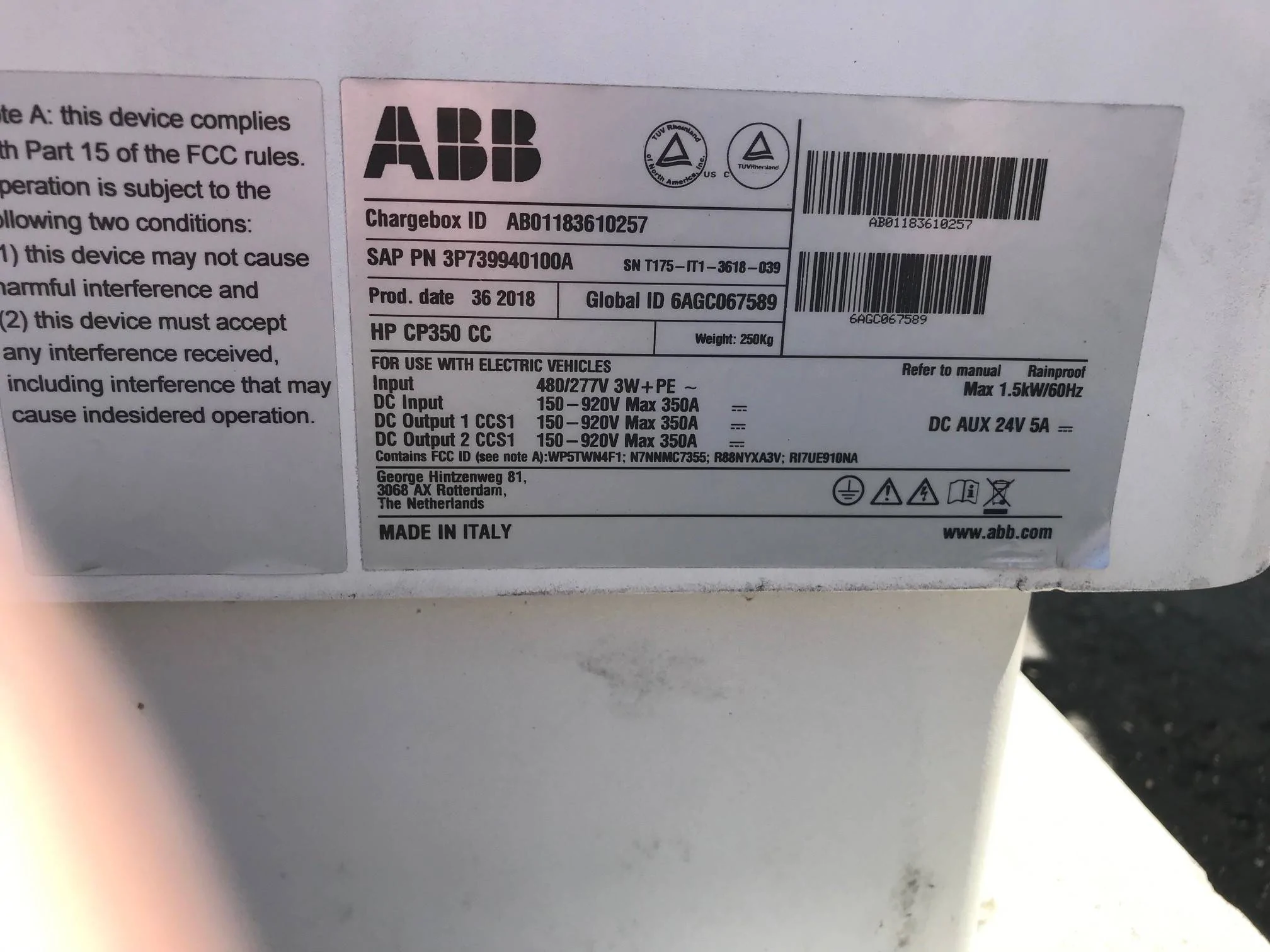
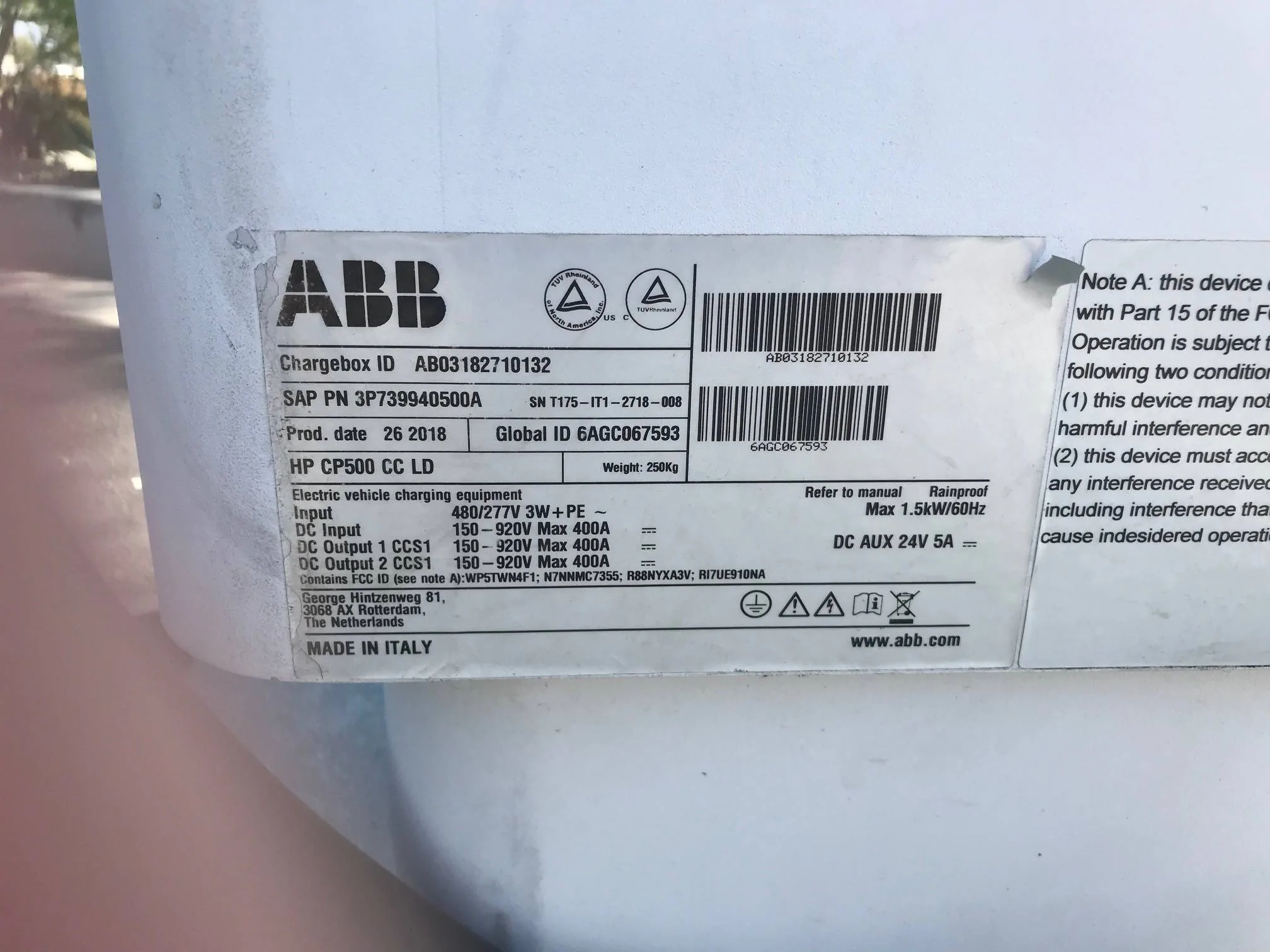
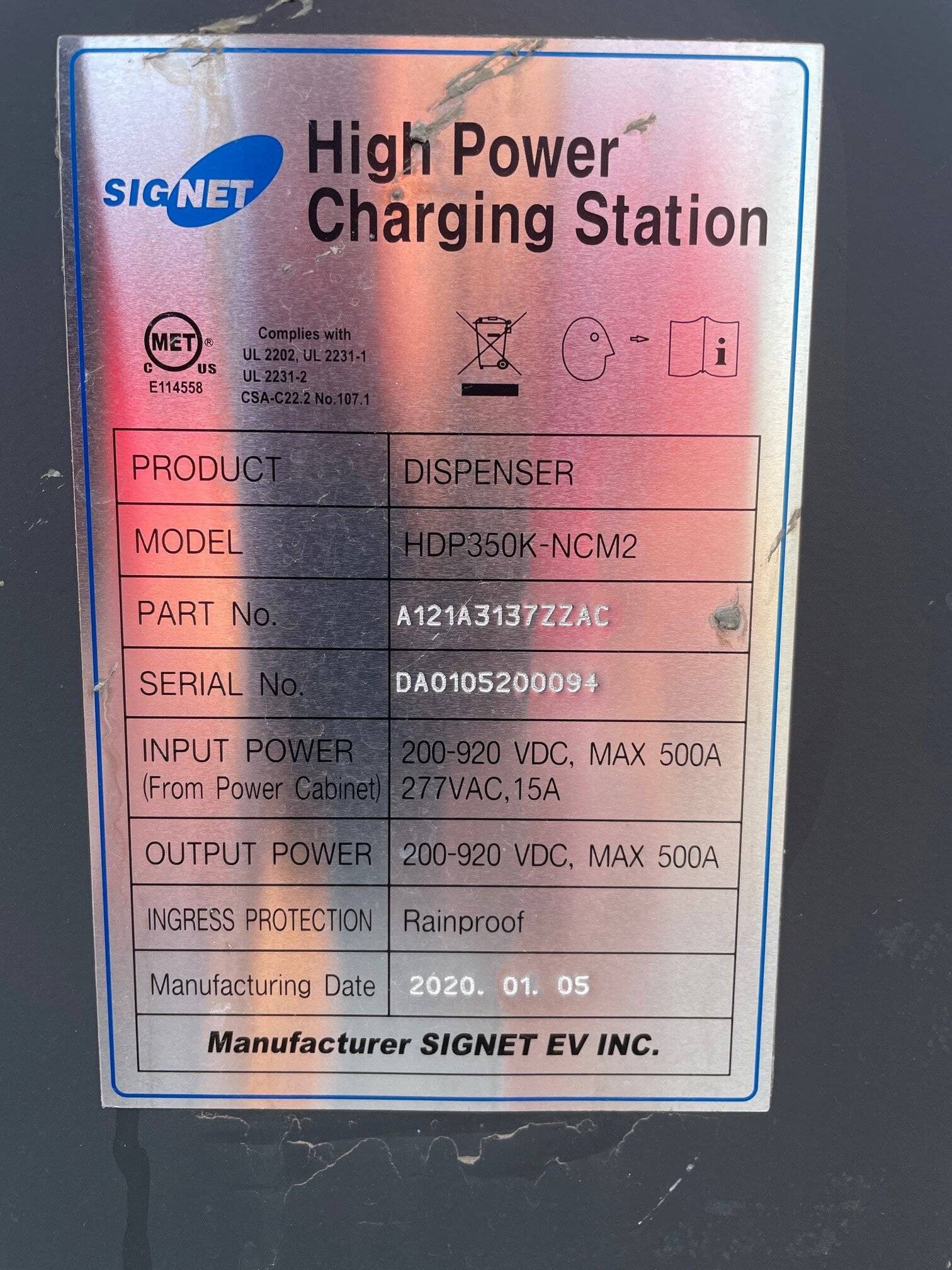
I have personally read the nameplates on the EA chargers, both Signet and ABB. ABB has two different dispensers for 150kw (350A) versus 350kw (400A), Signet only has one dispenser for both power ratings and all are rated at 500A. Here you go:

150kw ABB unit
Ford Mustang Mach-E 800v vs 400v Architecture ABB150KW

350kw ABB unit
Ford Mustang Mach-E 800v vs 400v Architecture ABB350KW

Signet units
Ford Mustang Mach-E 800v vs 400v Architecture Signet350KW
 

Mathington

Well-Known Member
Joined
Jul 6, 2021
Threads
20
Messages
882
Reaction score
868
Location
Canada
Vehicles
Mach-E Premium SR AWD
Country flag
I have personally read the nameplates on the EA chargers, both Signet and ABB. ABB has two different dispensers for 150kw (350A) versus 350kw (400A), Signet only has one dispenser for both power ratings and all are rated at 500A. Here you go:

150kw ABB unit
ABB150KW.jpg

350kw ABB unit
ABB350KW.jpg

Signet units
Signet350KW.jpg
Thanks!
 

RonTCat

Well-Known Member
First Name
Ron
Joined
Jul 21, 2020
Threads
27
Messages
1,135
Reaction score
2,979
Location
USA
Vehicles
Mach-E wannabuy
Country flag
There are definitely some positives to 800V systems, but there are a lot of misconceptions as well - here are the main constraints to how fast you can charge a battery:

  1. The maximum charging C-rate of the battery chemistry (at the cycle-life expectation for the product). A MachE charging at 150kW is at ~1.5C already, which is quite high for lithium batteries. Some allow slightly higher C-rates (or they are accepting more degradation risk).
  2. The internal efficiency of the battery, which determines how much waste heat is created. Remember that heat losses increase with the square of charging current, so charging twice as fast results in four times as much heat.
  3. The maximum temperature of the battery during charging, and your cooling system's ability to remove that heat (see #2).
  4. The maximum power available to the input of the DC fast charging station. This is limited by where it connects to the grid and what service voltages and currents are available there.
  5. The maximum amperage handling capabilities of the DC charger, the charge cable, and the internal components in the vehicle. Going to 800V reduces how much current this equipment has to handle for the same amount of power. This doesn't reduce waste heat in the battery modules (which see the same charging current per cell regardless of how you wire them), but it does reduce waste heat in the rest of the charging path.
Of these, 400V vs. 800V only affects #5 - all your other constraints are still in place. If you have a battery that can safely charge at 3C, then you might need 800V charging as a practical matter since you won't be able to move 300kW down a 400V cable. You need to halve the current first, hence moving to 800V. But if you can't remove the waste heat, then it doesn't help and if you can't supply more power to the charging station then it doesn't help.

So while on the surface, 800V looks like it should allow charging twice as fast, in practice it will rarely be that much faster. Maybe 10-25% faster in real world applications. When you get to HUGE batteries like 200kWh systems then 800V will be almost mandatory since your limiting factor will be the charging infrastructure, not the battery itself.

Keep in mind that some costs go up with 800V - you need more internal electrical insulation in the battery packs, internal cabling, contactors, etc. Motors and inverters need more insulation as well (though they may also benefit from the reduced current). Charging stations will need more internal insulation, though their current handling savings might offset that cost.

Generally higher voltage is good - for utility-scale storage applications we are already at 1500V for lithium systems, but it doesn't solve all your problems. For me, I'm happy with 400V until battery technology increases charging C-rates and decreases internal resistance a little more, making it possible to take true advantage of higher voltage charging.
Don't try to confuse things with facts and science...

800 > 400, so moare better. The bestest.
 

phidauex

Well-Known Member
First Name
Sam
Joined
Dec 8, 2020
Threads
17
Messages
967
Reaction score
1,843
Location
Colorado
Vehicles
2021 MachE 4EX, 2006 Prius, 1997 Tacoma
Occupation
Renewable Energy Engineer
Country flag
I have personally read the nameplates on the EA chargers, both Signet and ABB. ABB has two different dispensers for 150kw (350A) versus 350kw (400A), Signet only has one dispenser for both power ratings and all are rated at 500A. Here you go:
Thanks for posting some actual nameplates! One thing to keep in mind with ratings on power electronics like these is that the maximum voltage and the maximum current usually can't happen at the same time, so while the maximum current might be 350A, the unit probably can't do 350A at 920V. There will be some intermediate voltage where maximum current is possible, and the current at lower and higher voltages will be reduced.

These max values are also usually "maximum under any conceivable operating conditions" and usually don't include temperature derates and other reductions to the max current setpoint that will be in effect in actual use, so the units may never actually hit 350A or 400A in the real world.
 

PrimeFuture

Well-Known Member
First Name
Michael
Joined
Jul 8, 2020
Threads
15
Messages
137
Reaction score
217
Location
Houston
Vehicles
Mustang Mach-E Premium RWD ER, 2013 Ford Focus
Country flag

Billyk24

Well-Known Member
First Name
William
Joined
Nov 29, 2019
Threads
116
Messages
2,307
Reaction score
1,295
Location
PA
Vehicles
Ford C-Max Energi, Premium Mach-E ordered
Country flag
You'll be glad to know the Infrastructure Bill that Democrats pushed through despite Republican opposition will mandate 150kw chargers along highways.

https://arstechnica.com/cars/2022/0...y-50-miles-us-unveils-ev-infrastructure-plan/
You will be glad to hear there are no interstate highways in the UP of Michigan leaving it out of the bill. The UP of Michigan (Yoopers) are at strong odds with the LP of Michigan where the transportation head lives. More than once have they tried to become thrir own state.
 

PrimeFuture

Well-Known Member
First Name
Michael
Joined
Jul 8, 2020
Threads
15
Messages
137
Reaction score
217
Location
Houston
Vehicles
Mustang Mach-E Premium RWD ER, 2013 Ford Focus
Country flag
You will be glad to hear there are no interstate highways in the UP of Michigan leaving it out of the bill.
Why would I be happy that elected officials are being short sighted and idiotic?

I hope you're writing to your elected officials, and meeting with them when you can to push them to do the right thing here.
Sponsored


Top