SpaceEVDriver

Well-Known Member
Joined
Aug 26, 2021
Threads
71
Messages
2,651
Reaction score
4,774
Location
Arizona
Vehicles
2022 CA Route 1 AWD, ER; 2023 Lightning Lariat ER
Occupation
Planetary Science
Country flag
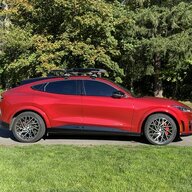
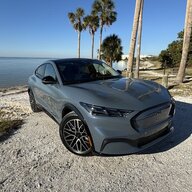
For reasons, we had to drive both the Mustang and the Lightning from northern AZ to Los Angeles the other day.

The Mustang is a 2022 California Route-1 AWD, Extended range (312 miles EPA, 91.7 kWh useable battery).
The Lightning is a 2023 Lariat Extended range (320 miles EPA, 131 kWh useable battery).

The Mustang has >50k miles on the odometer and the battery is ~4 years old.
The Lightning has >21k miles and is ~2 years old.

We told the vehicles to be charged to 100% by the time we left in the morning and they were ready to go.

The Mustang stayed behind the Lightning for most of the trip, but it wasn’t really drafting.

We stopped about halfway to take a restroom break and charge a bit.
We’d driven ~176 miles. Our stop was the new charging station in Yucca, AZ, across the highway from the Proving Grounds.

At that point, the Mustang was at 50% charge and the Lightning was at 52% charge.

Ford Mustang Mach-E Caravan Road Trip: Mach-E & Lightning from Northern AZ to LA PXL_20250822_181750380.RAW-01.COVER


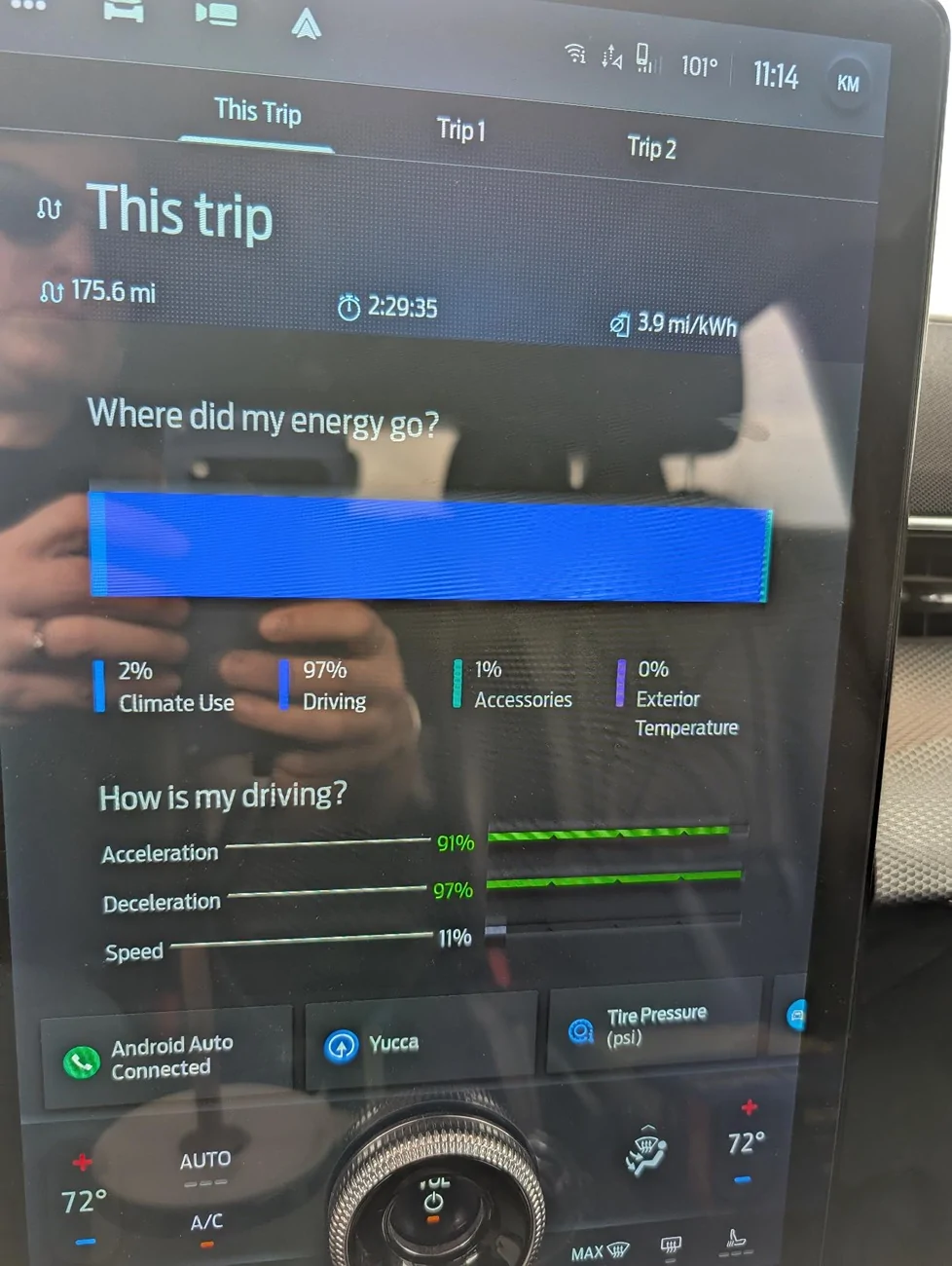
The Mustang claimed 3.9 miles/kWh efficiency on a drive with ~70 mph average speed.
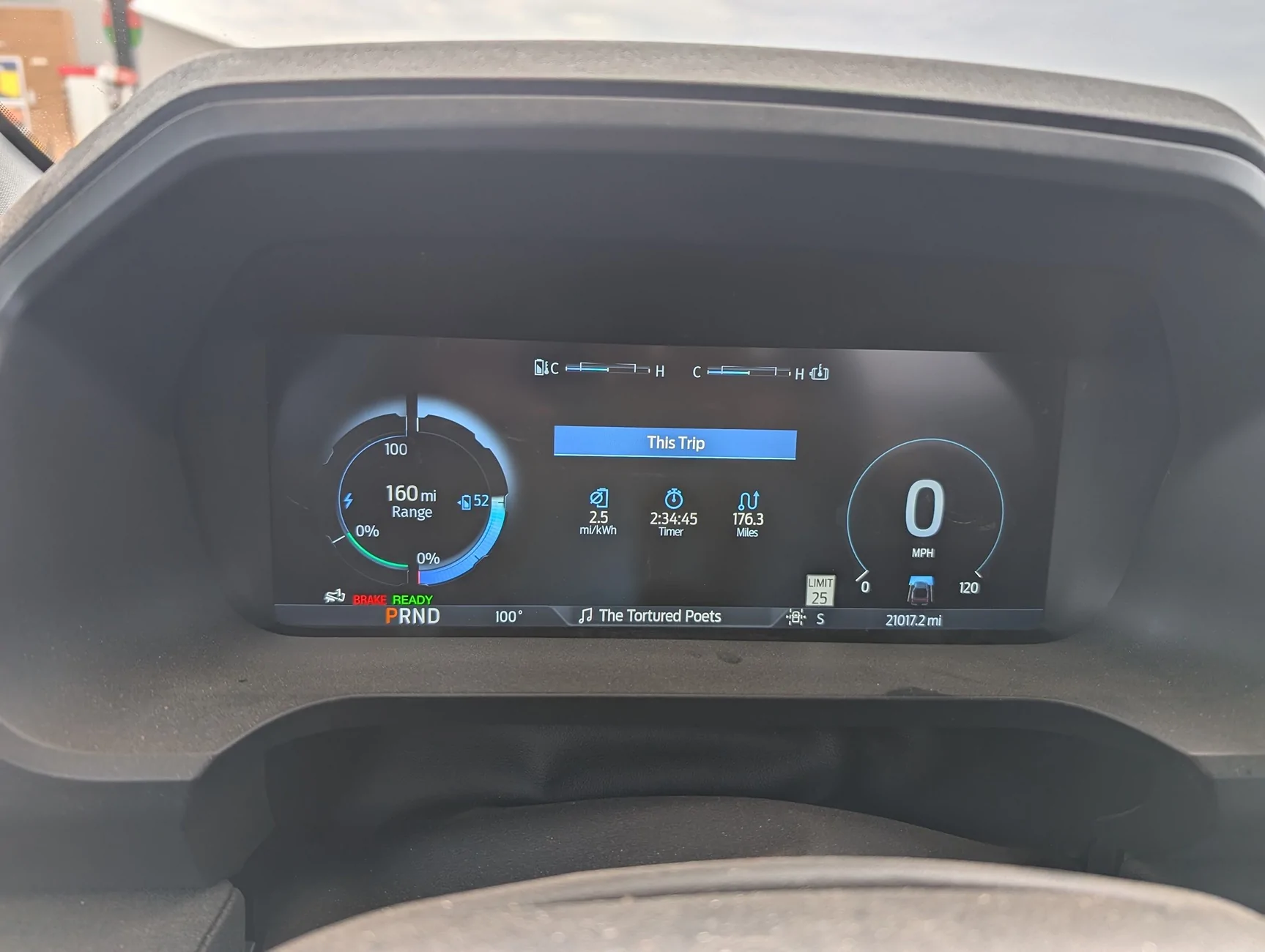
The Lightning claimed 2.5 miles/kWh efficiency on the same ~70 mph average speed.
(The slight differences in time and miles in the images below is because the Mustang driver shut off the car for a short time while running a very quick errand.)

Ford Mustang Mach-E Caravan Road Trip: Mach-E & Lightning from Northern AZ to LA signal-2025-08-22-113347_002


Ford Mustang Mach-E Caravan Road Trip: Mach-E & Lightning from Northern AZ to LA PXL_20250822_181418946.RAW-01.COVER


If we believe the 3.9 miles/kWh efficiency for the Mustang:
176 miles / 3.9 miles/kWh = 45 kWh.
45 kWh / 50% = 90 kWh.

According to this, battery degradation is minimal.
1.7 kWh / 91.7 kWh = 1.8%
That is good enough for me. Especially given that the car has >50k miles on it and the battery is ~4 years old. Not much measurable degradation. The last time I checked the State of Health, it reported around 94%, but I have no insight into how that number is calculated, so I’m not very trusting of it. I’m not at all concerned about the state of health of our Mustang’s battery, even after 50k miles and 4 years.

If we believe the 2.5 miles/kWh and we believe the depth of discharge for the Lightning:
176 miles / 2.5 miles/kWh = 70.4 kWh
But.
70.4 / 48% = 146.7 kWh. Which is more than the nominal full capacity, including the “buffer.”

What’s going on here? My experience is that the state of charge percent is accurate. I believe the truck isn’t calculating efficiency correctly, which likely doesn’t surprise people who pay attention to the vehicle’s various metrics. In fact, it’s giving a lower efficiency than reality, which I’ve seen multiple times.

Assuming 48% of the 131 kWh was used, that’s 62.9 kWh to go 176 miles. That’s an efficiency of 2.8 miles/kWh.

I’m also happy with that.
Sponsored


silverelan

Well-Known Member
Joined
Nov 25, 2019
Threads
131
Messages
3,685
Reaction score
5,390
Location
Seattle
Vehicles
2021 Mustang Mach-E GT, 2019 Bolt EV
Country flag
Nice trip, and that Pilot/Flying J stop with the canopy looks like a great place to charge! Yucca, AZ to Los Angeles is nearly 300 miles. I’m curious how you made that leg without stopping to charge.
 
OP
OP
SpaceEVDriver

SpaceEVDriver

Well-Known Member
Joined
Aug 26, 2021
Threads
71
Messages
2,651
Reaction score
4,774
Location
Arizona
Vehicles
2022 CA Route 1 AWD, ER; 2023 Lightning Lariat ER
Occupation
Planetary Science
Country flag
Nice trip, and that Pilot/Flying J stop with the canopy looks like a great place to charge! Yucca, AZ to Los Angeles is nearly 300 miles. I’m curious how you made that leg without stopping to charge.
We stopped in Barstow. That's the next post.

We got hit with the Santa Anna winds, so didn't have a choice. I've done the trip with only one stop, but it's a bit of a pucker at the end. And I don't like to sit for that long.

We used the brand-T station. The Mustang and the Lightning both averaged 80 kW, which is pretty abysmal for the Lightning. I believe the Lectron adapter from Ford is more sensitive to thermal issues than the A2ZEV adapter is. It was 123 ⁰F at the charge station.
 

Teslaeata

Well-Known Member
First Name
Mark
Joined
Sep 28, 2022
Threads
9
Messages
3,435
Reaction score
4,157
Location
Nottingham, England, UK
Vehicles
Red June ‘21 RWD ER Premium MME
Occupation
Forensic vehicle examiner, motor insurance assessor, expert witness
Country flag
For reasons, we had to drive both the Mustang and the Lightning from northern AZ to Los Angeles the other day.

The Mustang is a 2022 California Route-1 AWD, Extended range (312 miles EPA, 91.7 kWh useable battery).
The Lightning is a 2023 Lariat Extended range (320 miles EPA, 131 kWh useable battery).

The Mustang has >50k miles on the odometer and the battery is ~4 years old.
The Lightning has >21k miles and is ~2 years old.

We told the vehicles to be charged to 100% by the time we left in the morning and they were ready to go.

The Mustang stayed behind the Lightning for most of the trip, but it wasn’t really drafting.

We stopped about halfway to take a restroom break and charge a bit.
We’d driven ~176 miles. Our stop was the new charging station in Yucca, AZ, across the highway from the Proving Grounds.

At that point, the Mustang was at 50% charge and the Lightning was at 52% charge.
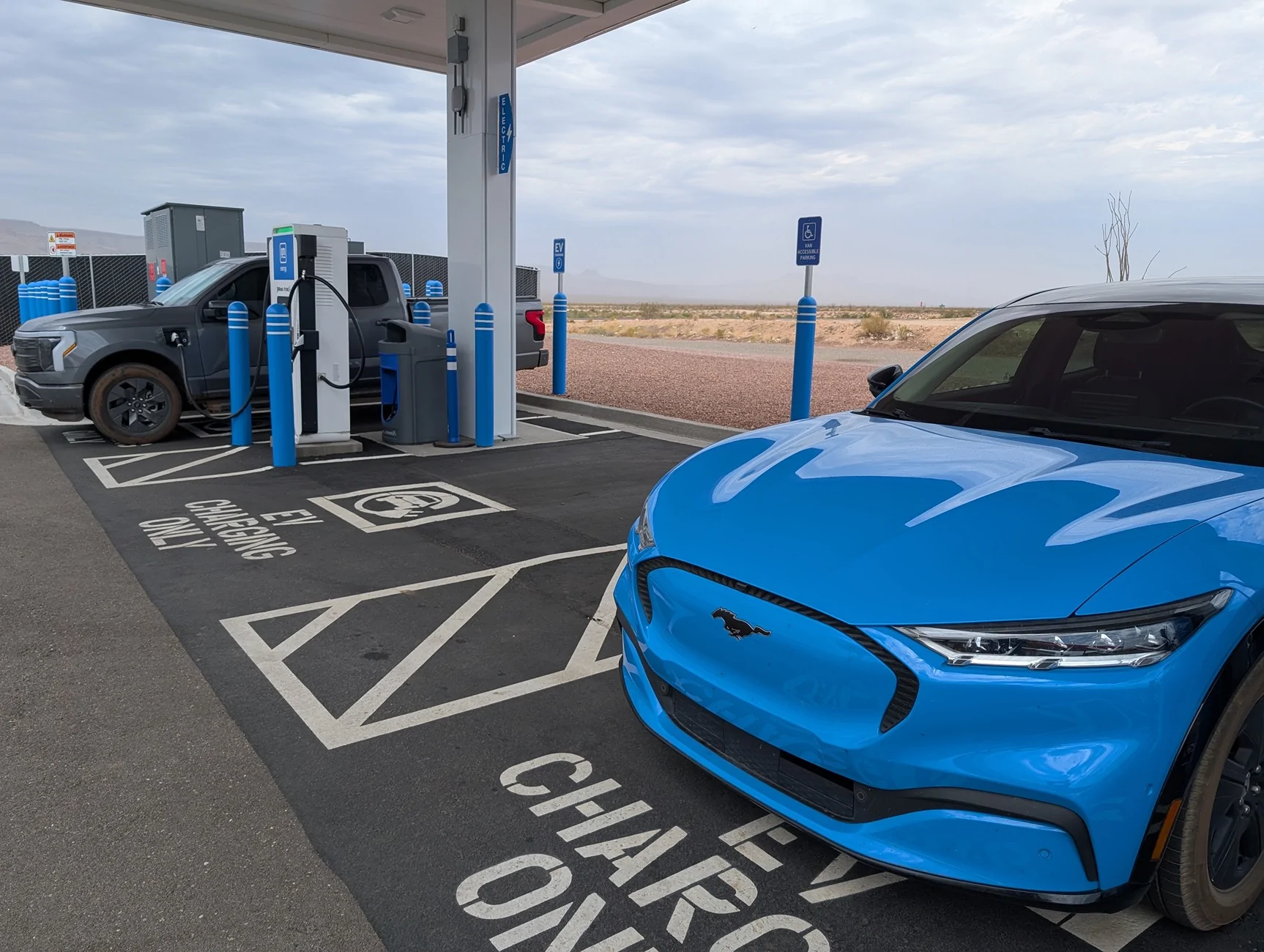
PXL_20250822_181750380.RAW-01.COVER.jpg


The Mustang claimed 3.9 miles/kWh efficiency on a drive with ~70 mph average speed.
The Lightning claimed 2.5 miles/kWh efficiency on the same ~70 mph average speed.
(The slight differences in time and miles in the images below is because the Mustang driver shut off the car for a short time while running a very quick errand.)
signal-2025-08-22-113347_002.jpeg


PXL_20250822_181418946.RAW-01.COVER.jpg


If we believe the 3.9 miles/kWh efficiency for the Mustang:
176 miles / 3.9 miles/kWh = 45 kWh.
45 kWh / 50% = 90 kWh.

According to this, battery degradation is minimal.
1.7 kWh / 91.7 kWh = 1.8%
That is good enough for me. Especially given that the car has >50k miles on it and the battery is ~4 years old. Not much measurable degradation. The last time I checked the State of Health, it reported around 94%, but I have no insight into how that number is calculated, so I’m not very trusting of it. I’m not at all concerned about the state of health of our Mustang’s battery, even after 50k miles and 4 years.

If we believe the 2.5 miles/kWh and we believe the depth of discharge for the Lightning:
176 miles / 2.5 miles/kWh = 70.4 kWh
But.
70.4 / 48% = 146.7 kWh. Which is more than the nominal full capacity, including the “buffer.”

What’s going on here? My experience is that the state of charge percent is accurate. I believe the truck isn’t calculating efficiency correctly, which likely doesn’t surprise people who pay attention to the vehicle’s various metrics. In fact, it’s giving a lower efficiency than reality, which I’ve seen multiple times.

Assuming 48% of the 131 kWh was used, that’s 62.9 kWh to go 176 miles. That’s an efficiency of 2.8 miles/kWh.

I’m also happy with that.
Interesting!

Over 118,00 miles with every mile and kWh used in charging, Stangy’s averaged 2.9miles/kWh fully loaded virtually all the time with A/Con & hearing nearly always in use which comparable to your caravan trip.
 

zephiyr

Well-Known Member
First Name
John
Joined
Jun 18, 2021
Threads
5
Messages
90
Reaction score
100
Location
CA
Vehicles
2021 Mach-E Premium ER RWD
Country flag
Did you have a strong tailwind? 3.9 MPK is remarkable for a 70 MPH road trip.


OP
OP
SpaceEVDriver

SpaceEVDriver

Well-Known Member
Joined
Aug 26, 2021
Threads
71
Messages
2,651
Reaction score
4,774
Location
Arizona
Vehicles
2022 CA Route 1 AWD, ER; 2023 Lightning Lariat ER
Occupation
Planetary Science
Country flag
Did you have a strong tailwind? 3.9 MPK is remarkable for a 70 MPH road trip.
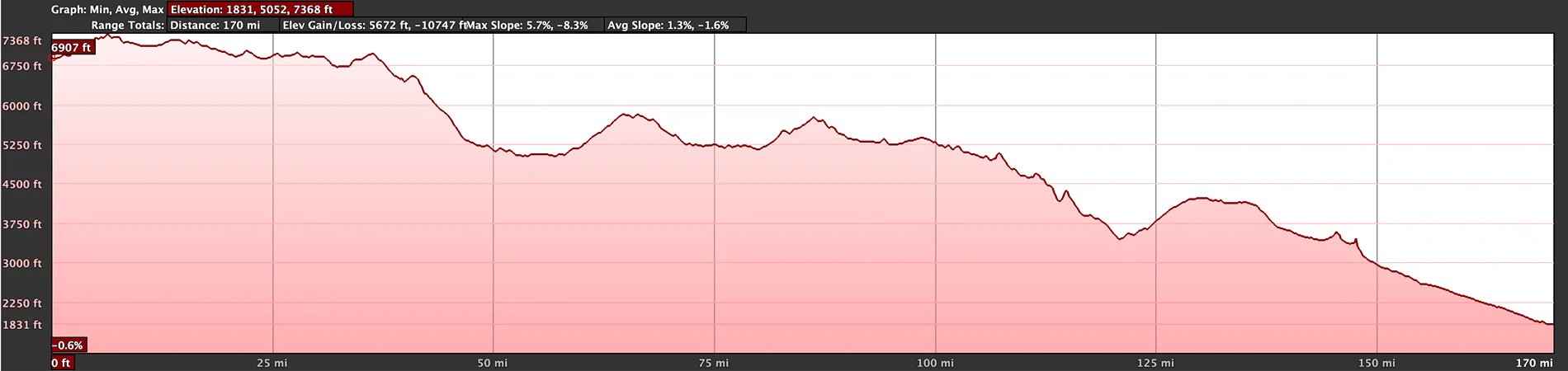
No. We had oncoming crosswinds. We did lose elevation overall. But wind resistance generally matters more than elevation.

Ford Mustang Mach-E Caravan Road Trip: Mach-E & Lightning from Northern AZ to LA Screenshot 2025-08-24 at 09.49.14
 
OP
OP
SpaceEVDriver

SpaceEVDriver

Well-Known Member
Joined
Aug 26, 2021
Threads
71
Messages
2,651
Reaction score
4,774
Location
Arizona
Vehicles
2022 CA Route 1 AWD, ER; 2023 Lightning Lariat ER
Occupation
Planetary Science
Country flag
3.9 miles or kWh isn't that far from what we usually get on this road trip. We average around 3.7-3.9 on this road trip, overall.

The second leg has us climbing out of the Colorado River Valley and facing the Santa Anna winds. But in the end our average is 3.7-3.9 unless it's the springtime winds. They can be brutal and we can see as bad as 2 miles per kWh.
 

Tampamike

Well-Known Member
First Name
Mike
Joined
Feb 19, 2021
Threads
24
Messages
2,069
Reaction score
2,806
Location
Tampa, FL
Vehicles
‘24 Mach E Premium RWD
Country flag
Yeah, 3.7 -3.9? Are you sure? I never get anywhere close to that in highway driving. I do go faster though. For me (both a ‘21 ER and a ‘24ER) I usually get around 2.5 miles/kw doing 79 with BC on And a flat road. Can’t imagine ever getting that high of efficiency even doing only 70. Even if I got 300 miles on a full charge that only equals 3.29 m/kw and I would never expect to get that even doing only, say 69 mph - 3.0 m/kw would be a lot. Something isn’t right. At 3.9 m/kw your total range at 70 mph would be 355 miles (3.9 m/kw x 91 kw battery). Maybe I’m missing something?
 
OP
OP
SpaceEVDriver

SpaceEVDriver

Well-Known Member
Joined
Aug 26, 2021
Threads
71
Messages
2,651
Reaction score
4,774
Location
Arizona
Vehicles
2022 CA Route 1 AWD, ER; 2023 Lightning Lariat ER
Occupation
Planetary Science
Country flag
I'm absolutely certain. Our efficiency is generally 3.5 to 4.0 on the freeway. This is from all different kinds of metrics and measurements.

We started at 100% charge. Went to 50% over 176.5 miles. The worst it could be is 176.5 miles/45.85 kWh = 3.85 miles per kWh. If there's any battery degradation, the efficiency is higher.

We are running Michelin Defender 2
225/60R18 at 42 PSI.
We don't go much faster than 73 mph on the freeway.
 

Tampamike

Well-Known Member
First Name
Mike
Joined
Feb 19, 2021
Threads
24
Messages
2,069
Reaction score
2,806
Location
Tampa, FL
Vehicles
‘24 Mach E Premium RWD
Country flag
I'm absolutely certain. Our efficiency is generally 3.5 to 4.0 on the freeway. This is from all different kinds of metrics and measurements.

We started at 100% charge. Went to 50% over 176.5 miles. The worst it could be is 176.5 miles/45.85 kWh = 3.85 miles per kWh. If there's any battery degradation, the efficiency is higher.

We are running Michelin Defender 2
225/60R18 at 42 PSI.
We don't go much faster than 73 mph on the freeway.
Ok then. I give. Maybe it’s the magic of the CR1. My typical number is 2.6-2.7 in my Premium ER RWD At 79mph. I plan on about 225 -250 at most on a full charge, 185-200 from 80%. You’re getting almost 2 1/2 hours of driving on only 50% charge. That’s pretty darn good.
 

Tampamike

Well-Known Member
First Name
Mike
Joined
Feb 19, 2021
Threads
24
Messages
2,069
Reaction score
2,806
Location
Tampa, FL
Vehicles
‘24 Mach E Premium RWD
Country flag
My CR1, RWD can get 300 miles driving at 75mph. It has the smaller and more efficient wheels than the other models.
I guess the wheels are the key? He’s getting even more - 350+. Or maybe it’s the dry air, I dunno. I don’t get anywhere near that driving on the east coast.
 
OP
OP
SpaceEVDriver

SpaceEVDriver

Well-Known Member
Joined
Aug 26, 2021
Threads
71
Messages
2,651
Reaction score
4,774
Location
Arizona
Vehicles
2022 CA Route 1 AWD, ER; 2023 Lightning Lariat ER
Occupation
Planetary Science
Country flag
My partner uses AC on this route as well.

Speed is the number one killer of efficiency. Hard acceleration to high speed is the next. Opposing winds and low tire pressure are next.

Also, a good quarter of the drive is at elevation above 6000 feet. That's a 20% reduction in drag relative to sea level, based on dry air density differences.

And there's the losing altitude. But it's not that great of a benefit: For a 2200 kg mass at 7000 ft, that's at most 12 kWh of potential energy (ignoring all the resistive forces).
 
OP
OP
SpaceEVDriver

SpaceEVDriver

Well-Known Member
Joined
Aug 26, 2021
Threads
71
Messages
2,651
Reaction score
4,774
Location
Arizona
Vehicles
2022 CA Route 1 AWD, ER; 2023 Lightning Lariat ER
Occupation
Planetary Science
Country flag
I guess the wheels are the key? He’s getting even more - 350+. Or maybe it’s the dry air, I dunno. I don’t get anywhere near that driving on the east coast.
80 vs 70 mph is a huge difference.
Just that speed difference can result in most of the difference between our efficiencies.
 
Last edited:

GreaseMonkey

Well-Known Member
First Name
Steve
Joined
Oct 3, 2021
Threads
21
Messages
3,233
Reaction score
5,173
Location
Chicago, IL
Vehicles
24 Mach-E GT
Country flag
I look forward to having 5 miles per kWh autos in the near future. That would mean a lighter weight 60 kWh battery good for a std 300-mile range. 2.5 makes me wanna cry. But I’m not into pickups, and have neither use nor appreciation for them.
Sponsored


Top