
Charging Curve...hacking?

Jiji

Well-Known Member
First Name
Rick
Joined
Jul 26, 2021
Threads
24
Messages
493
Reaction score
641
Location
Finger Lakes
Vehicles
2022 Mustang Mach-E GT 2024 F-150 Lightning
Country flag
Why is there a ~20 kW discrepancy between requested and delivered power that decreases with time? Are you using actual pack voltage or target pack voltage to calculate the kW? The traces should all be very close <6 kW difference or there's some kind of problem. You should graph the amperage curves and make sure they have the same pattern as the power curves.
I just report the data. ??

With the exception of the HVB coolant heater power, Ford to my knowledge doesn't report power values so they are calculated from the reported voltage and current values. For the chart in question the power values shown are

DC Charger Maximum Power (purple, top).dcChargerMaximumVoltage * .dcChargerMaximumCurrent
Vehicle Power Requested (orange).hvbChargeVoltageRequested * .hvbChargeCurrentRequested
Vehicle Charger Output Power (purple).chargerOutputVoltage * .chargerOutputCurrentMeasured
HVB Power (blue).hvbVoltage * .hvbCurrent

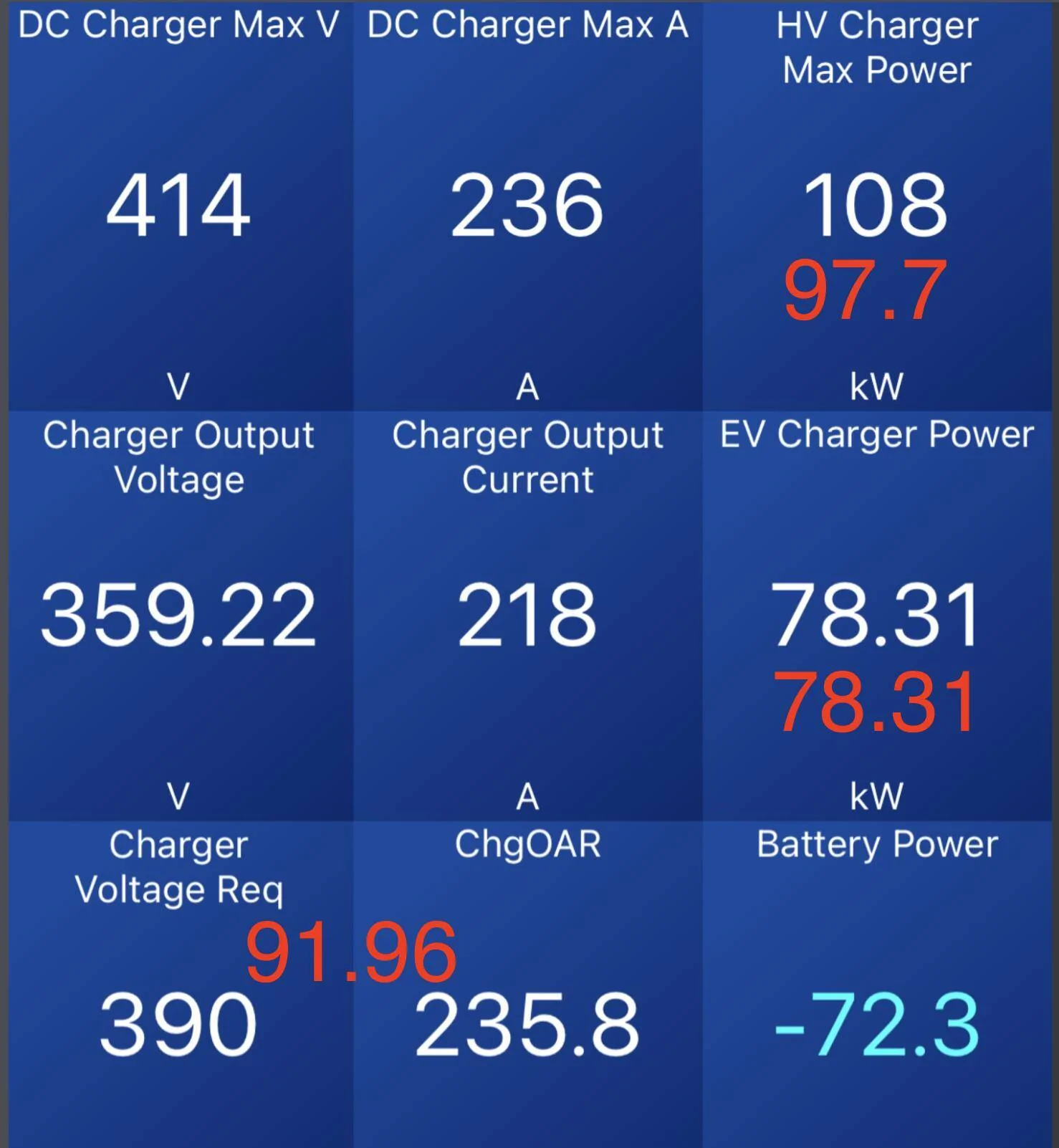
Only power values are logged so I can't go back and provide voltage or current curves. But at one point you were kind to share this charge data with me:
Ford Mustang Mach-E Charging Curve...hacking? 1681529340965


The first line should be the DC Charger Maximum Power, 414 * 236 = 97.7 kW which is less than the reported 108kW but maybe this is just sampling error. EV Charge Power is what I refer to as Vehicle Charger Output Power (second purple line) and is correct, 359.22 * 218 is 78.31kW.

The third line has the requested voltage and current in the first two columns, power is 91.96kW which is ~14kW more than the EV Charger Power. Can you explain this discrepancy or show me my error? The last column is the HVB power value which is marginally less than the charger output and appears correct but I don't have the HVB voltage/current values to check it. So your results are very much similar to those I reported.

I can understand a 6kW difference between the charger output power and the HVB power as some power is running the car, heating/cooling the battery, and heating/cooling the cabin. But there is a lot of unobserved charging logic going on so who is to say the observed difference between requested and charger output isn't real.

Finally, in the big picture any one of the observed charging curves displayed without any units would convey what the charging session looked like and that is what is important. I want to know what it looked like and will probably move on and never look at it again.
Sponsored
 

Mach-Lee

Well-Known Member
First Name
Lee
Joined
Jul 16, 2021
Threads
262
Messages
11,344
Reaction score
24,964
Location
Wisconsin
Vehicles
2022 Mach-E Premium AWD
Occupation
Sci/Eng
Country flag
I just report the data. ??

With the exception of the HVB coolant heater power, Ford to my knowledge doesn't report power values so they are calculated from the reported voltage and current values. For the chart in question the power values shown are

DC Charger Maximum Power (purple, top).dcChargerMaximumVoltage * .dcChargerMaximumCurrent
Vehicle Power Requested (orange).hvbChargeVoltageRequested * .hvbChargeCurrentRequested
Vehicle Charger Output Power (purple).chargerOutputVoltage * .chargerOutputCurrentMeasured
HVB Power (blue).hvbVoltage * .hvbCurrent

Only power values are logged so I can't go back and provide voltage or current curves. But at one point you were kind to share this charge data with me:

1681529340965.png


The first line should be the DC Charger Maximum Power, 414 * 236 = 97.7 kW which is less than the reported 108kW but maybe this is just sampling error. EV Charge Power is what I refer to as Vehicle Charger Output Power (second purple line) and is correct, 359.22 * 218 is 78.31kW.

The third line has the requested voltage and current in the first two columns, power is 91.96kW which is ~14kW more than the EV Charger Power. Can you explain this discrepancy or show me my error? The last column is the HVB power value which is marginally less than the charger output and appears correct but I don't have the HVB voltage/current values to check it. So your results are very much similar to those I reported.

I can understand a 6kW difference between the charger output power and the HVB power as some power is running the car, heating/cooling the battery, and heating/cooling the cabin. But there is a lot of unobserved charging logic going on so who is to say the observed difference between requested and charger output isn't real.

Finally, in the big picture any one of the observed charging curves displayed without any units would convey what the charging session looked like and that is what is important. I want to know what it looked like and will probably move on and never look at it again.
Replied via PM rather than getting super technical and way off-topic here.
 

Logal727

Well-Known Member
First Name
C
Joined
Aug 23, 2021
Threads
101
Messages
7,351
Reaction score
11,347
Location
Florida
Vehicles
‘21 Carbonized Gray Mustang Mach-E Premium AWD Ext
Country flag
Normally people try to find ways to make life easier and more simplistic. Why on earth anyone would want to repeatedly start and stop charge sessions to shave off a couple minutes (might even add time) is beyond me. It's probably not very healthy for the charge system either. I'm sure the duty cycles are high but they probably didn't account for some lunatic plugging and unplugging 10 times per session.
But you see it make number bigger… bigger number better
 

bbulkow

Well-Known Member
First Name
Brian
Joined
Aug 30, 2022
Threads
24
Messages
889
Reaction score
729
Location
menlo park, california
Vehicles
Honda CRV
Country flag
I just report the data. ??

With the exception of the HVB coolant heater power, Ford to my knowledge doesn't report power values so they are calculated from the reported voltage and current values. For the chart in question the power values shown are

DC Charger Maximum Power (purple, top).dcChargerMaximumVoltage * .dcChargerMaximumCurrent
Vehicle Power Requested (orange).hvbChargeVoltageRequested * .hvbChargeCurrentRequested
Vehicle Charger Output Power (purple).chargerOutputVoltage * .chargerOutputCurrentMeasured
HVB Power (blue).hvbVoltage * .hvbCurrent

Only power values are logged so I can't go back and provide voltage or current curves. But at one point you were kind to share this charge data with me:

1681529340965.png


The first line should be the DC Charger Maximum Power, 414 * 236 = 97.7 kW which is less than the reported 108kW but maybe this is just sampling error. EV Charge Power is what I refer to as Vehicle Charger Output Power (second purple line) and is correct, 359.22 * 218 is 78.31kW.

The third line has the requested voltage and current in the first two columns, power is 91.96kW which is ~14kW more than the EV Charger Power. Can you explain this discrepancy or show me my error? The last column is the HVB power value which is marginally less than the charger output and appears correct but I don't have the HVB voltage/current values to check it. So your results are very much similar to those I reported.

I can understand a 6kW difference between the charger output power and the HVB power as some power is running the car, heating/cooling the battery, and heating/cooling the cabin. But there is a lot of unobserved charging logic going on so who is to say the observed difference between requested and charger output isn't real.

Finally, in the big picture any one of the observed charging curves displayed without any units would convey what the charging session looked like and that is what is important. I want to know what it looked like and will probably move on and never look at it again.
6kw happens to be exactly the power draw of the battery heating system. I don't know about cooling. A complete graph might include the power being used by the batt heating system Sorry I don't remember exactly the name of the variable...
 

Teslaeata

Well-Known Member
First Name
Mark
Joined
Sep 28, 2022
Threads
9
Messages
3,436
Reaction score
4,158
Location
Nottingham, England, UK
Vehicles
Red June ‘21 RWD ER Premium MME
Occupation
Forensic vehicle examiner, motor insurance assessor, expert witness
Country flag
6kw happens to be exactly the power draw of the battery heating system. I don't know about cooling. A complete graph might include the power being used by the batt heating system Sorry I don't remember exactly the name of the variable...
My understanding is that there are a whole load of conditions which vary whilst charging progresses, some which involve the car and others which do not.

Power supply to the charge point and its share of capacity to deliver power amongst other local consumers including other adjacent charge points may vary power actually available to the car, then there is the reality that charge points themselves have their own temperature sensed cooling systems so performance of those systems, the temperature of charge point etc will vary power available to the car.

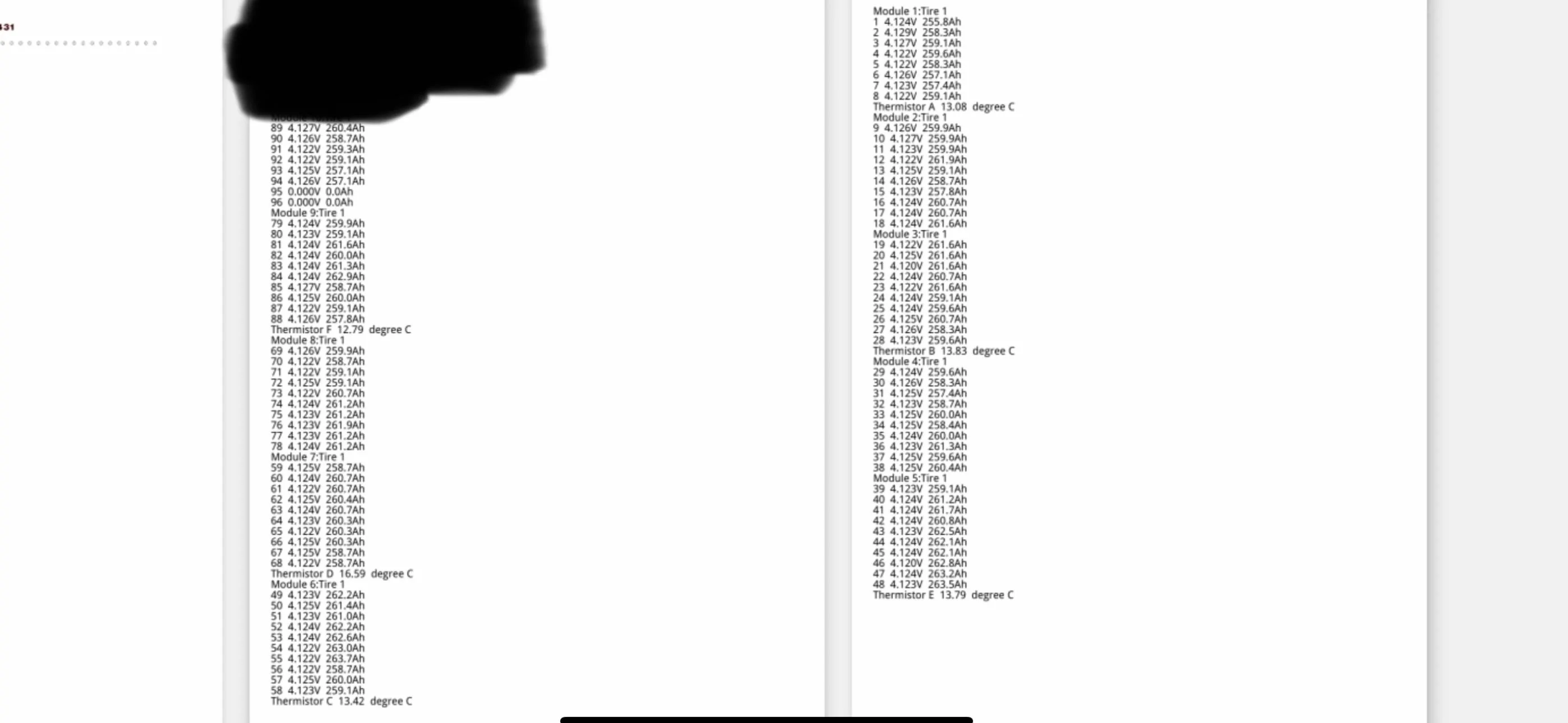
Then to the car which also has a sophisticated sensing system which the battery management system will use to vary charge rates-see the attached state of health chart for my ‘Stang which illustrates that a thermistor exists in each of its 94cells sensing each cells’ temperature at all times for the purposes of battery control & management.

Then there’s the potential for state of health conditions which may cause charge rates to vary by adjustments made by the car’s battery management system.

Cooling system performance may cause a variance between power drawn and charge rate but the apparent disparity between energy supplied to car and energy charted in the charging of the traction battery may be caused by more than just the draw of electrical energy by the cooling System.

So, because charging rate is contingent upon so many variable conditions beyond those thought to be known, unless every condition is monitored I think it’s impossible to use the measurable charge rates alone to fathom why and when charge rates differ or if simply unplugging and re-plugging at a charge point causes an increase of the speed of charging an EV.

………are my thoughts for what they’re worth??‍♂

Ford Mustang Mach-E Charging Curve...hacking? IMG_0129


Jiji

Well-Known Member
First Name
Rick
Joined
Jul 26, 2021
Threads
24
Messages
493
Reaction score
641
Location
Finger Lakes
Vehicles
2022 Mustang Mach-E GT 2024 F-150 Lightning
Country flag
6kw happens to be exactly the power draw of the battery heating system. I don't know about cooling. A complete graph might include the power being used by the batt heating system Sorry I don't remember exactly the name of the variable...
I happen to log the battery heater power/energy while driving and also while charging so I know its contribution to energy use. Looking at some recent data the peak power can exceed 7kW but varies during a trip or charge.

But there’s also the cost of running the vehicle along with heating or cooling it while charging and those are data points that I don’t monitor yet but can see as the difference between the charger output and the battery input.
 

Jiji

Well-Known Member
First Name
Rick
Joined
Jul 26, 2021
Threads
24
Messages
493
Reaction score
641
Location
Finger Lakes
Vehicles
2022 Mustang Mach-E GT 2024 F-150 Lightning
Country flag
So, because charging rate is contingent upon so many variable conditions beyond those thought to be known, unless every condition is monitored I think it’s impossible to use the measurable charge rates alone to fathom why and when charge rates differ or if simply unplugging and re-plugging at a charge point causes an increase of the speed of charging an EV.
I totally agree, I prefer to think of my logging a charge session as an overview or history and not a detailed analysis. It’s fun and easy to see what happened, but my brain hurts trying to figure out why.
 

astronut325

Well-Known Member
Joined
Nov 22, 2021
Threads
10
Messages
316
Reaction score
343
Location
Los Angeles, CA
Vehicles
Mach-E Premium, Toyota Camry, Honda Odyssey
Occupation
Software analyst
Country flag
Not sure where else to post this as I didn't feel like making a new thread:
- My Mach-E can't seem to go above 60kw when charging at any EA station. It typically just hangs around 48-52KW. I used Ford Navigation this past weekend to drive to a EA station a solid 20-30 minutes away. It was nice weather at 70F. I plug in and charge. I look at the EA charger screen and see 56KW. I even kept the AC/heating set to 70F. I was hoping to hit at least 100KW.

I think Ford is lying. There is no battery pre-conditioning. I'm on software version 4.2.4.
 

superdave80

Well-Known Member
First Name
David
Joined
Aug 18, 2022
Threads
5
Messages
1,332
Reaction score
2,027
Location
Santa Rosa, CA
Vehicles
2022 Mach E Select SR RWD
Country flag
Given the 'reliability' of starting a DC charging session, there is no way I'm going to voluntarily stop a perfectly functioning charge session to maybe shave a few minutes off.
Sponsored


Top