Charging with an extension cord

OP
OP
Dangerfish

Dangerfish

Well-Known Member
First Name
Jay
Joined
Dec 17, 2020
Threads
12
Messages
111
Reaction score
128
Location
Texas
Vehicles
'22 GTPE Cyber Orange
Occupation
Nurse Anesthetist
Country flag
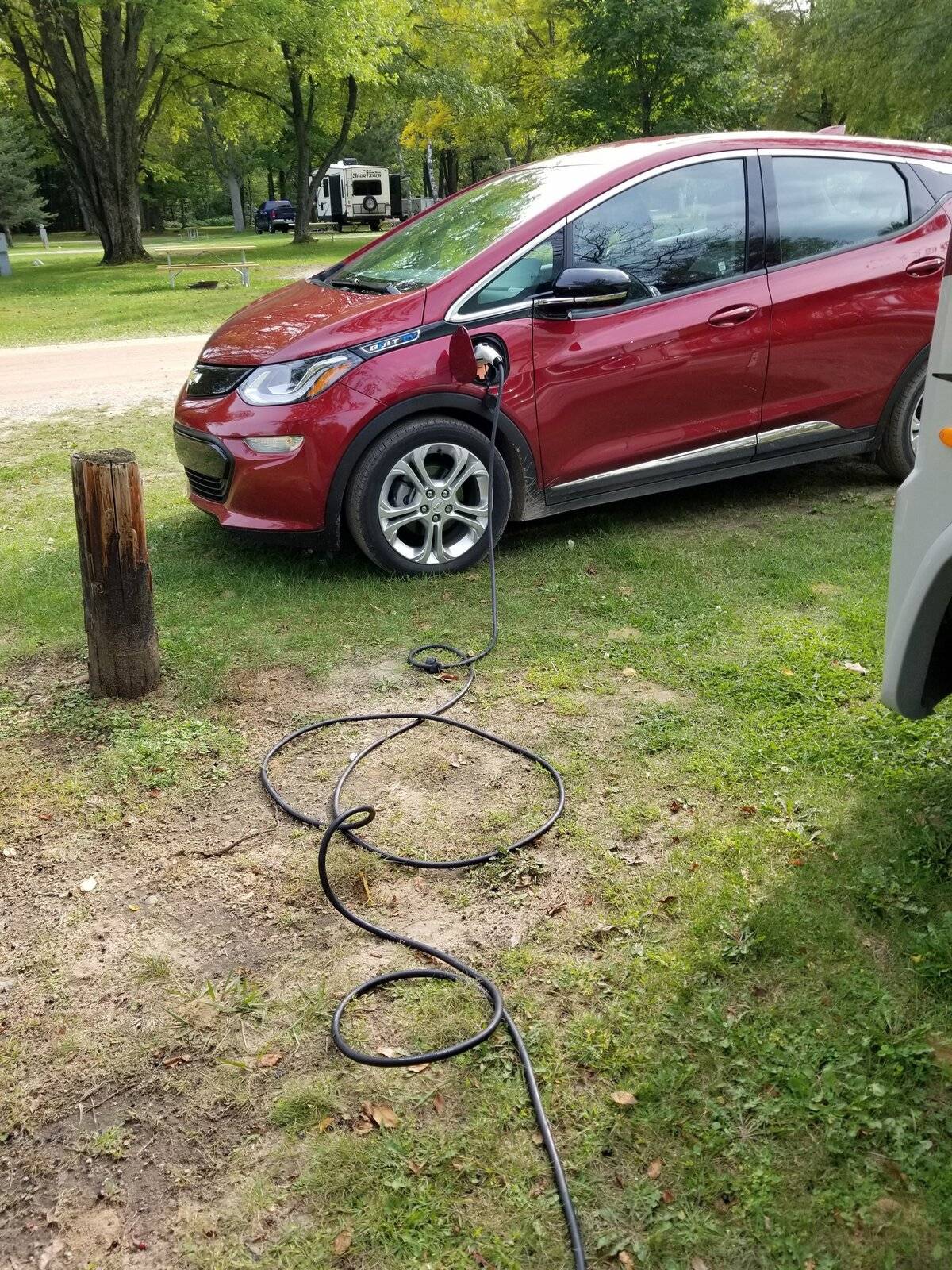
It isn't NEMA 1772. Its SAE J1772. This extension is on the other side of the EVSE--it goes between the EVSE and the car. Here is a pic:

This means it will work with 120V, 240V, whatever--just don't put too much current through it (e.g. I wouldn't use it with a 48amp EVSE--this is why there is that clipper creek in my trunk: 20amps).

Edit: I should re-take the pic with the Mach-E now that the Bolt is gone LOL.
You are correct, I mistyped.
I understand where the J1772 goes and that it can do both 120 and 240. Its just an extension of the EVSE that came with the car. But, if I end up somewhere that there is no NEMA 14 - 50 (potentially the rental cabin I'm going to), then how is this $240 cable better for me than a $100 heavy duty extension cord for a 120V outlet? That's what I'm not understanding. If I can find value in it, I'll happily spend the extra money but I'm just not seeing it.
Sponsored

 
OP
OP
Dangerfish

Dangerfish

Well-Known Member
First Name
Jay
Joined
Dec 17, 2020
Threads
12
Messages
111
Reaction score
128
Location
Texas
Vehicles
'22 GTPE Cyber Orange
Occupation
Nurse Anesthetist
Country flag
Are you sure you set the filters correctly on PlugShare? I found two places where you can plug in at 14-50 in Broken Bow (I thought it weird there wouldn't be one in a lake vacation spot). One is Tiny Town OK Cabins and RV Park. The other is Rodeway Inn. Probably pricey but it's a vacation! LOL
I may not have. I'll look again. I only tried using the site for the first time today. I found a cabin that had a Tesla L2 charger but I couldn't find anything else. I'll look again.
 

generaltso

Well-Known Member
Joined
Jun 24, 2020
Threads
76
Messages
15,389
Reaction score
28,696
Location
Vermont
Vehicles
2024 Kia EV9 GT-Line
Country flag
You are correct, I mistyped.
I understand where the J1772 goes and that it can do both 120 and 240. Its just an extension of the EVSE that came with the car. But, if I end up somewhere that there is no NEMA 14 - 50 (potentially the rental cabin I'm going to), then how is this $240 cable better for me than a $100 heavy duty extension cord for a 120V outlet? That's what I'm not understanding. If I can find value in it, I'll happily spend the extra money but I'm just not seeing it.
For this one instance, it may not be better. But it’s a handy tool to have as an EV owner. I’ve used mine when ICEd out of a public charging station. I just parked a few spaces away.
 

BATTERIESRIT

Active Member
First Name
Joe
Joined
Feb 25, 2021
Threads
13
Messages
37
Reaction score
20
Location
Iowa
Vehicles
Camry
Country flag
I searched and I think I know the answers but I'd just like to confirm.
I'm going to Oklahoma from Dallas this Summer. I can make it on a full charge with 20% battery left according to ABRP. The problem is that there are NO public charging options in this town and I don't know how close I can get the car to an outlet at the cabin. I will be there 3 days with limited driving while there. Leaving the car plugged in to 110V will probably give me plenty of charge to get back to the first public super charger 135 miles away on my way back home. There is a dryer outlet in the cabin. From what I understand, I as long as I buy very high quality extension cables (110 or 220), I would be fine to use these occasionally without risk of damaging the car or causing a fire?
Do I need to verify a certain amp circuit at the breaker box before using one of these options?

Something like these?
https://cutt.ly/txwtHK6
https://cutt.ly/UxwyDLy


TIA,

Jay
Guessing you will not be adding miles and miles of cord like breadcrumbs to keep it charging as you head out.
 
OP
OP
Dangerfish

Dangerfish

Well-Known Member
First Name
Jay
Joined
Dec 17, 2020
Threads
12
Messages
111
Reaction score
128
Location
Texas
Vehicles
'22 GTPE Cyber Orange
Occupation
Nurse Anesthetist
Country flag
For this one instance, it may not be better. But it’s a handy tool to have as an EV owner. I’ve used mine when ICEd out of a public charging station. I just parked a few spaces away.
I can see where it would be valuable to have it in a situation like this!


JamieGeek

Well-Known Member
Joined
Dec 29, 2019
Threads
82
Messages
3,589
Reaction score
6,823
Location
Southeastern Michigan
Website
spareelectrons.wordpress.com
Vehicles
Escape PHEV, old: Mach-E, Bolt, C-Max Energi, Focus Electric
Country flag
You are correct, I mistyped.
I understand where the J1772 goes and that it can do both 120 and 240. Its just an extension of the EVSE that came with the car. But, if I end up somewhere that there is no NEMA 14 - 50 (potentially the rental cabin I'm going to), then how is this $240 cable better for me than a $100 heavy duty extension cord for a 120V outlet? That's what I'm not understanding. If I can find value in it, I'll happily spend the extra money but I'm just not seeing it.
For this one instance, it may not be better. But it’s a handy tool to have as an EV owner. I’ve used mine when ICEd out of a public charging station. I just parked a few spaces away.
Yup that is correct: In the one instance it may not help but once you have one its a bit more versatile. Since it can be either 120V or 240V it gives you more options. A simple 120V would only work in one instance, not two.

I've used mine a few times when I couldn't reach the plug (the pic I posted above was a test--we were going to get the driveway repaved and I wanted to make sure I could charge in the street for the two weeks I couldn't park on the new cement).

I've also used it while camping where the 14-50 plug was too far away...
Ford Mustang Mach-E Charging with an extension cord 2020-09-14 16.40.52
 
OP
OP
Dangerfish

Dangerfish

Well-Known Member
First Name
Jay
Joined
Dec 17, 2020
Threads
12
Messages
111
Reaction score
128
Location
Texas
Vehicles
'22 GTPE Cyber Orange
Occupation
Nurse Anesthetist
Country flag
Yup that is correct: In the one instance it may not help but once you have one its a bit more versatile. Since it can be either 120V or 240V it gives you more options. A simple 120V would only work in one instance, not two.

I've used mine a few times when I couldn't reach the plug (the pic I posted above was a test--we were going to get the driveway repaved and I wanted to make sure I could charge in the street for the two weeks I couldn't park on the new cement).

I've also used it while camping where the 14-50 plug was too far away...
Ok, I'm starting to see the value now. Buy one cable once instead of potentially needing to buy a second extender later on. This one cable will do both.

Even if I went with a regular 120V extension cable, it would need to have not only the correct gauge wire but also be certified for the correct amp, right? Cables I'm finding on Amazon are only rated at 15amps. And that won't cut it, right?
 

JamieGeek

Well-Known Member
Joined
Dec 29, 2019
Threads
82
Messages
3,589
Reaction score
6,823
Location
Southeastern Michigan
Website
spareelectrons.wordpress.com
Vehicles
Escape PHEV, old: Mach-E, Bolt, C-Max Energi, Focus Electric
Country flag
Ok, I'm starting to see the value now. Buy one cable once instead of potentially needing to buy a second extender later on. This one cable will do both.

Even if I went with a regular 120V extension cable, it would need to have not only the correct gauge wire but also be certified for the correct amp, right? Cables I'm finding on Amazon are only rated at 15amps. And that won't cut it, right?
A 15 amp cable may cut it (car will charge at 12amps on 120V--15 amps * 80% = 12 amps).

Of course the J1772 cable is rated for a lot more so it would be a safer bet.
 
OP
OP
Dangerfish

Dangerfish

Well-Known Member
First Name
Jay
Joined
Dec 17, 2020
Threads
12
Messages
111
Reaction score
128
Location
Texas
Vehicles
'22 GTPE Cyber Orange
Occupation
Nurse Anesthetist
Country flag
A 15 amp cable may cut it (car will charge at 12amps on 120V--15 amps * 80% = 12 amps).

Of course the J1772 cable is rated for a lot more so it would be a safer bet.
Ok, you sold me. I'm going to get the Lectron cable from Amazon.
Thanks everyone for your input!
 
  • Like
Reactions: bcb

ajmartineau

Well-Known Member
Joined
Jun 23, 2020
Threads
33
Messages
1,392
Reaction score
1,979
Location
Washington
Vehicles
2021 Mach-E
Country flag
Do people really only get 110 volts from their outlets? Every time I check mine it's between 121 and 125 volts.
 

generaltso

Well-Known Member
Joined
Jun 24, 2020
Threads
76
Messages
15,389
Reaction score
28,696
Location
Vermont
Vehicles
2024 Kia EV9 GT-Line
Country flag
Do people really only get 110 volts from their outlets? Every time I check mine it's between 121 and 125 volts.
Most are close to 120v, just like most 240v outlets are close to 240v. But for some reason, a lot of people like to call them 110v and 220v. Not sure why.
 

AzCoronaDog

Well-Known Member
First Name
Jeff
Joined
Feb 26, 2021
Threads
7
Messages
236
Reaction score
511
Location
Scottsdale, AZ
Vehicles
'12 Porsche 911 Cabriolet, '21 MME, '17 Yukon XL
Country flag
Do people really only get 110 volts from their outlets? Every time I check mine it's between 121 and 125 volts.
110 is just legacy nomenclature for 120v. Technically incorrect, but has become part of the English lexicon due to popular usage. Everone gets ~120v in the US, regardless of the age of the electrical system, as it is regulated by the transformers the power company uses.

To paraphrase Mr. Mom, 110, 120, whatever it takes!
 

ajmartineau

Well-Known Member
Joined
Jun 23, 2020
Threads
33
Messages
1,392
Reaction score
1,979
Location
Washington
Vehicles
2021 Mach-E
Country flag
110 is just legacy nomenclature for 120v. Technically incorrect, but has become part of the English lexicon due to popular usage. Everone gets ~120v in the US, regardless of the age of the electrical system, as it is regulated by the transformers the power company uses.

To paraphrase Mr. Mom, 110, 120, whatever it takes!
Yeah, that's what I thought. ;) ..240, 241 what every it takes to charge my car fast.

https://getyarn.io/yarn-clip/5f893235-323c-40c7-930e-e7764e695d78
 

TheCats

Well-Known Member
Joined
Jan 18, 2021
Threads
0
Messages
95
Reaction score
77
Location
95033
Vehicles
Y5Z
Country flag
110 is just legacy nomenclature for 120v. Technically incorrect, but has become part of the English lexicon due to popular usage. Everone gets ~120v in the US, regardless of the age of the electrical system, as it is regulated by the transformers the power company uses.

To paraphrase Mr. Mom, 110, 120, whatever it takes!
It's all just a variation of 100V, the original target voltage for Edison systems.
Since it was DC distribution, voltage drop was an intractable issue. So as systems grew the generators were set to produce 110 VDC or higher.

When AC took over as the more convenient electrical system, the systems picked a voltage that would work best with the existing equipment, primarily lighting. That was variously chosen as 110V, 115V, 120V or 125V. It wasn't until relatively recently, the late 1960s, that 120V was chosen as the North American standard.

Occasionally you'll see equipment rated at 117V. That's just the mid-point of 110V and 125V, the extremes of the previous common voltages.

This history is also why AC voltage is reported as RMS (root mean square), rather than the more logical peak voltage. It is the equivalent DC voltage delivered to a resistive load, which is what people were used to at the time.
 

AzCoronaDog

Well-Known Member
First Name
Jeff
Joined
Feb 26, 2021
Threads
7
Messages
236
Reaction score
511
Location
Scottsdale, AZ
Vehicles
'12 Porsche 911 Cabriolet, '21 MME, '17 Yukon XL
Country flag
It's all just a variation of 100V, the original target voltage for Edison systems.
Since it was DC distribution, voltage drop was an intractable issue. So as systems grew the generators were set to produce 110 VDC or higher.

When AC took over as the more convenient electrical system, the systems picked a voltage that would work best with the existing equipment, primarily lighting. That was variously chosen as 110V, 115V, 120V or 125V. It wasn't until relatively recently, the late 1960s, that 120V was chosen as the North American standard.

Occasionally you'll see equipment rated at 117V. That's just the mid-point of 110V and 125V, the extremes of the previous common voltages.

This history is also why AC voltage is reported as RMS (root mean square), rather than the more logical peak voltage. It is the equivalent DC voltage delivered to a resistive load, which is what people were used to at the time.
Now I learned something new.
Unfortunately, at my age, that means some other knowlege has to be pushed out of my brain to make room. I hope I can find my car keys now... LOL
Sponsored


Top