Comparing DCFC costs to gas prices

GatorGrowl

Well-Known Member
Joined
Nov 2, 2023
Threads
6
Messages
204
Reaction score
233
Location
United States
Vehicles
2023 Mustang Mach-e Premium ER RWD
Country flag
I’ve been wondering just how much we save on energy costs when DC Fast Charging. It can cost up to 3x as much per kWh. I decided to compare to how much I’d spend on gas in an ICE equivalent.

For the ICE benchmark, I used the Ford Edge with an MPG of 25 combined.

I had driven 141 miles since my last charge, which consumed 42 kWh at the charger. The same distance at 25mpg would consume 5.64 gallons of gasoline.

I divided the cost of charging at various networks near me by the number of gallons to get a Cost per Gallon equivalent.

Here is what I found:
42 kWh at home (0.18/kWh) = $7.52
42 kWh public DCFC:
FPL (0.30/kWh): $12.60
ChargeUp (0.35/kWh+0.55+5%): $16.01
EA (0.48/kwh): $20.16
EVGo (0.57/kWh+$1): $24.95

Price per gallon (equivalent):
Home: $1.33/gal
FPL: $2.23/gal
ChargeUp: $2.83/gal
EA: $3.58/gal
EVGo: $4.42/gal

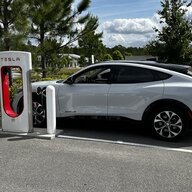
Assuming Tesla charging will cost the same as Magic Dock stations, those seem to be priced similar to EA.

I realize you can save 20% or more if you buy a membership, but for us who rarely charge away from home it seems quite pricy.
Sponsored

 

AKgrampy

Well-Known Member
First Name
Mike
Joined
Jan 29, 2022
Threads
7
Messages
3,527
Reaction score
3,601
Location
Fairbanks, Alaska
Vehicles
Ford Expedition, Ford F-150, Mach E GT
Occupation
Retired
Country flag
The issue is it depends what is your price of gas, price of DCFC, and mpg of the car you drive. The comparison is going to vary from vehicle to vehicle and place to place but my sense hs always been DCFC is the same or more expensive than gas in most cases. Especially now that it appears that DCFC is going to real time pricing.
 

RickMachE

Well-Known Member
Joined
Jul 1, 2021
Threads
267
Messages
17,957
Reaction score
27,994
Location
SE MI
Vehicles
2022 Mach-E Premium 4X, 2022 Lightning Lariat ER
Country flag
In short (which has been discussed repeatedly):

With gas at current prices, and a vehicle that got 25mpg, the cost for DC fast charging is roughly the same as gas.

HOWEVER, as noted, you leave home with a full battery from a lower cost, and on the road you charge for free at hotels (although getting harder to find that), or public chargers supplied by states / towns, or relatives.

On a long trip (4,700 miles), 36% (if memory serves me) was free.
On a shorter trip (2,900 miles), about 20% was free.

That lowers the overall cost.


RickMachE

Well-Known Member
Joined
Jul 1, 2021
Threads
267
Messages
17,957
Reaction score
27,994
Location
SE MI
Vehicles
2022 Mach-E Premium 4X, 2022 Lightning Lariat ER
Country flag
It still seems to me that DCFC providers are overcharging.
Based on what? Do you know what their cost of electricity is? Do you know what they're paying for rent for their locations?

When one company charges $0.64 per kilowatt and another company is charging $0.48, is the first company overcharging, or is the second company undercharging to win business?
 

timbop

Well-Known Member
First Name
Tim
Joined
Jan 3, 2020
Threads
65
Messages
6,832
Reaction score
14,036
Location
New Jersey
Vehicles
Solar powered 2021 MME ER RWD (CA RT1)
Occupation
Software Engineer
Country flag
In Florida, industrial power costs about 0.12 per kWh. (Source: https://www.eia.gov/electricity/monthly/epm_table_grapher.php?t=epmt_5_6_a)
The problem is that the utilities are allowed to pad the bill with "demand charges" for sudden peaks - which is what DCFC generally does: it's either drawing a trickle or > 120kw. Some DCFC have begun adding batteries to smooth out the demand, but those add costs also.

The charging companies aren't really making money yet; what it comes down to is that the demand charges and long periods of being idle are killing them.
 

RobbertPatrison

Well-Known Member
Joined
Mar 24, 2022
Threads
13
Messages
187
Reaction score
492
Location
Silicon Valley, California
Vehicles
Ice White Mustang Mach-E
Country flag
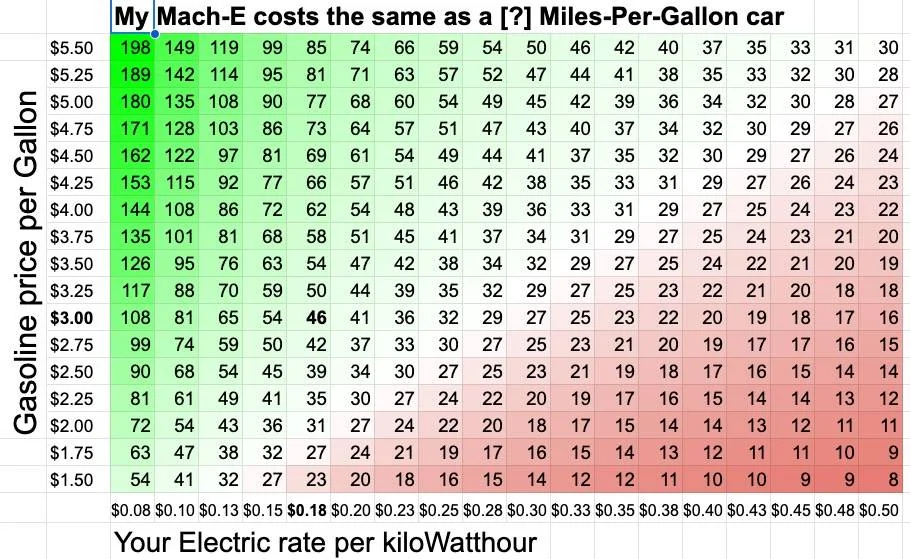
The current low gas prices and high DCFC rates could make operating MME as expensive as a gas guzzler. This table helps to quickly determine the 'penalty' for charging DCFC. It shows how equivalent MPG depends on the price of gasoline and your electric rate. At the current US national averages of $3/gallon and $0.18/kWh, the Mach-e is equivalent to a 46MPG car (similar to a Carmy Hybrid). If you live in Texas ($2.7/gallon) and charge at a public DCFC charger for $0.5/kWh the equivalent is a dismal 15 MPG. If you are in Washington state ($4/gallon, $0.13/kWh) the MME drives as cheap as an 86 MPG car. The values are for the AWD extended range MME. The RWD is slightly better, while the GT and in winter will see worse numbers.

Ford Mustang Mach-E Comparing DCFC costs to gas prices Screenshot 2024-01-19 at 14.51.09
 

leehinde

Well-Known Member
Joined
Feb 12, 2023
Threads
60
Messages
820
Reaction score
1,017
Location
California
Vehicles
Mach-E California Route 1
Country flag
The current low gas prices and high DCFC rates could make operating MME as expensive as a gas guzzler. This table helps to quickly determine the 'penalty' for charging DCFC.
That's true only if all you do is use DCFC. Which I'm guessing a statistically insignificant number of us do. Most of us charge at home and (unless you're stuck with PG&E, et. al.) we're paying much less than gas.

And, as I note, this all regional. You really can't make any blanket statement. As my attempt at a blanket statement demonstrates.
 

AKgrampy

Well-Known Member
First Name
Mike
Joined
Jan 29, 2022
Threads
7
Messages
3,527
Reaction score
3,601
Location
Fairbanks, Alaska
Vehicles
Ford Expedition, Ford F-150, Mach E GT
Occupation
Retired
Country flag
The problem is that the utilities are allowed to pad the bill with "demand charges" for sudden peaks - which is what DCFC generally does: it's either drawing a trickle or > 120kw. Some DCFC have begun adding batteries to smooth out the demand, but those add costs also.

The charging companies aren't really making money yet; what it comes down to is that the demand charges and long periods of being idle are killing them.
Just a pet peeve of mine but utilities do not “pad” the bill. If a commercial account has a 70 - 75% load factor the demand charge will equate to the same rate as residential costs, if the load factor is greater their effective rate is lower. I know I, and I would think you too, would expect the entity responsible for the electrical costs to cover them. For commercial loads a demand charge has been developed to allow utilities to recover their costs and not pass them on to the rest of the customer base. DCFC chargers unfortunately have low load factors.
 

Hammered

Banned
Banned
Joined
Oct 4, 2022
Threads
26
Messages
1,303
Reaction score
1,175
Location
SE US
Vehicles
2022 PB F150, MME GTPE
Country flag
Just a pet peeve of mine but utilities do not “pad” the bill. If a commercial account has a 70 - 75% load factor the demand charge will equate to the same rate as residential costs, if the load factor is greater their effective rate is lower. I know I, and I would think you too, would expect the entity responsible for the electrical costs to cover them. For commercial loads a demand charge has been developed to allow utilities to recover their costs and not pass them on to the rest of the customer base. DCFC chargers unfortunately have low load factors.
Utilities are notorious for cramming bills. There's a solid 4 nonsense fees on mine so they can claim their rates are lower than they actually are. The nonsense fees increase actual cost ~25%
Sponsored


Top