dan_meh
Well-Known Member
- First Name
- Daniel
- Joined
- Aug 12, 2024
- Threads
- 40
- Messages
- 550
- Reaction score
- 1,062
- Location
- Alexandria, VA
- Vehicles
- 2024 Mustang Mach-e Premium Extended AWD
- Occupation
- Technical Writer

- Thread starter
- #1
This post was a lot of fun. It got me thinking about my cold weather usage. I'm at pains to say: I'm not disagreeing with the OP in the other thread! Not only is it a good academic question - it's often good to poke at the extremes to understand the norms - but it's also the lived experience of some folks on this forum or who are shopping for an EV. My goal is just to also consider the "fat part of the bell curve" for most of the world's population (where latitude is an imperfect but close-enough gauge) and where we're headed (at least as measured in the US): a slow walk toward 90th percentile extreme load over 90th percentile extreme cold (play with the months, I started in January).
Moving it to personal experience, like most humans on the planet, my definition of cold doesn't start with molecules moving too slow to excite temperature above -10 C. My "cold" starts at the freezing point of water, so [checks high school chemistry notes...] that's 0 C and 32 F. For me, in my climate, sizing my transportation for -10 C would be like sizing my house's heat pump to -10 C.
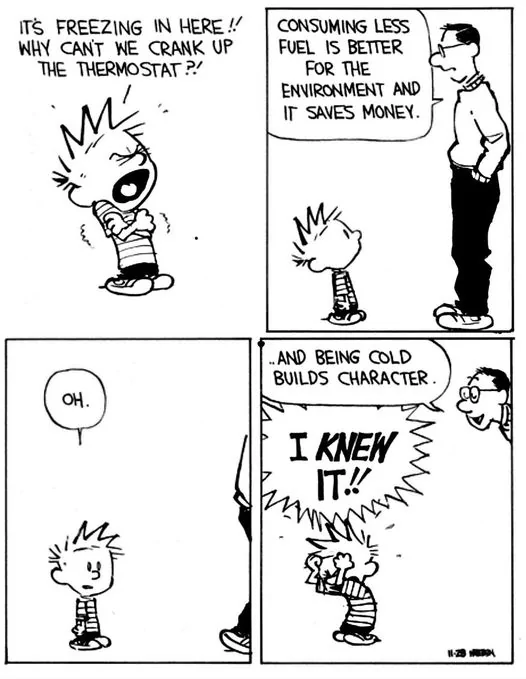
My Carrier unit does a great job down to about -10 C, but lower than that, it has a hard time keeping up. The smart people at Carrier thought about the ends of the bell curve, however, and added a little resistive heater in the air handler. And yeah, every other year, we'll get one or two polar vortex-es in DC and the Carrier will struggle. It won't fail. It will, as I said, struggle. Sure, I could have dug a well to do a geothermal-assisted heat pump if I really wanted, but I'm not putting that capex into a unicorn that's getting more rare (extreme cold). So I lower the temperature on the thermostat and embrace my inner "Calvin's Dad." Everyone puts pants and a sweater on and sucks it up for the 1/52nd of the year every other year. Seriously, why do teens think shorts in winter and complaining about cold is a winning formula?

If you've read about the 2025 MME heat pumps, you know that Ford came up with a similar solution as Carrier. The temperature range is different, and I'm aware that a car is not a house, but the concept is the same: solve for the near ends of bell curve and don't solve for the far ends of the bell curve. I don't have a 2025, I have a 2024, so I've got the 5kw resistive heater alone. No heat pump for me.
In my 2024 today, I woke up before sunrise to get kids off to school. I'm at about 38N latitude. It was about 30 degrees when I woke up this morning. There was high cloud cover, so not a lot of greenhouse effect (in the car). As @MachLee advises, I had a departure time set. My departure time was 7:15 AM, but I had to answer an email before I left, so I actually left for work at about 7:30 AM. The sun was up and the battery was still toasty (lots of thermal mass). I was wearing a Tech Worker uniform (button up shirt, brown pants, and a fleece). I had on the heat seater (auto) and the heated steering wheel as I would have in my Sienna (actually, no heated wheel there).
My route is about 30 miles to work. It's a mix of highway fast, highway stop-and-go, and surface streets. It's almost evenly divided. It takes me about an hour to get to work. About 20 minutes in, I was getting a little too toasty, so I turned the heat off and just ran the fan (on low) to get some fresh air. When I was waiting at a long light in South Reston, here's what I saw.

I was getting 3 miles per kwh, 12% of my portable energy was converted into power for climate use and 7% was spent on keeping the battery warm. "Portable energy" means "what I carry in the battery, NOT what I'm using from my plug. You can do all the math, but I don't want to lose the key point: at about 30 degrees (warming up to 34), I just drove the car like an ICE vehicle, but added a departure time (which I missed, of course!).
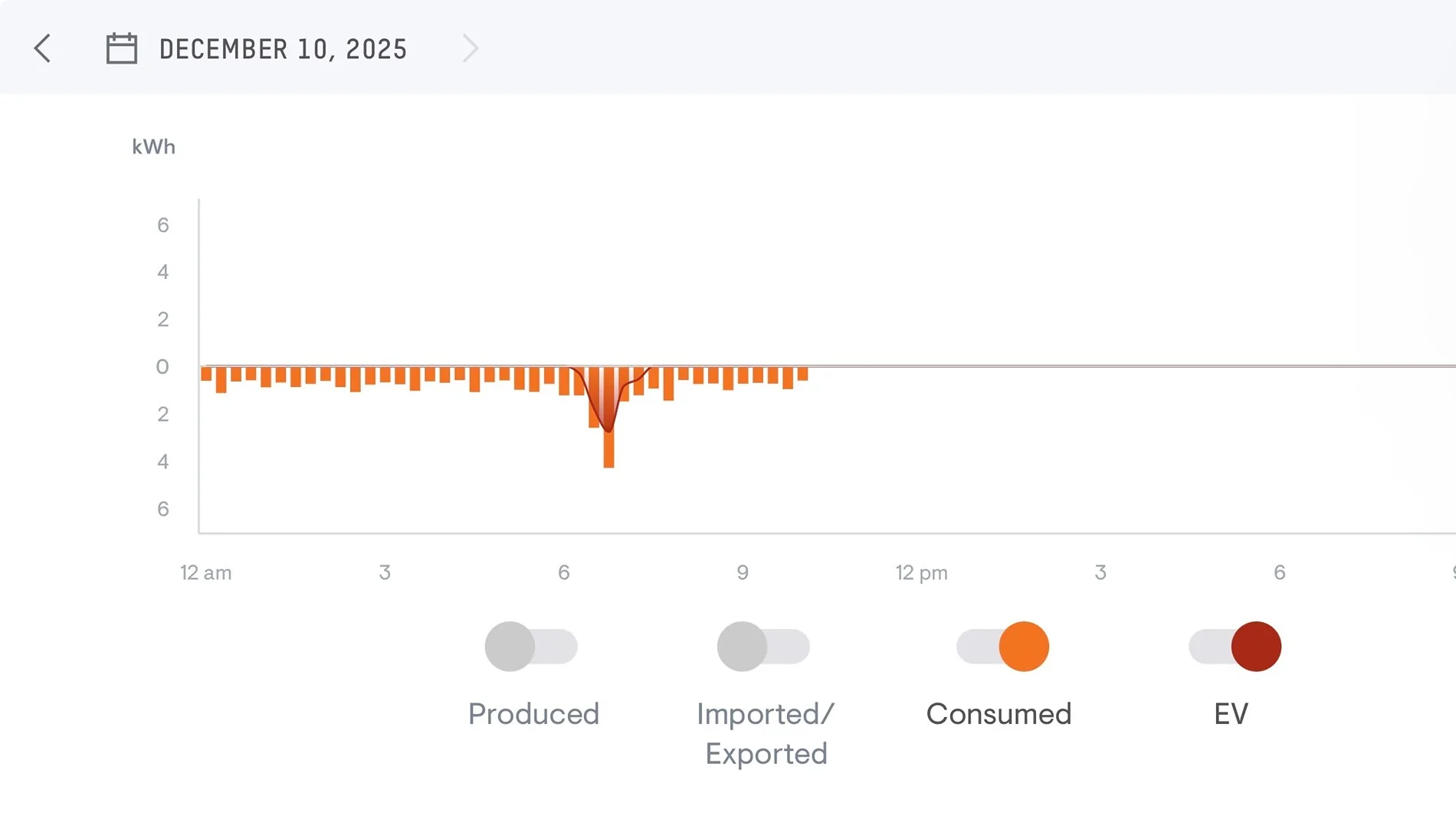
You can see the "shore power" (what comes in through the plug) from my enphase app. As @MachLee says (Hat Tip again), keep it plugged in. I used about 4 kw at peak of power to heat the battery and to heat the cabin... and that's key! Granted, it wouldn't have mattered for my 1 hour commute - I would have had plenty of battery even if I took that heating power out of "portable energy." In fact, when I leave from work, where I can't plug in, the temperature will be higher, but I can't warm the battery off of shore power. And it'll be fine.
[edit: I originally missed a decimal, as pointed out below. I thought it was more useful to talk about the peak power, but if you average it, it’s probably about 2.5]

Moving it to personal experience, like most humans on the planet, my definition of cold doesn't start with molecules moving too slow to excite temperature above -10 C. My "cold" starts at the freezing point of water, so [checks high school chemistry notes...] that's 0 C and 32 F. For me, in my climate, sizing my transportation for -10 C would be like sizing my house's heat pump to -10 C.
My Carrier unit does a great job down to about -10 C, but lower than that, it has a hard time keeping up. The smart people at Carrier thought about the ends of the bell curve, however, and added a little resistive heater in the air handler. And yeah, every other year, we'll get one or two polar vortex-es in DC and the Carrier will struggle. It won't fail. It will, as I said, struggle. Sure, I could have dug a well to do a geothermal-assisted heat pump if I really wanted, but I'm not putting that capex into a unicorn that's getting more rare (extreme cold). So I lower the temperature on the thermostat and embrace my inner "Calvin's Dad." Everyone puts pants and a sweater on and sucks it up for the 1/52nd of the year every other year. Seriously, why do teens think shorts in winter and complaining about cold is a winning formula?
If you've read about the 2025 MME heat pumps, you know that Ford came up with a similar solution as Carrier. The temperature range is different, and I'm aware that a car is not a house, but the concept is the same: solve for the near ends of bell curve and don't solve for the far ends of the bell curve. I don't have a 2025, I have a 2024, so I've got the 5kw resistive heater alone. No heat pump for me.
In my 2024 today, I woke up before sunrise to get kids off to school. I'm at about 38N latitude. It was about 30 degrees when I woke up this morning. There was high cloud cover, so not a lot of greenhouse effect (in the car). As @MachLee advises, I had a departure time set. My departure time was 7:15 AM, but I had to answer an email before I left, so I actually left for work at about 7:30 AM. The sun was up and the battery was still toasty (lots of thermal mass). I was wearing a Tech Worker uniform (button up shirt, brown pants, and a fleece). I had on the heat seater (auto) and the heated steering wheel as I would have in my Sienna (actually, no heated wheel there).
My route is about 30 miles to work. It's a mix of highway fast, highway stop-and-go, and surface streets. It's almost evenly divided. It takes me about an hour to get to work. About 20 minutes in, I was getting a little too toasty, so I turned the heat off and just ran the fan (on low) to get some fresh air. When I was waiting at a long light in South Reston, here's what I saw.
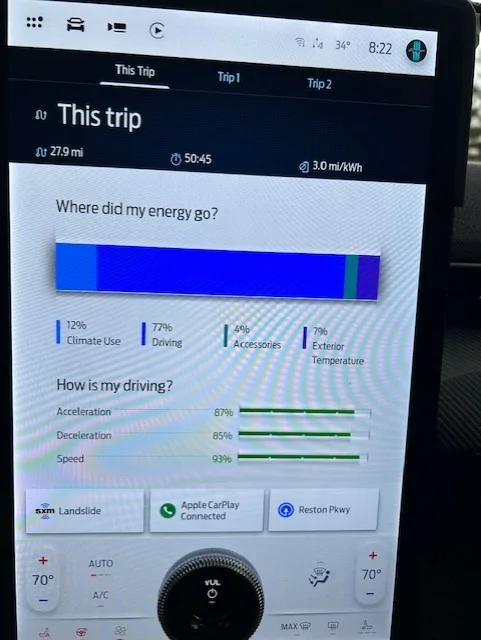
I was getting 3 miles per kwh, 12% of my portable energy was converted into power for climate use and 7% was spent on keeping the battery warm. "Portable energy" means "what I carry in the battery, NOT what I'm using from my plug. You can do all the math, but I don't want to lose the key point: at about 30 degrees (warming up to 34), I just drove the car like an ICE vehicle, but added a departure time (which I missed, of course!).
- I wore what I would wear in the Sienna - just my "work uniform."
- I set the temperature where I would have otherwise set it and turned on the "toasty buns and hands" feature.
- At some point, I turned off the heat (I do this in the Sienna too... at some point, I get too hot and turn the heat off).
You can see the "shore power" (what comes in through the plug) from my enphase app. As @MachLee says (Hat Tip again), keep it plugged in. I used about 4 kw at peak of power to heat the battery and to heat the cabin... and that's key! Granted, it wouldn't have mattered for my 1 hour commute - I would have had plenty of battery even if I took that heating power out of "portable energy." In fact, when I leave from work, where I can't plug in, the temperature will be higher, but I can't warm the battery off of shore power. And it'll be fine.
[edit: I originally missed a decimal, as pointed out below. I thought it was more useful to talk about the peak power, but if you average it, it’s probably about 2.5]
Sponsored
Last edited: