Definitive Range Optimization Technique

DevSecOps

Well-Known Member
First Name
Todd
Joined
Sep 22, 2021
Threads
69
Messages
4,764
Reaction score
11,624
Location
Sacramento, CA
Vehicles
'21 Audi SQ5 / '23 Rivian R1T / '23 M3P
Occupation
CISO
Country flag

RickMachE

Well-Known Member
Joined
Jul 1, 2021
Threads
267
Messages
17,903
Reaction score
27,867
Location
SE MI
Vehicles
2022 Mach-E Premium 4X, 2022 Lightning Lariat ER
Country flag
I don't have to refresh my knowledge, because once I read it, it sticks.
 

ctenidae

Well-Known Member
First Name
Alex
Joined
Jan 19, 2022
Threads
37
Messages
1,403
Reaction score
1,852
Location
Stamford, CT
Vehicles
DMG GT; Taycan, Q7, Sienna Hybrid
Occupation
Solver of problems
Country flag
Density of air at night vs. the coefficient of the permutation.
The regeneration rate for headlight fluid is much higher at night, yielding higher recombinant efficiencies in the n-space paradigms. As an adjunct to the permutation coefficients, of course.
 

ctenidae

Well-Known Member
First Name
Alex
Joined
Jan 19, 2022
Threads
37
Messages
1,403
Reaction score
1,852
Location
Stamford, CT
Vehicles
DMG GT; Taycan, Q7, Sienna Hybrid
Occupation
Solver of problems
Country flag
Every week I drive 400 miles round trip. Starting and stopping elevations are within 50' of each other. The 200 miles at 9am are always better on range than the 200 miles at 10pm. I don't know exactly why, but it's definitely a thing. I leave home with 100%SOC and arrive with 25%. I leave there with 100%SOC and arrive home with 10%. The only major difference is the time of day.
That's a bit of a pickle, there- are there enough wunderground stations on your route to get wind speed/direction data? I wonder if you have a net difference of windspeed of 15-20 mph one way vs the other? A 10 mph tailwind in the morning and a 10 mph headwind in the evening would make the difference.
 

DevSecOps

Well-Known Member
First Name
Todd
Joined
Sep 22, 2021
Threads
69
Messages
4,764
Reaction score
11,624
Location
Sacramento, CA
Vehicles
'21 Audi SQ5 / '23 Rivian R1T / '23 M3P
Occupation
CISO
Country flag
That's a bit of a pickle, there- are there enough wunderground stations on your route to get wind speed/direction data? I wonder if you have a net difference of windspeed of 15-20 mph one way vs the other? A 10 mph tailwind in the morning and a 10 mph headwind in the evening would make the difference.
The valley winds are normally southerly which would be in my favor at night. Since I do the route every single week, for the last 18 months I'm doubtful it's winds as they can't always be the same.


ctenidae

Well-Known Member
First Name
Alex
Joined
Jan 19, 2022
Threads
37
Messages
1,403
Reaction score
1,852
Location
Stamford, CT
Vehicles
DMG GT; Taycan, Q7, Sienna Hybrid
Occupation
Solver of problems
Country flag
The valley winds are normally southerly which would be in my favor at night. Since I do the route every single week, for the last 18 months I'm doubtful it's winds as they can't always be the same.
Wind speed/direction can be remarkably consistent (I've read too many wind farm plans to doubt it), so you could see very consistent outcomes, especially with a valley involved. HEre's the wind forecast for Sacramento: SACRAMENTO (KSAC) wind map and weather forecast — Windy.app with a fairly pronounced swing day to night. Wind is a good differentiator, since it effectively changes your speed/drag, and could affect the impact of air density, as well. A dense tailwind vs a light headwind could be multiplicative.
 
OP
OP
ronco

ronco

Active Member
First Name
Ron
Joined
Mar 29, 2023
Threads
4
Messages
26
Reaction score
15
Location
Arvada, CO
Vehicles
2023 Mach E California Route 1 edition
Country flag
Let me clarify my last post about this here since "omg speed" comes up on this board all the time. This way I have something to reference in future arguments :p

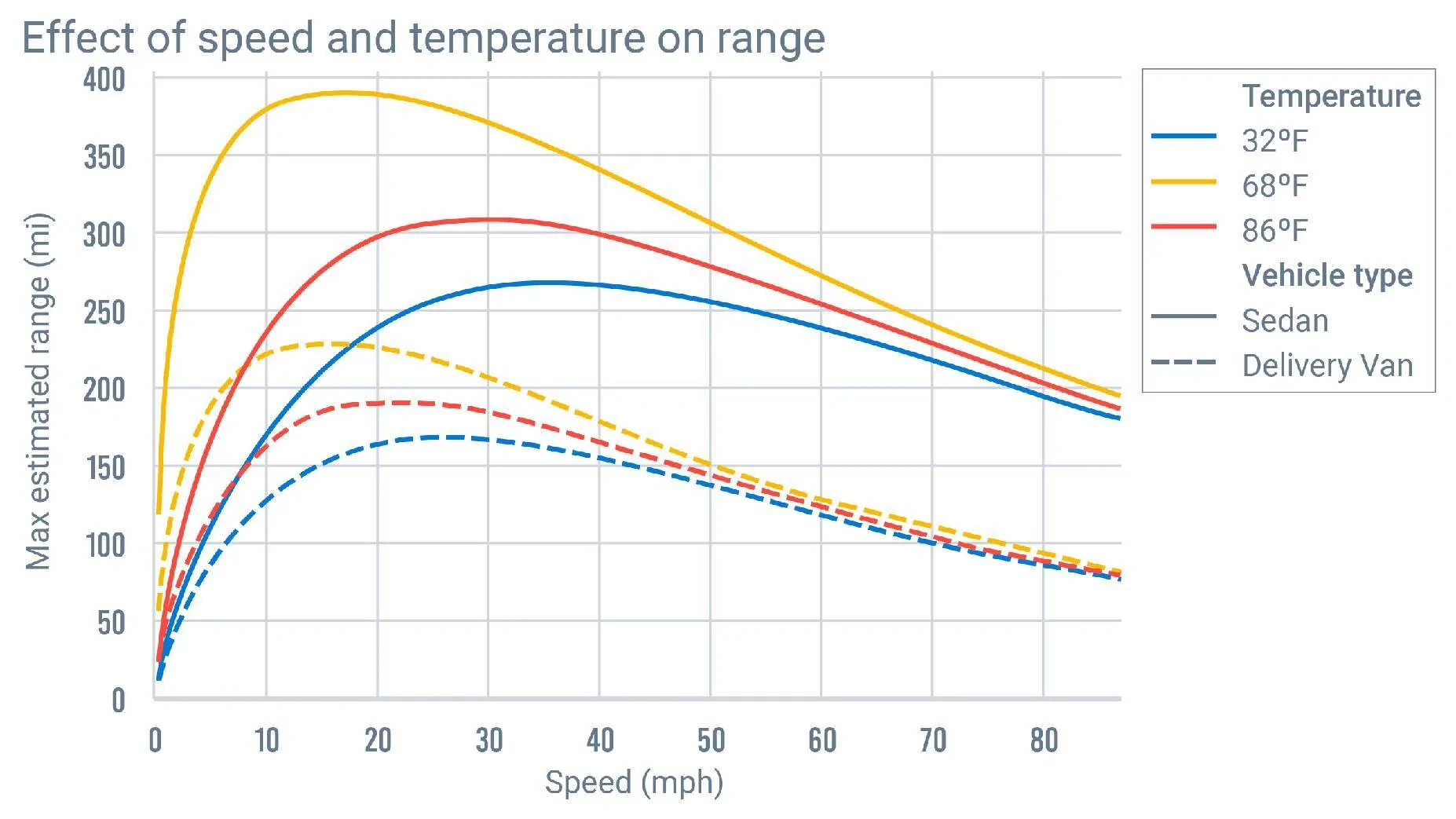
The issue with range for most EV owners is knowing what your constant is. The things we can't change and things we don't plan for are what get us in a pickle. If you decide to travel 10mph faster, that's a constant. You can plan for that. You can't however change the temperature, headwinds etc. Starting a drive with relatively calm winds, that change to strong headwinds can get you in trouble. This is due to drag, which is the same thing that increases with speed, but it's something you can't plan for as easily.

Assuming we are traveling long distance:

Facts:
- Speed will decrease your range by about 10% per 10 mph
- Optimal speed is 19mph (for all you "don't speed people")
- Range is mostly considered on long trips, not city driving
- 1pd vs 2pd on highway traveling makes no difference
- Drive modes make no difference

If we take a scenario of driving 70mph in 68F weather in an MME we will be able to drive 238 miles in 3h:24m.

If we take a scenario of driving 80mph in 68F weather in an MME we will be able to drive 209 miles in 2h:36m.

This makes for a difference of 29 miles and 48 minutes. At 80mph we can cover those 29 miles in 21 minutes.

Assuming, however, that both must stop to charge at the same station. The 80mph vehicle must DCFC for ~15kW more than the same vehicle arriving at the same charger that went 70mph, and would have to stay approximately 9 minutes longer if 100kw is being delivered via the charge unit. This will also result in an added cost of about $5, unless it's a free charge day!

The end result is a quicker arrival time at the expense of a little more energy ($) and slightly longer stops for charging. Obviously, if our goal was to get 225 miles, the slower vehicle would get there without the need to stop assuming perfect static environmental conditions. Even so, the same distance at 80mph would take 24 minutes less allowing for a quick top off of electrons which would probably get both vehicles to the same destination at the same time.

So, to recap - what is your goal? Is it to get there quickly? Or, is it to get as far as you can go without stopping? Most of the time we plan our routes and we leave 30-50ish miles as a buffer, mostly because chargers are sparse and conditions can change.

It all comes down to your comfort. I'm in my late 30's and I'm hyper. I want to get there as quick as possible. There's a lot of retired folk on this board that need to drain their bladder and walk their football sized ankle biters every 30 minutes (or refresh their knowledge of the owners manual) and don't care when they arrive.

To each their own, but in the grand scheme of things, as I said previously, drive the car however you want to drive the car and don't let people sow fear into how you're most comfortable driving. The facts have been laid out for you to make your own choices.


1682516367422.png
Wow! This is an incredible post @DevSecOps and clears up a lot for me. Knowing the way my wife works the throttle we'll be taking the drive fast and get there marginally sooner approach.
 
OP
OP
ronco

ronco

Active Member
First Name
Ron
Joined
Mar 29, 2023
Threads
4
Messages
26
Reaction score
15
Location
Arvada, CO
Vehicles
2023 Mach E California Route 1 edition
Country flag
You have an opportunity to run a (quasi) scientific study. Divide the trip into roughly similar segments, and utilize whatever combinations of settings/styles you want. Be consistent and track the results. You will have real world actionable data, and it will be especially relevant to you and how you drive.

My money is that you'll notice some difference in efficiency, though I suspect it will not be statistically significant. I'll lay a side bet that the style you have or will adopt/ed as your "regular" driving style will be 2nd most efficient, but 100% more comfortable for you.

At the very least, you'll graduate from being a n00b, and will be able to rebut any n00bie range discussions with "I actually did the study myself, and..."
@ctenidae I would love to, but we'll be driving through the Rockies. I think the slopes will create far too many moving variables for a study :(
 

ctenidae

Well-Known Member
First Name
Alex
Joined
Jan 19, 2022
Threads
37
Messages
1,403
Reaction score
1,852
Location
Stamford, CT
Vehicles
DMG GT; Taycan, Q7, Sienna Hybrid
Occupation
Solver of problems
Country flag
@ctenidae I would love to, but we'll be driving through the Rockies. I think the slopes will create far too many moving variables for a study :(
IN that case, here's your best range optimization planner:
Ford Mustang Mach-E Definitive Range Optimization Technique 1682529843194


As you can see, it'll handle a variety of variables. :cool:
 

CYBER-O

Well-Known Member
First Name
Daniel
Joined
Mar 6, 2023
Threads
7
Messages
149
Reaction score
85
Location
Richmond, BC
Vehicles
2022 Mach-E4X
Occupation
Independant IT Consultant, Lyft & Uber driver
Country flag
You can coast with 1PD enabled. It's all about the position of the accelerator pedal.
I concur. Jack rabbit starts are the killer. Feathering the accelarator pedal just the right amount is an art. If you back off too much or too quickly then you have to re-engage it to compensate and everyone knows that regen is not 100% efficient. If you can master that and achieve 100% braking efficiency then it's a moot point whether 1-pedal is on or not.
 

CYBER-O

Well-Known Member
First Name
Daniel
Joined
Mar 6, 2023
Threads
7
Messages
149
Reaction score
85
Location
Richmond, BC
Vehicles
2022 Mach-E4X
Occupation
Independant IT Consultant, Lyft & Uber driver
Country flag
Wow! This is an incredible post @DevSecOps and clears up a lot for me. Knowing the way my wife works the throttle we'll be taking the drive fast and get there marginally sooner approach.
Move her seat back so she can't push the pedal as far!
 

AliRafiee

Well-Known Member
First Name
Ali
Joined
Jan 20, 2023
Threads
103
Messages
3,267
Reaction score
4,191
Location
Seattle WA
Vehicles
2022 Mach E GT - Grabber Blue
Occupation
Software Eng.
Country flag
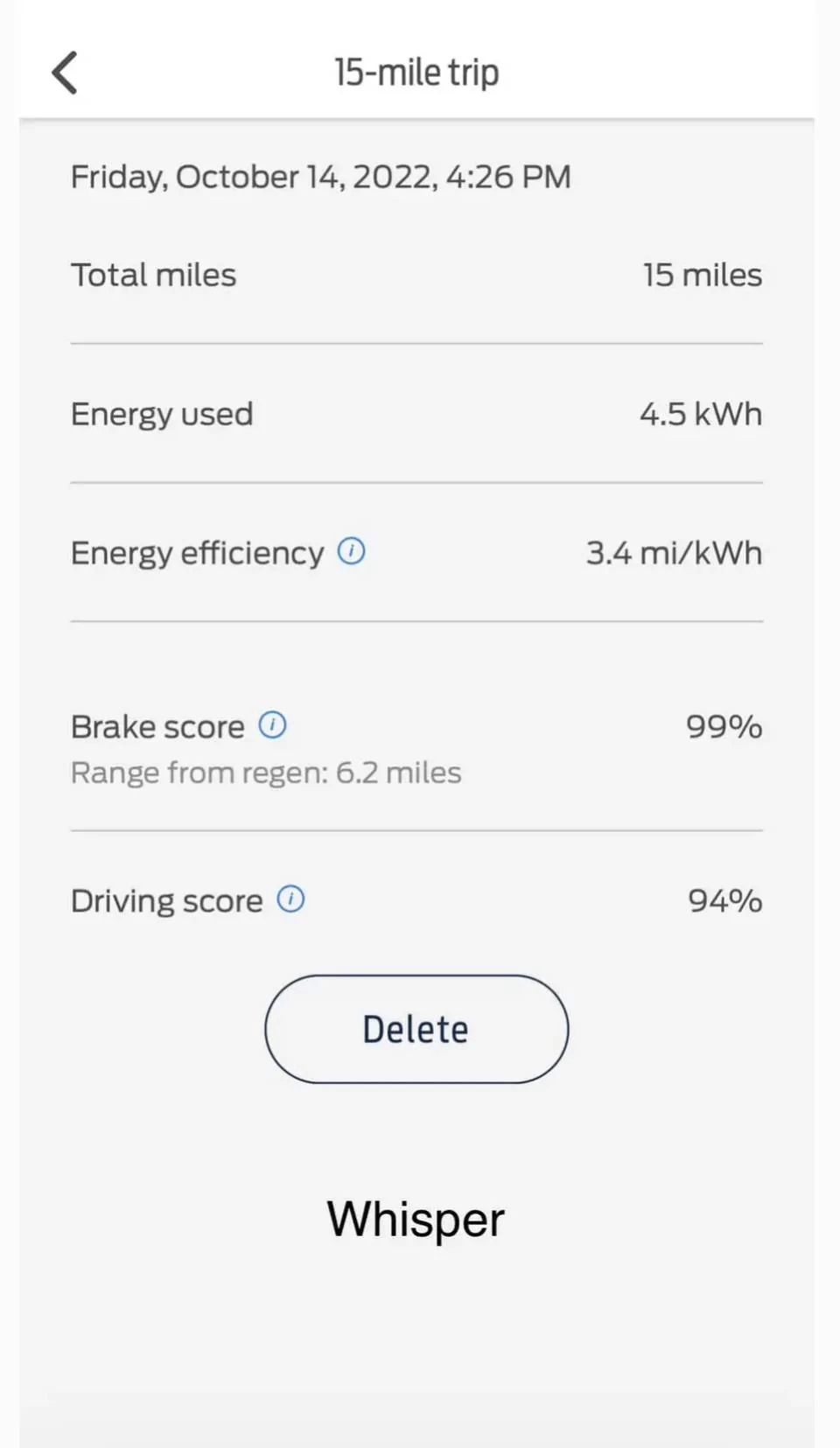
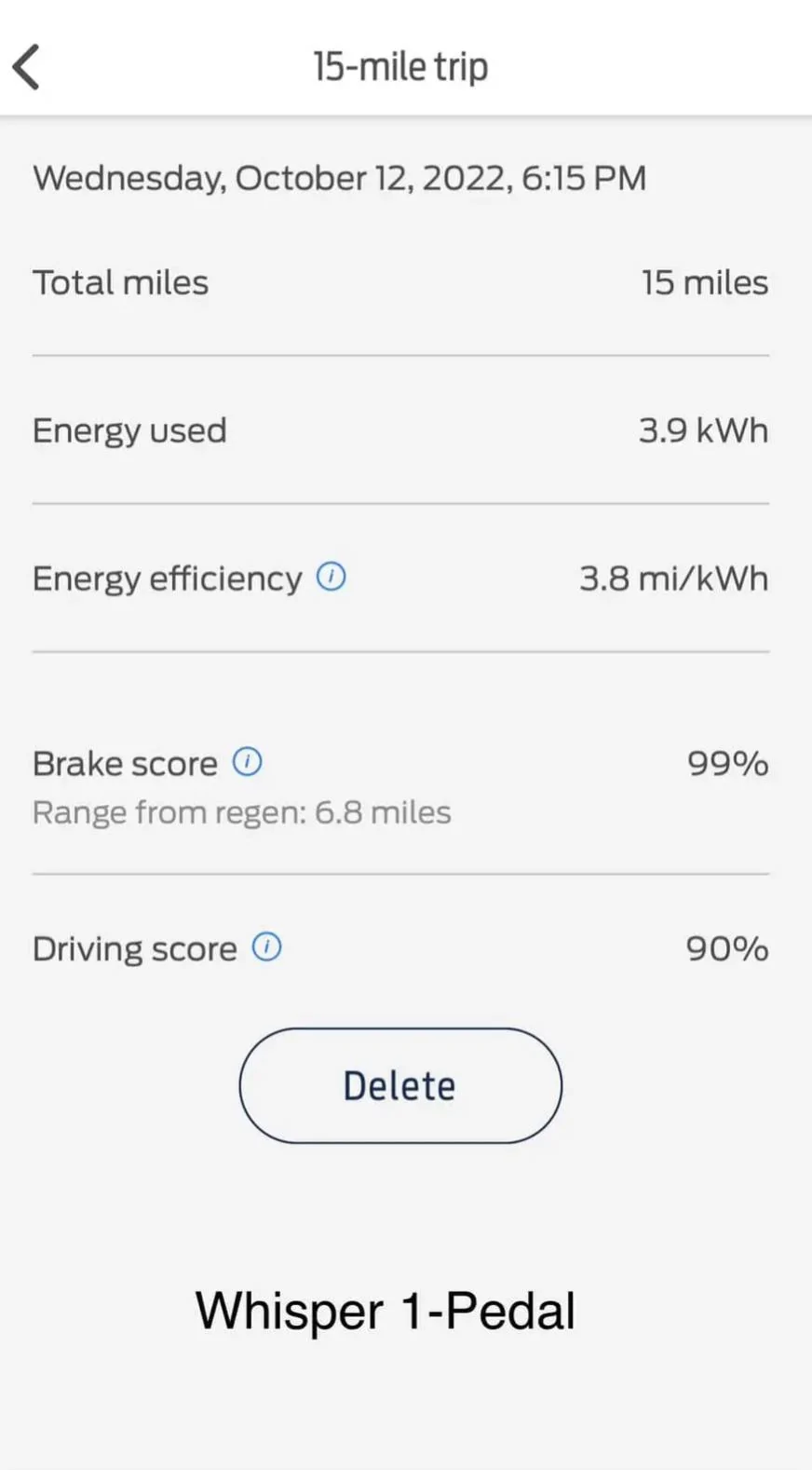
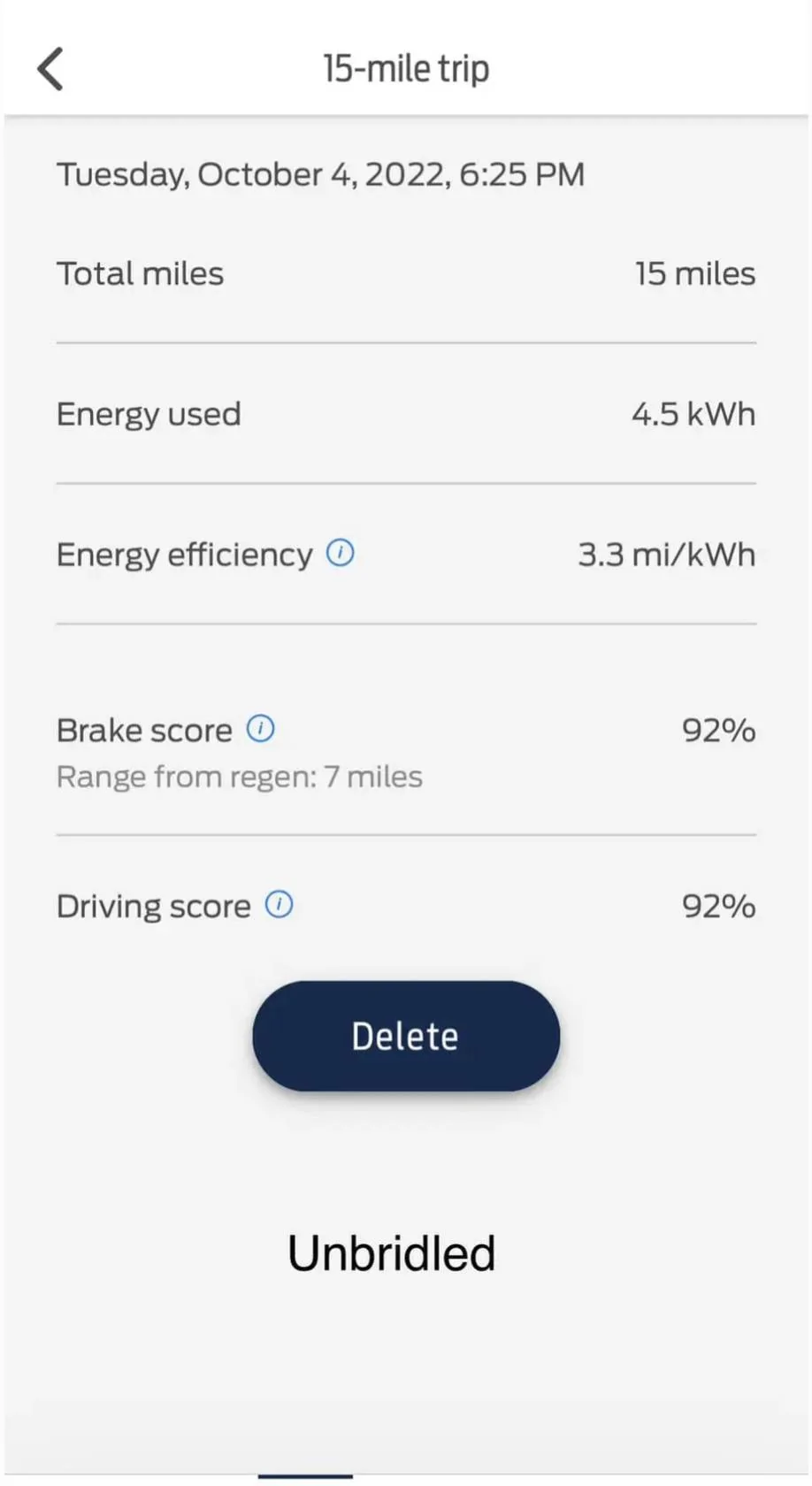
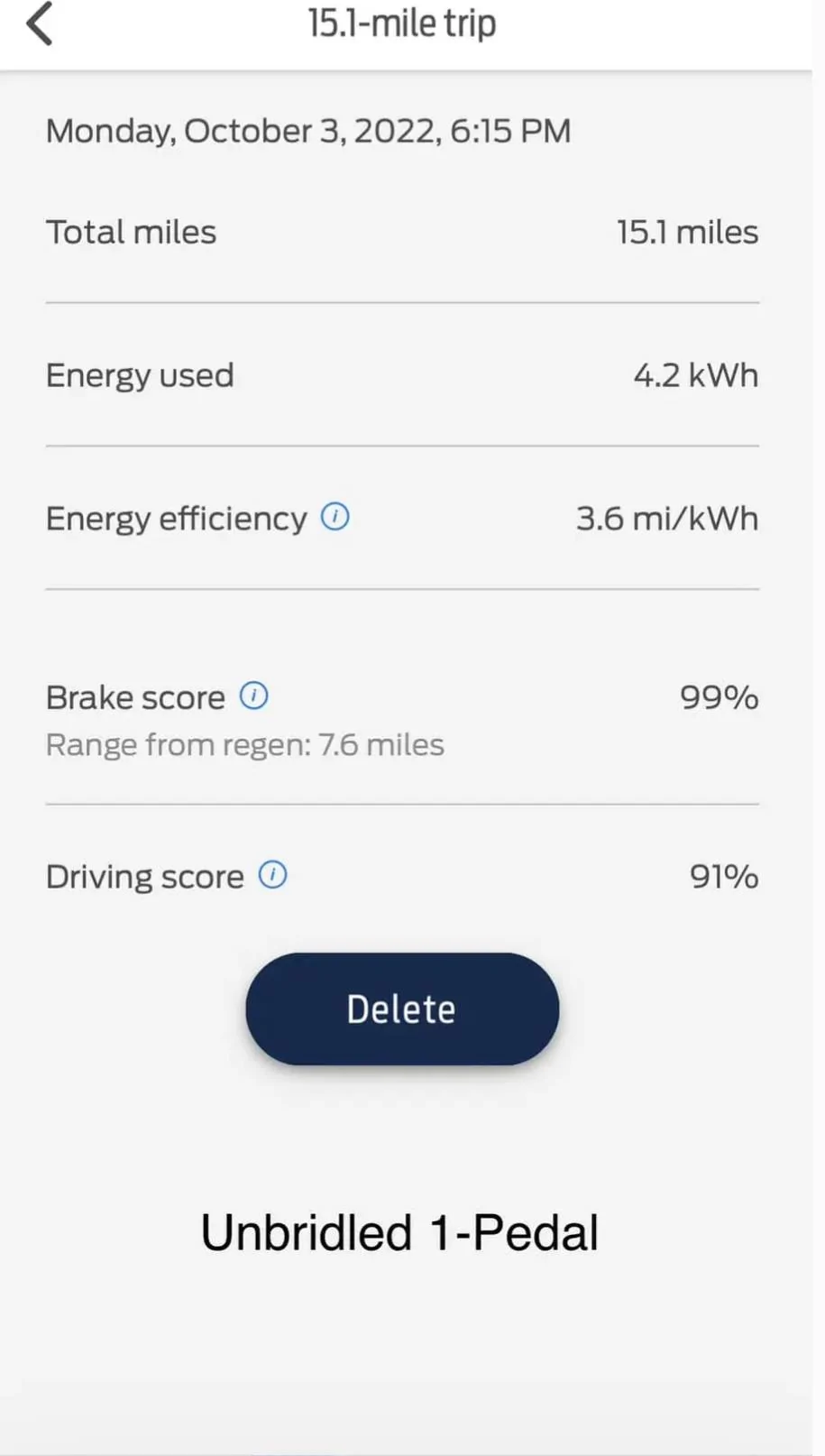
I did a comparison on all drive modes with and without 1-pedal.
I drove the same route, same time of day with each mode. This was my 15 mile commute from home to work, avg speed of 35 mph.
I used the logs in FPA for the results.
The difference was negligible. I can’t remember the exact numbers.
I posted the results in one of the Facebook pages.
I’ll try to find it.
 

bbulkow

Well-Known Member
First Name
Brian
Joined
Aug 30, 2022
Threads
24
Messages
889
Reaction score
729
Location
menlo park, california
Vehicles
Honda CRV
Country flag
Ok. So my main takeaways are:
  • Always use cruise control
  • Don’t be a speed demon
  • And I’m gonna switch to 2PD. Although @mkhuffman ’s study shows you can be equally efficient in either mode, it seems it takes less effort to drive efficiently in 2PD
I hope that (plus driving in warmer weather) will take us as far as possible on our trip.
Hi, here are my thoughts.

1. Over my first nearly 4,000 miles, the average spend on climate control is 10%. Average. Go to "trip 2" and you can see your value. Want 10% better range (which is a ton)? Turn off all climate control before you start. I get the most comfort by turning on the fan and NOT heat and AC. I use the heat and AC like a normal person (love those heated seats!) when I know where my next charge is, don't get me wrong :).

2. There will be an optimal speed for range. It's not 1mph, it's not 100mph, so it's somewhere between. I find I like about 67 for a nice combination of range and efficiency, although if I was on a road trip I could do a more sensible optimization. 75 burns electrons.

3. Cruise control behind another vehicle (eg, semi) with cruise distance set to minimum seems to give about 10% gain too. While this seems bad for normal driving where you rely on human vision, on cruise control, the huge radio signature of a semi's rear (or any other large truck) might well be safer than driving behind a car. If you trust cruise control. The trick is finding a truck going your way and speed and hitching a ride. I like the next-to-slowest lane, set the cruise control fairly high (70) until I pick up a truck, then we'll settle into 65 or so and I see the range go up fast. Finding a car to befriend is better than being in the lead. On bicycle, we know the follower has about a 10% improvement at about 20mph (at least, I get 20 watts delta out of roughly 200 watts using my power meter when cycling with a well trained peloton). I'd rather be behind a fairly boxy minivan at 70 than alone at 65, is my feel. Wish I had real data.

4. Avoid physical brakes. The key is knowing in which situations you overrun the regen braking, and in what braking situations you don't. This is the same as the "brake coach" you can turn on (100% is all regen). However, I don't think you can really train without the power meter, which has blue for expending energy, green for regen, but has a stop line deep in the green - when you hit that, you're applying the physical brakes. All other EVs have this feature and it's crazy that Ford requires ForScan to enable it. Keep an eye on that and you can train yourself to always be in regen (it's on the left lower corner when you enable it).

I think the greatest efficiency is also not to coast: try to be accelerating (even a little) or be braking to regen. I don't know why, it's like maybe the regen is inefficient at very low drag rates and is more efficient at higher power. This is entirely a guess but I've seen other drivers score better range with jerkier driving.

5. When you are in 1PD and 2PD, it is a matter of training to avoid physical brakes. Coming out of cruise control at high speed is one of the easiest way to end up using the physical brakes. I've found it's hard in a lot of situations to avoid at 65 mph. I like the physical convenience of 1PD, so when coming out of cruise control, I use the speed control to drop to 55mph as the offramp is coming up. Then I engage the accelerator slightly, then I turn off cruise control on the steering wheel, then I take it from there manually. Or I just grab a little throttle and turn off manually and avoid the step of dropping the speed. Using 1PD and hitting the brake to disengage cruise control is an easy way to engage the physical brakes according to the power meter.

6. I can make up two arguments about whether 1PD or 2PD is physically easier. 2PD has "more throw" because you've got (say) 1 inch of acceleration and 1 inch of brake, which is 2" of throw. If you use 1PD you might have 1 inch of accelerator throw covering half the brake action, and an extra half inch on the brake, so you've got less physical throw across the entire control range thus less accuracy. On the other side, with 2PD you have to change pedals, and that always introduces some slight inaccuracy when you land (the reason rally drivers learn to drive with one foot on each pedal). But then, you might argue 1PD whisper is pretty good, because you can be more sensitive on the throttle (this is the setting I use). I think that's all a very minor effect and you can train yourself one way or the other, compared to the 10%'s at the top of the list.

I think the reality is stay in regen and you're in good shape. I've noticed my GF has a more stop-and-go style and she gets better scores from the ford efficiency app! Coming down from speed faster is better (less time at speed?) as long as you don't overrun regen.
 
Last edited:

GuliblGuy

Well-Known Member
First Name
Justin
Joined
Apr 8, 2021
Threads
20
Messages
710
Reaction score
1,356
Location
North Tustin, CA
Vehicles
Eruption Green 2025 GT Mach E
Country flag
That's a bit of a pickle, there- are there enough wunderground stations on your route to get wind speed/direction data? I wonder if you have a net difference of windspeed of 15-20 mph one way vs the other? A 10 mph tailwind in the morning and a 10 mph headwind in the evening would make the difference.
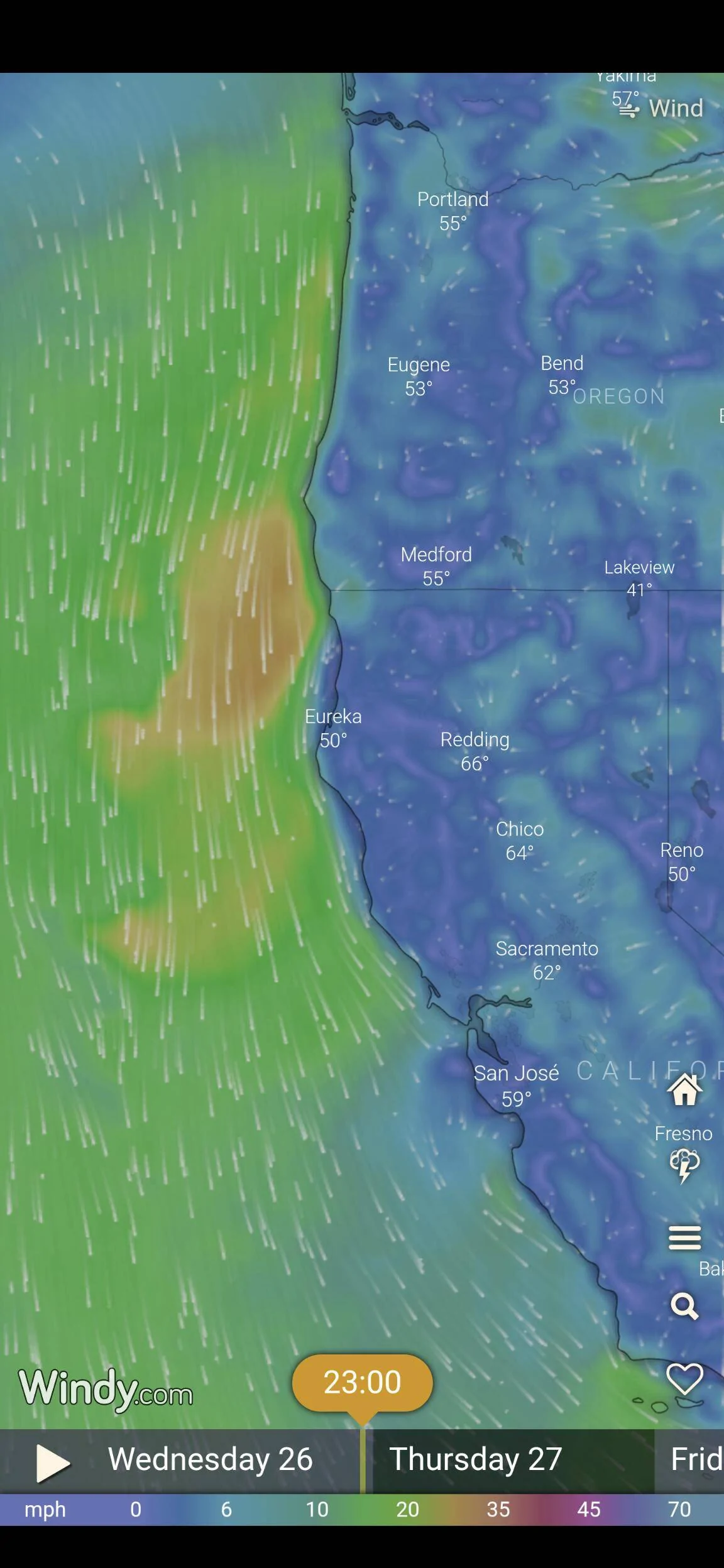
There's a great free app called Windy which you can use to see how the wind is blowing further along on your route and help you plan accordingly. Here's a screenshot I just took.

Ford Mustang Mach-E Definitive Range Optimization Technique Screenshot_20230426-230705
Sponsored


Top