
Stupid Physics Question

Kamuelaflyer

Well-Known Member
First Name
Bill
Joined
Feb 18, 2020
Threads
11
Messages
11,311
Reaction score
22,858
Location
Hawaii
Vehicles
2021 Premium Infinite Blue. ER AWD. 2020 Raptor, 2021 Ranger.
Country flag
He can go maybe 100 miles in his ICE on 2.7 gallons.
2.7*17=45.9. Unless you can find a 44.1 mile downhill stretch. I’ll be the ugly red truck blocking traffic along the main business street in either Kona or Hilo with that little gas. I’d be calling the tow truck a lot earlier driving my Tacoma that my Mach-e.

I’ll take the “less efficient storage” and more efficient energy conversion.
Sponsored

 

ripperAZ

Well-Known Member
First Name
Ripper
Joined
Mar 4, 2022
Threads
17
Messages
724
Reaction score
949
Location
AZ DESERT
Vehicles
2022 Ice White Mustang Mach E AWD EX BATT
Country flag
I’m just going to go with the spinal tap method of determining power and efficiency

“Our amps go to eleven (11) not ten (10)”

jes sayin. Burp !
 

SnBGC

Well-Known Member
First Name
Greg
Joined
Apr 20, 2020
Threads
46
Messages
5,962
Reaction score
9,778
Location
Phoenix
Vehicles
2021 Mach-E FE, 2021 Wrangler 4xe High Altitude
Occupation
Manager
Country flag
Right. I was going in that direction BUT a friend of mine keeps insisting that gasoline is the most efficient way to store energy (short of leveraging nuclear bonds). He references the energy density per kilogram. So, I’m trying to rationalize the amount of energy required to move a certain distance (I’m going to simplify the problem by saying both vehicles are using the same amount of energy and moving equal distances - yes, I know those are incorrect assumptions, but order of magnitude, they will work for this problem).
While the energy density per kg in gasoline is high, the device that extracts that energy is quite inefficient.
 

sotek2345

Well-Known Member
First Name
Tom
Joined
Aug 30, 2021
Threads
4
Messages
920
Reaction score
1,328
Location
Upstate NY
Vehicles
2021 Mach-e GT, 2017 Raptor, Lightning (9/5 Build)
Occupation
Engineering Manager
Country flag
While the energy density per kg in gasoline is high, the device that extracts that energy is quite inefficient.
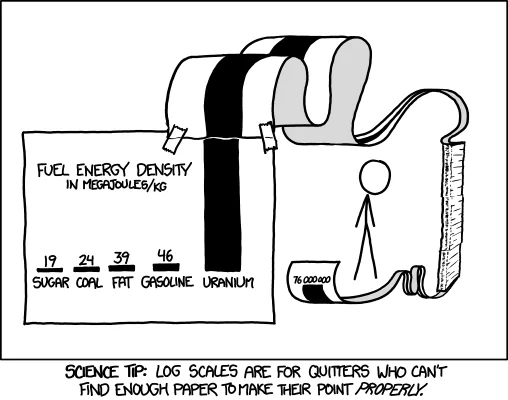
Nuclear guys hear laughing at all the folks saying the energy density of gasoline is high!

Ford Mustang Mach-E Stupid Physics Question Log_scal


MBCook

Well-Known Member
Joined
Mar 20, 2022
Threads
23
Messages
392
Reaction score
622
Location
USA
Vehicles
2021 Mach E AWD ER, Infinite Metallic Blue
Country flag
Can’t argue with XKCD.

If we could could make gasoline cleanly and very efficiently, and at the other end turn it back into energy just as cleanly and efficiently it would be a wonderful fuel.

But between the terrible efficiency already pointed out and the abysmal externalities batteries seem to be our most reasonable option at the moment.
 

SnBGC

Well-Known Member
First Name
Greg
Joined
Apr 20, 2020
Threads
46
Messages
5,962
Reaction score
9,778
Location
Phoenix
Vehicles
2021 Mach-E FE, 2021 Wrangler 4xe High Altitude
Occupation
Manager
Country flag
Right. I was going in that direction BUT a friend of mine keeps insisting that gasoline is the most efficient way to store energy (short of leveraging nuclear bonds). He references the energy density per kilogram. So, I’m trying to rationalize the amount of energy required to move a certain distance (I’m going to simplify the problem by saying both vehicles are using the same amount of energy and moving equal distances - yes, I know those are incorrect assumptions, but order of magnitude, they will work for this problem).
That is easy, because we have real world example to look at.
Take two 2017 Ford Focus vehicles. One ICE and the other BEV. These were actually produced.

The ICE will consume 1 gallon of gasoline in 35 miles which just under 1 mile per kW.
The BEV version will consume the same 1 gallon of energy equivalent in 140 miles which is right at 4 miles per kW.

The BEV will travel 4 times as far with the same energy......and it weighs 20% more.
 

timbop

Well-Known Member
First Name
Tim
Joined
Jan 3, 2020
Threads
65
Messages
6,832
Reaction score
14,036
Location
New Jersey
Vehicles
Solar powered 2021 MME ER RWD (CA RT1)
Occupation
Software Engineer
Country flag
If I borrow my friend’s ICE Escape, fill the tank, weigh the vehicle, drive it until the vehicle stops running (I.e., is out of gas), then weigh it again, the vehicle will weigh a bit less. Specifically, it will weigh one tank full of gas less, or whatever about 15 gallons of gas weighs. (Anyone know where I’m going? ?)
If I fully charge my Mustang Mach E, weigh I, then drive it until it stops (I.e., drain the HVB), then weigh the car again, what will the difference in weight be?
What’s going on here?
A tailpipe?

Nothing physically leaves a BEV as you convert potential energy into kinetic energy, but lots of noxious fumes float out of the back of an ICE. Tons per year, in fact. Someone should do a study to see what harm that causes....
 
Last edited:

EV_Pilot

Active Member
First Name
Scott
Joined
Apr 7, 2022
Threads
2
Messages
32
Reaction score
118
Location
Kansas City Metro
Vehicles
2022 MME Premium AWD, 17 Ridgeline, 13 Leaf(sold)
Country flag
If I fully charge my Mustang Mach E, weigh I, then drive it until it stops (I.e., drain the HVB), then weigh the car again, what will the difference in weight be?
What’s going on here?
I believe there would be zero change in vehicle weight, or more scientifically vehicle mass. The electrons in the HVB will have just shifted from a charged to discharged state. You will then plug the car in and apply energy which will move the electrons back to a charged state.
 

RetiredDP

Well-Known Member
First Name
Steve
Joined
Mar 30, 2020
Threads
5
Messages
569
Reaction score
627
Location
Camino, CA
Vehicles
Focus RS
Occupation
Retired Director of Videography, Editor, Compressionist
Country flag
Right. I was going in that direction BUT a friend of mine keeps insisting that gasoline is the most efficient way to store energy (short of leveraging nuclear bonds). He references the energy density per kilogram. So, I’m trying to rationalize the amount of energy required to move a certain distance (I’m going to simplify the problem by saying both vehicles are using the same amount of energy and moving equal distances - yes, I know those are incorrect assumptions, but order of magnitude, they will work for this problem).
Irregardless of the energy density of gasoline, gasoline's energy has to be burned in an explosion to change the energy into a useful form of propulsion. Gas engines are usually only about 20%-25% efficient in producing useful energy, with 75%-80% of the energy wasted as heat...which causes global warming.

All of this wasted heat energy also requires gas cars to have large complicated cooling systems, to get rid of all this heat. All of this heat requires oil to lubricate parts, which then wears out from the heat, requiring replacement of oil and car parts.

Electric motors don't need to heat something to work, and are 90%-95% efficient. Gasoline is energy-dense, but hugely energy-wasteful. Electric motors don't damage the planet, and in states like California with 70% hydro-solar-wind generated power, generating the electricity is mostly non-polluting as well. Gas is a dead end.
 

voxel

Well-Known Member
First Name
Nelson
Joined
Sep 6, 2021
Threads
27
Messages
2,032
Reaction score
1,858
Location
Altamonte Springs, FL
Vehicles
22 Mach-E 4X, 23 GC Limited
Occupation
Software Engineer
Country flag
Irregardless of the energy density of gasoline, gasoline's energy has to be burned in an explosion to change the energy into a useful form of propulsion. Gas engines are usually only about 20%-25% efficient in producing useful energy, with 75%-80% of the energy wasted as heat...which causes global warming.

All of this wasted heat energy also requires gas cars to have large complicated cooling systems, to get rid of all this heat. All of this heat requires oil to lubricate parts, which then wears out from the heat, requiring replacement of oil and car parts.

Electric motors don't need to heat something to work, and are 90%-95% efficient. Gasoline is energy-dense, but hugely energy-wasteful. Electric motors don't damage the planet, and in states like California with 70% hydro-solar-wind generated power, generating the electricity is mostly non-polluting as well. Gas is a dead end.
I argue for one special case where gas could be more efficient even with the massive energy losses and that's in sub-freezing climates. The excess heat generated has uses in extreme cold environments. BEVs need to use resistive heating + heat pumps to warm up batteries and the cabin and generally have terrible winter efficiency figures.

I've always argued that PHEVs were best for extreme cold climates where the battery can warm up the gas engine (RAV4 Prime does this) then some of this excess heat from combustion makes it way back into warming the cabin + batteries via heat pumps.
 

drg1012

Active Member
First Name
Dave
Joined
Mar 10, 2022
Threads
3
Messages
42
Reaction score
59
Location
Colorado
Vehicles
2022 MME Premium
Occupation
Mechanical Engineer
Country flag
it will be a little bit less heavy....
but - it is like an elephant with or without a fly on top (the difference is really hard to measure)
The reason for the difference in weight is E = m *c^2
E=mc^2 is valid in a nuclear reaction - i.e. nuclear fusion or nuclear fission. If any mass was converted to energy, we have a Hiroshima level problem - very, very, very bad. When there is no nuclear reaction, we revert to classical physics - in which matter is neither created or destroyed and energy is neither created nor destroyed (it just becomes less useful - all the chemical energy in the battery gets converted to heat - heat in the motors, the inverters, the tires, the brakes - if you stop really quickly, and most of all - friction with the air.). The battery doesn't gain or lose mass during charging or discharging. The anode and cathode of the battery change chemical composition during those processes - nothing else. Now, if you really want to pick nits, the tires lost some tread and weight slightly less after each trip, you may pick up some dirt as you drive, etc... But the battery does not change mass, and assuming you haven't moved it to the moon in the process and are thereby subject to a different gravitational force, weight doesn't change either.
 

drg1012

Active Member
First Name
Dave
Joined
Mar 10, 2022
Threads
3
Messages
42
Reaction score
59
Location
Colorado
Vehicles
2022 MME Premium
Occupation
Mechanical Engineer
Country flag
The original question was whether or not an MME/electric vehicle changes weight when the battery is discharged. The answer is no. Many of the replies went in the direction of efficiency and environmental "friendliness". The answer to whether a given electric vehicle is more efficient or cleaner than a gas engine is - no one on this thread can answer that question. It requires "facts not in evidence" - i.e it depends on a plethora of factors. In an ICE engine, the fuel is gas. ICE engines are fairly inefficient at converting chemical energy in gasoline into mechanical energy. Generally about 2-35% of the "available" energy in gasoline is converted into mechanical energy depending on your operating regime (for example an idling gasoline engine is essentially just converting chemical energy into heat with no useful mechanical energy - a complete and utter waste). For an electric car, you need to know the SOURCE of the electricity to answer this question. If you have solar panels on your house, they are probably getting about 18-22% efficiency in converting sunlight into electricity. Your electric car is extraordinarily inefficient in converting sunlight into mechanical energy in this scenario - but very "clean". If your source of energy is the coal plant down the road, that plant probably converts about 50% of the available energy in the coal to electricity, you then have transmission losses in the electrical wires and transformers before it gets to your house, but you still end up with probably a good 40% efficiency - far better than that ICE engine, but probably not very "clean". There are also lots of other factors such as the energy and pollution created in producing those lithium ion batteries, etc. At then end of the day, here's the only math that matters to me - I can buy my electricity from my local utility at night on a time of use plan for 6.7 cents/kwh. This translates to better than 2 cents/mile of energy cost. At $5/gallon for gasoline, I need an ICE engine that gets 250 miles/gallon to be as cost "efficient". That doesn't exist - so my electric car is much, much, much, much more COST efficient than an ICE engine...
 
Joined
Mar 29, 2022
Threads
3
Messages
14
Reaction score
4
Location
LA
Vehicles
Mach E premium grey
Country flag
E=mc^2 is valid in a nuclear reaction - i.e. nuclear fusion or nuclear fission. If any mass was converted to energy, we have a Hiroshima level problem - very, very, very bad. When there is no nuclear reaction, we revert to classical physics - in which matter is neither created or destroyed and energy is neither created nor destroyed (it just becomes less useful - all the chemical energy in the battery gets converted to heat - heat in the motors, the inverters, the tires, the brakes - if you stop really quickly, and most of all - friction with the air.). The battery doesn't gain or lose mass during charging or discharging. The anode and cathode of the battery change chemical composition during those processes - nothing else. Now, if you really want to pick nits, the tires lost some tread and weight slightly less after each trip, you may pick up some dirt as you drive, etc... But the battery does not change mass, and assuming you haven't moved it to the moon in the process and are thereby subject to a different gravitational force, weight doesn't change either.

Agree, Back to Physics. Energy stored has many forms. In gasoline, it's chemical energy stored and released when combust with oxygen. The final products are heat and gases that went to the exhaust, so the car loses weight.
In battery, energy is stored as potential energy that were reversed by your charger voltages to push the electrons to the opposite side ( kinda like compress a spring) and it releases as you unplug and drive as the electrons are streaming downhills by potential (similar to the compressed spring starts to push back to its equilibrium location)

So in later, there's no gain/lose in weight, energy has many forms and not all are stored as mass. Same mass can have different potential energy (i.e. with vary speed and thus different kinetic energy).


Top