
Mach-Lee
Well-Known Member
- First Name
- Lee
- Joined
- Jul 16, 2021
- Threads
- 262
- Messages
- 11,345
- Reaction score
- 24,966
- Location
- Wisconsin
- Vehicles
- 2022 Mach-E Premium AWD
- Occupation
- Sci/Eng

- Thread starter
- #1
I've been seeing a lot of reports about problems with window fogging in cold temps, so I wanted to do a write-up and analysis on this. Basically, fogging is going to be determined by the laws of physics or psychrometrics. Fogging will depend on how cold it is and how many people you have in your car.
Why do the windows fog?
Fogging will occur when the window glass is colder than the dew point of the cabin air. In other words, if dewpoint > glass temperature, then you get fogging. So to eliminate fogging, you can do two things. Raise the temperature of the glass, or lower the dew point of the air. Once dewpoint < glass temperature, then the fogging goes away. We can raise the temperature of the glass using defrost. In the summer, we can use the A/C to dehumidify and lower the dew point. But in the winter, the A/C system is inhibited when it's below freezing outside (<0ºC/32ºF). However air that is cold is also very dry (low in dew point), so rather than needing A/C, we just need to take in more fresh air from outside to lower the humidity level in the cabin.
When it's very cold outside, such as -20ºC or -4ºF, the amount of humidity in the cabin that causes the windows to fog is actually very low. If the windows are the same temp as the outside (-20ºC) and the cabin is warm (20ºC), the fogging threshold is only about 4% relative humidity (see table). If it's -30ºC outside, the threshold is even less, only about 1.5% humidity! The act of simply breathing inside the car is enough to fog the windows in these conditions.
In summary, when it gets extremely cold outside, the humidity threshold for fogging becomes extremely low, which is why it's difficult to avoid.
You are a Humidifier
Mammals constantly emit moisture. The inside of our lungs are moist, so we always exhale humid air. Our skin is also porous and allows water vapor to escape. You can see this if you hold your hand by a cold window (or breathe on it), it will fog. This is where the moisture that fogs the windows comes from—your body.
There can be other sources of moisture in the car as well, such as snow or water on your boots or mats, a wet jacket, wet hair, snow brush, or hot drinks. These can make the problem worse.
It's hard to quantify how much humidity a person emits, it depends on temperature, relative humidly, exposed skin, breathing rate, etc. Talking can also significantly increase your humidity output.
For these models, I've settled on a very conservative humidification rate of about 30 mL/hour per person. This is also called insensible water loss. The rate can be much higher if you're large, talking, or breathing heavily.
Model Assumptions
Above are the results. Based on the moisture dilution with outside air, I calculated the outside temp where the cabin dew point would be above the outside air temp (fogging threshold). For example, with two people in the car with defrost running, it may fail to keep the entire windshield clear if the outside temp is below -23ºC or -9ªF. About 256 CFM of air would be entering the cabin, but only at a temp of about 7ºC/44ºF with the 5 kW PTC heater. If you have a 7 kW heater, then you'd have a vent temp of about 18ºC/65ºF.
This fogging model isn't perfect, because it doesn't account for the local heating effect on the glass by the defrost vents. In reality, you'd probably have a windshield that's clear at the bottom by the vents, but may be foggy at the top. The amount of clear space you'd have would get worse the further below the threshold the outdoor temp is. In other words, the model is predicting what unheated glass would do (such as the side window near the B pillars or the very top of the windshield).
This model assumes highway speeds with lots of wind (convection) cooling off the windows to the ambient temp. If you are driving slow or are parked, the glass will be warmer and fogging will be less than predicted.
Relative humidity of the outside air can also make a difference in the results. Typical winter relative humidity is around 80% (it's often more than 50%, especially at night). Higher RH% will make it a bit more difficult to clear the fogging, lower RH% will make it easier. Last, I should also explain is the fogging threshold would actually be higher with a lower blower speed. This is because the dew point in the cabin would be higher with less fresh air introduction.
To make things simple, I made a "Will it Fog" chart based on the outside temp and the number of occupants in the vehicle. If the table says YES, you have a risk of not being able to keep the windshield completely clear.

Results will vary. You may see stubborn fog sooner or later depending on the exact moisture and HVAC conditions in your cabin.
Conclusions
In terms of HVAC settings, I typically recommend using AUTO as much as possible. If you get fogging, open the HVAC menu and select the front defrost mode button (stage 1). If that still doesn't clear it, then you will need to select the MAX Defrost button (stage 2). Minimize blower speed and MAX Defrost time as much as possible to preserve cabin heat. The higher the blower speed, the colder the air will be. Advanced users may be able to tweak the blower speed with defrost selected to optimize cabin heat and fog removal (they are a tradeoff). If fogging gets really bad, you might have to pull over to give the glass a better chance at warming up with defrost.
Remember to change your cabin air filter every 15,000 miles or 25,000 km. A dirty cabin air filter will reduce your defrost capability.
In the extreme cold, always try to run remote start for 15+ minutes or set a departure time to warm up the cabin and glass as much as possible before you get in.
Why do the windows fog?
Fogging will occur when the window glass is colder than the dew point of the cabin air. In other words, if dewpoint > glass temperature, then you get fogging. So to eliminate fogging, you can do two things. Raise the temperature of the glass, or lower the dew point of the air. Once dewpoint < glass temperature, then the fogging goes away. We can raise the temperature of the glass using defrost. In the summer, we can use the A/C to dehumidify and lower the dew point. But in the winter, the A/C system is inhibited when it's below freezing outside (<0ºC/32ºF). However air that is cold is also very dry (low in dew point), so rather than needing A/C, we just need to take in more fresh air from outside to lower the humidity level in the cabin.
When it's very cold outside, such as -20ºC or -4ºF, the amount of humidity in the cabin that causes the windows to fog is actually very low. If the windows are the same temp as the outside (-20ºC) and the cabin is warm (20ºC), the fogging threshold is only about 4% relative humidity (see table). If it's -30ºC outside, the threshold is even less, only about 1.5% humidity! The act of simply breathing inside the car is enough to fog the windows in these conditions.
| Outdoor/Glass Temp ºC | ºF | Maximum Cabin Relative Humidity @20ºC (Fogging Threshold) |
| +20 | 68 | 100% |
| +10 | 50 | 52.5% |
| 0 | 32 | 26.1% |
| -10 | 14 | 11.1% |
| -20 | -4 | 4.4% |
| -30 | -22 | 1.6% |
| -40 | -40 | 0.5% |
In summary, when it gets extremely cold outside, the humidity threshold for fogging becomes extremely low, which is why it's difficult to avoid.
You are a Humidifier
Mammals constantly emit moisture. The inside of our lungs are moist, so we always exhale humid air. Our skin is also porous and allows water vapor to escape. You can see this if you hold your hand by a cold window (or breathe on it), it will fog. This is where the moisture that fogs the windows comes from—your body.
There can be other sources of moisture in the car as well, such as snow or water on your boots or mats, a wet jacket, wet hair, snow brush, or hot drinks. These can make the problem worse.
It's hard to quantify how much humidity a person emits, it depends on temperature, relative humidly, exposed skin, breathing rate, etc. Talking can also significantly increase your humidity output.
For these models, I've settled on a very conservative humidification rate of about 30 mL/hour per person. This is also called insensible water loss. The rate can be much higher if you're large, talking, or breathing heavily.
Model Assumptions
- Each seated person emits 30 mL/hour of moisture
- The outdoor relative humidity is 80% (regardless of temperature)
- 100% outside air, dry mass flow rate of 22.5 lb/min (about 300 sCFM)
- Max Defrost used (blower and heater output at maximum)
- Glass temp = outside temp at highway speed
- Dew point threshold = glass temp
| People in car | Moisture generation (mL/min) | Outside temp at dewpoint limit (°C/ºF) | Warmed air equivalent flow (CFM) | Heat needed to maintain 20°C (kW) | Vent temp with 5 kW heater (°C/ºF) | Vent temp with 7 kW heater (°C/ºF) |
| 1 | 0.5 | -30º/-21º | 249 | 8.47 | 0º/32º | 11º/53º |
| 2 | 1 | -23º/-9º | 256 | 7.31 | 7º/44º | 18º/65º |
| 3 | 1.5 | -19º/-1º | 261 | 6.59 | 11º/51º | 22º/72º |
| 4 | 2 | -15º/4º | 264 | 6.06 | 14º/57º | 26º/78º |
| 5 | 2.5 | -13º/9º | 266 | 5.65 | 16º/61º | 28º/82º |
Above are the results. Based on the moisture dilution with outside air, I calculated the outside temp where the cabin dew point would be above the outside air temp (fogging threshold). For example, with two people in the car with defrost running, it may fail to keep the entire windshield clear if the outside temp is below -23ºC or -9ªF. About 256 CFM of air would be entering the cabin, but only at a temp of about 7ºC/44ºF with the 5 kW PTC heater. If you have a 7 kW heater, then you'd have a vent temp of about 18ºC/65ºF.
This fogging model isn't perfect, because it doesn't account for the local heating effect on the glass by the defrost vents. In reality, you'd probably have a windshield that's clear at the bottom by the vents, but may be foggy at the top. The amount of clear space you'd have would get worse the further below the threshold the outdoor temp is. In other words, the model is predicting what unheated glass would do (such as the side window near the B pillars or the very top of the windshield).
This model assumes highway speeds with lots of wind (convection) cooling off the windows to the ambient temp. If you are driving slow or are parked, the glass will be warmer and fogging will be less than predicted.
Relative humidity of the outside air can also make a difference in the results. Typical winter relative humidity is around 80% (it's often more than 50%, especially at night). Higher RH% will make it a bit more difficult to clear the fogging, lower RH% will make it easier. Last, I should also explain is the fogging threshold would actually be higher with a lower blower speed. This is because the dew point in the cabin would be higher with less fresh air introduction.
To make things simple, I made a "Will it Fog" chart based on the outside temp and the number of occupants in the vehicle. If the table says YES, you have a risk of not being able to keep the windshield completely clear.
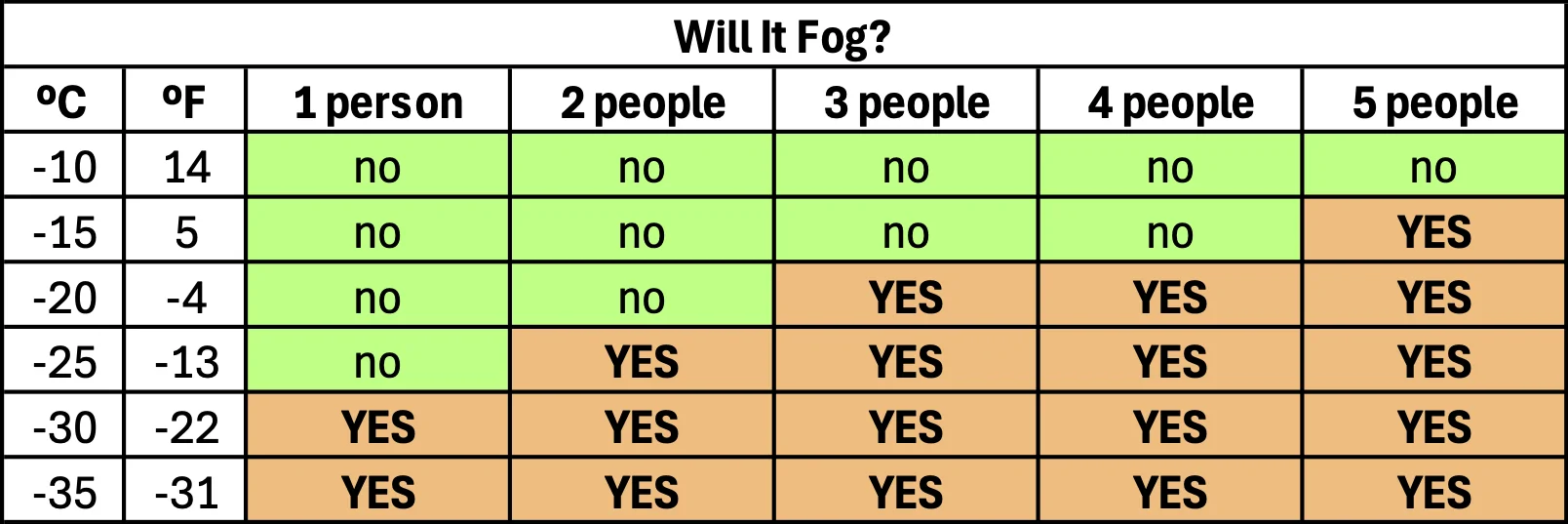
Results will vary. You may see stubborn fog sooner or later depending on the exact moisture and HVAC conditions in your cabin.
Conclusions
- Fog control gets harder as the number of passengers increases (because of more moisture generated), so the outside temperature that produces fogging becomes less cold.
- If you have more passengers, fogging will happen sooner and at a warmer outside temp.
- Even with a single occupant, fogging issues becomes likely below -30ºC or -22ºF.
- Fogging is primarily a function of the number of occupants and outside air intake rate (CFM).
- Because the blower has to run at high speed with 100% outside air to control fogging, the vent temps could get quite low. In some cases barely above freezing.
- The cabin temps will be quite cold with max defrost running based on the predicted vent temps.
- Results not shown, but the blower speed required to keep the windows clear increases exponentially the colder it gets. You would need 600+ CFM.
- Fogging becomes virtually unavoidable at extreme outdoor temps below -35ºC/-31ºF
- The heater output required to fully heat the outside air at the max blower speed is somewhere around 7.5 kW at -25ºC.
- Vehicles with the larger 7 kW PTC heater (or the heat pump) will likely experience warmer vent temps and cabins than Mach-E's with 5 kW PTC heaters, but fogging levels may be similar (mainly limited by outside airflow and cabin dew point, rather than heater power)
In terms of HVAC settings, I typically recommend using AUTO as much as possible. If you get fogging, open the HVAC menu and select the front defrost mode button (stage 1). If that still doesn't clear it, then you will need to select the MAX Defrost button (stage 2). Minimize blower speed and MAX Defrost time as much as possible to preserve cabin heat. The higher the blower speed, the colder the air will be. Advanced users may be able to tweak the blower speed with defrost selected to optimize cabin heat and fog removal (they are a tradeoff). If fogging gets really bad, you might have to pull over to give the glass a better chance at warming up with defrost.
Remember to change your cabin air filter every 15,000 miles or 25,000 km. A dirty cabin air filter will reduce your defrost capability.
In the extreme cold, always try to run remote start for 15+ minutes or set a departure time to warm up the cabin and glass as much as possible before you get in.
Sponsored
Last edited: