Jimrpa

Well-Known Member
First Name
Jim
Joined
Sep 10, 2020
Threads
297
Messages
9,547
Reaction score
12,875
Location
Wayne, PA
Vehicles
2021 Infinite Blue Premium Mustang Mach E ER AWD
Occupation
Retied (formerly tried to herd highly technical, independent cats)
Country flag
He went up the Tejon Pass (i.e. Grapevine) and was going down from the summit when this happened. Going up it you chew threw the battery like a fat kid with a twinkie. Going down he likely gained most back. So the range numbers aren't likely problematic, just a result of the terrain.
I’m not familiar - steep hill?
Sponsored


gpgrim

Well-Known Member
First Name
Gary
Joined
May 17, 2021
Threads
11
Messages
233
Reaction score
213
Location
Danville, CA
Vehicles
RR 4XP, MB E-350, Exp. EB, Subaru XTrek
Occupation
Physicist
Country flag
Okay, so for a little perspective here. The MME top end is supposed to be 124 mph, so let's call it 125 mph for convenience.

That means the system needs to be designed to deliver current to support that speed in nominal, i.e. flat, wind neutral conditions, call that I_pk.

In nominal freeway driving conditions, the power needed to over come wind resistance goes as speed cubed, or to the 3rd power, and in electrical terms, that means the product of voltage and current must track this. Assuming fixed voltage that means the current required will go as speed cubed.

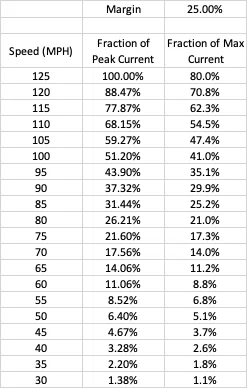
If we look at the amount of current required as a function of speed below the max speed, we see the table below.

Driving at 80 MPH, means that the motors are drawing 1/4 of the current need to support the max speed of the vehicle and 1/5 that of a 25% design margin.

Ford Mustang Mach-E 😭😭😭 POST BATTERY CONTACTOR RECALL -- FIRST JUNCTION BOX FAILURE 😭😭😭😭 1656707810667


Not knowing the circuit, I'd be hard pressed to make an intelligent guess as to the true issue, but it seems unlikely that any of the issues we've been reading about here are due to running the vehicle too hard.

I'd be more inclined to believe FoMoCo have a QA issue at the site of manufacture of the HVBJB.
 
Last edited:

ZuleMME

Well-Known Member
First Name
Zule
Joined
Apr 23, 2021
Threads
10
Messages
1,018
Reaction score
1,487
Location
Denver, CO
Vehicles
21' Job1 P4X MME, 22' MYP
Occupation
Implementation Engineer
Country flag
Okay, so for a little perspective here. The MME top end is supposed to be 124 mph, so let's call it 125 mph for convenience.

That means the system needs to be designed to deliver current to support that speed in nominal, i.e. flat, wind neutral conditions, call that I_pk.

In nominal freeway driving conditions, the power needed to over come wind resistance goes as speed cubed, or to the 3rd power, and in electrical terms, that means the product of voltage and current must track this. Assuming fixed voltage that means the current required will go as speed cubed.

If we look at the amount of current required as a function of speed below the max speed, we see the table below.

Driving at 80 MPH, means that the motors are drawing 1/4 of the current need to support the max speed of the vehicle and 1/5 that of a 25% design margin.

1656707810667.png


Not knowing the circuit, I'd be hard pressed to make an intelligent guess as to the true issue, but it seems unlikely that any of the issues we've been reading about here is due to running the vehicle too hard.

I'd be more inclined to believe FoMoCo have a QA issue at the site of manufacture of the HVBJB.
You seem to assume it's intended to run at 125mph for any reasonable length of time. We need an actual current basis.
 

dml105

Well-Known Member
Joined
Jul 26, 2020
Threads
27
Messages
949
Reaction score
1,421
Location
Arlington, VA
Vehicles
Shadowfax, the Star White Tricoated Metallic Pony
Country flag
I’m not familiar - steep hill?
steepish, but rather long.

Back when I lived in California, I had a fair number of close calls driving an ICE vehicle through the Grapevine because it will make your car chew through gasoline too.


Mach-Lee

Well-Known Member
First Name
Lee
Joined
Jul 16, 2021
Threads
262
Messages
11,373
Reaction score
25,044
Location
Wisconsin
Vehicles
2022 Mach-E Premium AWD
Occupation
Sci/Eng
Country flag
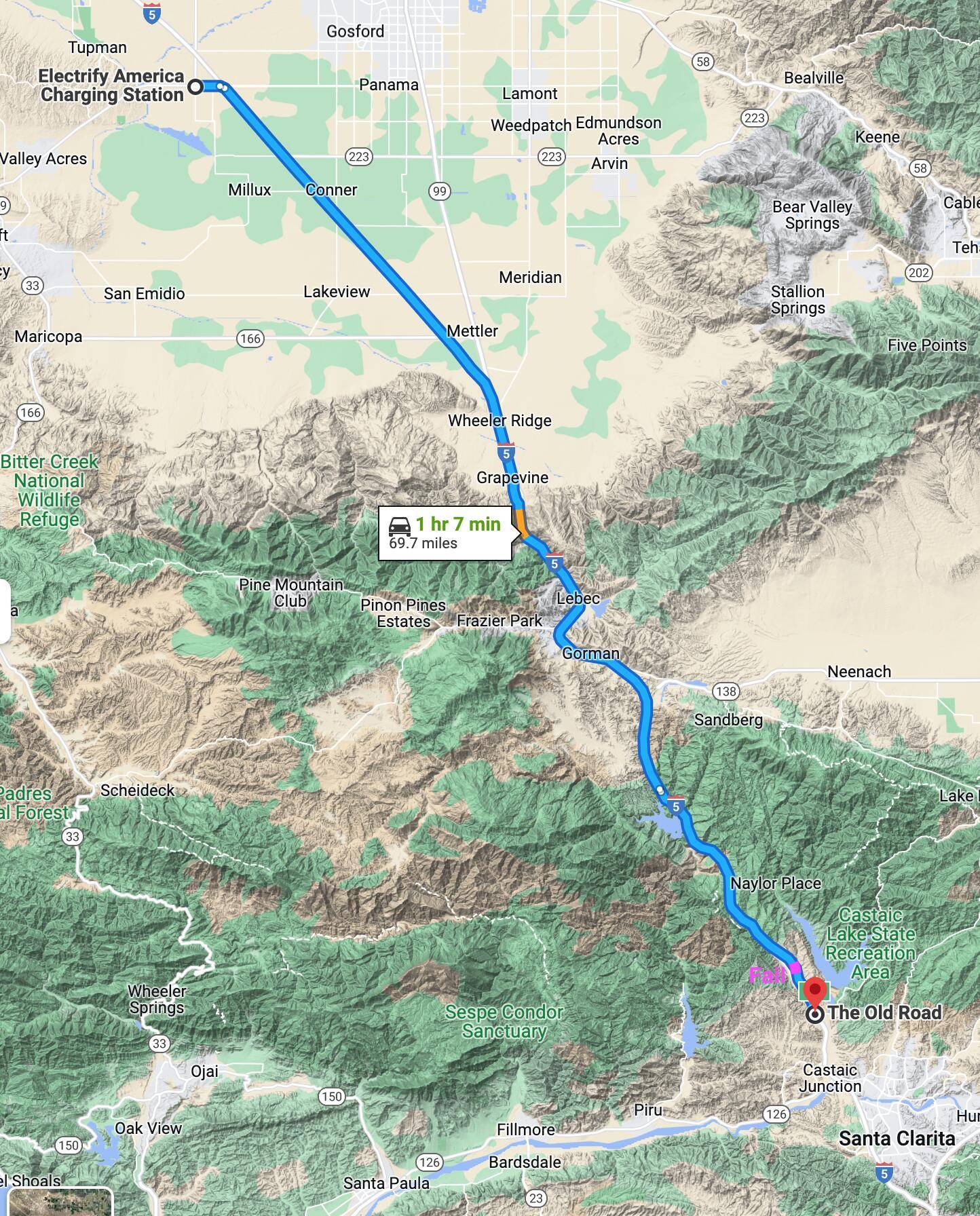
Here's some analysis, I believe this was scoopman's route. He started the last leg with a 44% to 81% DCFC at an average rate of about 87 kW, which is about 250A into the pack. The continued driving on I-5 South towards Los Angles, passing over a mountainous area locally called "The Grapevine". The "Service vehicle soon" message appeared near the end of the downhill side, shortly before Castaic, CA.

Ford Mustang Mach-E 😭😭😭 POST BATTERY CONTACTOR RECALL -- FIRST JUNCTION BOX FAILURE 😭😭😭😭 Screen Shot 2022-07-01 at 2.18.41 PM


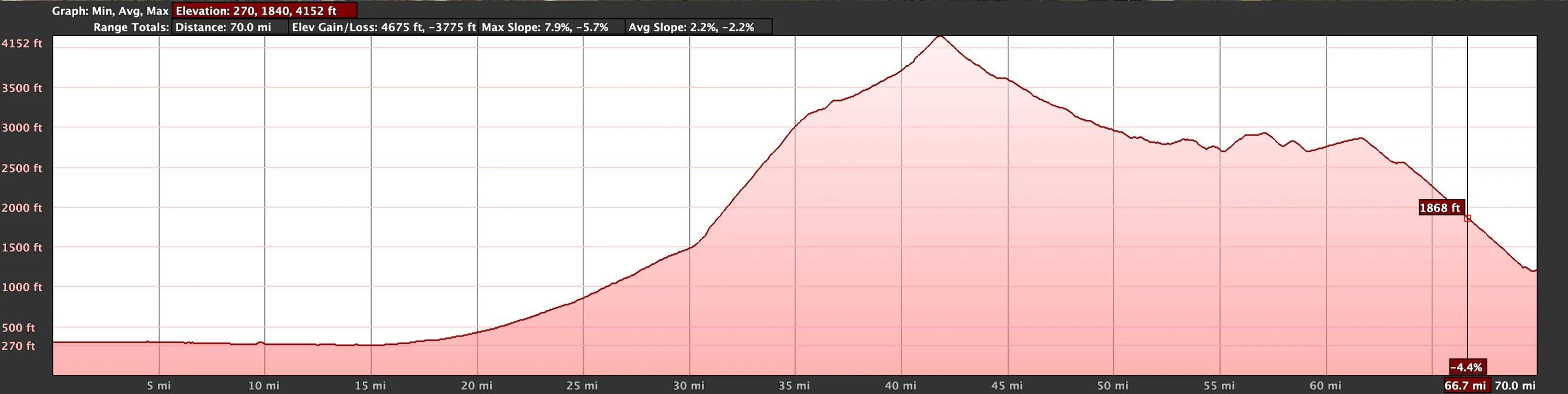
Failure point is marked in magenta on the map above. Here is the elevation profile of the leg:

Ford Mustang Mach-E 😭😭😭 POST BATTERY CONTACTOR RECALL -- FIRST JUNCTION BOX FAILURE 😭😭😭😭 Screen Shot 2022-07-01 at 2.31.20 PM


The cursor is at the failure point, approx. coordinates 34.53535 -118.64553. It occurred on a -4.4% downhill slope shortly after a brief lane change acceleration. Random thought: perhaps the contactor monitoring does not work during regen, if so it wouldn't notice overheating on long downhill stretches until power is used?

The maximum slope on the uphill side is 6.0%. Assuming the vehicle is fully loaded (GVWR), the power required to go up that hill at a constant 80 MPH would be: 2713 kg x 36 m/s x 6% = 5860 kgfβ‹…m/s or 57 kW of power to increase elevation, plus the normal aero and RR for 80 MPH of about 32 kW, so 89 kW total or about 250A (about the same power as the DCFC). This had the effect of basically two DCFC sessions in the course of an hour. The contactors rated for 500A should be able to handle 250A continuous just fine without overheating, so the contactors were likely faulty or damaged previously to overheat there. Shouldn't happen.

The other interesting point here is the 250A to go uphill is less than the ~350A power limit applied with the fault, so in theory you could still go over the Grapevine just fine with the power limit in effect, you just won't be able to pass anyone. Moving over and following a semi over the hill would be safe, pretend you are one.

If you have to drive up mountains in hot weather, it's probably wise to just use BlueCruise and avoid hitting the pedal to pass. Maybe you'd want to do a cool down period before and after DCFC, but I'm not sure how fast the contactors cool down? Meh. Either way, some people have bad parts and they are going to fail eventually no matter what you do. If you do have a good part, then you'd just be needlessly waiting, worrying, and babying the car. IDK, get the updates, live your life, take your trips, use the forum for catharsis, and just deal with the car problems if you happen to be the unlucky 1%. On the bright side, once you have a failure you'll get the new part so you can stop worrying.
 
OP
OP
scoopman

scoopman

Well-Known Member
Joined
Jan 30, 2021
Threads
60
Messages
2,771
Reaction score
5,816
Location
Bay Area
Vehicles
2023 KIA EV6 GT, 20214 Hyundai Ioniq 5 Ltd AWD
Occupation
former electric pony jockey, flatbed towing expert
Country flag
Do you put it in your frunk or trunk? I assume your frunk? Wasn’t sure what plastic pieces.
Sorry -- it is under the top center piece in the frunk which has some posts and things you can zip tie the bag to and it has easy access yet no one knows it is there.
 

gpgrim

Well-Known Member
First Name
Gary
Joined
May 17, 2021
Threads
11
Messages
233
Reaction score
213
Location
Danville, CA
Vehicles
RR 4XP, MB E-350, Exp. EB, Subaru XTrek
Occupation
Physicist
Country flag
You seem to assume it's intended to run at 125mph for any reasonable length of time. We need an actual current basis.
It certainly has to be designed to deliver those currents plus a margin and resistivity and thermal stress of materials isn't some new fangled science.

Further, there's no chance in hell a shop like FoMoCo doesn't run everything through design tools, review processes, FMEAs etc.

Sure shit happens, but it's more likely to be in a plant run by someone from Danny Ocean's crew.
 

buzznwood

Well-Known Member
Joined
Nov 14, 2019
Threads
3
Messages
1,163
Reaction score
1,379
Location
california
Vehicles
focus st & GTPE
Country flag
You seem to assume it's intended to run at 125mph for any reasonable length of time. We need an actual current basis.
For most manufactures a production viable ICE engine will need to pass a test that has them held at WOT for 300 to 400 hours. If Ford does not have an equivalent test for an EV then there engineering and testing department are an utter failure.

You are not exactly going to get much range at 125mph but that is cruising speed for some drivers on the autobahn and they would expect the vehicle to be able to delivery that day after day.
 

Mach-Lee

Well-Known Member
First Name
Lee
Joined
Jul 16, 2021
Threads
262
Messages
11,373
Reaction score
25,044
Location
Wisconsin
Vehicles
2022 Mach-E Premium AWD
Occupation
Sci/Eng
Country flag
Okay, so for a little perspective here. The MME top end is supposed to be 124 mph, so let's call it 125 mph for convenience.

That means the system needs to be designed to deliver current to support that speed in nominal, i.e. flat, wind neutral conditions, call that I_pk.

In nominal freeway driving conditions, the power needed to over come wind resistance goes as speed cubed, or to the 3rd power, and in electrical terms, that means the product of voltage and current must track this. Assuming fixed voltage that means the current required will go as speed cubed.

If we look at the amount of current required as a function of speed below the max speed, we see the table below.

Driving at 80 MPH, means that the motors are drawing 1/4 of the current need to support the max speed of the vehicle and 1/5 that of a 25% design margin.

1656707810667.webp


Not knowing the circuit, I'd be hard pressed to make an intelligent guess as to the true issue, but it seems unlikely that any of the issues we've been reading about here are due to running the vehicle too hard.

I'd be more inclined to believe FoMoCo have a QA issue at the site of manufacture of the HVBJB.
125 MPH continuous would take about 100 kW from my modeling, or about 290 amps. Getting there will use way more than that though depending on how fast you accelerate. So maybe 800 amps average to get to 125 MPH and then down to 300A to maintain? Either way using top speed as a durability test for EVs is not really the best way since the acceleration loads are much bigger/harder on the hardware.
 
OP
OP
scoopman

scoopman

Well-Known Member
Joined
Jan 30, 2021
Threads
60
Messages
2,771
Reaction score
5,816
Location
Bay Area
Vehicles
2023 KIA EV6 GT, 20214 Hyundai Ioniq 5 Ltd AWD
Occupation
former electric pony jockey, flatbed towing expert
Country flag
Here's some analysis, I believe this was scoopman's route. He started the last leg with a 44% to 81% DCFC at an average rate of about 87 kW, which is about 250A into the pack. The continued driving on I-5 South towards Los Angles, passing over a mountainous area locally called "The Grapevine". The "Service vehicle soon" message appeared near the end of the downhill side, shortly before Castaic, CA.

Screen Shot 2022-07-01 at 2.18.41 PM.png


Failure point is marked in magenta on the map above. Here is the elevation profile of the leg:

Screen Shot 2022-07-01 at 2.31.20 PM.png


The cursor is at the failure point, approx. coordinates 34.53535 -118.64553. It occurred on a -4.4% downhill slope shortly after a brief lane change acceleration. Random thought: perhaps the contactor monitoring does not work during regen, if so it wouldn't notice overheating on long downhill stretches until power is used?

The maximum slope on the uphill side is 6.0%. Assuming the vehicle is fully loaded (GVWR), the power required to go up that hill at a constant 80 MPH would be: 2713 kg x 36 m/s x 6% = 5860 kgfβ‹…m/s or 57 kW of power to increase elevation, plus the normal aero and RR for 80 MPH of about 32 kW, so 89 kW total or about 250A (about the same power as the DCFC). This had the effect of basically two DCFC sessions in the course of an hour. The contactors rated for 500A should be able to handle 250A continuous just fine without overheating, so the contactors were likely faulty or damaged previously to overheat there. Shouldn't happen.

The other interesting point here is the 250A to go uphill is less than the ~350A power limit applied with the fault, so in theory you could still go over the Grapevine just fine with the power limit in effect, you just won't be able to pass anyone. Moving over and following a semi over the hill would be safe, pretend you are one.

If you have to drive up mountains in hot weather, it's probably wise to just use BlueCruise and avoid hitting the pedal to pass. Maybe you'd want to do a cool down period before and after DCFC, but I'm not sure how fast the contactors cool down? Meh. Either way, some people have bad parts and they are going to fail eventually no matter what you do. If you do have a good part, then you'd just be needlessly waiting, worrying, and babying the car. IDK, get the updates, live your life, take your trips, use the forum for catharsis, and just deal with the car problems if you happen to be the unlucky 1%. On the bright side, once you have a failure you'll get the new part so you can stop worrying.
This is awesome analysis!
 

Z-one

Well-Known Member
Joined
Apr 23, 2022
Threads
14
Messages
187
Reaction score
112
Location
Chicago
Vehicles
2022 Mache GTPE
Country flag
Sorry -- it is under the top center piece in the frunk which has some posts and things you can zip tie the bag to and it has easy access yet no one knows it is there.
Thanks! You must have your dividers in. I have a job 2.
Sponsored


Top