JohnFoxeSheets

Well-Known Member
First Name
John
Joined
Jan 29, 2022
Threads
28
Messages
3,415
Reaction score
5,514
Location
San Francisco
Website
johnfoxesheets.com
Vehicles
2022 Iced Blue Silver Mach E GT
Occupation
Retired Engineer
Country flag
I did some basic back of the napkin calculations and I should not be exceeding the capacity of the 12 volt system. I do not anticipate that my mileage will go down.
Though if the lights flicker a bit in the SF Bay Area, we'll know the likely cause ???
Sponsored


SilverArrow

New Member
Joined
Dec 14, 2024
Threads
0
Messages
2
Reaction score
1
Location
Burlington, ON
Vehicles
2022 Mach-E GT; 2023 BMW iX, 2018 BMW i3S, 2012 C63 AMG
Occupation
Software and Industrial Automation
I wanted to share a write up for the installation of an aftermarket amplifier (amp) in my MME GT PE. This will be long one to provide detail. As another source of installation, I also point people to @Bda who did an over the top-quality installation on his MME.

I installed an aftermarket sub ....
This is really nice!
Could/would you have instructions how to take the side panels off? I don't want to break any clips and did not find anywhere any details. Thank you in advance!
 

markboris

Well-Known Member
First Name
Mark
Joined
Nov 13, 2019
Threads
44
Messages
5,754
Reaction score
16,455
Location
Sonora, CA
Vehicles
Currently: '20 Shelby GT500 FPB '24 Mach-E GTP GGM
Occupation
Retired
Country flag
OP
OP
MyLittlePony2022

MyLittlePony2022

Well-Known Member
First Name
William
Joined
Jul 17, 2021
Threads
37
Messages
798
Reaction score
809
Location
SF Bay Area, California
Vehicles
2022 "Mach-E Auto" GTPE, Cyber Orange
Country flag
@SilverArrow The seats have to be removed to take out the rear trunk panels. I would plan on breaking some clips. I did and do every time I take panels off. I do use trim removal tool but the clips are cheap plastic and just break. found replacements on line either through Ford dealerships or generic clips through Amazon. Depends on the clips. Other than the seats being removed, taking the panels off is not too hard.


OP
OP
MyLittlePony2022

MyLittlePony2022

Well-Known Member
First Name
William
Joined
Jul 17, 2021
Threads
37
Messages
798
Reaction score
809
Location
SF Bay Area, California
Vehicles
2022 "Mach-E Auto" GTPE, Cyber Orange
Country flag
I got a few direct messages about my aftermarket amplifier installation. I created, as a part of my install, a schematic. I am a visual person. Attached is how I wired the amplifier, speakers, , amplifier integration interface, and cooling fans. The cooling fans, delay timer, and accessories fused power block is the second PDF and was something I wanted to do. It was not a requirement.

I hope this helps others on the forum who are looking to upgrade or investigating a change of amplifier.

Please note, the fuses and gauge of wire used for the power and ground will need to be calculated based on your total system's configuration and current draw. This is important! What is shown is for my system. Underrating the power wire and overrating the fuse is a great way to catch your car on fire.

The wire size for the speakers is a mater for you to decide. There are many articles, forum discussions and videos on what gauge you should use. I did not show the passive cross overs on the speakers which I did add. The amplifier does have a cross-over but I did want to have a capacitor in line with the speakers as a precaution. There are lots of sights out there to help with specifying the correct capacitor based on your speakers.

I hope to see more post with people upgrading their systems.
 

Attachments

Nomad77888

Member
First Name
Alan
Joined
Dec 25, 2024
Threads
2
Messages
24
Reaction score
8
Location
Miami
Vehicles
2024 Ford mach-e
Occupation
IT
Anyone has any experience with installing an amp in a select (non-BO)?
 

mach searcy

New Member
First Name
edward
Joined
Feb 28, 2025
Threads
0
Messages
2
Reaction score
0
Location
Atlanta
Vehicles
2024 Ford Mach e Select
Occupation
network Engineer
I wanted to share a write up for the installation of an aftermarket amplifier (amp) in my MME GT PE. This will be long one to provide detail. As another source of installation, I also point people to @Bda who did an over the top-quality installation on his MME.

I installed an aftermarket sub (thanks @markboris) the first month I owned the car. It definitely filled a void in the stereo system. I followed Mark’s write up and installed a JL Audio ACP110LG-TW1

I was still not satisfied with the sound, so I started to plan to replace the speakers and amp. I did the research on the how and the what. The speakers went on sale first, so I swapped out the OEM speakers and added sound deadening on the doors. I did a write up on installing speakers.

The next step was dependent up on Crutchfield putting my amp on sale and last month they dropped the price by ~30%. I order an AudioControl (D-6.1200) and the PAC (AP4-FD31). I planned install the amp and the PAC in the same location as the OEM amp (passenger side cargo area rear panel). The PAC connection to the wiring harness connectors in the rear, so it must go there. You could put the amp somewhere else, but I chose to use the OEM space and bracket for the new amp. This was open space and the amp (I measured prior to ordering) fit, so why not put it there. The OEM is amp is 40% the size of the new amp, so fit is a bit tight under the rear trim panel.

The PAC system is an amplifier integration interface and is needed to convert the digital signal to analog for an aftermarket amp. The front door speakers and the rear door speakers (6.5ā€ and tweeter) are powered by the rear OEM amp. The front tweeter and center channel speakers are powered by the headend unit (i.e., the ā€œstereo receiverā€) via an analog signal. To powers the dash speakers, a front amp is required, or you can run speaker wires from your new amp. There is an PAC adapter (LPHFD31) to connect to the factor speaker wire harness for the dash speakers to the new amp. This is sold separately and not included in the PAC AP4-FD31. On a side not, @MrLoganRoss had a Mobridge interface installed instead of the PAC. He posted on his install.

I chose to run speaker wires directly from the rear amp to the front dash tweeters. I did not replace the center channel speaker and did not connect it to the new amp. I ran the wire under the carpet, near the floor door sill. There is room in the rear door sill but there is not room in the front door sills to run power or speaker wire. The cables for the front seats T-off and do not allow for pass-through from the rear to the front. I did not run new speaker wire to the rear door speakers or the front door speakers. The door ā€œpower plugā€ for the rear door is easily accessible and can be removed. There is room to drill this out and add speaker wire. I assume the front is the same and has room. However, the front door power plug is hard to get to and I could not remove it, thus the decision to use the OEM speaker wire and not to replace it with a heavier gauge wire. I sure the 16-gauge speaker wire would have added a bit more fidelity to the system and installing speaker wire may be a future endeavor.

The reason I chose my amp was that I wanted more than the 75-watts RMS power for the aftermarket speakers. However, the main reason was that the amp has a digital signal process (DSP) so I could tune the overall configuration and adjust for speaker delay. In addition, it had the preamp outputs to connect to my powered subwoofer and I can adjust and tune the bass via the DSP.

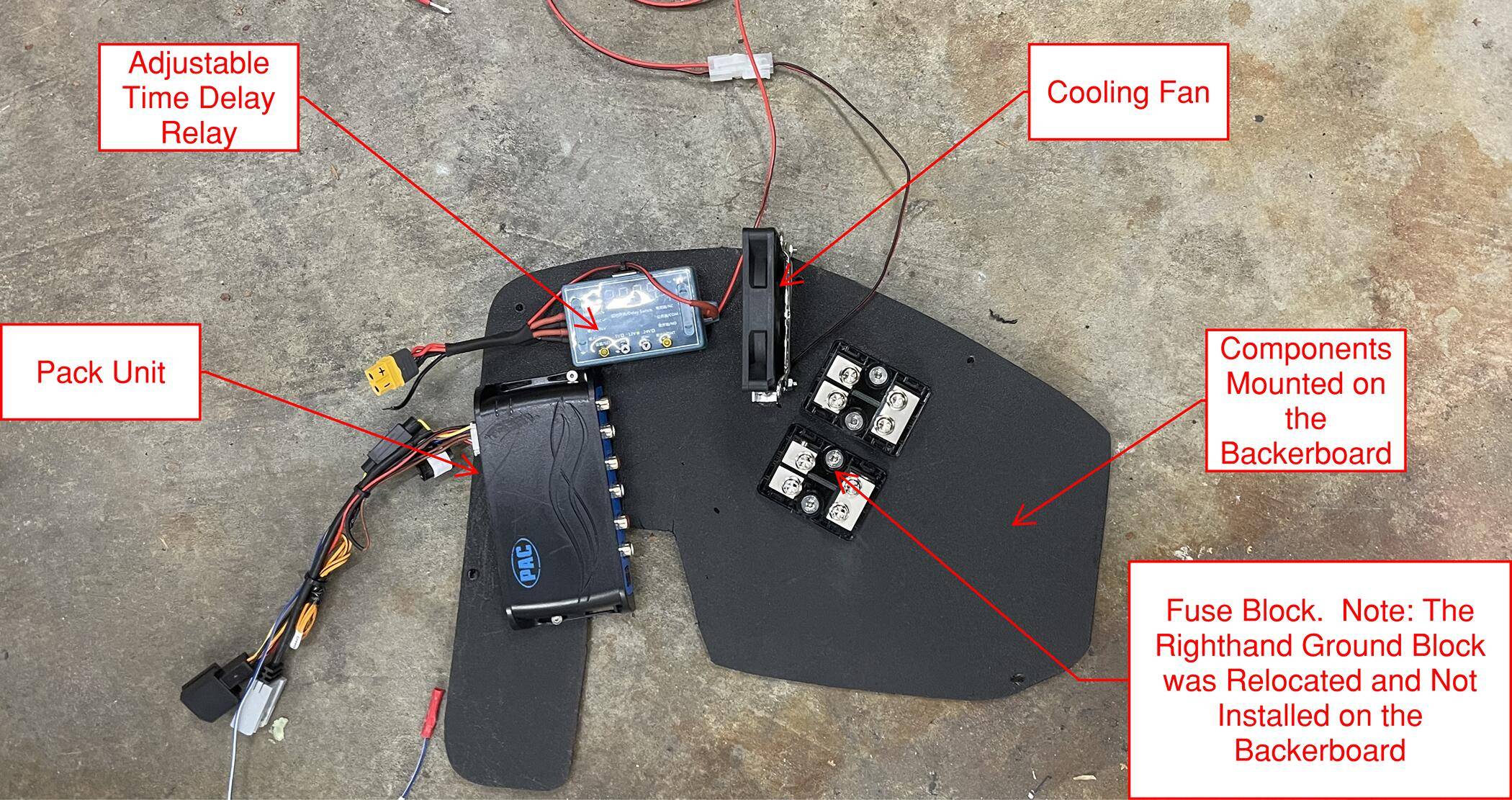
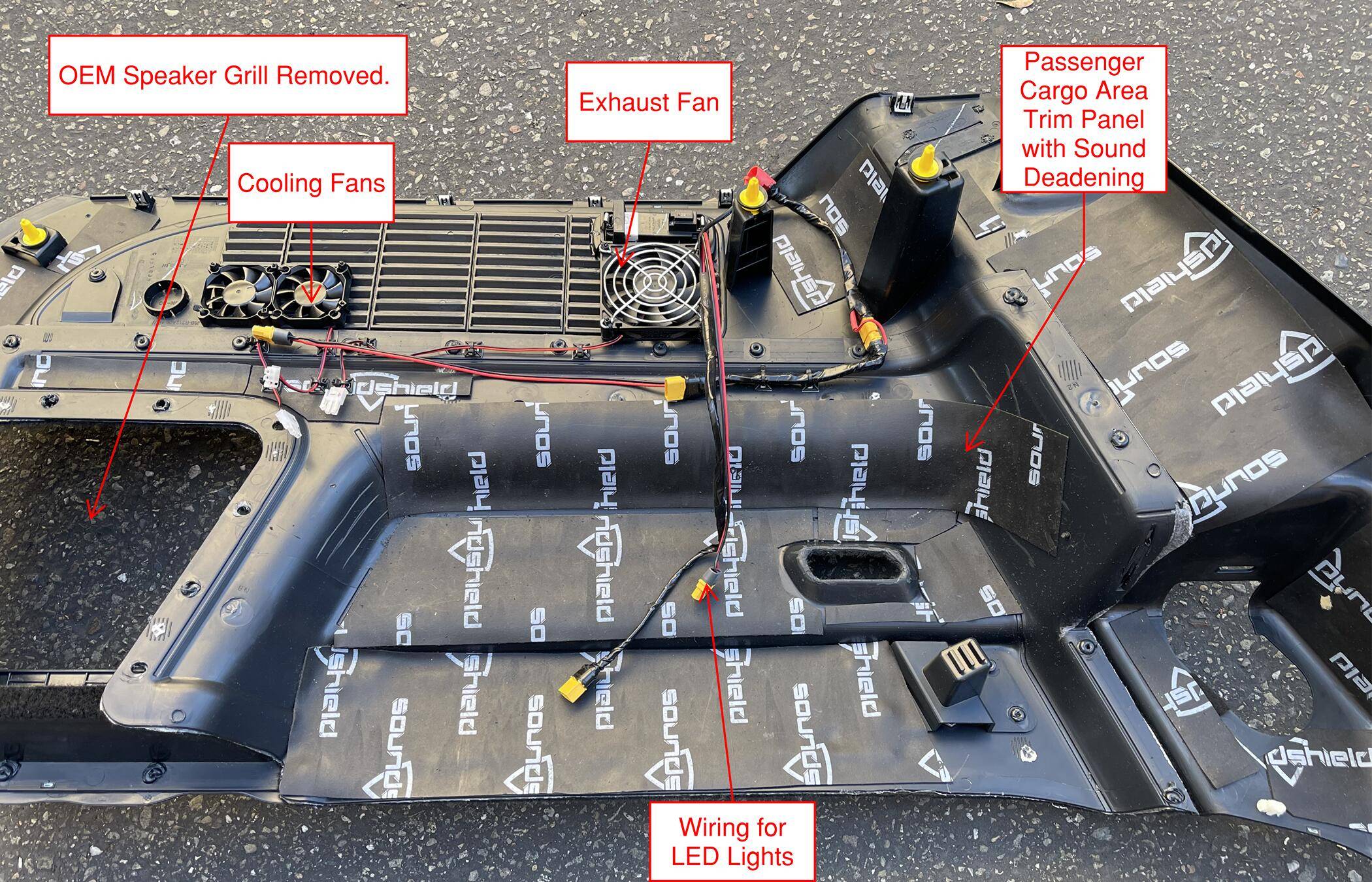
I decided to go a little further with my installation. I know that there might be a topic of debate on it and if I needed this, but I chose to do anyway. I wanted to install exhaust fans to remove the heat created by the amp since it was in the enclosed trim panel in the rear cargo area. I also installed a fan to move air across the amp’s cooling fins. Finally, I installed an adjustable time delay relay (setting P24) that allowed for the fans to turn on via the remote on signal. It will turn on 5 minutes after the remote signal is energized and the fans will stay on for 5 minutes after the signal is loss. As a part of the relay programming, the timing can be adjusted from seconds to minutes. The fans will hopefully reduce the temperature during operation and cool it after is shuts down. Not sure if it will really extend the life but I like to geek out on things like this.

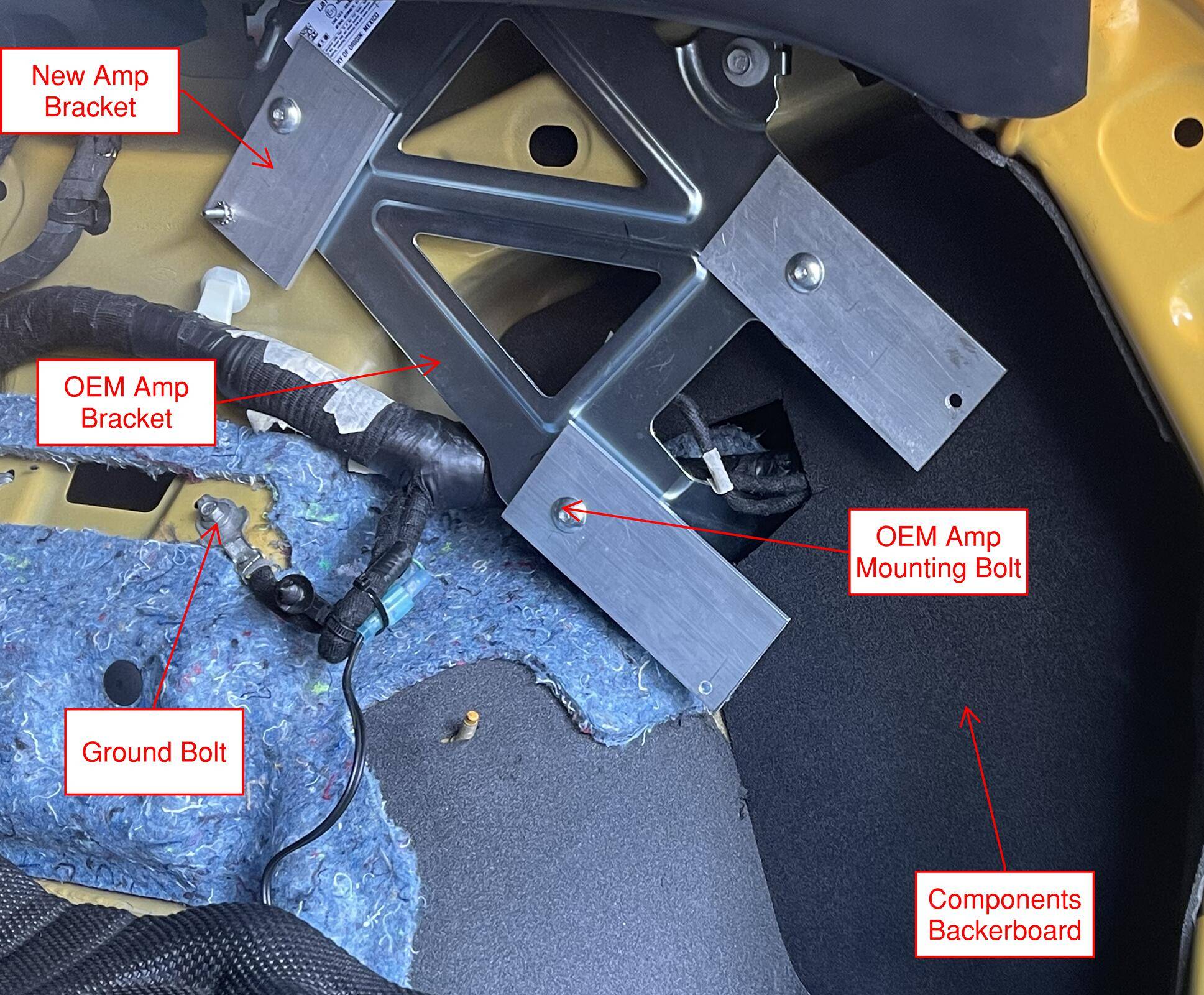
Removing the trim panel to get to the amp and mount the devices, requires removing the rear seats. I followed the write up from @21stCenturyPony. With the panel removed, I could easily remove the OEM amp and work toward mounting the new amp. I used the existing OEM amp bracket since it was secured to the car. The aluminum bracket will hopefully absorb some of the amps heat too. I used flat aluminum to extend the brackets holes to mount the new amp. I used cardboard as a template and then transferred them to the aluminum. I used the single OEM amp bracket bolt hole to mount the new bracket to the OEM bracket since it worked to keep the amp secure, and it also gave me some ā€œwiggle roomā€ to adjust the brackets for a final positioning. I only used three brackets to mount to the amp since getting to the top right amp mounting hole is not possible without removing the upper trim panel. Three is solid and secured the new amp.

With the amp location set, I worked to determine the best location for the PAC interface, the fused main power block, the ground block, the fan, the timing module, and the auxiliary fuse power block for the accessories. For the later, I could have tapped off the existing power on the car but decided to add it to allow for future growth. In fact, it came in handy. The amp location required the 12-volt outlet/socket to be relocated. I decided to install a 30-amp outlet instead of relocating or installing a 20-amp outlet. I plugged the existing hole with 30mm knock-out plug. To install the plug, it did require me to open the existing hole up just a bit with half round file. I installed the new outlet on the driver’s side rear cargo area trim panel. I routed the cable via the floor on the rear of the cargo area.

For the main power, I ran 4-gauge wire from the battery back to the cargo area with an in-line fuse in the frunk, close to the 12-volt battery. I routed the cable through an exist grommet in the firewall and sealed it with black RTV. There is limited access to install a firewall grommet. However, if that is a priority, you could do it by coming in from the inside, under the dash. The main power was run to a fused power block. I ran 8-gauge from the fused block to the sub-woofer and 4-gauge from the fused block to the amp. The unused and unfused side of the block was used to run 8-gauge inline fused cable to the auxiliary fuse block. This should give me enough growth on the auxiliary fuse block. I am not really pulling that much current for what is connected. I connected the 30-amp outlet, the exhaust/cooling fans and cargo LEDs to the auxiliary fuse block. The LED install is in another post.

I ran a short 4-gauge ground cable to a power block. Same as the above fused block but with metal connectors instead of fuses. Finding a ground bolt in this area is easy as there are several. I did connect the sub-woofer to a separate ground and not the ground block since there was a convenient ground bolt on the passenger side of the rear tailgate. The ground block was mounted on the top of the fender well, in the cargo area. I originally tried to mount them on the backerboard, but it was too crowded, and the wire routing was a bit more difficult.

If you are just mounting the main fused block and ground block, you can skip the paragraph below. You can find several locations to mount them under the trim panel in the cargo area.

Since I had the components to mount, I decided to install a 1/8ā€ ABS plastic backerboard in the old location of the OEM subwoofer. I used cardboard to make a template and then transferred it to the ABS. Evan after that, I still had to trim and modify the backerboard. The 1/8ā€ ABS can be easily cut and shaped. You can bend it to get it in and heat it up to shape it, thus the reason for not going with 3/16ā€ or 1/4ā€ ABS. You will need to do a bit of bending to get it installed with the OEM amp bracket in place. Used several small black sheet metal screws to mount the backerboard to the car. With the backerboard figured out, I worked out how I wanted to place the components on the backboard. The PAC fit perfect behind the OEM amp bracket as did the timing module. I put in a small computer fan below the amps cooling fins. I used a piece of scrap ABS to mount the auxiliary power block. I mounted this configuration to the two bolts that used to hold the subwoofer amp. Be careful of the mounting location of the auxiliary fuse block since it is close to the trim panel. Overall, this was not difficult, but it did take a weekend to get it all set up before I spend the next weekend wiring. I will say getting this in place, with the components mounted took the most time. I also installed two small fans and one larger computer fan on the trim panel to exhaust the hot air from behind the trim panel. You need to evaluate the fan location and depth relative to the amp. My first attempt at placing the fans, did not work since it hit the amp and I could not install the trim panel.

With all the components in place, I spent the next weekend routing all the cables to the various components. I used wire connectors to ensure I could remove and take out components, remove the trim panel in future, etc. I also spent some time putting sound deadening on the two rear trim panels. I removed the driver’s side trim panel to both put on deadening, install the 30-amp outlet and to install the cargo hooks ordered from @JohnFoxeSheets.

I also ran a AudioControl ACR-3 from the amp to the front of the car. This allows me to control the present configuration and adjust the volume level. I mounted it on the left-hand side under the main touch screen via 3M double sided tape. I did not want to drill into the car. I configured the presets with the speakers configured for just me in the car and with me and my wife (centered). The DSP allows you to configure the delay in speakers by distance or time. The volume level was set for the subwoofer. I have found that some songs need more bass and others need it turned down.

Both the PAC and the AudioControl amp have a USB-Micro cable interface. This is used to update the software and program the two units. You must download their software and use a PC to interface with the PAC unit and the amp. I updated the firmware first. On the PAC, you can adjust the chime volume level and sound settings (treble, mid and bass). The amp DSP will adjust the sound settings, so I did not use that function on the PAC. I did adjust the chime volume. If you want it quite or very loud, you have that option. The PAC does come with a removal volume knob with cable that allows you to adjust the chime volume, but I prefer to have access to the unit to adjust this and to be able to update the firmware. The amp USB cable allows you to update the software and to adjust the DSP. I left both USB cables in place and coiled up behind the trim panel, for future use and component adjustment.

With the components installed, I powered up the system and worked to adjust the chime volume and the DSP. Adjusting the DSP is a detailed write up that I am not going to do, since it will be dependent upon your amp, your taste, etc. There are plenty of videos on how to adjust your system. For my amp, I watched the video from @CarAudioFabrications and AudioControl online manual. I drove around for a week plus to ensure everything was functioning, the volume levels were good, the configuration was what I wanted, etc. There were a few items that did come up and required some attention. Once, I was happy, I put the trim panels back, and then the rear seats.

A few side notes: The OEM signal routed through the PAC is really a single channel. I installed two RCA cables and during tuning, the second signal was not full spectrum, so I chose to only use one RCA cable and use the signal for all the speakers. Since I connected the subwoofer via the line out, I did not connect the subwoofer signal from the OEM wiring harness to the PAC unit and thus did not connect the PAC unit via RCA to the amp or subwoofer. Your configuration may vary depending on your amp or set up. The sound setting on the touch screen, is no longer applicable. You cannot set the treble, mid and bass from the touch screen. With the single channel input into the amp, you also cannot fade the signal. You can control the balance. You can drill out the passenger side trim panel so that the grill, originally for the OEM subwoofer is removable. I put Velcro on so it can still attach. The space is small, but it can be used for storage, and I used it to access the USB cables and the fuses blocks.

I sure the question will be asked, is it worth all the work. That all depends on if you are satisfied with the OEM speakers and overall system. Also, is this something you can do and like to do. I love geeking out on this stuff and I was not happy with the B&O system. The speaker installation helped to improve the sound, but I could not adjust the ā€œsoundā€ of the speakers. The cars headend unit equalizer was too limited and was configured for the OEM speakers. The new amp with DSP gives me the versatility to adjust the system in so many ways and with 125 watts per channel there is enough power to allow me to rock out to Led Zeppelins’ Kashmir, jam out to Miles Davis’s So What, sing along to Carmen’s Habanera, ā€œAirā€ cello to YoY o Ma’s Bach: Cello Suite No. 1 or let my wife ā€œseat danceā€ to Uptown Funk.

Reply to this thread if you have questions or direct message me. Glad to help.

Below are some pictures of the installation:

1714415045875-uw.jpg


1714415391308-t4.jpg


1714415250664-dy.jpg


1714415344606-gg.jpg
so i have done the same with my 2024 mach e and it sounds really good but i am noticing that adding the amp with the facotry amp is causing the digging that the car make sounds diffrent plus i am hearing a little static/buzz noise in the speakers how do i fix that thanks
 

xRowdyxBurnsx

Member
First Name
Matt
Joined
Sep 14, 2025
Threads
2
Messages
12
Reaction score
3
Location
Maryland
Vehicles
2023 Mach E GT GG
Just want to thank you for this thread and the other info you have provided.

I am in the process of planning my build. I took a 25 year break from car audio until my last vehicle, an Infiniti Q50, which I just traded in for an 8k ā€˜23 GT. This system has me quite confused and would appreciate any advice.

I plan on replacing all speakers and adding a Sub. I have researched and it looks like I don’t want to surpass 1K RMS on stock electric which is fine.

I currently have a Mono Block amp that runs 550 watts @ 2 ohm. I also already have a DSP I will be using. I am going purchase a 4 channel amp for interior speakers but I don’t know how much power I need, 75x4 or 125x4.

Going back to sealed Sub, either 8ā€ or 10ā€. I have already found a few, including the box that will fit with the composite cover. I will have to cut squares in the composite for the sub and amps. Following that I will be laying down black steel mesh with breathable fiber cover over the openings for both a clean look and allowing the amps to breath.

My questions are:
1. Read somewhere that the stock components are powered separately rather than inline like aftermarket components? Seems like that could make the fronts painful to install.

2. While I have never heard of Focals in person, I see many only handle 60 RMS. Are these Focals highly efficient or something? I actually had Hertz Uno series (Entry Level) in my last car and were highly efficient and were run at 50 RMS BUT at high volumes they lost clarity. Bottom line is I am looking for balance but I do like my music loud.

3. No idea what to do with the Center channel. I know some just remove but I like a good center channel. Do I need to amp it or can I go with an efficient 3 1/2ā€?

Note: My local installer has not worked with a Mach E yet. I need to give him as much info as I can. I will likely wire the amps and Sub alone but I am not going to do the interior. Well, maybe the 3.5ā€ if it doesn’t need amped. I’m like a bull in a china shop and will break things in the doors. I’ll leave all the wiring to him on the Interiors.

Oh, anyone with experience on the difference between 8ā€ and 10ā€ sealed sub would be great. I have a sealed 12ā€, 4th order Reflex Bandpass 12ā€ and a custom ported Deaf Bonce 12ā€ sitting around. None of them below the composite deck. I also know that the Deaf Bonce is WAAAAY too loud at 800 RMS. Don’t need all that anymore. I listen to all types of music, Rock, Hip Hop, Country, EDM and Sports.

I appreciate any feedback!!!
Sponsored


Top