
dtbaker61

Well-Known Member
First Name
Dan
Joined
May 11, 2020
Threads
126
Messages
4,822
Reaction score
4,524
Location
santa fe,nm
Website
www.envirokarma.org
Vehicles
MME (delivered 2/26/21), DIY eMiata BEV
Occupation
Solar Sales/install
Country flag
I think I asked the question one time and I think the answer was yes but if you disconnect the negative battery cable from the battery essentially there’s no battery attached now, then try to use the cables. See what happens.?
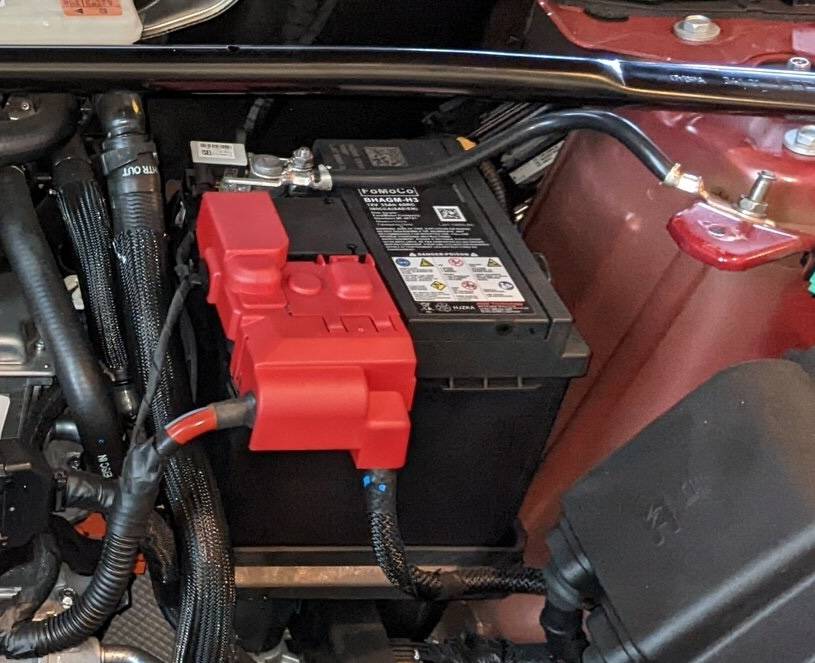
the 12v+ terminal is a lot easier to reach.
pop off rear 'beauty cover
10mm socket, pull off the terminal, put a rag or something on top so it doesn't fall back on...
Sponsored


 

MoonRiver

Well-Known Member
Joined
Jan 27, 2022
Threads
40
Messages
516
Reaction score
231
Location
Tampa Bay, FL
Vehicles
22 Mach e select, 07 Infiniti G35
Country flag
Very informative FAQ. Thank you Mach-Lee.

Now I know the door can be opened by pressing the button twice even the battery is dead. Then I can pop the frunk open by pulling the frunk open lever next to my left knee. My question is why Ford spent those money to create a jumping opening on the bumper and complicate the wiring? Is it the plan B in case the cable behind the lever broke? What do I miss here?
 
Last edited:
OP
OP
Mach-Lee

Mach-Lee

Well-Known Member
First Name
Lee
Joined
Jul 16, 2021
Threads
262
Messages
11,344
Reaction score
24,965
Location
Wisconsin
Vehicles
2022 Mach-E Premium AWD
Occupation
Sci/Eng
Country flag
Very informative FAQ. Thank you Mach-Lee.

Now I know the door can be opened by pressing the button twice even the battery is dead. Then I can pop the frunk open by pulling the frunk open lever next to my left knee. My question is why Ford spent those money to create a jumping opening on the bumper and complicate the wiring? Is it the plan B in case the cable behind the lever broke? What do I miss here?
Because the double press won’t work if doors were locked when the battery died. Only if they were last unlocked or accessed from the inside.
 

MoonRiver

Well-Known Member
Joined
Jan 27, 2022
Threads
40
Messages
516
Reaction score
231
Location
Tampa Bay, FL
Vehicles
22 Mach e select, 07 Infiniti G35
Country flag
Because the double press won’t work if doors were locked when the battery died. Only if they were last unlocked or accessed from the inside.
SonicBlue has a trick that I so far don't need to try out. That looks if you know where the number keys are in the dark you can still unlock the door.

https://www.macheforum.com/site/threads/12v-battery-faq.32744/page-20#post-846600

So I have made a template of the keypad, with the number buttons marked. In case I got locked out with a dead battery.

Thank you for the trick @SonicBlue
 
Last edited:

Squire330

Well-Known Member
First Name
Robert
Joined
Aug 30, 2024
Threads
1
Messages
61
Reaction score
49
Location
Chester, VA
Vehicles
2023 Mustang Mach-E
Occupation
Retired
Country flag
This will cover everything you ever wanted to know about the 12V battery in the Mach-E (also applies to F-150 Lightning).

Mach-E 12V battery.jpg


Click the hidden answers to display them. This is a work in progress, more FAQs may be periodically added or updated. This information comes from my knowledge, experience, and the factory service manual.

What type of 12V battery does the Mach-E have?

The 12V battery is a lead-acid AGM (Absorbed Glass Mat) type. This is very similar to traditional flooded lead-acid batteries which have been used for decades in cars. The difference is how the sulfuric acid electrolyte is stored, rather than the cells being flooded with free liquid, the acid is absorbed into glass matts stuck between the lead plates. As a result, the battery is considered “spill free”, if you shake one you won’t hear any liquid sloshing. AGMs are used in most new cars now because they charge faster and more efficiently than flooded batteries.

Where is the 12V battery?

The 12V battery is located under the hood on the left side of the vehicle (underneath the covers). Look for the embossed ⊕ and ⊖ symbols on the plastic covers, the jump start points are directly underneath these. The center and driver side plastic covers must be removed for access (there are multiple clips holding them down, pull up firmly near each clip until you get them all).

Why does the Mach-E even need a 12V battery?

All EV’s need some type of auxiliary battery to run their low voltage systems and switch the high voltage on and off for safety. You cannot have 400V running through a window switch because that would be dangerous. So these components need to run off low voltage DC, 12V is by far the most common standard. The 12V system is also used to run the modules that control the high voltage system, and is used to close the contactors that “switch” the high voltage battery on and off.

What are the 12V battery specifications?

Part number: BAGM-H3
35 Amp-hours, 380 CCA, 60 RC, 27 lbs
H3 size (175mm x 175mm x 190mm) L x W x H


Where can I buy a replacement 12V battery?

Parts counter at your local Ford dealer. If they work on a lot of Ford EVs they may have one in stock (BHAGM-H3). Otherwise they can order one from the national parts depot and have it in a couple business days. If you want the 36-month warranty on the replacement battery, you have to buy it through a Ford dealer (or FordParts.com) and save your receipt.

https://parts.ford.com/webapp/wcs/s...ponents/vehicle-battery-conventional-p-bagmh3 (you can use your FordPass points)

https://www.rockauto.com/?mfr=MOTORCRAFT&partnum=BAGMH3

https://shop.advanceautoparts.com/p...-60-minute-reserve-capacity-h3-xev/50001096-P

https://autoparts.toyota.com/products/product/toyota-truestart-battery-240-cca-00544h3ln0ts


What is the warranty on the 12V battery?

The original 12V battery is covered by the 3-year/36,000-mile (60,000 km) factory warranty. Replacement Motorcraft batteries purchased at an authorized Ford dealer or fitted during a service are also covered by a 36-month free replacement warranty that starts on the date of sale or installation. NOTE: The 12V battery is NOT covered by any of Ford's Extended Service Plans.

Is the Mach-E 12V battery smaller than normal? Is this causing 12V issues?

Yes, the H3 size is much smaller than a regular car battery, about half the size. It doesn’t need to be as big because it doesn’t have to crank an engine. No, the smaller size isn't causing the 12V issues. The battery is similar in size to other EVs and is appropriate for the application. The 12V issues are caused by how the battery is managed, not because of it being small.

Can I replace the stock AGM battery with bigger size?

Yes, however this is not recommended because of the additional issues it can cause. The stock battery is an H3 size, the battery tray has another set of holes to hold a larger H4 size battery, which will fit. However, a battery with a larger capacity will not play well with the BMS system. It expects a 35 Ah capacity AGM. The H4 battery is 33% larger, so the BMS will not be able accurately measure or utilize the extra capacity beyond 35 Ah. As a result, the larger battery may be chronically undercharged, causing early failure. In other words, it might make things worse, not better.

Can I replace the AGM battery with a lithium or LFP battery?

No, they are not compatible with Ford's managed charging system (despite what some battery companies claim). 12V lithium batteries operate at a different voltage point than 12V AGM batteries. The charging and BMS system of the Mach-E is calibrated for AGM battery chemistry only. If you put in a lithium battery, the BMS will not measure the state of charge % correctly, and the lithium battery may not be charged fully due to the lower voltage setpoint of AGM. For example, while driving the voltage is normally held around 12.9V, this will perfectly maintain an AGM at 100%, but a lithium battery will only be held at 20% SoC. This means a lithium battery will gradually discharge while driving to 20%. Load shed will eventually activate, causing your radio, HVAC, and accessories to shut down.

Some Ωf these lithium batteries are a borderline scam because they are extremely overpriced and contain cheap internal components held together with tape and spray foam. These will not perform better than a new AGM battery, save your money and buy the AGM.


How do I replace the 12V battery on the Mach-E?

There are photos and videos elsewhere, here is the general procedure. This is the method that does not require removing the frunk tub.
  1. Obtain the correct replacement AGM battery (see above FAQs).
  2. Fully charge the new battery overnight on a 12V AGM battery charger.
  3. Open hood and remove the top plastic frunk cover (put up on each clip).
  4. Remove the driver's side plastic frunk cover (pull up on each clip).
  5. Remove the strut tower brace nut, driver's side (18 mm).
  6. Loosen the passenger side nut holding the other end of the strut tower brace (18 mm).
    1. You may need to partially pull up the passenger side frunk cover to reach the nut.
  7. Lift up the driver's side of the strut bar and rotate forward out of the way.
    1. Do not force the bar if it does not move freely, you will bend metal.
  8. Remove the negative battery cable stud on the strut tower (13 mm), immediately cover it with with something non-conductive such as electrical tape or a glove.
    1. Set it aside so it doesn't touch metal (or it will spark).
  9. Squeeze and remove the small electrical connector on the BMS current sensor on the negative battery terminal.
  10. Loosen, but do not remove the negative battery terminal nut (10 mm).
  11. Lift and remove the negative battery cable.
  12. Remove the battery hold down clamp nuts behind the battery (2x 8mm) and remove the hold down clamp.
  13. Side the battery rearwards slightly for better access. Do not let the negative post touch metal yet.
  14. Lift up and remove the positive battery terminal cover.
  15. Loosen, but do not remove the positive battery terminal nut (10 mm).
  16. Lift and remove the positive battery terminal, position aside.
  17. Slide the battery back far enough for sufficient clearance, then lift straight up to remove.
  18. Clean terminals and posts with a battery terminal bush (optional).
  19. Carefully drop in the new battery, positive terminal goes forward.
  20. Install in reverse order of steps (see torques below).
  21. Reset the BMS, see "How do you reset the BMS?" FAQ below.
The BMS must be reset when the 12V battery is replaced, do not skip that step!

Torques:
Terminal nuts (10 mm): 48 lb.in (5.4 Nm)
Battery hold down clamp: (8 mm): 53 lb.in (6 Nm)
Negative body stud (13 mm): 26 lb.ft (35 Nm)
Strut brace nuts (18 mm): 66 lb.ft (90 Nm)

Alternatively, you may choose to remove the frunk tub instead, this takes a few extra minutes but provides easier access to the terminals and the strut bar does not need to be removed. Battery will come out forwards with the tub removed.


What precautions do I need to take with AGM batteries?

The worst thing you can do to an AGM is overcharge it. When a lead acid battery is overcharged, water is split into hydrogen and oxygen gas, which is vented out of the battery and permanently lost. Traditional flooded lead acid batteries have plenty of extra electrolyte, so if some boils off it’s not a big deal. But an AGM battery is “starved” of extra electrolyte, so they can not tolerate much electrolyte loss without permanent degradation. An AGM is sealed, so there is no way to add back water. Therefore charging of an AGM needs to be closely regulated, especially at higher voltages. A battery charger designed for flooded lead acid may hold the voltage too high for too long and cause electrolyte loss. This is why it’s important to use a battery charger with an AGM mode.

Other than overcharging, avoid deep prolonged discharge below 50%, as this can cause sulfation. Keep AGMs charged above 80% while not being used. Last, be careful when jump starting an AGM, they can explode just like flooded batteries due to hydrogen buildup and a spark.


Is the voltage of an AGM different than a flooded lead-acid battery?

Yes, the voltage of an AGM is slightly higher than a flooded battery. A fully charged AGM produces 12.85V vs. 12.65V for a flooded battery. The +0.2V difference is significant if you are using a voltage threshold to determine SoC. If you use the voltage thresholds for a flooded battery by mistake, you will be off by about -10% SoC on the AGM.

The charging and float voltage setpoints are also different, which is why you should use a charger with an AGM mode.


What voltage is fully charged?

12.85V (depends slightly on temperature)

What is the BMS?

BMS stands for Battery Management System. It is used to precisely manage the energy level in the 12V battery for maximum efficiency and battery longevity. It consists of a sensor on the negative battery terminal that measures both battery voltage and amperage with a high degree of precision. It uses this data to determine the percent state of charge and capacity of the battery at all times (even while off). Ford started using this system on almost all of their vehicles around 2013. Even though it’s been around for over a decade, the BMS is still poorly understood by many but is vitally important to the function of the entire 12V electrical system.

The primary way the BMS determines the % SoC is by measuring the current flow in and out of the battery over time. It keeps track of how many amps have be drained or charged and can calculate the SoC based off that (amps x hours = amp hours). The SoC is used to control the charging system voltage and to drop accessory loads if the battery gets too low (load shed). The SoC is also important for OTAs, as they require the car to run off 12V battery during installation.

The secondary way the BMS determines the SoC is by measuring the open-circuit battery voltage while the car is off. The voltage reading is used to adjust the SoC to account for minor errors. However this is a very slow process that requires approximately 8+ hours of parked off time to read the battery voltage accurately. The vehicle must he UNDISTURBED during this period or the BMS will not be able to accurately determine the SoC. Vehicles that are woken up or driven frequently with no breaks may have difficulty with this process.


What is BMS data quality?

BMS data quality refers to the confidence of the battery SoC reading based on the standby open circuit voltage. The BMS requires an ~8-hour rest period with a constant sensed voltage to read SoC with high confidence. If the rest period is disturbed in some way and the BMS does not have a recent reading of sufficient accuracy, the data quality will be flagged as poor. Disruptions include opening doors, walking near the car with a fob or PAAK, driving the vehicle, remote data pings, connecting a battery charger with a fluctuating voltage, resetting the BMS. Additionally, if there is an excessive standby drain of greater than 200 mA (e.g. dashcams), the BMS cannot accurately read the SoC.

Importantly, if BMS data quality is poor, an OTA will not install since sufficient battery capacity is not assured. Remove standby drains, chargers, and park the vehicle away from fobs (such as on the street) undisturbed for 8+ hours to fix.


How do you reset the BMS?

IMPORTANT: The BMS learned parameters should only be reset when the 12V battery is replaced, or when there is a definite problem with the BMS readings. Do NOT reset the BMS on a suspected failing or dead battery. Do not reset the BMS unless you have a good reason to do so, unnecessary resets cause incorrect battery age parameters to be used which may affect 12V battery longevity.

The battery should be in a fully charged state (or nearly so) before resetting the BMS. I recommend an overnight charge of the new battery before installation. The car's reading of SoC before a reset does not matter, proceed with the reset regardless. (For example, if you know the battery is fully charged but 12V SoC says 70%, you can reset it anyway.) An accurate SoC will be determined in the next six hours of idle time following a reset.

Ford BMS Reset Procedure:
  1. Press the START button without pressing the brake to engage ACCESSORY mode. NOTE: Complete steps 2 and 3 in the next 10 seconds.
  2. Flash and release the high beams with the stalk 5x
  3. Press and release the brake pedal 3x
  4. Battery icon on instrument cluster should flash 3x
  5. Turn OFF the car and open the driver's door
If the battery icon does not flash, you may have completed steps 2 and 3 too fast or slow. Try again with a one-second cadence.


What is SoC?

SoC stands for State of Charge. It’s how full your battery is in percent.

Where can I see the 12V SoC percentage?

Unfortunately, the 12V SoC % is not easily accessible to the user. It is not shown anywhere on the screens or in FordPass. It requires an OBD-II scan tool to read.

Can I determine the SoC based on the voltage?

Not easily. Battery voltage will fluctuate based on the current draw on the battery, and whether it’s being charged. The battery could be at 70% SoC and have a voltage anywhere from 11.5V to 15.2V. This is why the car uses SoC instead of voltage to determine the 12V state. The only time SoC can be inferred from voltage is when the battery has been sitting undisturbed for at least an hour (open circuit or resting voltage) which must be measured under specific conditions (see below).

I measured the voltage with the car off and it was only 12.0V, is the battery low?

Not necessarily. First of all, you need to measure the voltage the correct way with no loads. This means letting the car go to sleep for 30 minutes before a measurement. If you just open the hood and immediately make a measurement, it will be wrong because you just woke the car up by opening the hood. You must open the hood, wait 30+ minutes, and then make a measurement without disturbing the car. Also, if your phone or fob is in your pocket and you walk up to the car, you just woke it up (so keep your phone and fob well away when taking a voltage reading). In most cases, the voltage will come back up after you let the car go to sleep. If the resting voltage after 30 mins truly is 12.0V or less, then the battery is low and should be recharged.

What % SoC should the 12V battery have normally?

Typically above 70% on regularly driven vehicles. If your vehicle has been sitting for a few days, the 12V may be down to 50%.

An AGM should be kept above 50% SoC (12.0V) to prevent damaging sulfation. If you notice the resting voltage is below 12.0V or 50%, the AGM should be recharged as soon as possible. When driving, the 12V battery will charge to about 90%, possibly higher. When the car is parked, the SoC will slowly decline with time.


What % SoC does an OTA need to install?

It varies. Some OTAs require a higher percentage than others. It also depends on your current battery capacity and age. The exact threshold is calculated by the vehicle right before an OTA installs. The system ensures an adequate number of amps hours will be left in the battery after the OTA is finished to prevent bricking. If the reserve capacity calculation comes up short, the OTA will not install.

Longer OTAs such as 6.6.0 will typically require about 80% minimum. Shorter OTAs may only require 50%. This is why some OTAs are harder to install than others. Again, the exact threshold will vary from vehicle-to-vehicle based on battery capacity differences. If your 12V is failing and has poor capacity (as determined by the BMS), you may not be able to install OTAs even when charged to 100%. 12V battery replacement is necessary at this point.


How long does it take to charge the 12V battery to 100%?

This varies considerably depending on battery temperature, condition, aging, and charger output. A new battery at room temperature may only take 3 hours. In the winter, a cold sulfated battery may take as long as 48 hours to reach 100%. The last portion of the charging from 90% to 100% takes significantly longer. The charging rate is not linear, it's an exponential decay in rate.

How much 12V battery drain is normal while parked?

There is ~10% loss in the two hours immediately after shutdown, and thereafter it should be less than 5% loss per day. There are two types of drain, standby (or quiescent) drain, and periodic drain. Standby drain is a constant 24/7 low-level load when the car is fully asleep. This includes listening for nearby key fobs or PAAK, or incoming cellular pings from Ford. The quiescent current can be read from the BMS with a scan tool, and should normally be less than 50 milliamps. If there is a problem with a module not going to sleep, or an aftermarket dashcam is improperly installed to constant-on power, the standby drain will exceed 50 mA and can cause the battery to drain too quickly. Excessive quiescent current will also prevent the BMS from reading the SoC correctly.

The other type of drain is periodic, this happens whenever the car is woken up. There are many things that can wake up the car, including opening a door, walking near the car with a key fob or PAAK present, forcing a FordPass data refresh, 3rd party apps pinging the car, periodic data upload/download session, etc. You may hear a clunking noise from the car when it’s woken up. Battery drain can peak above 10A for a short time until gradually decreasing as modules go back to sleep. It takes about 10-15 minutes for the car to go fully back to sleep after each wakeup, and will sap about 2-3% from the battery each time. In some cases, the car is woken up dozens of times per day, which can drain the 12V significantly faster than 5% per day.


What type of 12V battery charger should I get?

The battery charger should be 4 amps or larger and have an AGM mode. This will ensure the battery will charge in a reasonable timeframe at the correct voltage. The charger should also be temperature compensated, meaning it adjusts the charging voltage based on the ambient temperature. Charging voltage needs to increase in cold conditions and decrease in warm conditions to properly charge the battery. Do not use a trickle charger to charge a battery, they take too long to be effective.

If the battery is completely dead, you will need to perform a jump start first (with a jump pack or jumper cables) before you can charge the battery, because the Mach-E will draw more amps than the charger can provide while trying to cold boot.


Should I install a battery maintainer?

Most people do not need to use a battery maintainer. Managing your driving and charging strategies is a better approach (see other FAQs). I only recommend a maintainer if you are going to regularly park the vehicle for several weeks at a time. If you are going on a vacation for one month or less, you can just park the vehicle (recommend parking with the HVB around 50%).

Where do I connect a 12V battery charger?

Connect the charger to the jump start points under the hood, left side. See photo. You’ll need to remove the frunk covers first, see the battery location FAQ. IMPORTANT: DO NOT CONNECT THE BATTERY CHARGER TO THE NEGATIVE BATTERY TERMINAL. You must use a body ground, such as the negative jump post on the left side strut tower. See below FAQ for more information on why this is critical.

FYI the emergency leads in the front bumper are not connected to the 12V battery, thus you cannot charge the battery with them. They are for opening the frunk only.


Is there a wrong way to connect the battery charger?

YES! YOU MUST USE A BODY GROUND! DO NOT CONNECT ANYTHING TO THE NEGATIVE BATTERY TERMINAL! A body ground is anywhere on the body besides the negative battery terminal. You can use the negative jump post on the strut tower. Why is this critical? If you connect a charger or power supply to the negative battery terminal, you will bypass the battery current sensor, and the BMS will think the battery is discharging (SoC % will go down) instead of charging since the current is flowing through the sensor in the wrong direction. The BMS thinks the battery is going dead (even though it’s charging) and will activate load shed modes by shutting down modules and features, causing extremely odd vehicle behavior. You will think your car is possessed.

I cannot stress how important it is to connect the charger to body ground properly because it will wreak havoc with the vehicle’s systems if you do it wrong.


What does “System Off to Save Battery” on the touchscreen mean?

This means the BMS thinks the 12V battery is getting low (below 50%) and is switching off accessory loads to save battery power (this is called load shed mode). If you see this message, immediately turn the car fully ON (if not already on) so the 12V battery can charge. The message should go away in a few minutes. If the message does not go away, or pops up while driving, this could indicate a serious issue with your 12V battery or charging system and warrants an immediate dealer trip.

Does plugging in the car keep the 12V battery charged?

NO! That is one of the biggest misunderstandings of the Mach-E 12V system that I see. The 12V battery is only charged when the vehicle is ON or CHARGING. If the vehicle is plugged in and NOT charging, the 12V battery is NOT charged. So if the vehicle was not driven or charged very long or very recently, the 12V battery is not going to be full. Some people think plugging in works like a 12V trickle charger, that is NOT the case.

But won’t the 12V automatically recharge when low?

Yes, but this is designated to be a failsafe against the battery going completely dead rather than a regular occurrence. This recharge event does not occur until the SoC is all the way down to 30-45% (quite low). This is well past the point of significant sulfation formation, and past the point the battery will freeze in cold temps. Repeated deep recharge events are stressful cycling on the battery and should be avoided. Automatic recharge is also disabled when the HVB is below 20%—the 12V battery will be allowed to go completely dead. Which is another reason it shouldn't be relied upon. For example, people with improperly wired dashcams have parked their car with <20% and the dascham completely drains the 12V battery, resulting in a lock out.

What should I do if I don’t drive a lot? Or take short trips?

This can be a difficult situation for the 12V battery because it doesn’t have enough time to fully recharge with short or infrequent trips. As a result, the battery can become chronically sulfated which causes the capacity to decrease. One thing you can do to help is structure your charging so it occurs in long continuous sessions. For example, drive the car below 50% before recharging to 90%, which will result in a long charging session. Another suggestion is to use a 120V L1 EVSE instead of L2 if you don’t drive much, this means longer charging times which is good for the 12V battery. Or if you have a smart EVSE, reduce the amp setting as low as you can.

Another approach is to just leave the car on in the garage once a week. Disable auto shutdown timer, shut off HVAC, and leave the car on for about 2 hours.

Last approach is to use a maintenance or trickle charger, although this more work and requires 12V battery access.


Will running the car in park charge the 12V battery?

Yes, you can leave the car on for a while to charge the 12V battery. How long varies, at least 30 minutes, but If the battery is very low you'll need more like 3+ hours to charge it. Disable auto shutdown timer in settings if you want it to run longer than 30 minutes.

What happens when the 12V battery goes dead? How do I get in the car?

If the 12V battery goes completely dead, you’ll need a jump start to get into the car if it’s locked. Because there is no key cylinder anymore, there is a special access procedure to open the frunk and jump start the 12V battery. You will need a 12V jump pack or jumper cables to open the frunk (NOT a battery charger! Battery chargers won’t work!). The procedure is covered in the owner’s manual and numerous videos, search for details. In a nutshell, you will need to pull out the emergency leads through the access panel in the front bumper, apply 12V to them to open the frunk, then remove the frunk panels and jump start the 12V battery using the provided jump terminals. NOTE: The bumper leads are not connected to the 12V battery. Their only purpose is to power the motor that opens the frunk, that’s it. You must apply power from a jump pack or jumper cables to fully power up the vehicle. The Mach-E has a huge inrush current demand on startup, so you need a powerful jump pack (rated for V8 or diesel engines) or traditional jumper cables. I recommend lithium jump packs rather than the traditional/older lead acid type.

If your Mach-E died while unlocked, the doors should still open after pressing the button TWICE. Then you can open the hood from inside and jump the 12V as described above.

Again, a battery charger will not work due to the inrush current demands required.


What type of jump pack should I get for the Mach-E?

Avoid the larger traditional type with a lead acid battery inside, they are not powerful enough. I recommend lithium jump packs instead. In terms of amperage rating, I would look for something with at least 2000A peak amps and capable of starting a 6.0L diesel engine. However the most important thing the lithium jump pack needs to have is a manual override or boost button, otherwise it will be useless for opening the frunk! I see not all brands have this feature anymore, so double check before purchase! The override allows the jump pack to supply power even when no voltage is detected on the terminals (which is the case with the frunk leads). The override is usually a small button somewhere on the safety device at the base of the jumper cables. My preferred brands are NOCO or GOOLOO which do have the boost/override capability. Read the owner's manual to understand how to use the override button on your specific jump pack.

NOTE: Do not store the jump pack inside the Mach-E, you won't be able to get to it if the 12V battery dies. Store it at home or in a different vehicle instead.

You can also use a traditional full-size car battery, which should have enough power.

8x AA batteries in series (12V) will open the frunk, but is obviously not enough power for a jump. A 9V battery will not work whatsoever.


Can I jump start other disabled vehicles with the Mach-E?

Ford does not recommend this. The 12V battery in the Mach-E is small and there are risks to the electrical system electronics and headlights if there is a large voltage dip or surge while jump starting another vehicle. Do not jump start another vehicle unless it is a true emergency.

How often does the 12V battery need to get replaced?

Every 2-6 years depending on your climate and usage level. Heat kills batteries, so the hotter the climate, the shorter it will last. If you live in the southern US, 2-4 years is typical. If you live in the northern US or Canada, 4-6 years is typical. It also depends on usage. FYI if you have a dashcam that drains the 12V battery, your battery will wear out approximately 2x faster than normal (it might only last a year or two with a dashcam).

Is my 12V battery going bad?

If you get warnings in FordPass about your 12V battery, the vehicle frequently enters deep-sleep mode in FordPass, you have a lot of difficulty getting OTAs to install, or notice other odd symptoms, it is possible the 12V battery is going bad. Have the battery tested with a digital battery analyzer by your dealer or other professional and replace as necessary. Also consider reconditioning the 12V battery per my topic to restore some lost capacity.

What are some signs my 12V battery is extremely low?

Common warning signs are the startup chimes sounding antiquated (because they are played through the instrument cluster instead of the speakers), a repetitive thumping or popping noise coming from the speakers, false door-opened intrusion alarms (if you’re sure the doors weren’t opened), and a message on the instrument cluster that says “System off to save battery".

Will my dashcam cause problems with the 12V battery?

Yes, if you wire it improperly. It is very important that the dashcam does not drain the 12V battery when the vehicle is off. It is strongly recommended that the dashcam is wired to switched accessory power only, which is depowered about 15 minutes after the car is shut off to save the 12V battery. The Mach-E 12V battery is small, only about half the size of a regular car battery, so it drains twice as fast. Dashcams can cause problems with low 12V state of charge and chronic sulfation, which may cause additional problems such as OTAs not installing, the center screen to stop working “System off to save battery”, odd vehicle glitches such as thumping speakers, or a completely dead battery and unresponsive vehicle. Excessive key-off load from a dash cam can also interfere with the BMS’s ability to read the 12V percentage accurately, and you may receive 12V drain notifications in FordPass. Last, running an improperly wired dashcam will cause your 12V battery to wear out much faster than normal due to excessive cycling, in as little as a year.

In comparison, a dashcam wired to run only when the vehicle is ON will cause none of these problems.


Can I install an always-on dashcam with a parking mode enabled?

Yes, but this strongly not recommended on the Mach-E due to the 12V issues it can cause (see above FAQ). A lot of people want Sentry Mode, but the Mach-E 12V system was not designed for this. Sentry Mode on a Tesla keeps the 12V system on 24/7 so the 12V battery doesn’t drain. This is not possible on the Mach-E, so installing an always-on dashcam WILL drain and degrade the 12V battery.

If you absolutely must run a dashcam in parking mode, it should be tightly controlled to shut off before the 12V battery is excessively drained. The cutoff voltage must be set to 12.2V or higher (60%). The default of 12.0V (40%) a lot of cameras use is too low! Understand that by doing this, you will need to replace your 12V battery more often, perhaps every two years due to extra wear and cycling.

A better alternative is to install a dashcam battery pack, which is a separate battery the dashcam runs off while the car is off. When the vehicle is turned on, the dashcam battery will automatically recharge. There is no key-off drain on the Mach-E battery this way.


Can installing a dashcam or other 12V accessory void the warranty on my 12V battery?

Yes. If wired improperly to cause a constant drain, Ford is not responsible for the excessive wear and tear on the 12V battery that an always-on dashcam will cause. If the dealer finds the dashcam or accessory is the cause of a 12V drain or worn-out battery, you may have to pay for the service visit or replacement 12V battery yourself. 12V accessories shall only be wired to switched accessory power per Ford. (Using the provided 12V power and USB ports is totally fine since they are switched.)

How is the 12V battery charged?

Instead of an alternator being turned by an engine, the Mach-E uses something called a DC-to-DC converter. This is a box that converts high voltage 350V DC from the big battery to low voltage 12V DC for the small battery. This DC/DC converter is only active and charging when 1) the car is turned on and 2) while charging the high voltage battery. When the car finishes charging, the DC/DC is turned off and the 12V battery is no longer charged. The DC/DC can also be switched on in special situations such as if the 12V battery is about to go dead, or if an OTA is installing (only certain OTAs).

What is the base load on the electrical system?

The base load is about 20 amps (260W) with the car on and all accessories off.

How many amps can the DC/DC converter output?

The standard Mach-E DC/DC converter can output 160 amps peak. GT models have a larger unit that can output 220 amps peak. The typical load on the 12V system is anywhere from 20-150 amps depending on accessories used (headlights, blower motor, rear defrost, power steering rack, radiator fan, etc). Continuous loads shall be less than peak output. NOTE: The base vehicle (non-GT variant) does not have capacity for additional loads beyond vehicle standard equipment. This vehicle configuration should not be used for applications that add aftermarket equipment.

How big of an 120VAC inverter can I wire to the 12V system?

Do this at your own risk, see above. To prevent overloading the electrical system, use a 1500W inverter or less (<2000W for GT only). A 1500W inverter running at 80% efficiency will draw about 150 amps full load. Do not run more than 80% continuous load (1200W) because the DC/DC converter output wire will get very hot and may overheat. During use, the car must be switched fully ON (disable power-down timer if necessary) and all accessories must be turned off. Monitor the high voltage battery and discontinue use at 20%.

Will using the accessory mode (green light blinking) cause the 12V battery to drain?

YES! The 12V battery is not continuously charged in accessory mode and will drain just like in an ICE vehicle. If you want to listen to the radio while parked, always turn the car FULLY ON (solid green light on Start/Stop button). I recommend not using accessory mode ever, there’s no point. It’s a legacy ICE holdover that should have been eliminated.

Why are there so many problems with the 12V battery?

This is complicated to answer since there are several factors that contribute to 12V issues. But in my opinion, the largest factor is that the charging logic does not sufficiently maintain the 12V battery at high states of charge when the vehicle is parked. The car also wakes up from sleep an excessive number of times while parked, which drains the battery. If you’ve ever noticed clunks coming from the Mach-E while parked, this is the car waking up and using 12V battery (perhaps because you brought a fob or PAAK nearby). Short and infrequent trips also cause increased 12V issues since there is not enough ON time to recharge the 12V battery completely.

Hardwired dashcams, 3rd party apps accessing vehicle data, and OBD-II adapters left plugged in are also common owner mistakes that cause drains and contribute to 12V issues.


What causes 12V drains?

Here are the most common causes:

  • An improperly wired dashcam that stays on when the vehicle is off.
  • 3rd party apps (such as Recurrent, Optiwatt, Tronity, ev.energy, Home Assistant, Homebridge, Utility smart charging app, etc.) that access vehicle or charging data 24/7. The pings from these apps wake up the car too often. Ford has mostly cracked down on this and will lock your account if they detect misuse.
  • An OBD-II adapter left plugged in (except for OBDLink MX+, which has a low enough standby drain) or left active (always be sure to stop data collection and disconnect when done).
  • Excessive welcome lighting activation from fobs or PAAK near the vehicle. Disable welcome lighting in vehicle settings, keep your fobs 25’ from the car, and quit/disable FordPass on your phone.
  • A rodent has chewed some wires.


Can I leave a Bluetooth OBD-II adapter plugged in under the dash?

Yes, but it could drain your 12V battery. I've tested the OBDLink MX+ and Vgate iCar Pro 4.0 BLE, and both have a low enough standby draw to be safe (less than 5mA). However, there are many adapters that consume a lot more power (sometimes 10x more), and may trigger a 12V drain message. It's generally a good idea to unplug OBD-II adapters when not in use. Additionally, keeping such adapters plugged in poses a security risk, as many can be accessed via Bluetooth by anyone nearby. Don’t forget that leaving apps like Car Scanner active in the background can also prevent your car from going to sleep and lead to significant battery drain.

Will leaving something plugged into the 12V power port drain the battery?

No. The 12V and USB ports shut off automatically a few minutes after the vehicle is turned off, so they are safe to use and will not cause a drain. Remember to avoid using accessory mode, if you want to use the ports turn the car fully ON.

What is sulfation?

Sulfation is the name of the process that occurs on the surface of the lead acid plates inside the battery when it’s discharged. The electrochemical reaction for discharge converts sulfuric acid electrolyte into solid lead sulfate, which coats the electrode plates in the cells. As the battery discharges more, the lead sulfate gets thicker. On flooded batteries, you can actually see the sulfation on the plates if you opened the cell caps on a discharged battery (it looks like an off-white plaque).

Charging the battery reverses this condition, lead sulfate goes back to sulfuric acid. However, if the battery has been left in a discharged state for a long time (weeks or months) this sulfation plaque can become hardened and will not go away easily. This is why chronically undercharged batteries (that spend most of their time below 60%) can be difficult to recharge and may have reduced capacity. The only way to fix this in an AGM is with extended duration charging (called desulfation or reconditioning). Depending on severity, it can take days or weeks to desulfate a battery. For more information, see my separate topic: How to Recondition/Service Your 12V Battery


How do cold temps affect the 12V battery?

Cold slows down the rate of chemical reactions. This means your battery takes longer to charge, and also can’t supply power as fast. It will also lose capacity in the cold just like the high voltage battery. At 5ºF, the 12V battery is down to only 50% capacity.

The cold can particularly affect OTA installations. The battery has less capacity available to install updates, and it takes much longer to charge up to the required level. So cold becomes a double whammy for OTAs.

Extreme cold can also cause the 12V battery to freeze. See below.


Can the 12V battery freeze?

Yes, if it is discharged and cold enough. A fully charged AGM can withstand -75ºF. But the freezing point of the electrolyte increases as the battery is discharged. If the battery is discharged to 40% SoC, the electrolyte will now freeze at +5ºF. In other words, discharged batteries can freeze. AGMs are starved of electrolyte and are more resistant to freezing than flooded batteries, but they can still freeze. When a battery freezes, it will cease to function, cannot be charged, could be permanently damaged, and could split open. This is why it’s important to keep lead acid batteries fully charged in extreme cold weather.
Took a while to find this thread, but well worth it. I’ve been driving EVs since 2016 and your info is invaluable to every Mach -E owner.


Gatorguy

Active Member
First Name
Peter
Joined
Jun 23, 2022
Threads
1
Messages
44
Reaction score
17
Location
29920
Vehicles
2021 Mustang Mach-e Premium AWD
Country flag
This will cover everything you ever wanted to know about the 12V battery in the Mach-E (also applies to F-150 Lightning).

Mach-E 12V battery.jpg


Click the hidden answers to display them. This is a work in progress, more FAQs may be periodically added or updated. This information comes from my knowledge, experience, and the factory service manual.

What type of 12V battery does the Mach-E have?

The 12V battery is a lead-acid AGM (Absorbed Glass Mat) type. This is very similar to traditional flooded lead-acid batteries which have been used for decades in cars. The difference is how the sulfuric acid electrolyte is stored, rather than the cells being flooded with free liquid, the acid is absorbed into glass matts stuck between the lead plates. As a result, the battery is considered “spill free”, if you shake one you won’t hear any liquid sloshing. AGMs are used in most new cars now because they charge faster and more efficiently than flooded batteries.

Where is the 12V battery?

The 12V battery is located under the hood on the left side of the vehicle (underneath the covers). Look for the embossed ⊕ and ⊖ symbols on the plastic covers, the jump start points are directly underneath these. The center and driver side plastic covers must be removed for access (there are multiple clips holding them down, pull up firmly near each clip until you get them all).

Why does the Mach-E even need a 12V battery?

All EV’s need some type of auxiliary battery to run their low voltage systems and switch the high voltage on and off for safety. You cannot have 400V running through a window switch because that would be dangerous. So these components need to run off low voltage DC, 12V is by far the most common standard. The 12V system is also used to run the modules that control the high voltage system, and is used to close the contactors that “switch” the high voltage battery on and off.

What are the 12V battery specifications?

Part number: BAGM-H3
35 Amp-hours, 380 CCA, 60 RC, 27 lbs
H3 size (175mm x 175mm x 190mm) L x W x H


Where can I buy a replacement 12V battery?

Parts counter at your local Ford dealer. If they work on a lot of Ford EVs they may have one in stock (BHAGM-H3). Otherwise they can order one from the national parts depot and have it in a couple business days. If you want the 36-month warranty on the replacement battery, you have to buy it through a Ford dealer (or FordParts.com) and save your receipt.

https://parts.ford.com/webapp/wcs/s...ponents/vehicle-battery-conventional-p-bagmh3 (you can use your FordPass points)

https://www.rockauto.com/?mfr=MOTORCRAFT&partnum=BAGMH3

https://shop.advanceautoparts.com/p...-60-minute-reserve-capacity-h3-xev/50001096-P

https://autoparts.toyota.com/products/product/toyota-truestart-battery-240-cca-00544h3ln0ts


What is the warranty on the 12V battery?

The original 12V battery is covered by the 3-year/36,000-mile (60,000 km) factory warranty. Replacement Motorcraft batteries purchased at an authorized Ford dealer or fitted during a service are also covered by a 36-month free replacement warranty that starts on the date of sale or installation. NOTE: The 12V battery is NOT covered by any of Ford's Extended Service Plans.

Is the Mach-E 12V battery smaller than normal? Is this causing 12V issues?

Yes, the H3 size is much smaller than a regular car battery, about half the size. It doesn’t need to be as big because it doesn’t have to crank an engine. No, the smaller size isn't causing the 12V issues. The battery is similar in size to other EVs and is appropriate for the application. The 12V issues are caused by how the battery is managed, not because of it being small.

Can I replace the stock AGM battery with bigger size?

Yes, however this is not recommended because of the additional issues it can cause. The stock battery is an H3 size, the battery tray has another set of holes to hold a larger H4 size battery, which will fit. However, a battery with a larger capacity will not play well with the BMS system. It expects a 35 Ah capacity AGM. The H4 battery is 33% larger, so the BMS will not be able accurately measure or utilize the extra capacity beyond 35 Ah. As a result, the larger battery may be chronically undercharged, causing early failure. In other words, it might make things worse, not better.

Can I replace the AGM battery with a lithium or LFP battery?

No, they are not compatible with Ford's managed charging system (despite what some battery companies claim). 12V lithium batteries operate at a different voltage point than 12V AGM batteries. The charging and BMS system of the Mach-E is calibrated for AGM battery chemistry only. If you put in a lithium battery, the BMS will not measure the state of charge % correctly, and the lithium battery may not be charged fully due to the lower voltage setpoint of AGM. For example, while driving the voltage is normally held around 12.9V, this will perfectly maintain an AGM at 100%, but a lithium battery will only be held at 20% SoC. This means a lithium battery will gradually discharge while driving to 20%. Load shed will eventually activate, causing your radio, HVAC, and accessories to shut down.

Some Ωf these lithium batteries are a borderline scam because they are extremely overpriced and contain cheap internal components held together with tape and spray foam. These will not perform better than a new AGM battery, save your money and buy the AGM.


How do I replace the 12V battery on the Mach-E?

There are photos and videos elsewhere, here is the general procedure. This is the method that does not require removing the frunk tub.
  1. Obtain the correct replacement AGM battery (see above FAQs).
  2. Fully charge the new battery overnight on a 12V AGM battery charger.
  3. Open hood and remove the top plastic frunk cover (put up on each clip).
  4. Remove the driver's side plastic frunk cover (pull up on each clip).
  5. Remove the strut tower brace nut, driver's side (18 mm).
  6. Loosen the passenger side nut holding the other end of the strut tower brace (18 mm).
    1. You may need to partially pull up the passenger side frunk cover to reach the nut.
  7. Lift up the driver's side of the strut bar and rotate forward out of the way.
    1. Do not force the bar if it does not move freely, you will bend metal.
  8. Remove the negative battery cable stud on the strut tower (13 mm), immediately cover it with with something non-conductive such as electrical tape or a glove.
    1. Set it aside so it doesn't touch metal (or it will spark).
  9. Squeeze and remove the small electrical connector on the BMS current sensor on the negative battery terminal.
  10. Loosen, but do not remove the negative battery terminal nut (10 mm).
  11. Lift and remove the negative battery cable.
  12. Remove the battery hold down clamp nuts behind the battery (2x 8mm) and remove the hold down clamp.
  13. Side the battery rearwards slightly for better access. Do not let the negative post touch metal yet.
  14. Lift up and remove the positive battery terminal cover.
  15. Loosen, but do not remove the positive battery terminal nut (10 mm).
  16. Lift and remove the positive battery terminal, position aside.
  17. Slide the battery back far enough for sufficient clearance, then lift straight up to remove.
  18. Clean terminals and posts with a battery terminal bush (optional).
  19. Carefully drop in the new battery, positive terminal goes forward.
  20. Install in reverse order of steps (see torques below).
  21. Reset the BMS, see "How do you reset the BMS?" FAQ below.
The BMS must be reset when the 12V battery is replaced, do not skip that step!

Torques:
Terminal nuts (10 mm): 48 lb.in (5.4 Nm)
Battery hold down clamp: (8 mm): 53 lb.in (6 Nm)
Negative body stud (13 mm): 26 lb.ft (35 Nm)
Strut brace nuts (18 mm): 66 lb.ft (90 Nm)

Alternatively, you may choose to remove the frunk tub instead, this takes a few extra minutes but provides easier access to the terminals and the strut bar does not need to be removed. Battery will come out forwards with the tub removed.


What precautions do I need to take with AGM batteries?

The worst thing you can do to an AGM is overcharge it. When a lead acid battery is overcharged, water is split into hydrogen and oxygen gas, which is vented out of the battery and permanently lost. Traditional flooded lead acid batteries have plenty of extra electrolyte, so if some boils off it’s not a big deal. But an AGM battery is “starved” of extra electrolyte, so they can not tolerate much electrolyte loss without permanent degradation. An AGM is sealed, so there is no way to add back water. Therefore charging of an AGM needs to be closely regulated, especially at higher voltages. A battery charger designed for flooded lead acid may hold the voltage too high for too long and cause electrolyte loss. This is why it’s important to use a battery charger with an AGM mode.

Other than overcharging, avoid deep prolonged discharge below 50%, as this can cause sulfation. Keep AGMs charged above 80% while not being used. Last, be careful when jump starting an AGM, they can explode just like flooded batteries due to hydrogen buildup and a spark.


Is the voltage of an AGM different than a flooded lead-acid battery?

Yes, the voltage of an AGM is slightly higher than a flooded battery. A fully charged AGM produces 12.85V vs. 12.65V for a flooded battery. The +0.2V difference is significant if you are using a voltage threshold to determine SoC. If you use the voltage thresholds for a flooded battery by mistake, you will be off by about -10% SoC on the AGM.

The charging and float voltage setpoints are also different, which is why you should use a charger with an AGM mode.


What voltage is fully charged?

12.85V (depends slightly on temperature)

What is the BMS?

BMS stands for Battery Management System. It is used to precisely manage the energy level in the 12V battery for maximum efficiency and battery longevity. It consists of a sensor on the negative battery terminal that measures both battery voltage and amperage with a high degree of precision. It uses this data to determine the percent state of charge and capacity of the battery at all times (even while off). Ford started using this system on almost all of their vehicles around 2013. Even though it’s been around for over a decade, the BMS is still poorly understood by many but is vitally important to the function of the entire 12V electrical system.

The primary way the BMS determines the % SoC is by measuring the current flow in and out of the battery over time. It keeps track of how many amps have be drained or charged and can calculate the SoC based off that (amps x hours = amp hours). The SoC is used to control the charging system voltage and to drop accessory loads if the battery gets too low (load shed). The SoC is also important for OTAs, as they require the car to run off 12V battery during installation.

The secondary way the BMS determines the SoC is by measuring the open-circuit battery voltage while the car is off. The voltage reading is used to adjust the SoC to account for minor errors. However this is a very slow process that requires approximately 8+ hours of parked off time to read the battery voltage accurately. The vehicle must he UNDISTURBED during this period or the BMS will not be able to accurately determine the SoC. Vehicles that are woken up or driven frequently with no breaks may have difficulty with this process.


What is BMS data quality?

BMS data quality refers to the confidence of the battery SoC reading based on the standby open circuit voltage. The BMS requires an ~8-hour rest period with a constant sensed voltage to read SoC with high confidence. If the rest period is disturbed in some way and the BMS does not have a recent reading of sufficient accuracy, the data quality will be flagged as poor. Disruptions include opening doors, walking near the car with a fob or PAAK, driving the vehicle, remote data pings, connecting a battery charger with a fluctuating voltage, resetting the BMS. Additionally, if there is an excessive standby drain of greater than 200 mA (e.g. dashcams), the BMS cannot accurately read the SoC.

Importantly, if BMS data quality is poor, an OTA will not install since sufficient battery capacity is not assured. Remove standby drains, chargers, and park the vehicle away from fobs (such as on the street) undisturbed for 8+ hours to fix.


How do you reset the BMS?

IMPORTANT: The BMS learned parameters should only be reset when the 12V battery is replaced, or when there is a definite problem with the BMS readings. Do NOT reset the BMS on a suspected failing or dead battery. Do not reset the BMS unless you have a good reason to do so, unnecessary resets cause incorrect battery age parameters to be used which may affect 12V battery longevity.

The battery should be in a fully charged state (or nearly so) before resetting the BMS. I recommend an overnight charge of the new battery before installation. The car's reading of SoC before a reset does not matter, proceed with the reset regardless. (For example, if you know the battery is fully charged but 12V SoC says 70%, you can reset it anyway.) An accurate SoC will be determined in the next six hours of idle time following a reset.

Ford BMS Reset Procedure:
  1. Press the START button without pressing the brake to engage ACCESSORY mode. NOTE: Complete steps 2 and 3 in the next 10 seconds.
  2. Flash and release the high beams with the stalk 5x
  3. Press and release the brake pedal 3x
  4. Battery icon on instrument cluster should flash 3x
  5. Turn OFF the car and open the driver's door
If the battery icon does not flash, you may have completed steps 2 and 3 too fast or slow. Try again with a one-second cadence.


What is SoC?

SoC stands for State of Charge. It’s how full your battery is in percent.

Where can I see the 12V SoC percentage?

Unfortunately, the 12V SoC % is not easily accessible to the user. It is not shown anywhere on the screens or in FordPass. It requires an OBD-II scan tool to read.

Can I determine the SoC based on the voltage?

Not easily. Battery voltage will fluctuate based on the current draw on the battery, and whether it’s being charged. The battery could be at 70% SoC and have a voltage anywhere from 11.5V to 15.2V. This is why the car uses SoC instead of voltage to determine the 12V state. The only time SoC can be inferred from voltage is when the battery has been sitting undisturbed for at least an hour (open circuit or resting voltage) which must be measured under specific conditions (see below).

I measured the voltage with the car off and it was only 12.0V, is the battery low?

Not necessarily. First of all, you need to measure the voltage the correct way with no loads. This means letting the car go to sleep for 30 minutes before a measurement. If you just open the hood and immediately make a measurement, it will be wrong because you just woke the car up by opening the hood. You must open the hood, wait 30+ minutes, and then make a measurement without disturbing the car. Also, if your phone or fob is in your pocket and you walk up to the car, you just woke it up (so keep your phone and fob well away when taking a voltage reading). In most cases, the voltage will come back up after you let the car go to sleep. If the resting voltage after 30 mins truly is 12.0V or less, then the battery is low and should be recharged.

What % SoC should the 12V battery have normally?

Typically above 70% on regularly driven vehicles. If your vehicle has been sitting for a few days, the 12V may be down to 50%.

An AGM should be kept above 50% SoC (12.0V) to prevent damaging sulfation. If you notice the resting voltage is below 12.0V or 50%, the AGM should be recharged as soon as possible. When driving, the 12V battery will charge to about 90%, possibly higher. When the car is parked, the SoC will slowly decline with time.


What % SoC does an OTA need to install?

It varies. Some OTAs require a higher percentage than others. It also depends on your current battery capacity and age. The exact threshold is calculated by the vehicle right before an OTA installs. The system ensures an adequate number of amps hours will be left in the battery after the OTA is finished to prevent bricking. If the reserve capacity calculation comes up short, the OTA will not install.

Longer OTAs such as 6.6.0 will typically require about 80% minimum. Shorter OTAs may only require 50%. This is why some OTAs are harder to install than others. Again, the exact threshold will vary from vehicle-to-vehicle based on battery capacity differences. If your 12V is failing and has poor capacity (as determined by the BMS), you may not be able to install OTAs even when charged to 100%. 12V battery replacement is necessary at this point.


How long does it take to charge the 12V battery to 100%?

This varies considerably depending on battery temperature, condition, aging, and charger output. A new battery at room temperature may only take 3 hours. In the winter, a cold sulfated battery may take as long as 48 hours to reach 100%. The last portion of the charging from 90% to 100% takes significantly longer. The charging rate is not linear, it's an exponential decay in rate.

How much 12V battery drain is normal while parked?

There is ~10% loss in the two hours immediately after shutdown, and thereafter it should be less than 5% loss per day. There are two types of drain, standby (or quiescent) drain, and periodic drain. Standby drain is a constant 24/7 low-level load when the car is fully asleep. This includes listening for nearby key fobs or PAAK, or incoming cellular pings from Ford. The quiescent current can be read from the BMS with a scan tool, and should normally be less than 50 milliamps. If there is a problem with a module not going to sleep, or an aftermarket dashcam is improperly installed to constant-on power, the standby drain will exceed 50 mA and can cause the battery to drain too quickly. Excessive quiescent current will also prevent the BMS from reading the SoC correctly.

The other type of drain is periodic, this happens whenever the car is woken up. There are many things that can wake up the car, including opening a door, walking near the car with a key fob or PAAK present, forcing a FordPass data refresh, 3rd party apps pinging the car, periodic data upload/download session, etc. You may hear a clunking noise from the car when it’s woken up. Battery drain can peak above 10A for a short time until gradually decreasing as modules go back to sleep. It takes about 10-15 minutes for the car to go fully back to sleep after each wakeup, and will sap about 2-3% from the battery each time. In some cases, the car is woken up dozens of times per day, which can drain the 12V significantly faster than 5% per day.


What type of 12V battery charger should I get?

The battery charger should be 4 amps or larger and have an AGM mode. This will ensure the battery will charge in a reasonable timeframe at the correct voltage. The charger should also be temperature compensated, meaning it adjusts the charging voltage based on the ambient temperature. Charging voltage needs to increase in cold conditions and decrease in warm conditions to properly charge the battery. Do not use a trickle charger to charge a battery, they take too long to be effective.

If the battery is completely dead, you will need to perform a jump start first (with a jump pack or jumper cables) before you can charge the battery, because the Mach-E will draw more amps than the charger can provide while trying to cold boot.


Should I install a battery maintainer?

Most people do not need to use a battery maintainer. Managing your driving and charging strategies is a better approach (see other FAQs). I only recommend a maintainer if you are going to regularly park the vehicle for several weeks at a time. If you are going on a vacation for one month or less, you can just park the vehicle (recommend parking with the HVB around 50%).

Where do I connect a 12V battery charger?

Connect the charger to the jump start points under the hood, left side. See photo. You’ll need to remove the frunk covers first, see the battery location FAQ. IMPORTANT: DO NOT CONNECT THE BATTERY CHARGER TO THE NEGATIVE BATTERY TERMINAL. You must use a body ground, such as the negative jump post on the left side strut tower. See below FAQ for more information on why this is critical.

FYI the emergency leads in the front bumper are not connected to the 12V battery, thus you cannot charge the battery with them. They are for opening the frunk only.


Is there a wrong way to connect the battery charger?

YES! YOU MUST USE A BODY GROUND! DO NOT CONNECT ANYTHING TO THE NEGATIVE BATTERY TERMINAL! A body ground is anywhere on the body besides the negative battery terminal. You can use the negative jump post on the strut tower. Why is this critical? If you connect a charger or power supply to the negative battery terminal, you will bypass the battery current sensor, and the BMS will think the battery is discharging (SoC % will go down) instead of charging since the current is flowing through the sensor in the wrong direction. The BMS thinks the battery is going dead (even though it’s charging) and will activate load shed modes by shutting down modules and features, causing extremely odd vehicle behavior. You will think your car is possessed.

I cannot stress how important it is to connect the charger to body ground properly because it will wreak havoc with the vehicle’s systems if you do it wrong.


What does “System Off to Save Battery” on the touchscreen mean?

This means the BMS thinks the 12V battery is getting low (below 50%) and is switching off accessory loads to save battery power (this is called load shed mode). If you see this message, immediately turn the car fully ON (if not already on) so the 12V battery can charge. The message should go away in a few minutes. If the message does not go away, or pops up while driving, this could indicate a serious issue with your 12V battery or charging system and warrants an immediate dealer trip.

Does plugging in the car keep the 12V battery charged?

NO! That is one of the biggest misunderstandings of the Mach-E 12V system that I see. The 12V battery is only charged when the vehicle is ON or CHARGING. If the vehicle is plugged in and NOT charging, the 12V battery is NOT charged. So if the vehicle was not driven or charged very long or very recently, the 12V battery is not going to be full. Some people think plugging in works like a 12V trickle charger, that is NOT the case.

But won’t the 12V automatically recharge when low?

Yes, but this is designated to be a failsafe against the battery going completely dead rather than a regular occurrence. This recharge event does not occur until the SoC is all the way down to 30-45% (quite low). This is well past the point of significant sulfation formation, and past the point the battery will freeze in cold temps. Repeated deep recharge events are stressful cycling on the battery and should be avoided. Automatic recharge is also disabled when the HVB is below 20%—the 12V battery will be allowed to go completely dead. Which is another reason it shouldn't be relied upon. For example, people with improperly wired dashcams have parked their car with <20% and the dascham completely drains the 12V battery, resulting in a lock out.

What should I do if I don’t drive a lot? Or take short trips?

This can be a difficult situation for the 12V battery because it doesn’t have enough time to fully recharge with short or infrequent trips. As a result, the battery can become chronically sulfated which causes the capacity to decrease. One thing you can do to help is structure your charging so it occurs in long continuous sessions. For example, drive the car below 50% before recharging to 90%, which will result in a long charging session. Another suggestion is to use a 120V L1 EVSE instead of L2 if you don’t drive much, this means longer charging times which is good for the 12V battery. Or if you have a smart EVSE, reduce the amp setting as low as you can.

Another approach is to just leave the car on in the garage once a week. Disable auto shutdown timer, shut off HVAC, and leave the car on for about 2 hours.

Last approach is to use a maintenance or trickle charger, although this more work and requires 12V battery access.


Will running the car in park charge the 12V battery?

Yes, you can leave the car on for a while to charge the 12V battery. How long varies, at least 30 minutes, but If the battery is very low you'll need more like 3+ hours to charge it. Disable auto shutdown timer in settings if you want it to run longer than 30 minutes.

What happens when the 12V battery goes dead? How do I get in the car?

If the 12V battery goes completely dead, you’ll need a jump start to get into the car if it’s locked. Because there is no key cylinder anymore, there is a special access procedure to open the frunk and jump start the 12V battery. You will need a 12V jump pack or jumper cables to open the frunk (NOT a battery charger! Battery chargers won’t work!). The procedure is covered in the owner’s manual and numerous videos, search for details. In a nutshell, you will need to pull out the emergency leads through the access panel in the front bumper, apply 12V to them to open the frunk, then remove the frunk panels and jump start the 12V battery using the provided jump terminals. NOTE: The bumper leads are not connected to the 12V battery. Their only purpose is to power the motor that opens the frunk, that’s it. You must apply power from a jump pack or jumper cables to fully power up the vehicle. The Mach-E has a huge inrush current demand on startup, so you need a powerful jump pack (rated for V8 or diesel engines) or traditional jumper cables. I recommend lithium jump packs rather than the traditional/older lead acid type.

If your Mach-E died while unlocked, the doors should still open after pressing the button TWICE. Then you can open the hood from inside and jump the 12V as described above.

Again, a battery charger will not work due to the inrush current demands required.


What type of jump pack should I get for the Mach-E?

Avoid the larger traditional type with a lead acid battery inside, they are not powerful enough. I recommend lithium jump packs instead. In terms of amperage rating, I would look for something with at least 2000A peak amps and capable of starting a 6.0L diesel engine. However the most important thing the lithium jump pack needs to have is a manual override or boost button, otherwise it will be useless for opening the frunk! I see not all brands have this feature anymore, so double check before purchase! The override allows the jump pack to supply power even when no voltage is detected on the terminals (which is the case with the frunk leads). The override is usually a small button somewhere on the safety device at the base of the jumper cables. My preferred brands are NOCO or GOOLOO which do have the boost/override capability. Read the owner's manual to understand how to use the override button on your specific jump pack.

NOTE: Do not store the jump pack inside the Mach-E, you won't be able to get to it if the 12V battery dies. Store it at home or in a different vehicle instead.

You can also use a traditional full-size car battery, which should have enough power.

8x AA batteries in series (12V) will open the frunk, but is obviously not enough power for a jump. A 9V battery will not work whatsoever.


Can I jump start other disabled vehicles with the Mach-E?

Ford does not recommend this. The 12V battery in the Mach-E is small and there are risks to the electrical system electronics and headlights if there is a large voltage dip or surge while jump starting another vehicle. Do not jump start another vehicle unless it is a true emergency.

How often does the 12V battery need to get replaced?

Every 2-6 years depending on your climate and usage level. Heat kills batteries, so the hotter the climate, the shorter it will last. If you live in the southern US, 2-4 years is typical. If you live in the northern US or Canada, 4-6 years is typical. It also depends on usage. FYI if you have a dashcam that drains the 12V battery, your battery will wear out approximately 2x faster than normal (it might only last a year or two with a dashcam).

Is my 12V battery going bad?

If you get warnings in FordPass about your 12V battery, the vehicle frequently enters deep-sleep mode in FordPass, you have a lot of difficulty getting OTAs to install, or notice other odd symptoms, it is possible the 12V battery is going bad. Have the battery tested with a digital battery analyzer by your dealer or other professional and replace as necessary. Also consider reconditioning the 12V battery per my topic to restore some lost capacity.

What are some signs my 12V battery is extremely low?

Common warning signs are the startup chimes sounding antiquated (because they are played through the instrument cluster instead of the speakers), a repetitive thumping or popping noise coming from the speakers, false door-opened intrusion alarms (if you’re sure the doors weren’t opened), and a message on the instrument cluster that says “System off to save battery".

Will my dashcam cause problems with the 12V battery?

Yes, if you wire it improperly. It is very important that the dashcam does not drain the 12V battery when the vehicle is off. It is strongly recommended that the dashcam is wired to switched accessory power only, which is depowered about 15 minutes after the car is shut off to save the 12V battery. The Mach-E 12V battery is small, only about half the size of a regular car battery, so it drains twice as fast. Dashcams can cause problems with low 12V state of charge and chronic sulfation, which may cause additional problems such as OTAs not installing, the center screen to stop working “System off to save battery”, odd vehicle glitches such as thumping speakers, or a completely dead battery and unresponsive vehicle. Excessive key-off load from a dash cam can also interfere with the BMS’s ability to read the 12V percentage accurately, and you may receive 12V drain notifications in FordPass. Last, running an improperly wired dashcam will cause your 12V battery to wear out much faster than normal due to excessive cycling, in as little as a year.

In comparison, a dashcam wired to run only when the vehicle is ON will cause none of these problems.


Can I install an always-on dashcam with a parking mode enabled?

Yes, but this strongly not recommended on the Mach-E due to the 12V issues it can cause (see above FAQ). A lot of people want Sentry Mode, but the Mach-E 12V system was not designed for this. Sentry Mode on a Tesla keeps the 12V system on 24/7 so the 12V battery doesn’t drain. This is not possible on the Mach-E, so installing an always-on dashcam WILL drain and degrade the 12V battery.

If you absolutely must run a dashcam in parking mode, it should be tightly controlled to shut off before the 12V battery is excessively drained. The cutoff voltage must be set to 12.2V or higher (60%). The default of 12.0V (40%) a lot of cameras use is too low! Understand that by doing this, you will need to replace your 12V battery more often, perhaps every two years due to extra wear and cycling.

A better alternative is to install a dashcam battery pack, which is a separate battery the dashcam runs off while the car is off. When the vehicle is turned on, the dashcam battery will automatically recharge. There is no key-off drain on the Mach-E battery this way.


Can installing a dashcam or other 12V accessory void the warranty on my 12V battery?

Yes. If wired improperly to cause a constant drain, Ford is not responsible for the excessive wear and tear on the 12V battery that an always-on dashcam will cause. If the dealer finds the dashcam or accessory is the cause of a 12V drain or worn-out battery, you may have to pay for the service visit or replacement 12V battery yourself. 12V accessories shall only be wired to switched accessory power per Ford. (Using the provided 12V power and USB ports is totally fine since they are switched.)

How is the 12V battery charged?

Instead of an alternator being turned by an engine, the Mach-E uses something called a DC-to-DC converter. This is a box that converts high voltage 350V DC from the big battery to low voltage 12V DC for the small battery. This DC/DC converter is only active and charging when 1) the car is turned on and 2) while charging the high voltage battery. When the car finishes charging, the DC/DC is turned off and the 12V battery is no longer charged. The DC/DC can also be switched on in special situations such as if the 12V battery is about to go dead, or if an OTA is installing (only certain OTAs).

What is the base load on the electrical system?

The base load is about 20 amps (260W) with the car on and all accessories off.

How many amps can the DC/DC converter output?

The standard Mach-E DC/DC converter can output 160 amps peak. GT models have a larger unit that can output 220 amps peak. The typical load on the 12V system is anywhere from 20-150 amps depending on accessories used (headlights, blower motor, rear defrost, power steering rack, radiator fan, etc). Continuous loads shall be less than peak output. NOTE: The base vehicle (non-GT variant) does not have capacity for additional loads beyond vehicle standard equipment. This vehicle configuration should not be used for applications that add aftermarket equipment.

How big of an 120VAC inverter can I wire to the 12V system?

Do this at your own risk, see above. To prevent overloading the electrical system, use a 1500W inverter or less (<2000W for GT only). A 1500W inverter running at 80% efficiency will draw about 150 amps full load. Do not run more than 80% continuous load (1200W) because the DC/DC converter output wire will get very hot and may overheat. During use, the car must be switched fully ON (disable power-down timer if necessary) and all accessories must be turned off. Monitor the high voltage battery and discontinue use at 20%.

Will using the accessory mode (green light blinking) cause the 12V battery to drain?

YES! The 12V battery is not continuously charged in accessory mode and will drain just like in an ICE vehicle. If you want to listen to the radio while parked, always turn the car FULLY ON (solid green light on Start/Stop button). I recommend not using accessory mode ever, there’s no point. It’s a legacy ICE holdover that should have been eliminated.

Why are there so many problems with the 12V battery?

This is complicated to answer since there are several factors that contribute to 12V issues. But in my opinion, the largest factor is that the charging logic does not sufficiently maintain the 12V battery at high states of charge when the vehicle is parked. The car also wakes up from sleep an excessive number of times while parked, which drains the battery. If you’ve ever noticed clunks coming from the Mach-E while parked, this is the car waking up and using 12V battery (perhaps because you brought a fob or PAAK nearby). Short and infrequent trips also cause increased 12V issues since there is not enough ON time to recharge the 12V battery completely.

Hardwired dashcams, 3rd party apps accessing vehicle data, and OBD-II adapters left plugged in are also common owner mistakes that cause drains and contribute to 12V issues.


What causes 12V drains?

Here are the most common causes:

  • An improperly wired dashcam that stays on when the vehicle is off.
  • 3rd party apps (such as Recurrent, Optiwatt, Tronity, ev.energy, Home Assistant, Homebridge, Utility smart charging app, etc.) that access vehicle or charging data 24/7. The pings from these apps wake up the car too often. Ford has mostly cracked down on this and will lock your account if they detect misuse.
  • An OBD-II adapter left plugged in (except for OBDLink MX+, which has a low enough standby drain) or left active (always be sure to stop data collection and disconnect when done).
  • Excessive welcome lighting activation from fobs or PAAK near the vehicle. Disable welcome lighting in vehicle settings, keep your fobs 25’ from the car, and quit/disable FordPass on your phone.
  • A rodent has chewed some wires.


Can I leave a Bluetooth OBD-II adapter plugged in under the dash?

Yes, but it could drain your 12V battery. I've tested the OBDLink MX+ and Vgate iCar Pro 4.0 BLE, and both have a low enough standby draw to be safe (less than 5mA). However, there are many adapters that consume a lot more power (sometimes 10x more), and may trigger a 12V drain message. It's generally a good idea to unplug OBD-II adapters when not in use. Additionally, keeping such adapters plugged in poses a security risk, as many can be accessed via Bluetooth by anyone nearby. Don’t forget that leaving apps like Car Scanner active in the background can also prevent your car from going to sleep and lead to significant battery drain.

Will leaving something plugged into the 12V power port drain the battery?

No. The 12V and USB ports shut off automatically a few minutes after the vehicle is turned off, so they are safe to use and will not cause a drain. Remember to avoid using accessory mode, if you want to use the ports turn the car fully ON.

What is sulfation?

Sulfation is the name of the process that occurs on the surface of the lead acid plates inside the battery when it’s discharged. The electrochemical reaction for discharge converts sulfuric acid electrolyte into solid lead sulfate, which coats the electrode plates in the cells. As the battery discharges more, the lead sulfate gets thicker. On flooded batteries, you can actually see the sulfation on the plates if you opened the cell caps on a discharged battery (it looks like an off-white plaque).

Charging the battery reverses this condition, lead sulfate goes back to sulfuric acid. However, if the battery has been left in a discharged state for a long time (weeks or months) this sulfation plaque can become hardened and will not go away easily. This is why chronically undercharged batteries (that spend most of their time below 60%) can be difficult to recharge and may have reduced capacity. The only way to fix this in an AGM is with extended duration charging (called desulfation or reconditioning). Depending on severity, it can take days or weeks to desulfate a battery. For more information, see my separate topic: How to Recondition/Service Your 12V Battery


How do cold temps affect the 12V battery?

Cold slows down the rate of chemical reactions. This means your battery takes longer to charge, and also can’t supply power as fast. It will also lose capacity in the cold just like the high voltage battery. At 5ºF, the 12V battery is down to only 50% capacity.

The cold can particularly affect OTA installations. The battery has less capacity available to install updates, and it takes much longer to charge up to the required level. So cold becomes a double whammy for OTAs.

Extreme cold can also cause the 12V battery to freeze. See below.


Can the 12V battery freeze?

Yes, if it is discharged and cold enough. A fully charged AGM can withstand -75ºF. But the freezing point of the electrolyte increases as the battery is discharged. If the battery is discharged to 40% SoC, the electrolyte will now freeze at +5ºF. In other words, discharged batteries can freeze. AGMs are starved of electrolyte and are more resistant to freezing than flooded batteries, but they can still freeze. When a battery freezes, it will cease to function, cannot be charged, could be permanently damaged, and could split open. This is why it’s important to keep lead acid batteries fully charged in extreme cold weather.
Unfortunately I got stuck on the step where you remove the BMS electrical connector attached to negative terminal. The connector will not come off even when I squeeze the tip of it and pull. Tried everything but it doesn't want to come off. ?
 
OP
OP
Mach-Lee

Mach-Lee

Well-Known Member
First Name
Lee
Joined
Jul 16, 2021
Threads
262
Messages
11,344
Reaction score
24,965
Location
Wisconsin
Vehicles
2022 Mach-E Premium AWD
Occupation
Sci/Eng
Country flag
Unfortunately I got stuck on the step where you remove the BMS electrical connector attached to negative terminal. The connector will not come off even when I squeeze the tip of it and pull. Tried everything but it doesn't want to come off. ?
Well I think you should still be able to get the battery out if that doesn't come off. You can remove the negative battery cable from the strut tower and flip it out of the way, or remove the frunk and slide the battery forwards to get it out.
 

SteveMach-ee

Well-Known Member
First Name
Steve
Joined
Nov 6, 2024
Threads
1
Messages
126
Reaction score
169
Location
Mass
Vehicles
2021 MME Select AWD, 2023 Ariya Venture+
Unfortunately I got stuck on the step where you remove the BMS electrical connector attached to negative terminal. The connector will not come off even when I squeeze the tip of it and pull. Tried everything but it doesn't want to come off. ?
Are you sure you are squeezing the right area to release the connector's latch? I can't find a closeup photo and can't access my car right now to get a photo. Take a close look to find the latch. Suggest using a phone camera if your eyes are old like mine. I remember mine came off with no force at all. Maybe someone can check if it is the tip or the middle of the connector body that you should squeeze.
 

mkhuffman

Well-Known Member
First Name
Mike
Joined
Nov 19, 2020
Threads
29
Messages
6,875
Reaction score
9,507
Location
Virginia
Vehicles
2025 Rivian R1T Tri-Max, Jeep GC-L, VW Jetta
Country flag
Unfortunately I got stuck on the step where you remove the BMS electrical connector attached to negative terminal. The connector will not come off even when I squeeze the tip of it and pull. Tried everything but it doesn't want to come off. ?
Well I think you should still be able to get the battery out if that doesn't come off. You can remove the negative battery cable from the strut tower and flip it out of the way, or remove the frunk and slide the battery forwards to get it out.
That's exactly what I did. I didn't even try to remove it. I disconnected the ground wire from the body, removed the ground wire assembly from the battery, and flipped it out of the way. No need to disconnect anything else.
 

Gatorguy

Active Member
First Name
Peter
Joined
Jun 23, 2022
Threads
1
Messages
44
Reaction score
17
Location
29920
Vehicles
2021 Mustang Mach-e Premium AWD
Country flag
Are you sure you are squeezing the right area to release the connector's latch? I can't find a closeup photo and can't access my car right now to get a photo. Take a close look to find the latch. Suggest using a phone camera if your eyes are old like mine. I remember mine came off with no force at all.
Let me know where you squeeze it. I see a lever towards the wire side end of the connector. When I depress it then I can see a flange move inside the connector. I simultaneously try to pull the connector off. I have also tried just pulling the connector off with no squeezing. Finally, I tried squeezing the middle of the connector and simultaneously pulling it off. None of these caused the connector to budge. I even tried pulling it off with a small vice grip.
 

Gatorguy

Active Member
First Name
Peter
Joined
Jun 23, 2022
Threads
1
Messages
44
Reaction score
17
Location
29920
Vehicles
2021 Mustang Mach-e Premium AWD
Country flag
That's exactly what I did. I didn't even try to remove it. I disconnected the ground wire from the body, removed the ground wire assembly from the battery, and flipped it out of the way. No need to disconnect anything else.
Thanks for the corroboration. I may just try that.
 

GrumblesTheDog

Well-Known Member
Joined
Aug 21, 2020
Threads
9
Messages
421
Reaction score
644
Location
Ohio
Vehicles
2021 Mustang Mach-E GB FE
Country flag
Just chiming in to thank @Mach-Lee for the excellent guide. I elected to remove the tub which wasn't that much extra work. Only boneheaded moment was when I opened and forgot to close that green electrical disconnect, so I got a "Stop safely now" until I remembered to reconnect it. Oops. Made me sweat a bit...
 

mkhuffman

Well-Known Member
First Name
Mike
Joined
Nov 19, 2020
Threads
29
Messages
6,875
Reaction score
9,507
Location
Virginia
Vehicles
2025 Rivian R1T Tri-Max, Jeep GC-L, VW Jetta
Country flag
Just chiming in to thank @Mach-Lee for the excellent guide. I elected to remove the tub which wasn't that much extra work. Only boneheaded moment was when I opened and forgot to close that green electrical disconnect, so I got a "Stop safely now" until I remembered to reconnect it. Oops. Made me sweat a bit...
For reference, I didn't disable the HVB via the green connector either. No issues.
 

GrumblesTheDog

Well-Known Member
Joined
Aug 21, 2020
Threads
9
Messages
421
Reaction score
644
Location
Ohio
Vehicles
2021 Mustang Mach-E GB FE
Country flag
For reference, I didn't disable the HVB via the green connector either. No issues.
Yeah, almost certainly overkill on my end. Lesson learned the next time this needs replacing.
Sponsored


Top