chargepoint home flex weirdness

OP
OP
johnmark

johnmark

Well-Known Member
First Name
JM
Joined
Jun 22, 2022
Threads
14
Messages
364
Reaction score
373
Location
Massachusetts
Vehicles
'22 Mustang Mach-E GT
Country flag
There is no lack of guidance. Everyone knows that charging lithium cells past 90% heats them and degrades them. It’s the same kind of thing happens when you drain them below 20 or 10% it stresses them with heat that degrades the chemical properties of the battery it’s science get an issue, of popular science and you can read about


Apple Computer was class action sued about it and now they created intelligent charging that doesn’t allow any other device to go over 80% for that very reason.

Now watch the video. Trust SCIENCE


Jes sayin. You get the Thomas Dolby shouting SCIENCE. award for tonight.

https://www.google.com/url?sa=t&source=web&cd=&ved=2ahUKEwiuu-3cmP_5AhWHLUQIHd17Ch4Q3yx6BAgUEAI&url=https://m.youtube.com/watch?v=V83JR2IoI8k&usg=AOvVaw1YZH7NPz2kFYQyKGJwfuAn
SCIENCE!!!!
Sponsored

 
OP
OP
johnmark

johnmark

Well-Known Member
First Name
JM
Joined
Jun 22, 2022
Threads
14
Messages
364
Reaction score
373
Location
Massachusetts
Vehicles
'22 Mustang Mach-E GT
Country flag
are you getting this fault consistently or only one time?
This is the only time. Thanks for the rec - I haven't called tech support in a LOOOONG time.
 

SnBGC

Well-Known Member
First Name
Greg
Joined
Apr 20, 2020
Threads
46
Messages
5,962
Reaction score
9,778
Location
Phoenix
Vehicles
2021 Mach-E FE, 2021 Wrangler 4xe High Altitude
Occupation
Manager
Country flag
I see a lot of conflicting guidance on this. I see a lot of "it doesn't matter if you always charge all the way to 100%" and then I also see some "charge sparingly in small time alotments, stapping at 80-90%"

I'd like to see if there's any data to support either conclusion.
Great question. The internet is full of opinions comparing high voltage batteries to cell phones and laptops. I wish people would stop doing that.

Here is a post with links to address your concern.

https://www.macheforum.com/site/threads/80-charge-or-90-charge-for-daily-use.21158/post-500584

Spoiler. In the end, it is much ado about nothing.
 

gpgrim

Well-Known Member
First Name
Gary
Joined
May 17, 2021
Threads
11
Messages
233
Reaction score
213
Location
Danville, CA
Vehicles
RR 4XP, MB E-350, Exp. EB, Subaru XTrek
Occupation
Physicist
Country flag
Just out of curiosity what does 100% mean when a '21 early Job 2 ER calls that 88 kWh, but for a '22 its 91 kWh? in both case it seems like 90% regardless.
 

SnBGC

Well-Known Member
First Name
Greg
Joined
Apr 20, 2020
Threads
46
Messages
5,962
Reaction score
9,778
Location
Phoenix
Vehicles
2021 Mach-E FE, 2021 Wrangler 4xe High Altitude
Occupation
Manager
Country flag
Just out of curiosity what does 100% mean when a '21 early Job 2 ER calls that 88 kWh, but for a '22 its 91 kWh? in both case it seems like 90% regardless.
100% displayed on your driver's screen means you have all of your usable kWh available.

In both cases, the actual State of Charge percentage is around 96 or 97%.


SnBGC

Well-Known Member
First Name
Greg
Joined
Apr 20, 2020
Threads
46
Messages
5,962
Reaction score
9,778
Location
Phoenix
Vehicles
2021 Mach-E FE, 2021 Wrangler 4xe High Altitude
Occupation
Manager
Country flag
Just out of curiosity what does 100% mean when a '21 early Job 2 ER calls that 88 kWh, but for a '22 its 91 kWh? in both case it seems like 90% regardless.
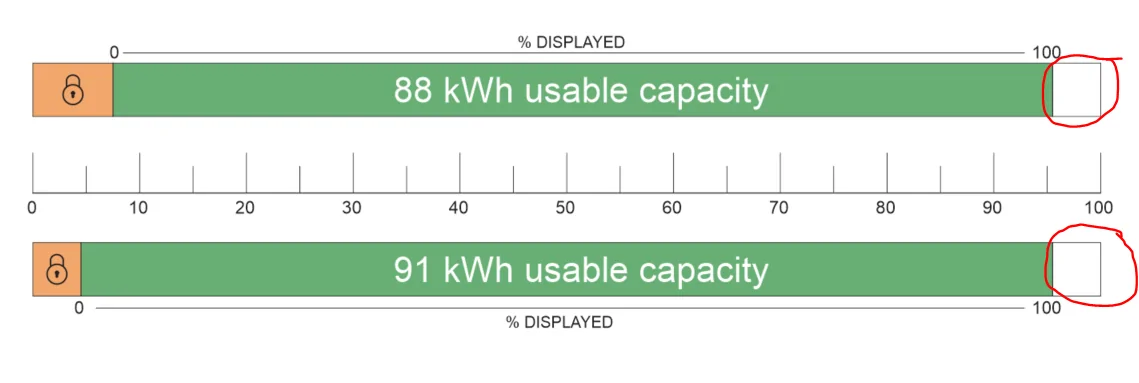
Here is a visual that might help. This isn't exactly how it works but this is an over-simplification for discussion purposes.....
For 2021, the usable capacity of the Extended Range battery is 88 kWh.
For 2022-23, the usable capacity of the Extended Range battery is 91 kWh.
The HVB is the same component of course so the usable amount is controlled by software.

Ford does not allow the battery to be fully charged so there is a portion at the top end that remains empty (circled in red).

Additionally, Ford locks out a portion at the bottom end of the battery that can never be discharged by the driver (shown in orange). If remains charged at all times so when the display says 0%, there still is a charge remaining.......you just can't use it.

For 2022, that reserve at the lower end was nearly halved, which is where that extra 3 kWh came from. It makes total sense why Ford would be comfortable doing that because most of us never drive the car down to 0% displayed anyway. So, in either scenario the bottom end remains fully charged all the time. The difference is with the 91 kWh usable models, you have a little more range for emergencies (which in theory are very rare events anyway).

At least this is how I understand it anyway. ?
Hope this helps.

Ford Mustang Mach-E chargepoint home flex weirdness 1662484827715
 

gpgrim

Well-Known Member
First Name
Gary
Joined
May 17, 2021
Threads
11
Messages
233
Reaction score
213
Location
Danville, CA
Vehicles
RR 4XP, MB E-350, Exp. EB, Subaru XTrek
Occupation
Physicist
Country flag
Here is a visual that might help. This isn't exactly how it works but this is an over-simplification for discussion purposes.....
For 2021, the usable capacity of the Extended Range battery is 88 kWh.
For 2022-23, the usable capacity of the Extended Range battery is 91 kWh.
The HVB is the same component of course so the usable amount is controlled by software.

Ford does not allow the battery to be fully charged so there is a portion at the top end that remains empty (circled in red).

Additionally, Ford locks out a portion at the bottom end of the battery that can never be discharged by the driver (shown in orange). If remains charged at all times so when the display says 0%, there still is a charge remaining.......you just can't use it.

For 2022, that reserve at the lower end was nearly halved, which is where that extra 3 kWh came from. It makes total sense why Ford would be comfortable doing that because most of us never drive the car down to 0% displayed anyway. So, in either scenario the bottom end remains fully charged all the time. The difference is with the 91 kWh usable models, you have a little more range for emergencies (which in theory are very rare events anyway).

At least this is how I understand it anyway. ?
Hope this helps.

1662484827715.png
Greg,

Thanks for taking the time to explain this. To be honest, I was just trying to sarcastically make the point that the language Ford is using is imprecise at best, and intellectually disingenuous regardless. The fact that the '21 and '22 battery packs are the same total capacity, but are managed differently is a tad annoying. I can accept there's likely a tech difference in the control systems, but it's difficult to believe that this is meaningfull to the 3 kWh top end difference between the two MYs. In the grand scheme not a bit deal, i.e. 10 miles, bfd, but it does feel like sloppy management. Meh.
Sponsored


Top