Definitive Range Optimization Technique

SpaceEVDriver

Well-Known Member
Joined
Aug 26, 2021
Threads
71
Messages
2,651
Reaction score
4,774
Location
Arizona
Vehicles
2022 CA Route 1 AWD, ER; 2023 Lightning Lariat ER
Occupation
Planetary Science
Country flag
Ok. So my main takeaways are:
  • Always use cruise control
  • Don’t be a speed demon
  • And I’m gonna switch to 2PD. Although @mkhuffman ’s study shows you can be equally efficient in either mode, it seems it takes less effort to drive efficiently in 2PD
I hope that (plus driving in warmer weather) will take us as far as possible on our trip.
My feelings:
  • Use cruise control as much as you're comfortable using cruise control.
  • I don't drive super fast. But I don't begrudge anyone else driving at their preferred speed (as long as they don't cause major dangers at too-high or too-low a speed. Play around with your long-ish trips and find your preferred trades between speed, charge time, and total trip time.
  • 1 PD or 2 PD doesn't matter for efficiency. Use the one you feel most comfortable with and the one you feel most safe using. Around town it doesn't matter for range (perhaps for efficiency/cost, but off-the-line acceleration might matter more). On the freeway you're using cruise control.
  • I personally don't like the feeling of the vehicle "just rolling away from me" when I let go of the accelerator and it's in 2 pd mode. I'm too used to compression braking and 1pd gives me something closer to that feel.
If you're worried about range for your trip, install the plugshare app, and the "a better route planner" app, and play around with them.
Sponsored


Socalsp3

Well-Known Member
Joined
Oct 29, 2021
Threads
27
Messages
650
Reaction score
667
Location
CA
Vehicles
Ioniq 5, Mach E
Country flag
The best mode is the one you drive most efficiently with.
 

npgeorgeuw

Well-Known Member
First Name
Nicholas
Joined
Feb 5, 2022
Threads
5
Messages
161
Reaction score
173
Location
Issaquah, WA
Vehicles
Mach E GT PE, Jeep Gladiator "Willys"
Occupation
Business Owner
Country flag
Regen braking is an alternative to friction brakes, not to coasting. 95% of the time, the only way to coast to a stop is to hit something.
I believe the OP means heat due to inversion loss, “process step”….
 

67 Stang Convertible

Well-Known Member
First Name
Rich
Joined
Jan 27, 2021
Threads
50
Messages
1,686
Reaction score
2,439
Location
Georgia, USA
Vehicles
1967 Mustang, 2013 Kia Optima, 2018 Kia Sportage
Occupation
Physician
Country flag
You can coast with 1PD enabled. It's all about the position of the accelerator pedal.
Is this just by lightly touching the pedal? I've noticed when stopped at a red light, if I'm on an incline and my foot is resting on the accelerator I can roll back. I've never done this on the highway to "coast" but will try if this is the case.
 

SWO

Well-Known Member
Joined
Aug 28, 2021
Threads
21
Messages
2,222
Reaction score
2,802
Location
MD, USA
Vehicles
2022 Mach E GT, 2021 Escape PHEV, 2019 F-150
Country flag
One thing I didn't see mentioned is that regen is impacted at a high SOC (I believe someone from Ford said above 85%?). So, if you don't need a full charge, your vehicle should be less efficient "topped off."

Speed (aside from weather which you can't control) is the most important factor, though whisper is going to lag/soften the throttle response and give you better efficiency - particularly in hilly terrain.

I always precondition if I can.


21st Century Pony

Well-Known Member
First Name
Martin
Joined
May 21, 2022
Threads
36
Messages
1,976
Reaction score
2,243
Location
Arlington, Virginia
Vehicles
formerly Ford Mustang Mach E 2022 Premium AWD ER, now a li'l bit of Lightning ER
Country flag
I have found that the most significant energy consumption differential is a result of how fast you drive. If you are going on a road trip, 65mph vs 75mph cruising is about 10% difference ( estimate). I have personally monitored my miles per kilowatt performance at these speeds and there is definitely a difference. The 1 pedal, unbridled vs engage and regen braking all make significant energy efficiency differences during in-town stop and go driving but not much, if anything, at cruising speeds. After-all on any major trip, most time is spent cruising. I have checked my "trip" performance numbers and when I am not paying attention, I might get about 2.4 to 2.5 miles per kilo watt and that is when I drive aggressively, just like everyone else @ 70 to 80 mph. But if I drive the speed limits, and avoid being the fastest car on the freeway, I can get 2.7 to 3 miles per kilo watt, or better, average efficiency.


Good luck
^^ This. ^^
 

DevSecOps

Well-Known Member
First Name
Todd
Joined
Sep 22, 2021
Threads
69
Messages
4,764
Reaction score
11,624
Location
Sacramento, CA
Vehicles
'21 Audi SQ5 / '23 Rivian R1T / '23 M3P
Occupation
CISO
Country flag
Let me clarify my last post about this here since "omg speed" comes up on this board all the time. This way I have something to reference in future arguments :p

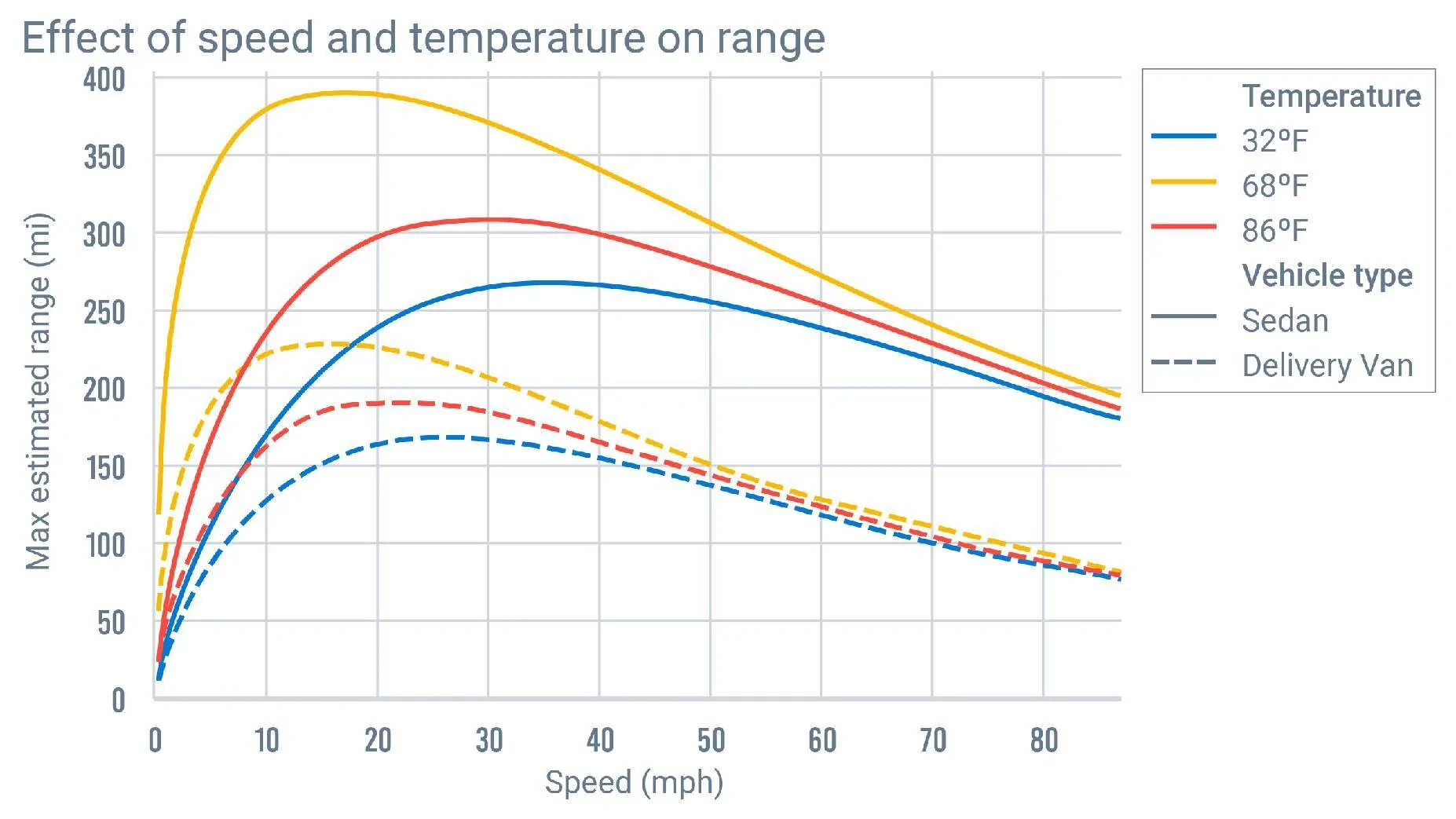
The issue with range for most EV owners is knowing what your constant is. The things we can't change and things we don't plan for are what get us in a pickle. If you decide to travel 10mph faster, that's a constant. You can plan for that. You can't however change the temperature, headwinds etc. Starting a drive with relatively calm winds, that change to strong headwinds can get you in trouble. This is due to drag, which is the same thing that increases with speed, but it's something you can't plan for as easily.

Assuming we are traveling long distance:

Facts:
- Speed will decrease your range by about 10% per 10 mph
- Optimal speed is 19mph (for all you "don't speed people")
- Range is mostly considered on long trips, not city driving
- 1pd vs 2pd on highway traveling makes no difference
- Drive modes make no difference

If we take a scenario of driving 70mph in 68F weather in an MME we will be able to drive 238 miles in 3h:24m.

If we take a scenario of driving 80mph in 68F weather in an MME we will be able to drive 209 miles in 2h:36m.

This makes for a difference of 29 miles and 48 minutes. At 80mph we can cover those 29 miles in 21 minutes.

Assuming, however, that both must stop to charge at the same station. The 80mph vehicle must DCFC for ~15kW more than the same vehicle arriving at the same charger that went 70mph, and would have to stay approximately 9 minutes longer if 100kw is being delivered via the charge unit. This will also result in an added cost of about $5, unless it's a free charge day!

The end result is a quicker arrival time at the expense of a little more energy ($) and slightly longer stops for charging. Obviously, if our goal was to get 225 miles, the slower vehicle would get there without the need to stop assuming perfect static environmental conditions. Even so, the same distance at 80mph would take 24 minutes less allowing for a quick top off of electrons which would probably get both vehicles to the same destination at the same time.

So, to recap - what is your goal? Is it to get there quickly? Or, is it to get as far as you can go without stopping? Most of the time we plan our routes and we leave 30-50ish miles as a buffer, mostly because chargers are sparse and conditions can change.

It all comes down to your comfort. I'm in my late 30's and I'm hyper. I want to get there as quick as possible. There's a lot of retired folk on this board that need to drain their bladder and walk their football sized ankle biters every 30 minutes (or refresh their knowledge of the owners manual) and don't care when they arrive.

To each their own, but in the grand scheme of things, as I said previously, drive the car however you want to drive the car and don't let people sow fear into how you're most comfortable driving. The facts have been laid out for you to make your own choices.


Ford Mustang Mach-E Definitive Range Optimization Technique 1682516367422
 
Last edited:

ctenidae

Well-Known Member
First Name
Alex
Joined
Jan 19, 2022
Threads
37
Messages
1,403
Reaction score
1,852
Location
Stamford, CT
Vehicles
DMG GT; Taycan, Q7, Sienna Hybrid
Occupation
Solver of problems
Country flag
Has there been a scientific study of the effects of driving style, particularly on highway? I have a road trip plan and I’d like to understand and maximize my range.
You have an opportunity to run a (quasi) scientific study. Divide the trip into roughly similar segments, and utilize whatever combinations of settings/styles you want. Be consistent and track the results. You will have real world actionable data, and it will be especially relevant to you and how you drive.

My money is that you'll notice some difference in efficiency, though I suspect it will not be statistically significant. I'll lay a side bet that the style you have or will adopt/ed as your "regular" driving style will be 2nd most efficient, but 100% more comfortable for you.

At the very least, you'll graduate from being a n00b, and will be able to rebut any n00bie range discussions with "I actually did the study myself, and..."
 

Lowertc

Well-Known Member
First Name
Tom
Joined
Feb 18, 2023
Threads
13
Messages
55
Reaction score
16
Location
Connecticut
Vehicles
2022 Mach e AWD
Country flag
My take on your takeaway...

Drive in the mode you most enjoy. Drive as fast as you want. Don't change how you drive unless you're in an oh-shit, I need a charger now, mode. Enjoy the car and drive it like any other car you've driven. People put way too much into small gains.

You might be able to get a few more miles out of it driving slower, but if you're going on a long trip your likely not going to plan on charging at 5% SOC. You'll have chargers planned on the route with a buffer.

After driving 40k miles, almost all highway, I can tell you that head winds, night time driving and cold temps are going to affect your range far more than driving style or what modes you select.
Night driving why?
 

DevSecOps

Well-Known Member
First Name
Todd
Joined
Sep 22, 2021
Threads
69
Messages
4,764
Reaction score
11,624
Location
Sacramento, CA
Vehicles
'21 Audi SQ5 / '23 Rivian R1T / '23 M3P
Occupation
CISO
Country flag
Night driving why?
Combination of lower temps resulting in lower range and cabin warming mostly. I think there's also a little more usage for all the lighting when driving at night, which isn't really that negligible until you spend hours on the road.

Every week I drive 400 miles round trip. Starting and stopping elevations are within 50' of each other. The 200 miles at 9am are always better on range than the 200 miles at 10pm. I don't know exactly why, but it's definitely a thing. I leave home with 100%SOC and arrive with 25%. I leave there with 100%SOC and arrive home with 10%. The only major difference is the time of day.
 

RickMachE

Well-Known Member
Joined
Jul 1, 2021
Threads
267
Messages
17,898
Reaction score
27,851
Location
SE MI
Vehicles
2022 Mach-E Premium 4X, 2022 Lightning Lariat ER
Country flag
Let me clarify my last post about this here since "omg speed" comes up on this board all the time. This way I have something to reference in future arguments :p

The issue with range for most EV owners is knowing what your constant is. The things we can't change and things we don't plan for are what get us in a pickle. If you decide to travel 10mph faster, that's a constant. You can plan for that. You can't however change the temperature, headwinds etc. Starting a drive with relatively calm winds, that change to strong headwinds can get you in trouble. This is due to drag, which is the same thing that increases with speed, but it's something you can't plan for as easily.

Assuming we are traveling long distance:

Facts:
- Speed will decrease your range by about 10% per 10 mph
- Optimal speed is 19mph (for all you "don't speed people")
- Range is mostly considered on long trips, not city driving
- 1pd vs 2pd on highway traveling makes no difference
- Drive modes make no difference

If we take a scenario of driving 70mph in 68F weather in an MME we will be able to drive 238 miles in 3h:24m.

If we take a scenario of driving 80mph in 68F weather in an MME we will be able to drive 209 miles in 2h:36m.

This makes for a difference of 29 miles and 48 minutes. At 80mph we can cover those 29 miles in 21 minutes.

Assuming, however, that both must stop to charge at the same station. The 80mph vehicle must DCFC for ~15kW more than the same vehicle arriving at the same charger that went 70mph, and would have to stay approximately 9 minutes longer if 100kw is being delivered via the charge unit. This will also result in an added cost of about $5, unless it's a free charge day!

The end result is a quicker arrival time at the expense of a little more energy ($) and slightly longer stops for charging. Obviously, if our goal was to get 225 miles, the slower vehicle would get there without the need to stop assuming perfect static environmental conditions. Even so, the same distance at 80mph would take 24 minutes less allowing for a quick top off of electrons which would probably get both vehicles to the same destination at the same time.

So, to recap - what is your goal? Is it to get there quickly? Or, is it to get as far as you can go without stopping? Most of the time we plan our routes and we leave 30-50ish miles as a buffer, mostly because chargers are sparse and conditions can change.

It all comes down to your comfort. I'm in my late 30's and I'm hyper. I want to get there as quick as possible. There's a lot of retired folk on this board that need to drain their bladder and walk their football sized ankle biters every 30 minutes (or refresh their knowledge of the owners manual) and don't care when they arrive.

To each their own, but in the grand scheme of things, as I said previously, drive the car however you want to drive the car and don't let people sew fear into how you're most comfortable driving style. The facts have been laid out for you to make your own choices.
Totally wrong. It's "SOW FEAR", not "SEW FEAR". ?

I'll put my 60yr+ ankles up against yours anytime. ?

The biggest issue about range is the lack of the general population to remotely understand most of these concepts. They can't even wrap their minds around batteries not likely cold. Think of the "I was going 85 and my range dropped really fast, WFT!".
 

RickMachE

Well-Known Member
Joined
Jul 1, 2021
Threads
267
Messages
17,898
Reaction score
27,851
Location
SE MI
Vehicles
2022 Mach-E Premium 4X, 2022 Lightning Lariat ER
Country flag
Combination of lower temps resulting in lower range and cabin warming mostly. I think there's also a little more usage for all the lighting when driving at night, which isn't really that negligible until you spend hours on the road.

Every week I drive 400 miles round trip. Starting and stopping elevations are within 50' of each other. The 200 miles at 9am are always better on range than the 200 miles at 10pm. I don't know exactly why, but it's definitely a thing. I leave home with 100%SOC and arrive with 25%. I leave there with 100%SOC and arrive home with 10%. The only major difference is the time of day.
Density of air at night vs. the coefficient of the permutation.
 

DevSecOps

Well-Known Member
First Name
Todd
Joined
Sep 22, 2021
Threads
69
Messages
4,764
Reaction score
11,624
Location
Sacramento, CA
Vehicles
'21 Audi SQ5 / '23 Rivian R1T / '23 M3P
Occupation
CISO
Country flag
Totally wrong. It's "SOW FEAR", not "SEW FEAR". ?

I'll put my 60yr+ ankles up against yours anytime. ?
Well, aren't you the grammar police today ... my turn -

An ankle biter is a small dog, I don't want to see your ankles Rick.
 

RickMachE

Well-Known Member
Joined
Jul 1, 2021
Threads
267
Messages
17,898
Reaction score
27,851
Location
SE MI
Vehicles
2022 Mach-E Premium 4X, 2022 Lightning Lariat ER
Country flag
Touche'.

Have no dog.
Sponsored


Top