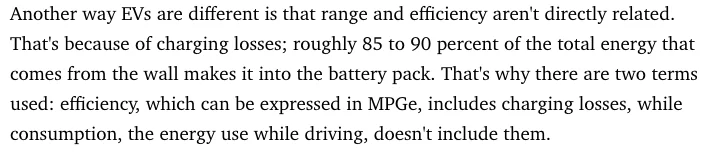
The following paragraph I wish I knew a long time ago. It took me forever to figure it out myself why the range didn't sync up with MPGe and kwh/100mi.
I wouldn't quite say "only", but I would say "overwhelmingly" for the vast majority of drivers.
For the vast majority of Mach-E drivers that will be able to charge at home, they're gonna have way more range than they need for their daily around-home use. About the only time range will come into play is on a lengthy road trip away from home. That's usually highway speeds.
The following paragraph I wish I knew a long time ago. It took me forever to figure it out myself why the range didn't sync up with MPGe and kwh/100mi.
And up until now I've usually been ignoring that in my calculations for charging time and such. But a 10-15% loss seems HUGE. That would mean, for instance, that a 50 kW charger would really only be adding 43-45 kWh each hour to the battery, not 50. Adds quite a bit to charging time.
How do they adjust for wind speed? How do they adjust for traffic? How do they adjust for moisture on the road? How do they adjust for climate control usage at different exterior temperatures?
All of those variables *are* standardized in a lab test, so lab tests are, definitionally, the only tests worth comparing, because they are the only test where the variable is the vehicle.
And up until now I've usually been ignoring that in my calculations for charging time and such. But a 10-15% loss seems HUGE. That would mean, for instance, that a 50 kW charger would really only be adding 43-45 kWh each hour to the battery, not 50. Adds quite a bit to charging time.
Those losses are AC losses. AC charging has greater "meter to ground" losses due to the AC->DC->AC conversion losses, and keeping the car awake means the car's computer overhead is a higher % of the total charging energy.
That was just a random example. I could have used various L2 kW charging speeds too.
I'm guessing that 10-15% loss they cite is more to average in bad conditions, like charging outside in the cold, or high heat. Or a hot or cold battery. With charging in a garage the vast majority of the time, I'd be surprised if the loss is that high.
To be clear. It's not about babying anything. You can drive an EV like any other car and it will perform just fine. Over time however you will notice (learn) that there are things you can do that will change/enhance the experience and performance.
For example, a lot of people new to EV's choose to go without HVAC or use it intermittently to decrease battery consumption. Turns out once you really get connected with your car, you find out that may not be necessary. To illustrate this, my son has for years sworn on turning off the HVAC system completely except when absolutely needed. Turns out if you simply leave the system in normal defogger position there's no change in range from when it's on, to when it's off and the windows are always clear (even with Heat & A/C turned off for you fellow Bolt drivers). It's little things like this that engineers have already thought of that may not be apparent until you really get to know the car.
As for cruise control, great on flat roads. If you're up and down hills though, you can probably do better yourself once you're used to the feedback the car is giving you.
Those losses are AC losses. AC charging has greater "meter to ground" losses due to the AC->DC->AC conversion losses, and keeping the car awake means the car's computer overhead is a higher % of the total charging energy.