
ajmartineau
Well-Known Member
- Joined
- Jun 23, 2020
- Threads
- 33
- Messages
- 1,392
- Reaction score
- 1,979
- Location
- Washington
- Vehicles
- 2021 Mach-E
- Thread starter
- #91
They are not going to unlock the buffer
Sponsored
The issue I have with this is Ford knew reviewers were going to test it. If what you said was true, seems like they would have told reviewers.If it stays that way, I'd agree. What they appeared to do in the preproductions is limit 80%+ DCFC to what amounts to L2 power. 48A @ 240V is 11 kW. Probably no coincidence they chose that power level to taper (more like plummet) it to at 80% SOC, knowing that was probably already well tested.
But I've gotta think that will be bumped up on DCFC in the production units, either already, or via OTA. Even though I may never actually need to DCFC above 80%, it would be nice to know we could reasonably go higher if there's a long leg ahead (without dropping all the way to an L2 crawl).
The warranty guarantee is only for 70% at 8 years though. That's a whopping 30% "acceptable" degradation.I think they will only unlock that buffer to counter battery degradation...that 11% is their protection from warranty claims.
Ironically, it could also have the opposite effect. On an EA charger that prices by the kWh, you're losing time but not $$ by leaving it plugged in for an extra hour+ above 80%. That takes the idle fees out of the picture (for probably 90 minutes, anyway). That could result in some people tying up the charger longer (while they're off having an hour+ meal somewhere).That 12kW limit is also it get you off the charger. I am wondering if it will do that on all chargers. Or if I plug in at 81%
Yeah, that thought crossed my mind too. Doesn't seem like you want want to come in too low for the reviewers. So probably not gonna change a lot.The issue I have with this is Ford knew reviewers were going to test it. If what you said was true, seems like they would have told reviewers.
Yes that is why I noted we will know in a couple of years (twice). Tesla M3 and MY have 75 KWh batteries with 72 KWh usable (4% buffer) so you can determine if 3 times that is too much and a warranty grab. The warranty is based now on the 88 KWh usable so you can be down to 62KWh on your 100 KWh pack and still be in warranty.Too soon to make those dire determinations, I think. First, we need to see what the production units do, to see if it's already been set differently than the preproductions. Second, we need to see what OTA updates may be coming out in the first year (like Tesla did). It's very possible that some of that 11% buffer will be unlocked, and that the charging curve above 80% will improve.
As for protecting the warranty vs the battery, it's pretty much one in the same thing. Unless they're truly going overboard with excessive and unnecessary buffer. And we won't know that for a while yet either. (Also possible we'll never know that.)
Some of your math vs the Tesla leaves out the same practical limitations on it too, bit not worth nitpicking that one. Yes, miles/kWh is less efficient on the MME. It's a heavier vehicle knowingly designed not to sacrifice style/looks for aerodynamics as much as the Teslas do. It's simply not the same vehicle as the Model Y (which is more good than bad, IMO).
Didn't say the math was off, I think you just didn't account for some of the more liberal factors that are part of the Tesla numbers, which make it a bit of an apples-to-oranges comparison. In Teslas, the conventional wisdom is that you need to self limit how deep you charge the battery. Whereas the the Ford limits it for you. Also, Tesla is known to use a method that produces the most liberal EPA range relative to most everyone else.Yes that is why I noted we will know in a couple of years (twice). Tesla M3 and MY have 75 KWh batteries with 72 KWh usable (4% buffer) so you can determine if 3 times that is too much and a warranty grab. The warranty is based now on the 88 KWh usable so you can be down to 62KWh on your 100 KWh pack and still be in warranty.
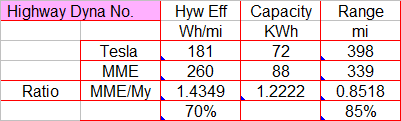
Maybe you can show me where my numbers are off? Of course I am talking highway efficiency; you of all here should not have a problem with that? It is carrying around 100 kwh of batteries so it is heavier; now if more of it was usable we would be all set.
![]()
You are complaining about a design and engineering process that has been in place for decades. Not restricted to electric vehicles but every successful vehicle since the late 80's.It is not protecting the battery it is protecting Ford and their new fear of warranty issues. The cost of a 100 KWh pack now produces 63 KWh highway usable.
They reduced our purchased 100 KWh battery with a 11% buffer to 88 KWh reducing 2 cycle epa range from 270 miles to 250 mi on the 4x. Current reviews indicate they also may limit DCFC to 80% on the remaining 88 KWh so now we have 70 KWh to start. When you are 30% less efficient than the model Y and now have 2 KWh less battery you are not too much of a competitor.
So I respectfully disagree. Do you also believe that is what Tesla and the others are doing; trashing their batteries? I think there are a couple of model S out there still trashing them. Appears to me it is ford protecting themselves which is not helping adoption. Could have been awesome; was engineered and prior managed to be just that. Appears now to be taken over at launch by management whos priority goes to Ford and their warranty items. Won't take long to determine that (couple of years) and then we can all determine our next move. Possible we will get 90% of that 88 KWh on a DCFC but that would not be because of lack of complaining. In two years if it is still a 11% buffer we will know how Ford intends to embrace the future. Right now it has gone from awesome to mere so so. Bean counter decisions and warranty fearers have done that.
I doubt that would be visible in the car's UI (I would be happy to be wrong, however).Is there a way to see Battery Temperature in the car’s user interface?
Collecting charging rate data without that key piece of information is almost pointless. A cold soaked battery in a Maine winter will behave differently than a heat happy battery in Hawaii.
Ideal charging temperatures (for the Taycan) are from 77-90°F. If the battery temp is below 77° it will not charge at the full potential rate. I’m still trying to find Ford’s specifications for charge rates.
Initial State of Charge is also critical information to gather. Peak charge rates adjust downward as the SoC goes up.
I collected a large amount (100 charge sessions) of DC charge data (of a Taycan) early last year. So I have some (hopefully) relevant data & knowledge.
Nothing is carved in stone.Never say never.![]()
Never say never.![]()
Except for software/firmware. That's written once and can NEVER be changed. Ever. Once the Mach E ships it is a static and never changing platform; all this OTA talk is fake news.Nothing is carved in stone.