
MME Charging Curve Data Collection

OP
OP
ajmartineau

ajmartineau

Well-Known Member
Joined
Jun 23, 2020
Threads
33
Messages
1,392
Reaction score
1,979
Location
Washington
Vehicles
2021 Mach-E
Country flag
They are not going to unlock the buffer
Sponsored
 

mattbostonmache

Well-Known Member
First Name
Matt
Joined
Jul 25, 2020
Threads
89
Messages
522
Reaction score
700
Location
Newton, MA
Vehicles
Rav4
Country flag
Is the buffer split between both the top and the bottom? We don't want the battery at true 100%. But we also don't want it at true 0% (which is much much worse than 100% from what I've read on the forums).
 

zhackwyatt

Well-Known Member
Joined
Dec 18, 2019
Threads
14
Messages
1,617
Reaction score
2,635
Location
Arizona
Vehicles
'21 InfBlu Prem MMEx, '21 F150 PowerBoost Hybrid Past: '13 C-Max '98 Explorer
Country flag
If it stays that way, I'd agree. What they appeared to do in the preproductions is limit 80%+ DCFC to what amounts to L2 power. 48A @ 240V is 11 kW. Probably no coincidence they chose that power level to taper (more like plummet) it to at 80% SOC, knowing that was probably already well tested.

But I've gotta think that will be bumped up on DCFC in the production units, either already, or via OTA. Even though I may never actually need to DCFC above 80%, it would be nice to know we could reasonably go higher if there's a long leg ahead (without dropping all the way to an L2 crawl).
The issue I have with this is Ford knew reviewers were going to test it. If what you said was true, seems like they would have told reviewers.
 

dbsb3233

Well-Known Member
First Name
TimCO
Joined
Dec 30, 2019
Threads
56
Messages
10,100
Reaction score
11,965
Location
Colorado, USA
Vehicles
2021 Mustang Mach-E FE, 2025 Porche Macan Electric
Occupation
Retired
Country flag
I think they will only unlock that buffer to counter battery degradation...that 11% is their protection from warranty claims.
The warranty guarantee is only for 70% at 8 years though. That's a whopping 30% "acceptable" degradation.

They'd probably still hold at least a 5% buffer anyway (all BEVs need some buffer to protect the extreme ends), so we're only talking about an extra ~6%. Doesn't seem like moving their leeway from 30% to 36% very likely to make the difference in many warranty claims.

I think it's more that they're just being extra cautious with their first major BEV until they get more data collected. I don't think they want to leave a bunch of range on the table unnecessarily (that would otherwise be a selling point). I just don't think they're 100% that it's unnecessary yet, until months of winter user data can give them a more confident prediction.


dbsb3233

Well-Known Member
First Name
TimCO
Joined
Dec 30, 2019
Threads
56
Messages
10,100
Reaction score
11,965
Location
Colorado, USA
Vehicles
2021 Mustang Mach-E FE, 2025 Porche Macan Electric
Occupation
Retired
Country flag
That 12kW limit is also it get you off the charger. I am wondering if it will do that on all chargers. Or if I plug in at 81%
Ironically, it could also have the opposite effect. On an EA charger that prices by the kWh, you're losing time but not $$ by leaving it plugged in for an extra hour+ above 80%. That takes the idle fees out of the picture (for probably 90 minutes, anyway). That could result in some people tying up the charger longer (while they're off having an hour+ meal somewhere).
 

dbsb3233

Well-Known Member
First Name
TimCO
Joined
Dec 30, 2019
Threads
56
Messages
10,100
Reaction score
11,965
Location
Colorado, USA
Vehicles
2021 Mustang Mach-E FE, 2025 Porche Macan Electric
Occupation
Retired
Country flag
The issue I have with this is Ford knew reviewers were going to test it. If what you said was true, seems like they would have told reviewers.
Yeah, that thought crossed my mind too. Doesn't seem like you want want to come in too low for the reviewers. So probably not gonna change a lot.

But nearly all the 2021's are pre-sold anyway, so doesn't really cost them anything to come in low on that right now if they think it'll probably improve later.

Maybe we're just overthinking it. Could be they simply don't know yet until they get more data.
 

Louv

Well-Known Member
First Name
Don
Joined
Jan 1, 2021
Threads
1
Messages
56
Reaction score
209
Location
Maine
Vehicles
TBD
Country flag
Is there a way to see Battery Temperature in the car’s user interface?

Collecting charging rate data without that key piece of information is almost pointless. A cold soaked battery in a Maine winter will behave differently than a heat happy battery in Hawaii.

Ideal charging temperatures (for the Taycan) are from 77-90°F. If the battery temp is below 77° it will not charge at the full potential rate. I’m still trying to find Ford’s specifications for charge rates.

Initial State of Charge is also critical information to gather. Peak charge rates adjust downward as the SoC goes up.

I collected a large amount (100 charge sessions) of DC charge data (of a Taycan) early last year. So I have some (hopefully) relevant data & knowledge.
 

Shayne

Well-Known Member
Joined
Aug 9, 2020
Threads
18
Messages
3,824
Reaction score
2,738
Location
Northern Ontario Canada
Vehicles
2021 MME4x Prem
Occupation
Retired
Country flag
Too soon to make those dire determinations, I think. First, we need to see what the production units do, to see if it's already been set differently than the preproductions. Second, we need to see what OTA updates may be coming out in the first year (like Tesla did). It's very possible that some of that 11% buffer will be unlocked, and that the charging curve above 80% will improve.

As for protecting the warranty vs the battery, it's pretty much one in the same thing. Unless they're truly going overboard with excessive and unnecessary buffer. And we won't know that for a while yet either. (Also possible we'll never know that.)

Some of your math vs the Tesla leaves out the same practical limitations on it too, bit not worth nitpicking that one. Yes, miles/kWh is less efficient on the MME. It's a heavier vehicle knowingly designed not to sacrifice style/looks for aerodynamics as much as the Teslas do. It's simply not the same vehicle as the Model Y (which is more good than bad, IMO).
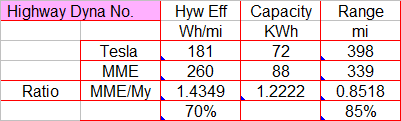
Yes that is why I noted we will know in a couple of years (twice). Tesla M3 and MY have 75 KWh batteries with 72 KWh usable (4% buffer) so you can determine if 3 times that is too much and a warranty grab. The warranty is based now on the 88 KWh usable so you can be down to 62KWh on your 100 KWh pack and still be in warranty.

Maybe you can show me where my numbers are off? Of course I am talking highway efficiency; you of all here should not have a problem with that? It is carrying around 100 kwh of batteries so it is heavier; now if more of it was usable we would be all set.

Ford Mustang Mach-E MME Charging Curve Data Collection 1609729557239
 
  • Like
Reactions: UW2

dbsb3233

Well-Known Member
First Name
TimCO
Joined
Dec 30, 2019
Threads
56
Messages
10,100
Reaction score
11,965
Location
Colorado, USA
Vehicles
2021 Mustang Mach-E FE, 2025 Porche Macan Electric
Occupation
Retired
Country flag
Yes that is why I noted we will know in a couple of years (twice). Tesla M3 and MY have 75 KWh batteries with 72 KWh usable (4% buffer) so you can determine if 3 times that is too much and a warranty grab. The warranty is based now on the 88 KWh usable so you can be down to 62KWh on your 100 KWh pack and still be in warranty.

Maybe you can show me where my numbers are off? Of course I am talking highway efficiency; you of all here should not have a problem with that? It is carrying around 100 kwh of batteries so it is heavier; now if more of it was usable we would be all set.

1609729557239.png
Didn't say the math was off, I think you just didn't account for some of the more liberal factors that are part of the Tesla numbers, which make it a bit of an apples-to-oranges comparison. In Teslas, the conventional wisdom is that you need to self limit how deep you charge the battery. Whereas the the Ford limits it for you. Also, Tesla is known to use a method that produces the most liberal EPA range relative to most everyone else.

I know we could argue that it may actually be better to allow drivers to self-limit, if they're responsible about it (i.e. do it very infrequently). I'd actually prefer that too, although I can also see why they don't trust all owners to be responsible with that. And I know you have your own deal you keep pushing on the EPA calculation. I'm not gonna chase that rabbit down the hole. My point was that Tesla is known to use a liberal method that tends to exaggerate their EPA range more than most.

Moreover, this will likely all be moot anyway, as the chances of changes/updates by Ford seem pretty good.
 
Last edited:

SnBGC

Well-Known Member
First Name
Greg
Joined
Apr 20, 2020
Threads
46
Messages
5,962
Reaction score
9,778
Location
Phoenix
Vehicles
2021 Mach-E FE, 2021 Wrangler 4xe High Altitude
Occupation
Manager
Country flag
It is not protecting the battery it is protecting Ford and their new fear of warranty issues. The cost of a 100 KWh pack now produces 63 KWh highway usable.

They reduced our purchased 100 KWh battery with a 11% buffer to 88 KWh reducing 2 cycle epa range from 270 miles to 250 mi on the 4x. Current reviews indicate they also may limit DCFC to 80% on the remaining 88 KWh so now we have 70 KWh to start. When you are 30% less efficient than the model Y and now have 2 KWh less battery you are not too much of a competitor.

So I respectfully disagree. Do you also believe that is what Tesla and the others are doing; trashing their batteries? I think there are a couple of model S out there still trashing them. Appears to me it is ford protecting themselves which is not helping adoption. Could have been awesome; was engineered and prior managed to be just that. Appears now to be taken over at launch by management whos priority goes to Ford and their warranty items. Won't take long to determine that (couple of years) and then we can all determine our next move. Possible we will get 90% of that 88 KWh on a DCFC but that would not be because of lack of complaining. In two years if it is still a 11% buffer we will know how Ford intends to embrace the future. Right now it has gone from awesome to mere so so. Bean counter decisions and warranty fearers have done that.
You are complaining about a design and engineering process that has been in place for decades. Not restricted to electric vehicles but every successful vehicle since the late 80's.

If you get a chance to sit in and participate in the vast amount of decisions and testing made by the engineers it would blow your mind.

I have first hand knowledge of some of the goals and concerns when Ford and Magna were setting the design specs for the FFE and it was amazing to see those teams at work.

Similar story for the folks who designed the Super Duty platform. Those early models were very over engineered per the spec because Ford was blazing new ground. Without question, the 1999-2003 PowerStroke SD trucks were the most durable and conservative. From that point up to today, EVERY single design change made to that vehicle was made for a reason.....usually related to the bottom line. Sometimes that is a simple cost saving decision, sometimes it is for increased efficiency, sometimes it is regulated and sometimes it is for product improvement to keep or grow market share. Either way, it is a choice made with much thought and consideration.

I am very sure the battery pack was designed to satisfy hundreds of engineering criteria and wasn't sized just to keep some of it away from the user. It all gets used for some purpose that Ford has deemed necessary at this time.
 

JamieGeek

Well-Known Member
Joined
Dec 29, 2019
Threads
82
Messages
3,589
Reaction score
6,823
Location
Southeastern Michigan
Website
spareelectrons.wordpress.com
Vehicles
Escape PHEV, old: Mach-E, Bolt, C-Max Energi, Focus Electric
Country flag
Is there a way to see Battery Temperature in the car’s user interface?

Collecting charging rate data without that key piece of information is almost pointless. A cold soaked battery in a Maine winter will behave differently than a heat happy battery in Hawaii.

Ideal charging temperatures (for the Taycan) are from 77-90°F. If the battery temp is below 77° it will not charge at the full potential rate. I’m still trying to find Ford’s specifications for charge rates.

Initial State of Charge is also critical information to gather. Peak charge rates adjust downward as the SoC goes up.

I collected a large amount (100 charge sessions) of DC charge data (of a Taycan) early last year. So I have some (hopefully) relevant data & knowledge.
I doubt that would be visible in the car's UI (I would be happy to be wrong, however).

It will likely be accessible via a OBD-II dongle with the Forscan app. We were able to view battery temps on the Focus Electric with it so I would guess that they will figure it out once they get their hands on a Mach-E.
 

timbop

Well-Known Member
First Name
Tim
Joined
Jan 3, 2020
Threads
65
Messages
6,832
Reaction score
14,036
Location
New Jersey
Vehicles
Solar powered 2021 MME ER RWD (CA RT1)
Occupation
Software Engineer
Country flag


Top