UVCatastrophe
New Member
- First Name
- Shaun
- Joined
- Jan 3, 2024
- Threads
- 1
- Messages
- 2
- Reaction score
- 57
- Location
- Portland OR
- Vehicles
- 2023 Mustang Mach-E GTPE

- Thread starter
- #1
Hi Everyone,
I have seen a lot of suggestions that the optimal EVSE current to charge at is the lowest possible current. Based on the reasoning that minimizing the I^2R losses minimizes overall loss. However this seems to ignore the efficiency of the AC to DC conversion equipment. Given the fact that no data on the operating characteristics of the onboard charger are available from Ford...
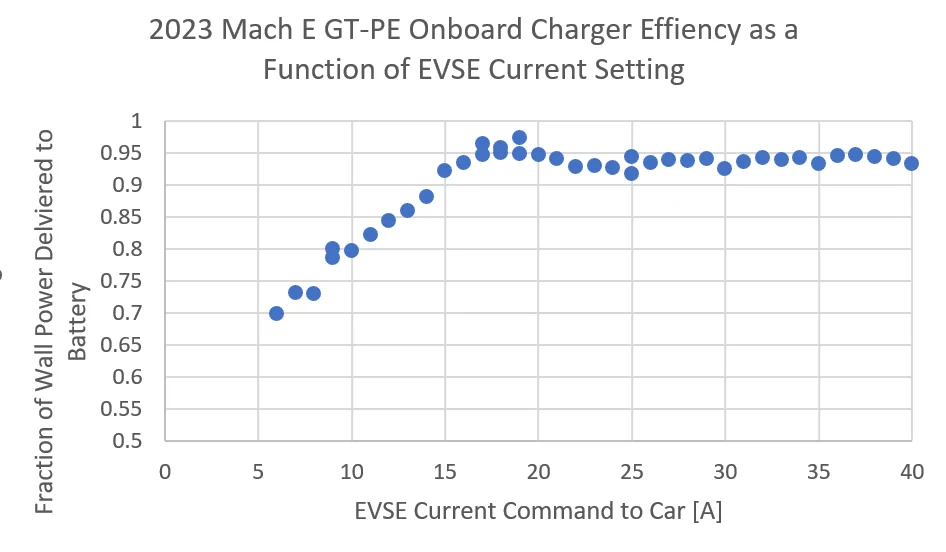
I went through the process of measuring the actual current draw from the car for each current set point from the EVSE and also measured the AC voltage at the car for each current set point to obtain the AC power delivered to the vehicle. I then compared that to the energy output from the onboard charger based on data from the Car Scanner OBDII reader to come up with an efficiency as a function of EVSE current set point for my Wallbox Pulsar Plus.
Based on the data it is outrageously inefficient to operate at very low AC wall current at 240Vac! There is a linear increase in efficiency with wall current from about 70% at 6A (lowest i can run) up to a maximum of almost 96% efficient at 18A. At that point there is a slight decrease for a reason I don't understand ( any guesses are welcome) and then a very broad plateau at ~94% all the way out to 40A (the highest I can run). I really wish this data were available from Ford so that we could make informed decsions on how to operate our vehicles. I know it might seem like that low current effecienty is bad but I think that the engineering team should be commended for how flat and efficent their power coverter is from 20A to 40A, I just really wish the data was availbile. Please let me know if this information is usefull or if you have any questions.

I have seen a lot of suggestions that the optimal EVSE current to charge at is the lowest possible current. Based on the reasoning that minimizing the I^2R losses minimizes overall loss. However this seems to ignore the efficiency of the AC to DC conversion equipment. Given the fact that no data on the operating characteristics of the onboard charger are available from Ford...
I went through the process of measuring the actual current draw from the car for each current set point from the EVSE and also measured the AC voltage at the car for each current set point to obtain the AC power delivered to the vehicle. I then compared that to the energy output from the onboard charger based on data from the Car Scanner OBDII reader to come up with an efficiency as a function of EVSE current set point for my Wallbox Pulsar Plus.
Based on the data it is outrageously inefficient to operate at very low AC wall current at 240Vac! There is a linear increase in efficiency with wall current from about 70% at 6A (lowest i can run) up to a maximum of almost 96% efficient at 18A. At that point there is a slight decrease for a reason I don't understand ( any guesses are welcome) and then a very broad plateau at ~94% all the way out to 40A (the highest I can run). I really wish this data were available from Ford so that we could make informed decsions on how to operate our vehicles. I know it might seem like that low current effecienty is bad but I think that the engineering team should be commended for how flat and efficent their power coverter is from 20A to 40A, I just really wish the data was availbile. Please let me know if this information is usefull or if you have any questions.
Sponsored