MachE70

Well-Known Member
Joined
Dec 25, 2021
Threads
2
Messages
98
Reaction score
109
Location
Utah
Vehicles
2021 Kia Telluride SX, 2022 Mustang Mach-e GT
Country flag
OK, I had time to review the NHTSA documents for 23V-687 / 23S56 and give my opinions. First, I'd like to remind folks the previous recall was for software only. This time the HVBJB part is actually being recalled. NHTSA only cares about the vehicle losing motive power while driving as a safety issue. If you get a "Stop Safely Now" while parked and become stranded, that is not considered a safety issue by the government.

The only reason this new recall is happening is because 107 Mach-E's that had the 22S41 software recall done later lost motive power while driving. Which proves what we already knew about the software-only remedy not being able to completely prevent catastrophic HVBJB failure.

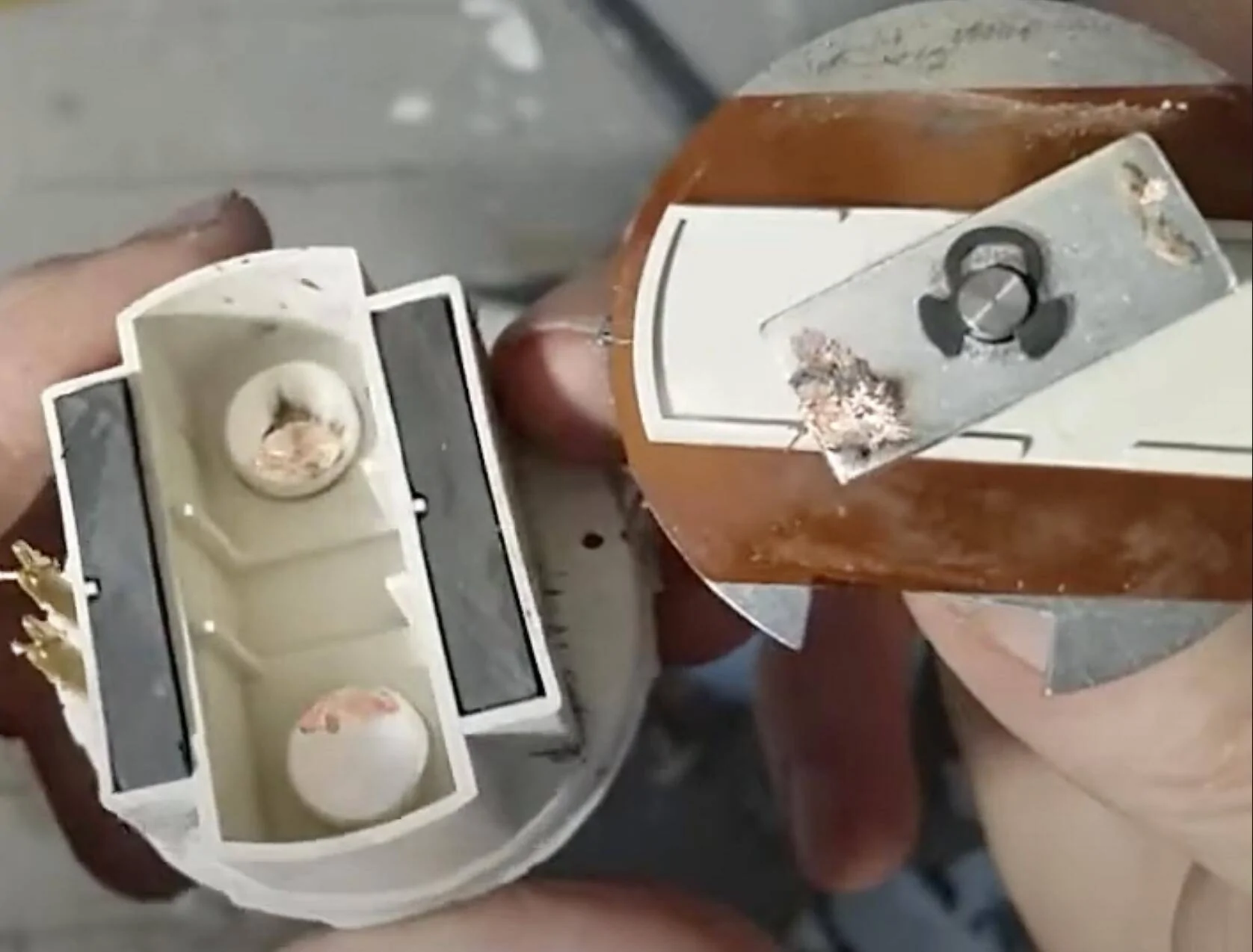
For the first time, we might know why the original contactors fail. It's because they had rounded contacts inside, and a groove on the movable contact surface. These would have caused a smaller point of contact than a flat surface. Smaller contact area means more heating and greater likelihood of arcing under load. The rounded contacts and groove likely has to do with fritting or arc suppression, but unfortunately the original design appears to have hampered durability. The new contactors are described to use flat contact surfaces, the increased contact surface should reduce heating.

Here's a picture of what burnt contacts look like (this contactor is not from a Mach-E). The bar on the right is what presses down against the round button contacts on the left part to close the circuit.

Burnt Contacts.png


Both the original and revised contractors are made by TE connectivity in Mexico. They also make the entire HVBJB.


See above, the flatter contacts should increase surface area of contact and heat dissipation. The new HVBJB still will not have any temperature sensors or a thermal management system. The only difference is the shape of the contacts.

More from the NHTSA document:


This is exactly what we saw. There was significant part-to-part variation which meant some cars are fine for 30k miles and others might fail at only 3k with the exact same driving conditions. Heat from multiple wide-open pedal events in a short time seems to be primary cause of thermal damage, but is not always required for failure. My SVS was triggered by several pedal events in a row. Prolonged hill climbing at higher speeds also caused overheating in some cases, such as the Grapevine failures. DCFC was a lesser factor, but high power 120+ kW DCFC can also contribute to overheating.


We also saw this. Older vehicles that had more miles before the recall software was released were more likely to get a SSN error after the recall software was installed versus vehicles that had fewer accumulated miles when the software was installed. This is because they had accumulated more latent damage before the recall software was installed. Ford had likely hoped the software would stop the damage in time to prevent SSN, but some vehicles already had too much damage, or the contacts stuck anyway due to part variation.


This is the "Service vehicle soon" message and associated power limit that occurs when a high voltage drop across the contactors is detected. However the detection isn't perfect and relies on a high amp draw (wide-open pedal). If you drive your car gingerly, the software may not have a chance to detect a failure.


Extended range owners that are on the original HVBJB will definitely get a replacement. However the big question is:

Will vehicles that already had the HVBJB replaced with the new part need ANOTHER replacement for this recall?

My opinion is that they will not based on this line from the document:


What production vehicles got after May 25th 2022 is the same part we get now for a HVBJB replacement. To me, I don't see any evidence or mention of there being a third revision to the contactors. The part numbers don't tell the whole story, because Ford uses different part numbers on the box vs. the part itself. The part numbers in the NHTSA document refer to the number on the part itself. The catalog number will be different. And Ford can release a newer part revision that still uses the same revised contactors.

I could be wrong, but the recall procedure will probably read something like this:
  1. Verify if 10C666 has been previously replaced in warranty history. If the part number matches {list}, the HVBJB does not need to be replaced.
  2. Replace the HVBJB if there is no matching part number found.
  3. Update the PCM/BECM/SOBDMC software to latest using FDRS.
There is no mention of new software in the NHTSA document. I don't think anything will change with the software necessarily. Ford mentions a software update in their bulletin, which might just be a matter-of-fact thing to ensure the recall software is installed in case it was somehow missed.


Last we have the reason why only the extended packs are getting replacement HVBJBs. The standard range models don't draw as many amps, so the contactors don't heat up nearly as much. There have been only 7 loss-of-power incidents in standard range packs, which was judged to be an acceptably low risk.

In terms of logistics, this is going to be a nightmare to replace 34,762 HVBJBs. It will take YEARS. The dealers are already swamped with HVBJB repairs and there are not enough EV certified techs to do the work. When I took my car in, they had three HVBJBs to do ahead of me.
If you are right that the new HVBJB we will get as part of this recall is the same as the part introduced in May 2022, then I am astounded and disappointed that Ford would proactively put a part in 30,000 MMEs that is known to fail (see @heisnuts among many others who have seen failures of the new part). Do we know how many failures of the new post-May 2002 HVBJB have been loss of motive power (the only kind of failure that NHTSA seems to care about)? Do we know that all of the 107 failures with loss of motive power after completion of 22S41 were from the original HVBJB?

Perhaps Ford and the NHTSA are comfortable that any further failures of the new part will only result in SVS for the most part with only the rare SSN, but as an owner that gives me very little added confidence whatsoever. Before I start out on a 2,000 mile roadtrip with my family, or before my wife drives alone in this car, I want no thoughts at all in my mind of a defective part that could very well fail in any way at any point due to cumulative damage. Since the new HVBJB has been shown to fail, it is still defective in my view.

I can't even imagine Ford putting a still defective part in these cars that they will have to keep replacing as failures continue over time, even if at a lower rate. They would be the laughing stock of the automotive world. Mach-Lee may well be right that there is no fail-safe third version of the HVBJB, but I really hope he is wrong. Further, it sounds like Ford's confusing part number scheme will ensure that we have no idea which part is going in our cars. When I look at the part #'s, I clearly see that this recall will involve a third version of the HVBJB.

One further question: if the same part will be used for this recall, why did Ford tell the dealers to wait until Ford provided parts ordering information before any new cars subject to the recall could be delivered to customers? It seems like Ford could have just told them to fix the cars with the existing part.
 

yazoo888

Well-Known Member
Joined
Jul 24, 2021
Threads
10
Messages
149
Reaction score
89
Location
SoCal
Vehicles
2015 MDX Tech+SHAWD, 2017 GLE550e, 2021 Mach E
Occupation
Engine..Engineer,
Country flag
SAME for 2021 Select SR. No recall, but CSP 23B50.
 

yazoo888

Well-Known Member
Joined
Jul 24, 2021
Threads
10
Messages
149
Reaction score
89
Location
SoCal
Vehicles
2015 MDX Tech+SHAWD, 2017 GLE550e, 2021 Mach E
Occupation
Engine..Engineer,
Country flag
Is this why SR does not to be recalled? The HVBJB is good at 266 HP for S.R. vs 290 or 346 HP -- not enough margin?
 

heisnuts

Well-Known Member
First Name
Darrel
Joined
Dec 5, 2021
Threads
21
Messages
978
Reaction score
2,038
Location
Oregon
Vehicles
Model 3 Performance
Country flag
If you are right that the new HVBJB we will get as part of this recall is the same as the part introduced in May 2022, then I am astounded and disappointed that Ford would proactively put a part in 30,000 MMEs that is known to fail (see @heisnuts among many others who have seen failures of the new part). Do we know how many failures of the new post-May 2002 HVBJB have been loss of motive power (the only kind of failure that NHTSA seems to care about)? Do we know that all of the 107 failures with loss of motive power after completion of 22S41 were from the original HVBJB?

Perhaps Ford and the NHTSA are comfortable that any further failures of the new part will only result in SVS for the most part with only the rare SSN, but as an owner that gives me very little added confidence whatsoever. Before I start out on a 2,000 mile roadtrip with my family, or before my wife drives alone in this car, I want no thoughts at all in my mind of a defective part that could very well fail in any way at any point due to cumulative damage. Since the new HVBJB has been shown to fail, it is still defective in my view.

I can't even imagine Ford putting a still defective part in these cars that they will have to keep replacing as failures continue over time, even if at a lower rate. They would be the laughing stock of the automotive world. Mach-Lee may well be right that there is no fail-safe third version of the HVBJB, but I really hope he is wrong. Further, it sounds like Ford's confusing part number scheme will ensure that we have no idea which part is going in our cars. When I look at the part #'s, I clearly see that this recall will involve a third version of the HVBJB.

One further question: if the same part will be used for this recall, why did Ford tell the dealers to wait until Ford provided parts ordering information before any new cars subject to the recall could be delivered to customers? It seems like Ford could have just told them to fix the cars with the existing part.
Being the huge optimist that I am, I am thinking that Ford is replacing the HVBJB with an updated part that is a lot stronger than the current part (and reman parts). I hope that is why they were so eager to get my data tracking info so that they could use that data to test the updated part to make sure it could hold up to my unique driving out in the country.

If that holds true, that would explain why cars like mine who have already had the "latest" reman part installed would still need to have the recall done. Again, the optimist in me says they are starting with all the GT and extended range MMEs built before July, 2022 first because they are the most prone to failure. Once a good portion of those vehicles have completed the recall, I would not be surprised to see that recall expanded to include the rest of the MMEs.

It really is too early to tell for sure, but I am sure once the recall is finally released and parts are available we will know a lot more. Let's hope my optimism holds true.


AKgrampy

Well-Known Member
First Name
Mike
Joined
Jan 29, 2022
Threads
7
Messages
3,525
Reaction score
3,600
Location
Fairbanks, Alaska
Vehicles
Ford Expedition, Ford F-150, Mach E GT
Occupation
Retired
Country flag
Are you talking about this??
"Ford provided the general reimbursement plan for the cost of remedies paid for by vehicle owners prior to notification of a safety recall in May 2023. The ending date for reimbursement eligibility is estimated to be March 31, 2024."

That only refers to any customer that had to pay for replacement prior to the recall being issued.
Thanks! I knew that could not be right and that I must be misinterpreting things. That was referring to something else.
 

AKgrampy

Well-Known Member
First Name
Mike
Joined
Jan 29, 2022
Threads
7
Messages
3,525
Reaction score
3,600
Location
Fairbanks, Alaska
Vehicles
Ford Expedition, Ford F-150, Mach E GT
Occupation
Retired
Country flag
Being the huge optimist that I am, I am thinking that Ford is replacing the HVBJB with an updated part that is a lot stronger than the current part (and reman parts). I hope that is why they were so eager to get my data tracking info so that they could use that data to test the updated part to make sure it could hold up to my unique driving out in the country.

If that holds true, that would explain why cars like mine who have already had the "latest" reman part installed would still need to have the recall done. Again, the optimist in me says they are starting with all the GT and extended range MMEs built before July, 2022 first because they are the most prone to failure. Once a good portion of those vehicles have completed the recall, I would not be surprised to see that recall expanded to include the rest of the MMEs.

It really is too early to tell for sure, but I am sure once the recall is finally released and parts are available we will know a lot more. Let's hope my optimism holds true.
I hope you are correct but my gut doubts it.
 

kevC

Well-Known Member
Joined
Jul 8, 2021
Threads
18
Messages
321
Reaction score
666
Location
Houston
Vehicles
2021 Mustang Mach-E AWD Preimum Carbon Gray
Country flag
I haven't done any recall stuff including the windows/roof. I haven't had any problems.
 

MachE70

Well-Known Member
Joined
Dec 25, 2021
Threads
2
Messages
98
Reaction score
109
Location
Utah
Vehicles
2021 Kia Telluride SX, 2022 Mustang Mach-e GT
Country flag
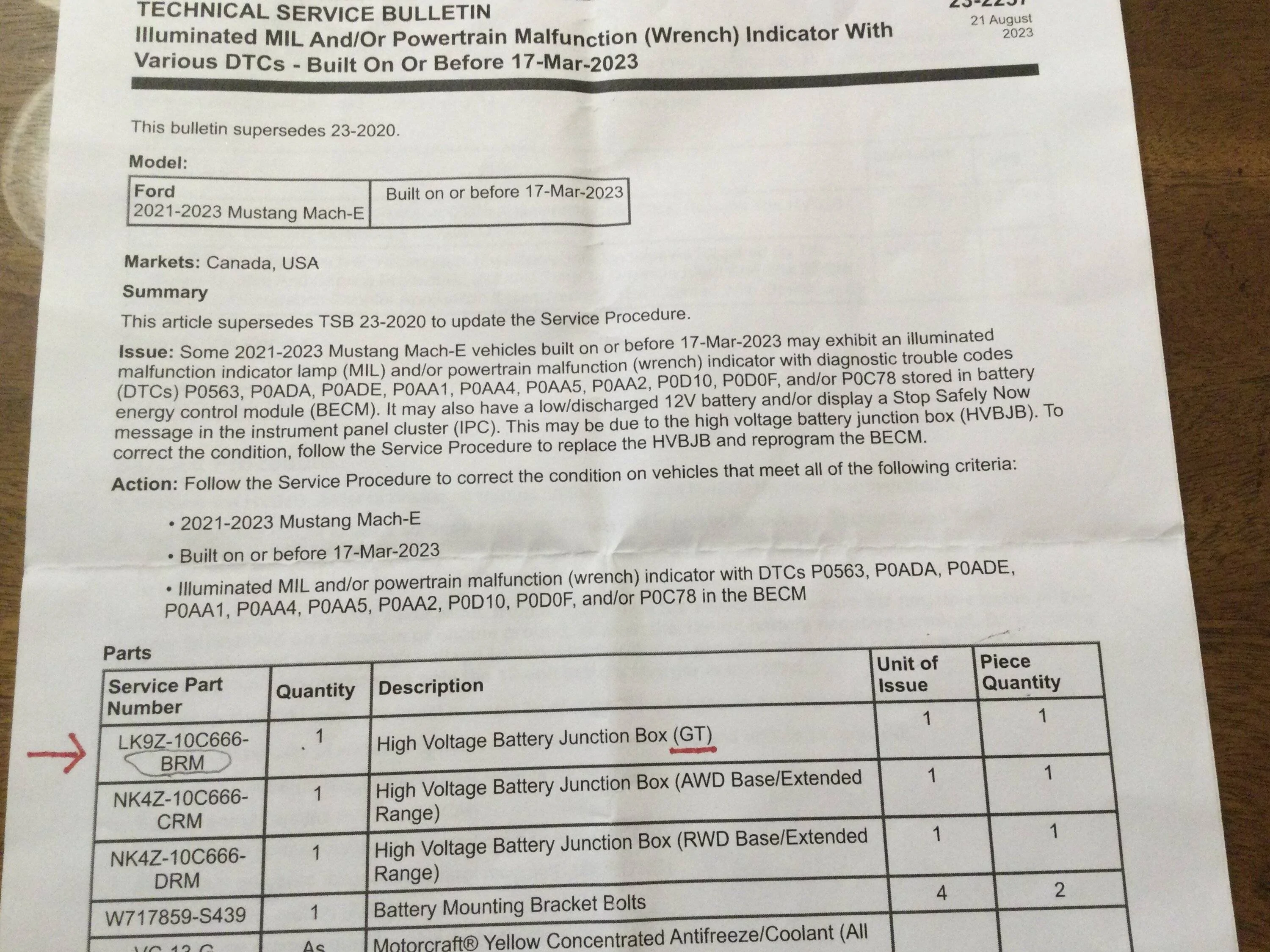
I’m in the same boat as you, Mark, but this TSB from August leaves me with a question- my replacement part, as shown on my work order last month, and I assume yours, has the “RM” (for ReManufacured) at the end of the part number. However, this August TSB refers to these specific parts (with the RM) to be used for repairs on cars built on or before 17-Mar-2023… so what I’m wondering is whether or not some of the later HVBJB failures people are referring to include only cars built prior 17-Mar-2023, or repaired prior to the RM part becoming available? Is it possible they weren’t using the RM part prior to March 17th of this year in their manufacturing? Until we know for sure, it appears there’s a chance that we’ve been repaired with a part that will do the job for the longer term. I’m hoping so.

27F5BC01-9615-4D0D-9D9E-43EEA67B849F.jpeg
We know that the 2nd version of the HVBJB was installed in production cars at the factory built after May 24, 2022. One could interpret that the above TSB implies a 3rd version of the HVBJB began to be installed in factory cars after March 17, 2023. Why else would Ford limit the repair to cars built before that date? They are basically saying the 2nd version of the HVBJB is also defective and may well fail, but they have more confidence in the post-March 17 version of the HVBJB.

So what would Ford due for HVBJB failures in cars built after March 17, 2023? I am sure such failures would be covered under warranty, but what TSB would cover it? Has anyone with a post-March 17th car had a failure?

Also, I can't believe Ford would use a remanufactured part in a new factory car, so my guess is the BRM part number shown in this TSB is not being installed in new factory cars. Does anyone know the HVBJB part number that is being installed in post March 17 cars? I wonder if it is the same version that will be used for the pending 30,000 vehicle recall.
 

21st Century Pony

Well-Known Member
First Name
Martin
Joined
May 21, 2022
Threads
36
Messages
1,976
Reaction score
2,243
Location
Arlington, Virginia
Vehicles
formerly Ford Mustang Mach E 2022 Premium AWD ER, now a li'l bit of Lightning ER
Country flag
All this makes me wonder whether "remanufactured" applies / can apply to "remanufactured [major] assemblies with critical newly designed, newly manufactured sub-assemblies added as replacements".

Wording can be tricky... said a one-time multilingual arms control treaty inspector now masquerading as a 21st Century Pony ;)
 

thekat03

Well-Known Member
First Name
Kat
Joined
May 2, 2023
Threads
5
Messages
808
Reaction score
1,508
Location
China, Maine
Vehicles
2023 Mustang Mach-E CR-1, 2022 Volvo C40
Occupation
Physician
Country flag
Well how long did it take GM to replace every Bolt battery? (which they are likely still doing now...)
Actually this summer, GM said that the 2020 and newer Bolts didn't all need to have batteries replaced, and put in software to detect which cars would need new batteries instead. So after 2 years, they just gave up doing more.
 

RMoore

Well-Known Member
First Name
Rob
Joined
Jul 25, 2021
Threads
75
Messages
1,139
Reaction score
801
Location
New Jersey
Vehicles
Audi Q5, Toyota Sienna, 2022 Mach e
Country flag
I'm glad this is happening it's very clear that this was design mistake sure under normal low the current part should function fine permanently but as soon as you plug it into a situation where it goes beyond the standard specifications of the parts and goes out towards the bleeding edge of the specification it's clear that the heat causes problems this is all too common and many cars and other components where manufactures look for the cheapest part that meets a specification but the specification doesn't necessarily mean that it can maintain at the high-level of the specification they should've made parts that were on the high-end of the specification and even higher so that they would've been able to do you handle the extra heat this is so unfortunate but I'm sure they're going to repair all the cars they know are bad including mine which is already had this thing blow at once
I think you win the e. e. cummings award :) .
 

VindictivePantz

Well-Known Member
Joined
Oct 7, 2022
Threads
28
Messages
435
Reaction score
426
Location
Arlen, TX
Vehicles
2021 Mustang MACH-E Premium AWD w/ Ext. Battery
Country flag
The other ingredient to through into the mix is that they are probably also designing/have designed a "new" version for the next generation of the MME and other vehicles.

It would make the most economic and engineering sense to concentrate on a new or revised design and apply it to next generation vehicles that ideally worked on existing vehicles as well, unless the next generation will have a different architecture or a bottoms-up redesign of the part and related parts.

We'll be in speculation territory until we get pictures, part numbers, etc.

Ford Mustang Mach-E High Voltage Battery Junction Box (HVBJB) Replacement Recall for  recall HVBJB in 30,013 Mach-E giphy
 

Diego

Active Member
First Name
Diego
Joined
Sep 5, 2021
Threads
5
Messages
41
Reaction score
49
Location
Massachusetts
Vehicles
Mach e 4x - was 2021, now a 2023
Country flag
Sigh, of course my job 1 Premium 4x is on the list. Never had mine fail, but then I have never DC charged my car. Just L2 50amp at home. I floor it often enough and am in the hills, but absolutely never will DC fast charge. I have gassers if I am going that far and L2s are fine for overnight stays.

I hope they get this done within a couple months.
Sponsored


Top