Jimrpa

Well-Known Member
First Name
Jim
Joined
Sep 10, 2020
Threads
297
Messages
9,569
Reaction score
12,896
Location
Wayne, PA
Vehicles
2021 Infinite Blue Premium Mustang Mach E ER AWD
Occupation
Retied (formerly tried to herd highly technical, independent cats)
Country flag
All MMEs have been built in the same Mexico plant.
Except for the Chinese made cars manufactured and sold in the Chinese market, that are branded as “Mustang Mach Es”
Sponsored


kennethjk

Well-Known Member
First Name
Ken
Joined
Sep 3, 2021
Threads
30
Messages
3,331
Reaction score
2,124
Location
NY
Vehicles
MME Prem. EB 4WD, X3, IX50
Occupation
Retired
Country flag
OK, I had time to review the NHTSA documents for 23V-687 / 23S56 and give my opinions. First, I'd like to remind folks the previous recall was for software only. This time the HVBJB part is actually being recalled. NHTSA only cares about the vehicle losing motive power while driving as a safety issue. If you get a "Stop Safely Now" while parked and become stranded, that is not considered a safety issue by the government.

The only reason this new recall is happening is because 107 Mach-E's that had the 22S41 software recall done later lost motive power while driving. Which proves what we already knew about the software-only remedy not being able to completely prevent catastrophic HVBJB failure.

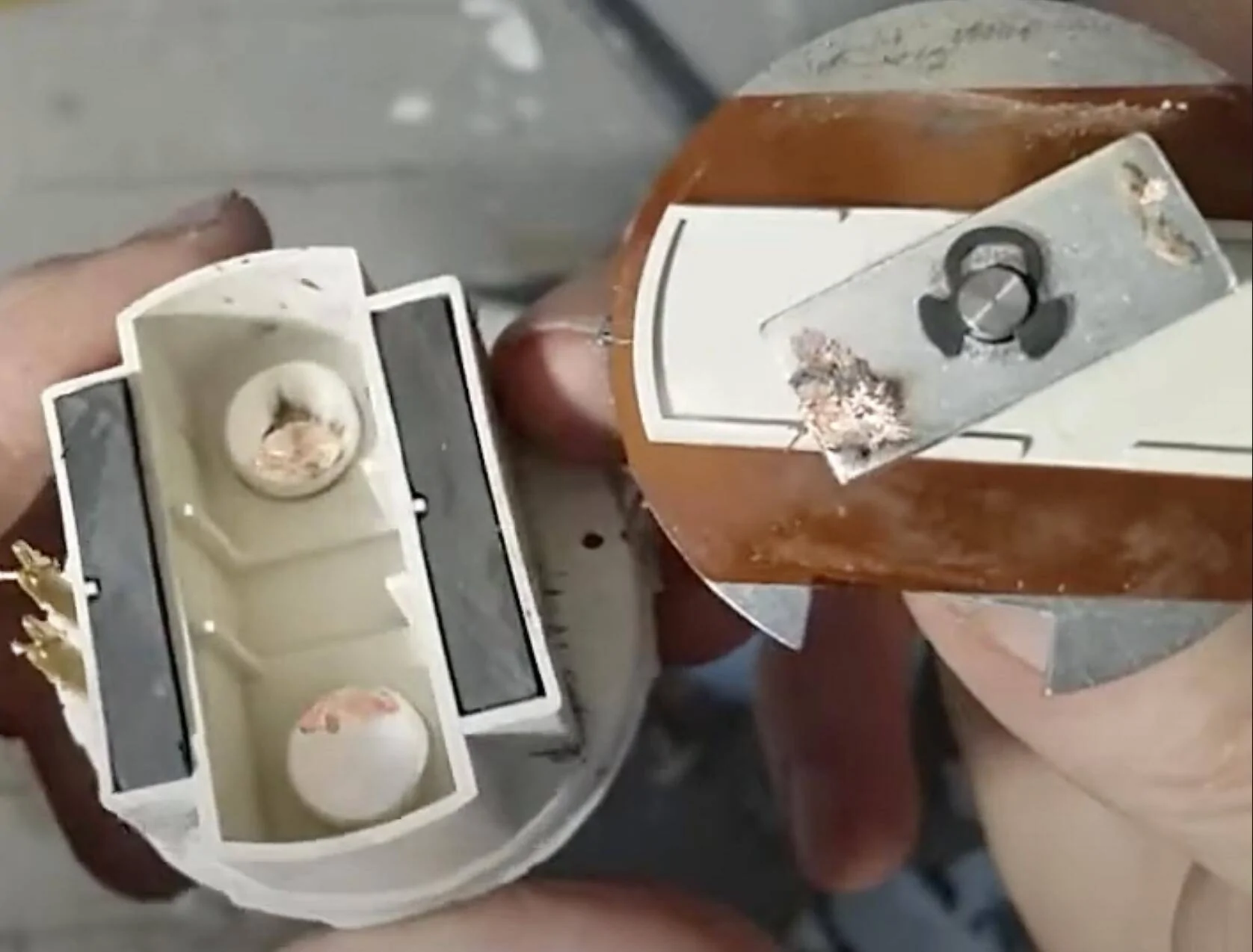
For the first time, we might know why the original contactors fail. It's because they had rounded contacts inside, and a groove on the movable contact surface. These would have caused a smaller point of contact than a flat surface. Smaller contact area means more heating and greater likelihood of arcing under load. The rounded contacts and groove likely has to do with fritting or arc suppression, but unfortunately the original design appears to have hampered durability. The new contactors are described to use flat contact surfaces, the increased contact surface should reduce heating.

Here's a picture of what burnt contacts look like (this contactor is not from a Mach-E). The bar on the right is what presses down against the round button contacts on the left part to close the circuit.

Burnt Contacts.webp


Both the original and revised contractors are made by TE connectivity in Mexico. They also make the entire HVBJB.


See above, the flatter contacts should increase surface area of contact and heat dissipation. The new HVBJB still will not have any temperature sensors or a thermal management system. The only difference is the shape of the contacts.

More from the NHTSA document:


This is exactly what we saw. There was significant part-to-part variation which meant some cars are fine for 30k miles and others might fail at only 3k with the exact same driving conditions. Heat from multiple wide-open pedal events in a short time seems to be primary cause of thermal damage, but is not always required for failure. My SVS was triggered by several pedal events in a row. Prolonged hill climbing at higher speeds also caused overheating in some cases, such as the Grapevine failures. DCFC was a lesser factor, but high power 120+ kW DCFC can also contribute to overheating.


We also saw this. Older vehicles that had more miles before the recall software was released were more likely to get a SSN error after the recall software was installed versus vehicles that had fewer accumulated miles when the software was installed. This is because they had accumulated more latent damage before the recall software was installed. Ford had likely hoped the software would stop the damage in time to prevent SSN, but some vehicles already had too much damage, or the contacts stuck anyway due to part variation.


This is the "Service vehicle soon" message and associated power limit that occurs when a high voltage drop across the contactors is detected. However the detection isn't perfect and relies on a high amp draw (wide-open pedal). If you drive your car gingerly, the software may not have a chance to detect a failure.


Extended range owners that are on the original HVBJB will definitely get a replacement. However the big question is:

Will vehicles that already had the HVBJB replaced with the new part need ANOTHER replacement for this recall?

My opinion is that they will not based on this line from the document:


What production vehicles got after May 25th 2022 is the same part we get now for a HVBJB replacement. To me, I don't see any evidence or mention of there being a third revision to the contactors. The part numbers don't tell the whole story, because Ford uses different part numbers on the box vs. the part itself. The part numbers in the NHTSA document refer to the number on the part itself. The catalog number will be different. And Ford can release a newer part revision that still uses the same revised contactors.

I could be wrong, but the recall procedure will probably read something like this:
  1. Verify if 10C666 has been previously replaced in warranty history. If the part number matches {list}, the HVBJB does not need to be replaced.
  2. Replace the HVBJB if there is no matching part number found.
  3. Update the PCM/BECM/SOBDMC software to latest using FDRS.
There is no mention of new software in the NHTSA document. I don't think anything will change with the software necessarily. Ford mentions a software update in their bulletin, which might just be a matter-of-fact thing to ensure the recall software is installed in case it was somehow missed.


Last we have the reason why only the extended packs are getting replacement HVBJBs. The standard range models don't draw as many amps, so the contactors don't heat up nearly as much. There have been only 7 loss-of-power incidents in standard range packs, which was judged to be an acceptably low risk.

In terms of logistics, this is going to be a nightmare to replace 34,762 HVBJBs. It will take YEARS. The dealers are already swamped with HVBJB repairs and there are not enough EV certified techs to do the work. When I took my car in, they had three HVBJBs to do ahead of me.
Thanks for the extensive write up.

I know there are many Ford dealerships that sell MME’s. Maybe 2,000. But if only 750 are really qualified, a big if, that means on average they would have to repair about 50 cars each. In the scheme of things not that bad.

plus if you are right and the cars that already have replacement parts won’t need new ones, that will also relieve some stress on the system.

I hope I am close to being right. In any event members of this forum probably won’t have to wait as long since they will be the first ones in line for the replacement.
 

RWG

Well-Known Member
First Name
Randal
Joined
Jan 16, 2022
Threads
0
Messages
169
Reaction score
231
Location
Chaska Minnesota
Vehicles
2021 Mach E
Occupation
Retired
Country flag
Does anyone know exactly what is being replaced and what changes were made to improve reliability? I checked online and our Mach E is in the recall group.

So far I have not seen or heard what is the root cause of the failures and therefore what needs to be changed to make the system better.
 

ChasingCoral

Well-Known Member
First Name
Mark
Joined
Feb 3, 2020
Threads
502
Messages
14,318
Reaction score
28,680
Location
Maryland
Vehicles
2021 GB E4X FE, 2022 F-150 Lightning Lariat ER
Occupation
Retired oceanographer
Country flag
OK, I had time to review the NHTSA documents for 23V-687 / 23S56 and give my opinions. First, I'd like to remind folks the previous recall was for software only. This time the HVBJB part is actually being recalled. NHTSA only cares about the vehicle losing motive power while driving as a safety issue. If you get a "Stop Safely Now" while parked and become stranded, that is not considered a safety issue by the government.

The only reason this new recall is happening is because 107 Mach-E's that had the 22S41 software recall done later lost motive power while driving. Which proves what we already knew about the software-only remedy not being able to completely prevent catastrophic HVBJB failure.

For the first time, we might know why the original contactors fail. It's because they had rounded contacts inside, and a groove on the movable contact surface. These would have caused a smaller point of contact than a flat surface. Smaller contact area means more heating and greater likelihood of arcing under load. The rounded contacts and groove likely has to do with fritting or arc suppression, but unfortunately the original design appears to have hampered durability. The new contactors are described to use flat contact surfaces, the increased contact surface should reduce heating.

Here's a picture of what burnt contacts look like (this contactor is not from a Mach-E). The bar on the right is what presses down against the round button contacts on the left part to close the circuit.

Burnt Contacts.png


Both the original and revised contractors are made by TE connectivity in Mexico. They also make the entire HVBJB.


See above, the flatter contacts should increase surface area of contact and heat dissipation. The new HVBJB still will not have any temperature sensors or a thermal management system. The only difference is the shape of the contacts.

More from the NHTSA document:


This is exactly what we saw. There was significant part-to-part variation which meant some cars are fine for 30k miles and others might fail at only 3k with the exact same driving conditions. Heat from multiple wide-open pedal events in a short time seems to be primary cause of thermal damage, but is not always required for failure. My SVS was triggered by several pedal events in a row. Prolonged hill climbing at higher speeds also caused overheating in some cases, such as the Grapevine failures. DCFC was a lesser factor, but high power 120+ kW DCFC can also contribute to overheating.


We also saw this. Older vehicles that had more miles before the recall software was released were more likely to get a SSN error after the recall software was installed versus vehicles that had fewer accumulated miles when the software was installed. This is because they had accumulated more latent damage before the recall software was installed. Ford had likely hoped the software would stop the damage in time to prevent SSN, but some vehicles already had too much damage, or the contacts stuck anyway due to part variation.


This is the "Service vehicle soon" message and associated power limit that occurs when a high voltage drop across the contactors is detected. However the detection isn't perfect and relies on a high amp draw (wide-open pedal). If you drive your car gingerly, the software may not have a chance to detect a failure.


Extended range owners that are on the original HVBJB will definitely get a replacement. However the big question is:

Will vehicles that already had the HVBJB replaced with the new part need ANOTHER replacement for this recall?

My opinion is that they will not based on this line from the document:


What production vehicles got after May 25th 2022 is the same part we get now for a HVBJB replacement. To me, I don't see any evidence or mention of there being a third revision to the contactors. The part numbers don't tell the whole story, because Ford uses different part numbers on the box vs. the part itself. The part numbers in the NHTSA document refer to the number on the part itself. The catalog number will be different. And Ford can release a newer part revision that still uses the same revised contactors.

I could be wrong, but the recall procedure will probably read something like this:
  1. Verify if 10C666 has been previously replaced in warranty history. If the part number matches {list}, the HVBJB does not need to be replaced.
  2. Replace the HVBJB if there is no matching part number found.
  3. Update the PCM/BECM/SOBDMC software to latest using FDRS.
There is no mention of new software in the NHTSA document. I don't think anything will change with the software necessarily. Ford mentions a software update in their bulletin, which might just be a matter-of-fact thing to ensure the recall software is installed in case it was somehow missed.


Last we have the reason why only the extended packs are getting replacement HVBJBs. The standard range models don't draw as many amps, so the contactors don't heat up nearly as much. There have been only 7 loss-of-power incidents in standard range packs, which was judged to be an acceptably low risk.

In terms of logistics, this is going to be a nightmare to replace 34,762 HVBJBs. It will take YEARS. The dealers are already swamped with HVBJB repairs and there are not enough EV certified techs to do the work. When I took my car in, they had three HVBJBs to do ahead of me.
Awesome analysis!

if you are correct, and I think you are, then the HVBJB replacement I got this week (listed as a manufactured part) will suffice as the recall work.

I wonder if part of the recall will be conducted remotely. They should be able to look up the replacement part without me coming back in. Needless to say I’ll wait to do this until I’m going in for something else.
 

silverelan

Well-Known Member
Joined
Nov 25, 2019
Threads
131
Messages
3,692
Reaction score
5,402
Location
Seattle
Vehicles
2021 Mustang Mach-E GT, 2019 Bolt EV
Country flag
As Mach-Lee's summary mentions, like NHTSA is only requiring replacement of the contactors with already updated one, but I will still hold out a little hope that Ford will deploy a 3rd beefier rev to fix it once and for all since the 2nd rev continues to fail and is costing them to repeatedly replace the HVBJBs.
Excellent breakdown by @Mach-Lee , thank you!

If Ford is rolling out the part recall using the existing version, then I'm not 100% confident that's going to solve the problem based on the sporadic reports of failed HVBJBs in post-May 25th 2022 builds.

Does anybody know if there been a compilation on the forum of confirmed post-revision failures?


mkhuffman

Well-Known Member
First Name
Mike
Joined
Nov 19, 2020
Threads
29
Messages
6,878
Reaction score
9,514
Location
Virginia
Vehicles
2025 Rivian R1T Tri-Max, Jeep GC-L, VW Jetta
Country flag
OK, I had time to review the NHTSA documents for 23V-687 / 23S56 and give my opinions. First, I'd like to remind folks the previous recall was for software only. This time the HVBJB part is actually being recalled. NHTSA only cares about the vehicle losing motive power while driving as a safety issue. If you get a "Stop Safely Now" while parked and become stranded, that is not considered a safety issue by the government.

The only reason this new recall is happening is because 107 Mach-E's that had the 22S41 software recall done later lost motive power while driving. Which proves what we already knew about the software-only remedy not being able to completely prevent catastrophic HVBJB failure.

For the first time, we might know why the original contactors fail. It's because they had rounded contacts inside, and a groove on the movable contact surface. These would have caused a smaller point of contact than a flat surface. Smaller contact area means more heating and greater likelihood of arcing under load. The rounded contacts and groove likely has to do with fritting or arc suppression, but unfortunately the original design appears to have hampered durability. The new contactors are described to use flat contact surfaces, the increased contact surface should reduce heating.

Here's a picture of what burnt contacts look like (this contactor is not from a Mach-E). The bar on the right is what presses down against the round button contacts on the left part to close the circuit.

Burnt Contacts.png


Both the original and revised contractors are made by TE connectivity in Mexico. They also make the entire HVBJB.


See above, the flatter contacts should increase surface area of contact and heat dissipation. The new HVBJB still will not have any temperature sensors or a thermal management system. The only difference is the shape of the contacts.

More from the NHTSA document:


This is exactly what we saw. There was significant part-to-part variation which meant some cars are fine for 30k miles and others might fail at only 3k with the exact same driving conditions. Heat from multiple wide-open pedal events in a short time seems to be primary cause of thermal damage, but is not always required for failure. My SVS was triggered by several pedal events in a row. Prolonged hill climbing at higher speeds also caused overheating in some cases, such as the Grapevine failures. DCFC was a lesser factor, but high power 120+ kW DCFC can also contribute to overheating.


We also saw this. Older vehicles that had more miles before the recall software was released were more likely to get a SSN error after the recall software was installed versus vehicles that had fewer accumulated miles when the software was installed. This is because they had accumulated more latent damage before the recall software was installed. Ford had likely hoped the software would stop the damage in time to prevent SSN, but some vehicles already had too much damage, or the contacts stuck anyway due to part variation.


This is the "Service vehicle soon" message and associated power limit that occurs when a high voltage drop across the contactors is detected. However the detection isn't perfect and relies on a high amp draw (wide-open pedal). If you drive your car gingerly, the software may not have a chance to detect a failure.


Extended range owners that are on the original HVBJB will definitely get a replacement. However the big question is:

Will vehicles that already had the HVBJB replaced with the new part need ANOTHER replacement for this recall?

My opinion is that they will not based on this line from the document:


What production vehicles got after May 25th 2022 is the same part we get now for a HVBJB replacement. To me, I don't see any evidence or mention of there being a third revision to the contactors. The part numbers don't tell the whole story, because Ford uses different part numbers on the box vs. the part itself. The part numbers in the NHTSA document refer to the number on the part itself. The catalog number will be different. And Ford can release a newer part revision that still uses the same revised contactors.

I could be wrong, but the recall procedure will probably read something like this:
  1. Verify if 10C666 has been previously replaced in warranty history. If the part number matches {list}, the HVBJB does not need to be replaced.
  2. Replace the HVBJB if there is no matching part number found.
  3. Update the PCM/BECM/SOBDMC software to latest using FDRS.
There is no mention of new software in the NHTSA document. I don't think anything will change with the software necessarily. Ford mentions a software update in their bulletin, which might just be a matter-of-fact thing to ensure the recall software is installed in case it was somehow missed.


Last we have the reason why only the extended packs are getting replacement HVBJBs. The standard range models don't draw as many amps, so the contactors don't heat up nearly as much. There have been only 7 loss-of-power incidents in standard range packs, which was judged to be an acceptably low risk.

In terms of logistics, this is going to be a nightmare to replace 34,762 HVBJBs. It will take YEARS. The dealers are already swamped with HVBJB repairs and there are not enough EV certified techs to do the work. When I took my car in, they had three HVBJBs to do ahead of me.
So all the WOTs I do are actually helping the software detect a impending failure. Awesome! I can't wait to do another WOT! A WOT before every trip, a WOT to start the day. It's almost as good as that first cup of coffee!
 

jbooth

Well-Known Member
First Name
Jonathan
Joined
Sep 6, 2021
Threads
6
Messages
198
Reaction score
244
Location
Illinois
Vehicles
Honda Fit, Mustang Mach-E
Occupation
Software Engineer
Country flag
So... I didn't read all 20 pages. Are there any hints in the NHTSA report of if this is a "don't drive" recall? Because "will take years" and "don't drive" especially on a BEV where the B degrades with time... Yeah, I'd be real pissed.
 

Blusteed

Well-Known Member
First Name
George
Joined
Feb 25, 2021
Threads
4
Messages
89
Reaction score
152
Location
Ardsley, New York
Vehicles
'17 Mustang GT Vert PP1, '21 Mach-E GTPE
Occupation
Retired
Country flag
Awesome analysis!

if you are correct, and I think you are, then the HVBJB replacement I got this week (listed as a manufactured part) will suffice as the recall work.

I wonder if part of the recall will be conducted remotely. They should be able to look up the replacement part without me coming back in. Needless to say I’ll wait to do this until I’m going in for something else.
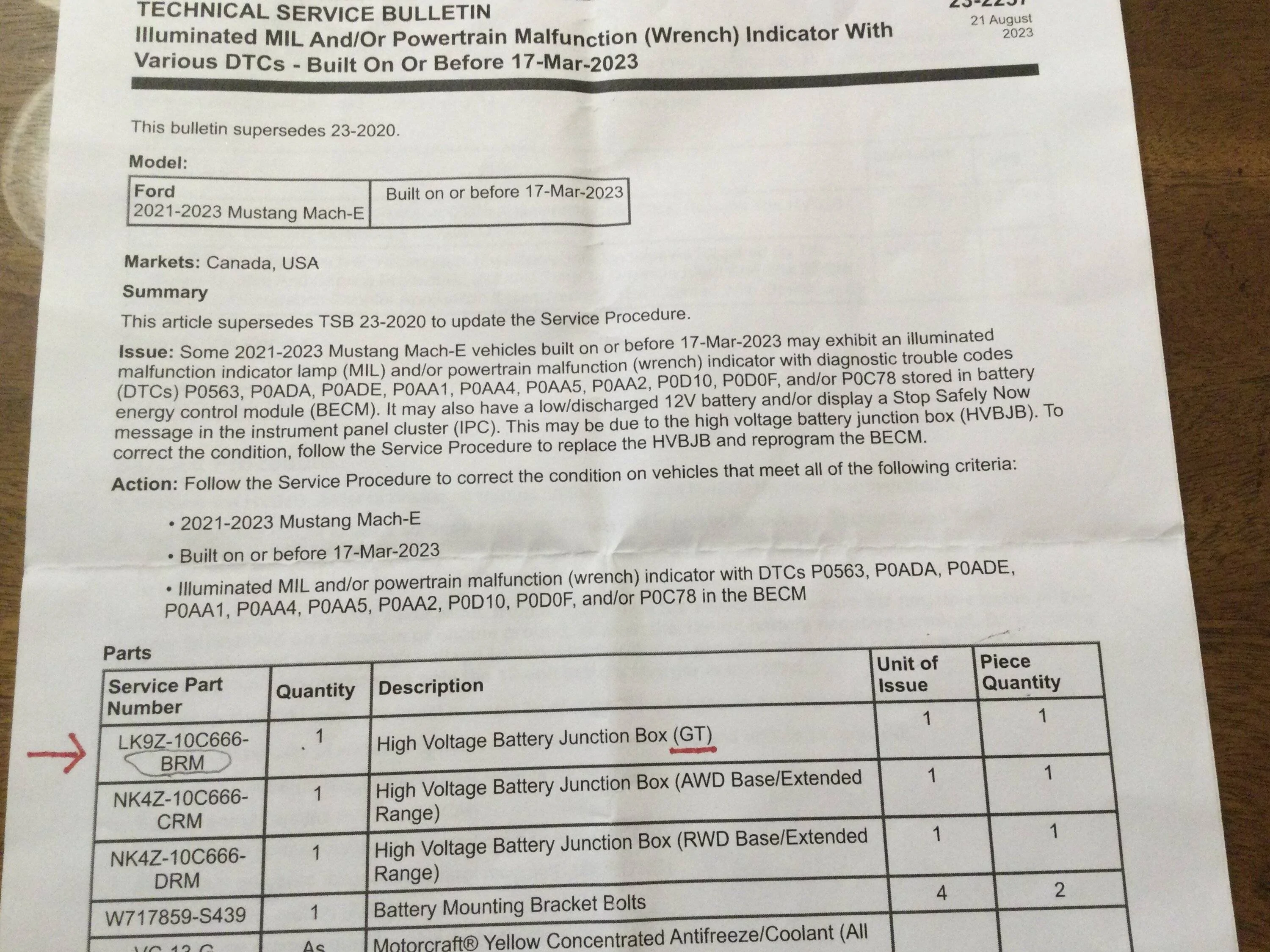
I’m in the same boat as you, Mark, but this TSB from August leaves me with a question- my replacement part, as shown on my work order last month, and I assume yours, has the “RM” (for ReManufacured) at the end of the part number. However, this August TSB refers to these specific parts (with the RM) to be used for repairs on cars built on or before 17-Mar-2023… so what I’m wondering is whether or not some of the later HVBJB failures people are referring to include only cars built prior 17-Mar-2023, or repaired prior to the RM part becoming available? Is it possible they weren’t using the RM part prior to March 17th of this year in their manufacturing? Until we know for sure, it appears there’s a chance that we’ve been repaired with a part that will do the job for the longer term. I’m hoping so.

Ford Mustang Mach-E High Voltage Battery Junction Box (HVBJB) Replacement Recall for  recall HVBJB in 30,013 Mach-E 27F5BC01-9615-4D0D-9D9E-43EEA67B849F
 

JamieGeek

Well-Known Member
Joined
Dec 29, 2019
Threads
82
Messages
3,589
Reaction score
6,823
Location
Southeastern Michigan
Website
spareelectrons.wordpress.com
Vehicles
Escape PHEV, old: Mach-E, Bolt, C-Max Energi, Focus Electric
Country flag
OK, I had time to review the NHTSA documents for 23V-687 / 23S56 and give my opinions. First, I'd like to remind folks the previous recall was for software only. This time the HVBJB part is actually being recalled. NHTSA only cares about the vehicle losing motive power while driving as a safety issue. If you get a "Stop Safely Now" while parked and become stranded, that is not considered a safety issue by the government.

The only reason this new recall is happening is because 107 Mach-E's that had the 22S41 software recall done later lost motive power while driving. Which proves what we already knew about the software-only remedy not being able to completely prevent catastrophic HVBJB failure.

For the first time, we might know why the original contactors fail. It's because they had rounded contacts inside, and a groove on the movable contact surface. These would have caused a smaller point of contact than a flat surface. Smaller contact area means more heating and greater likelihood of arcing under load. The rounded contacts and groove likely has to do with fritting or arc suppression, but unfortunately the original design appears to have hampered durability. The new contactors are described to use flat contact surfaces, the increased contact surface should reduce heating.

Here's a picture of what burnt contacts look like (this contactor is not from a Mach-E). The bar on the right is what presses down against the round button contacts on the left part to close the circuit.

Burnt Contacts.png


Both the original and revised contractors are made by TE connectivity in Mexico. They also make the entire HVBJB.


See above, the flatter contacts should increase surface area of contact and heat dissipation. The new HVBJB still will not have any temperature sensors or a thermal management system. The only difference is the shape of the contacts.

More from the NHTSA document:


This is exactly what we saw. There was significant part-to-part variation which meant some cars are fine for 30k miles and others might fail at only 3k with the exact same driving conditions. Heat from multiple wide-open pedal events in a short time seems to be primary cause of thermal damage, but is not always required for failure. My SVS was triggered by several pedal events in a row. Prolonged hill climbing at higher speeds also caused overheating in some cases, such as the Grapevine failures. DCFC was a lesser factor, but high power 120+ kW DCFC can also contribute to overheating.


We also saw this. Older vehicles that had more miles before the recall software was released were more likely to get a SSN error after the recall software was installed versus vehicles that had fewer accumulated miles when the software was installed. This is because they had accumulated more latent damage before the recall software was installed. Ford had likely hoped the software would stop the damage in time to prevent SSN, but some vehicles already had too much damage, or the contacts stuck anyway due to part variation.


This is the "Service vehicle soon" message and associated power limit that occurs when a high voltage drop across the contactors is detected. However the detection isn't perfect and relies on a high amp draw (wide-open pedal). If you drive your car gingerly, the software may not have a chance to detect a failure.


Extended range owners that are on the original HVBJB will definitely get a replacement. However the big question is:

Will vehicles that already had the HVBJB replaced with the new part need ANOTHER replacement for this recall?

My opinion is that they will not based on this line from the document:


What production vehicles got after May 25th 2022 is the same part we get now for a HVBJB replacement. To me, I don't see any evidence or mention of there being a third revision to the contactors. The part numbers don't tell the whole story, because Ford uses different part numbers on the box vs. the part itself. The part numbers in the NHTSA document refer to the number on the part itself. The catalog number will be different. And Ford can release a newer part revision that still uses the same revised contactors.

I could be wrong, but the recall procedure will probably read something like this:
  1. Verify if 10C666 has been previously replaced in warranty history. If the part number matches {list}, the HVBJB does not need to be replaced.
  2. Replace the HVBJB if there is no matching part number found.
  3. Update the PCM/BECM/SOBDMC software to latest using FDRS.
There is no mention of new software in the NHTSA document. I don't think anything will change with the software necessarily. Ford mentions a software update in their bulletin, which might just be a matter-of-fact thing to ensure the recall software is installed in case it was somehow missed.


Last we have the reason why only the extended packs are getting replacement HVBJBs. The standard range models don't draw as many amps, so the contactors don't heat up nearly as much. There have been only 7 loss-of-power incidents in standard range packs, which was judged to be an acceptably low risk.

In terms of logistics, this is going to be a nightmare to replace 34,762 HVBJBs. It will take YEARS. The dealers are already swamped with HVBJB repairs and there are not enough EV certified techs to do the work. When I took my car in, they had three HVBJBs to do ahead of me.
Well how long did it take GM to replace every Bolt battery? (which they are likely still doing now...)
 

AKgrampy

Well-Known Member
First Name
Mike
Joined
Jan 29, 2022
Threads
7
Messages
3,526
Reaction score
3,600
Location
Fairbanks, Alaska
Vehicles
Ford Expedition, Ford F-150, Mach E GT
Occupation
Retired
Country flag
Well how long did it take GM to replace every Bolt battery? (which they are likely still doing now...)
Not that it will be accurate but the recall claims, if I read it correctly, change outs must be completed by May 2024.
 

Scooby24

Well-Known Member
First Name
Greg
Joined
Jul 2, 2021
Threads
29
Messages
2,123
Reaction score
3,296
Location
Olathe, KS
Vehicles
'25 BMW i4 M50; '25 MME GT
Occupation
Healthcare IT
Country flag
Having this recall to force a replacement of a HVBJB seems like maybe the path forward to developing updates related to resistance thresholds relevant to the new HVBJB. I have a hunch that the "failures" of the newer part is related to a resistance threshold that is too tailored to the old HVBJB as they have to accommodate the vehicles that still have the old one. Now they can push a new update specifically for all WITH a new HVBJB tailored to just it?

Just my hunch.
 

BMT1071

Well-Known Member
First Name
Mike
Joined
Mar 21, 2021
Threads
65
Messages
3,197
Reaction score
4,377
Location
Glendale, AZ
Vehicles
21 MME SR RWD, 23 MME GTPE
Occupation
EV Technical Trainer
Country flag
Not that it will be accurate but the recall claims, if I read it correctly, change outs must be completed by May 2024.
Are you talking about this??
"Ford provided the general reimbursement plan for the cost of remedies paid for by vehicle owners prior to notification of a safety recall in May 2023. The ending date for reimbursement eligibility is estimated to be March 31, 2024."

That only refers to any customer that had to pay for replacement prior to the recall being issued.
 

BMT1071

Well-Known Member
First Name
Mike
Joined
Mar 21, 2021
Threads
65
Messages
3,197
Reaction score
4,377
Location
Glendale, AZ
Vehicles
21 MME SR RWD, 23 MME GTPE
Occupation
EV Technical Trainer
Country flag
don't you mean your El MME..?
Very presumptuous of you to gender their car. Vehicles are usually referred to as feminine, so it would be La MME. LOL. ??
Sponsored


Top