48A L2 Charger Comparison

Maquis

Well-Known Member
First Name
Dave
Joined
Dec 21, 2020
Threads
34
Messages
5,687
Reaction score
8,068
Location
Illinois
Vehicles
2021 Mach E4X, 2023 Lightning Lariat ER
Country flag
That is what I assumed. I do wonder what the differential is between 32A, 40A and 48A charging on a efficiency basis.
I don’t have numbers, but my gut tells me that the higher rates should be slightly more efficient given the constant overhead. There could be circumstances that might change that. For example, if it’s hot and the cooling fans need to run at 48A, but aren’t needed at 32A, then 32 might be better.
Its probably not worth worrying about.
Sponsored
 

DadzBoyz

Well-Known Member
First Name
Dan
Joined
Jun 6, 2022
Threads
53
Messages
743
Reaction score
807
Location
Oldsmar, FL
Vehicles
22 Mustang Mach-E GTPE (ordered), 20 Mazda CX-5
Occupation
Software Systems Integrator
Country flag
Can you share your reason for wanting to change the amperage via the app?
I’ve had mine for 18 months, never once encountered a situation where I felt like changing amperage was necessary.
If you have another EV that can only take a lower charge amperage, you don’t have to control that manually. It’s built into the J1772 spec that any charger will only deliver the amperage request by the vehicle.
One use case to change charging levels.

I have solar panels on my home. During parts of the day, the panels produce more power than we consume. The ability to adjust would enable me to only charge using the free electrons from the sun during the day (my office is at home).
 

mkhuffman

Well-Known Member
First Name
Mike
Joined
Nov 19, 2020
Threads
29
Messages
6,875
Reaction score
9,507
Location
Virginia
Vehicles
2025 Rivian R1T Tri-Max, Jeep GC-L, VW Jetta
Country flag
Its probably not worth worrying about.
Yep The difference in efficiency at various L2 speeds can't be significant.

However, if you want to measure it, get out your trusty OBDII scanner and measure how much kWh is added compared to how much the charger supplied. It is an easy test. Do it at different current levels and compare. Personally I don't have an interest in doing that but those who claim the difference is significant should do the testing so we have real data rather than conjecture.

If you want the best charging efficiency, only DCFC, which is much more efficient than any AC charging.
 

devmach-e

Well-Known Member
First Name
David
Joined
Sep 8, 2021
Threads
1
Messages
2,015
Reaction score
2,469
Location
SF Bay Area
Vehicles
2022 Premium RWD ER, 2016 Toyota Highlander Hybrid
Occupation
Unix Sysadmin
Country flag
The heat is literally energy you're paying for that's being dumped into the atmosphere. It also increases the bounds of the thermal cycling of your charging infrastructure, and higher temperatures accelerate thermally-induced material breakdown.


Let's do the math assuming a 1 Ω resistance in the entire system, which I suspect isn't unreasonable given all the different connections and components in the circuit. P = I²R. With R =1 Ω then P = I². Thus 32 A is 1.024 kW, 40 A is 1.600 kW, and 48 A is 2.304 kW. That's a lot of (usually) unnecessary heat loss. Even if the system resistance is half then 48 A is still 640 W greater than 32 A.

I'm not saying never charge faster than 32 A. You're doing it right; with the battery capacity of these cars most people should be able to get a full charge overnight at 32 A, so do that. If you're needing a quick turn-around to get out of town then definitely up your charger to 40 A or 48 A. It's just that there are downsides to charging at 40+ A all the time.
There is no way that there is 1 kW worth of heat loss when charging at 32A. I think your math is off Various online calculators tell me that 240V@32A (7.68 kW) has a resistance of 7.5 Ohms in the whole circuit.

Generally, the efficiency of the internal charging system is about 90%. I.e for every 1 kWh drawn from the wall, 0.9 kWh makes it into the battery. Which is 768W "lost." But it isn't all lost as heat. Some of the power loss is running various electronics, pumps, compressors, and fans to keep the battery in a happy state. Charging at 48A only increases this "loss" by about 384W. In the grand scheme of things, it is minuscule compared to how is going into the battery.

I wonder if there is a PID available that measures current going into the internal AC/DC charger versus the current going into the battery itself.
 

sukhoi_584th

Well-Known Member
Joined
Sep 29, 2021
Threads
15
Messages
318
Reaction score
302
Location
United States
Vehicles
2022 MME CR1 AWD
Country flag
There is no way that there is 1 kW worth of heat loss when charging at 32A. I think your math is off Various online calculators tell me that 240V@32A (7.68 kW) has a resistance of 7.5 Ohms in the whole circuit.

Generally, the efficiency of the internal charging system is about 90%. I.e for every 1 kWh drawn from the wall, 0.9 kWh makes it into the battery. Which is 768W "lost." But it isn't all lost as heat. Some of the power loss is running various electronics, pumps, compressors, and fans to keep the battery in a happy state. Charging at 48A only increases this "loss" by about 384W. In the grand scheme of things, it is minuscule compared to how is going into the battery.

I wonder if there is a PID available that measures current going into the internal AC/DC charger versus the current going into the battery itself.
Maybe 1 Ω is high, but 0.5 Ω total resistance is certainly realistic for people with long runs from their electric meter to their EVSE.

https://chargedevs.com/features/a-c...harging-losses-from-the-breaker-to-ev-part-1/
https://chargedevs.com/features/a-closer-look-at-minimizing-charging-losses-the-charger-part-2/

And ~500 W is not minuscule when it's added up over many hours per day/week for years on end.


DadzBoyz

Well-Known Member
First Name
Dan
Joined
Jun 6, 2022
Threads
53
Messages
743
Reaction score
807
Location
Oldsmar, FL
Vehicles
22 Mustang Mach-E GTPE (ordered), 20 Mazda CX-5
Occupation
Software Systems Integrator
Country flag
OK. This may be worrying too much, but here goes.
I like the Emporia, the favorable reviews, people’s testimonials here, etc.
Here’s the “But”.
When I look at it, I can’t help but think that the piece that comes out of the bottom, that holds the charger plug/grip/handle looks like a piece of plastic that would break really easily. It looks like if you put it back in there to hard or forcefully, it would snap off.
Plus, I live in Florida. If you mount the charger outside, the sun and UV would make it brittle. If you mount it inside the garage, the constant 100+ degree heat would also make it brittle.
That’s my reservation on the design….
 

DadzBoyz

Well-Known Member
First Name
Dan
Joined
Jun 6, 2022
Threads
53
Messages
743
Reaction score
807
Location
Oldsmar, FL
Vehicles
22 Mustang Mach-E GTPE (ordered), 20 Mazda CX-5
Occupation
Software Systems Integrator
Country flag

devmach-e

Well-Known Member
First Name
David
Joined
Sep 8, 2021
Threads
1
Messages
2,015
Reaction score
2,469
Location
SF Bay Area
Vehicles
2022 Premium RWD ER, 2016 Toyota Highlander Hybrid
Occupation
Unix Sysadmin
Country flag
Maybe 1 Ω is high, but 0.5 Ω total resistance is certainly realistic for people with long runs from their electric meter to their EVSE.

https://chargedevs.com/features/a-c...harging-losses-from-the-breaker-to-ev-part-1/
https://chargedevs.com/features/a-closer-look-at-minimizing-charging-losses-the-charger-part-2/

And ~500 W is not minuscule when it's added up over many hours per day/week for years on end.
Depends upon how that “loss” is apportioned. Some of it is wasted as heat. Some of it, as I said previously, goes towards ancillary loads as part of the charging process.

Edited to add:
But there is a component you are forgetting: time. While the wattage loss at 32A is 2/3rds of the loss at 48A, the amount of time spent charging at 48A is 1/3rd less. There’s no difference between pulling 32A@240V for 12 hours and 48A@240V for 8 hours. Still the same 92 kWh. The car’s internal charger doesn’t care. It was engineered to be able to do 48A.
 
Last edited:

satchel prefect

Well-Known Member
Joined
Sep 2, 2022
Threads
9
Messages
157
Reaction score
274
Location
South Florida, USA
Vehicles
Crusty old PHEV
Country flag
OK. This may be worrying too much, but here goes.
I like the Emporia, the favorable reviews, people’s testimonials here, etc.
Here’s the “But”.
When I look at it, I can’t help but think that the piece that comes out of the bottom, that holds the charger plug/grip/handle looks like a piece of plastic that would break really easily. It looks like if you put it back in there to hard or forcefully, it would snap off.
Plus, I live in Florida. If you mount the charger outside, the sun and UV would make it brittle. If you mount it inside the garage, the constant 100+ degree heat would also make it brittle.
That’s my reservation on the design….
On my Emporia, that piece is metal and quite sturdy. I am not a fan of fiddling with a tethered soft cover so I left the mount uninstalled and use this instead:

https://www.amazon.com/gp/product/B00TBW1NRM/ref=ppx_yo_dt_b_search_asin_title?ie=UTF8&psc=1
 

Jstepy

Active Member
First Name
Justin
Joined
Sep 5, 2022
Threads
2
Messages
26
Reaction score
24
Location
Eastern Idaho
Vehicles
2022 MME GT Performance
Country flag
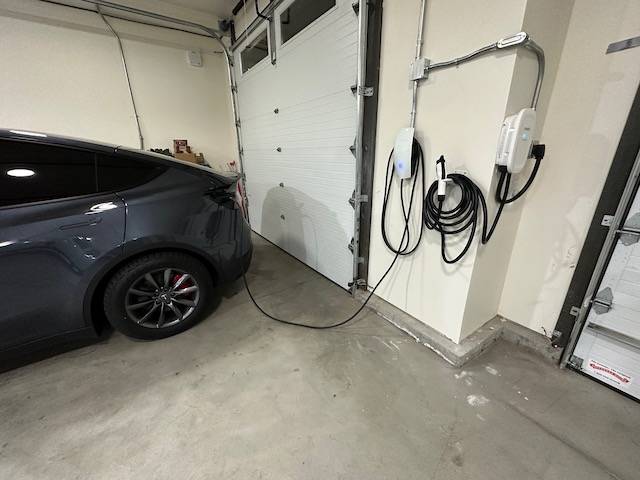
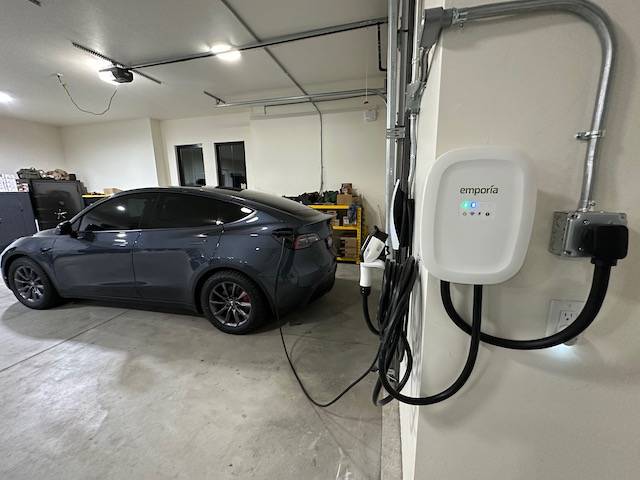
I too went with the Emporia, I liked all the reviews and the features etc. and the price was right. Still waiting for the Mach-E which should be here in two weeks. As of now it works great on my Tesla MYP but wanted the option to charge both EV's at the same time if needed.

Ford Mustang Mach-E 48A L2 Charger Comparison IMG_0059


Ford Mustang Mach-E 48A L2 Charger Comparison IMG_0060
 

mkhuffman

Well-Known Member
First Name
Mike
Joined
Nov 19, 2020
Threads
29
Messages
6,875
Reaction score
9,507
Location
Virginia
Vehicles
2025 Rivian R1T Tri-Max, Jeep GC-L, VW Jetta
Country flag
Maybe 1 Ω is high, but 0.5 Ω total resistance is certainly realistic for people with long runs from their electric meter to their EVSE.

https://chargedevs.com/features/a-c...harging-losses-from-the-breaker-to-ev-part-1/
https://chargedevs.com/features/a-closer-look-at-minimizing-charging-losses-the-charger-part-2/

And ~500 W is not minuscule when it's added up over many hours per day/week for years on end.
The first article mentions how 120V charging is the least efficient because of all the systems needed to enable the charging process. Neither article makes a claim about 32 Amps vs. 48 Amps, but I believe a similar rule applies - the less time the systems needed to support L2 charging are on and supporting the charging process, the more efficient the overall charge. So a quicker charge will be more efficient, and consequently, a 48 Amp charge is the most efficient.

Depends upon how that “loss” is apportioned. Some of it is wasted as heat. Some of it, as I said previously, goes towards ancillary loads as part of the charging process.

Edited to add:
But there is a component you are forgetting: time. While the wattage loss at 32A is 2/3rds of the loss at 48A, the amount of time spent charging at 48A is 1/3rd less. There’s no difference between pulling 32A@240V for 12 hours and 48A@240V for 8 hours. Still the same 92 kWh. The car’s internal charger doesn’t care. It was engineered to be able to do 48A.
Electrical resistance does increase with heat, so there should be more loss in theory if the temperature of the wire and other components are higher at the higher speed. You charge for less time but since the resistance is higher, there is more loss. But seriously, it will be minuscule and I am sure unmeasurable compared to the efficiency loss due to keeping all the HVB systems running, cooling, etc. for a shorter period of time.

Anyway, I am not convinced 32 Amp charging is more efficient than 48 Amp. In order to prove it is, testing on the MME is needed. Until that happens, this is a pretty useless debate.

And even more than that, I don't care if 48 Amps is less efficient. I want to charge at the fastest speed possible. I want my car always charged and always ready to go, as fast as I can get it there in my house. So if I lose 10 Watts due to increased resistance every time I charge, it is worth the cost to me.

But that is a big "if". So far, there is no proof 32 Amps is more efficient at all.
 

Pioneer74

Well-Known Member
Joined
Feb 24, 2022
Threads
14
Messages
567
Reaction score
1,095
Location
Dearborn
Vehicles
2022 Lightning Lariat ER - 2025 Mach-E Premium ER
Country flag

AKgrampy

Well-Known Member
First Name
Mike
Joined
Jan 29, 2022
Threads
7
Messages
3,519
Reaction score
3,590
Location
Fairbanks, Alaska
Vehicles
Ford Expedition, Ford F-150, Mach E GT
Occupation
Retired
Country flag
The first article mentions how 120V charging is the least efficient because of all the systems needed to enable the charging process. Neither article makes a claim about 32 Amps vs. 48 Amps, but I believe a similar rule applies - the less time the systems needed to support L2 charging are on and supporting the charging process, the more efficient the overall charge. So a quicker charge will be more efficient, and consequently, a 48 Amp charge is the most efficient.


Electrical resistance does increase with heat, so there should be more loss in theory if the temperature of the wire and other components are higher at the higher speed. You charge for less time but since the resistance is higher, there is more loss. But seriously, it will be minuscule and I am sure unmeasurable compared to the efficiency loss due to keeping all the HVB systems running, cooling, etc. for a shorter period of time.

Anyway, I am not convinced 32 Amp charging is more efficient than 48 Amp. In order to prove it is, testing on the MME is needed. Until that happens, this is a pretty useless debate.

And even more than that, I don't care if 48 Amps is less efficient. I want to charge at the fastest speed possible. I want my car always charged and always ready to go, as fast as I can get it there in my house. So if I lose 10 Watts due to increased resistance every time I charge, it is worth the cost to me.

But that is a big "if". So far, there is no proof 32 Amps is more efficient at all.
I think you are correct in your thinking. I was just wondering if anyone had ever measured the efficiency at various amps. I think I will go back to 40 amp charging as I now believe faster is better from an overall efficiency perspective; although, the difference is probably not that significant.
 

mkhuffman

Well-Known Member
First Name
Mike
Joined
Nov 19, 2020
Threads
29
Messages
6,875
Reaction score
9,507
Location
Virginia
Vehicles
2025 Rivian R1T Tri-Max, Jeep GC-L, VW Jetta
Country flag
I think you are correct in your thinking. I was just wondering if anyone had ever measured the efficiency at various amps. I think I will go back to 40 amp charging as I now believe faster is better from an overall efficiency perspective; although, the difference is probably not that significant.
It will be a fairly easy test for anyone who has a direct wired Emporia charger. You can change the current setting using software.

But you need a good, long charge to really get a sufficient test. And you really need to test it under the same conditions if at all possible: same ambient temperature and same battery SOC. So do two 20-80% charges, one at 32 Amps and one at 48 Amps. Then record how much power the EVSE reported it supplied, and how much power the OBDII scanner reported the car added.

I am tempted to do the test, but I don't care enough regarding the result. As I posted, faster is always better for me, even if it costs more.
 

sukhoi_584th

Well-Known Member
Joined
Sep 29, 2021
Threads
15
Messages
318
Reaction score
302
Location
United States
Vehicles
2022 MME CR1 AWD
Country flag
What software is necessary to read the MME OBDII data for this test? Just what comes with the reader, or something else? I have an ancient USB OBDII reader I've never used, and can change the amperage on my Pulsar Plus 40 A.
Sponsored


Top