Charging on Dryer Outlet

LinkRS

Well-Known Member
First Name
Rich
Joined
Sep 2, 2022
Threads
11
Messages
146
Reaction score
135
Location
Texas
Vehicles
2023 Mustang Mach E GT Performance Edition
Occupation
Software Engineer
Country flag
I'm an EE and don't usually jump into these topics. However, the answer to your question is sort of... yes. A NEMA 14-50 is RATED up to 50 amps at 240V. So you also need 50-amp capable wiring from the outlet to the 50-amp circuit breaker in your panel. I hope that makes sense. You should NOT connect a NEMA 14-50 to wiring that is only capable of handling 30 amps. And you certainly CANNOT just swap out a 30-amp breaker with a 50-amp breaker and leave your 30-amp cabling in-between. The wire will get HOT. To be clear the scenario I just described is a NEMA 14-50 with 30 amp wiring to a 50-amp breaker. (BIG NO-NO).

This is why there are different configurations of 240V outlets and plugs. Just because they are 240V capable, you CANNOT ignore the amp carrying capability all the way from the breaker panel, the breaker, the wiring, and the outlet. One of the primary benefits of 240 circuitry is the additional amp carrying capability it has.

My last point is the topic of "continuous use." To avoid a possible fire in the future I always design for worse case. That means I assume "continuous use" whether I use it continuously or not. For continuous use you want to only run at 80% of what the circuit is actually capable of. That being said... That means if you run a 60amp breaker, 60 amp carrying wiring, to a 60 amp termination. I used the word termination as this is the way many "hard wired" ESVE's are used. There is no outlet/plug. They are hardwired in. So for a 60 amp, hardwired ESVE I still would only ever run it at 48 amps (80% * 60 amps).

For your 50 amp NEMA 14-50 outlet/plug combination I would still limit the EVSE to 40 amps (80% x 50amps).

I hope this helps.
Thanks @65MustangBoy ! Appreciate your response. When I got my Mach E in Dec 2023, I used the Ford Mobile Charger with a 110V outlet as the 240V cable that came with it, would not fit my dryer plug. I then had a Ford Connected Charger installed professionally, and it is hardwired, and configured to provide 48A, and is connected to a 60A breaker. I know this, as when they first installed it, they used a 50A breaker, and I had to call them to correct it. This was Qmerit who arranged the installation FWIW. Thanks again!
Sponsored


65MustangBoy

Well-Known Member
First Name
Les
Joined
Jan 27, 2023
Threads
8
Messages
197
Reaction score
239
Location
Indiana
Vehicles
65 Mustang, 2023 Mach E Premium
Occupation
Retired
Country flag
Opinions vary... but many sources say you can use the stock provided cord with a 40 amp breaker and a NEMA 14-50 outlet that is signed to only allow 32 amp continuous max (40 max) and 8 AWG wire (as short as possible). The math works But I am sure others will say that the stock cord should not be used and the Nema 14-50 MUST be 50 amp. This is really no different than allow a 50 amp breaker to allow a 40 amps continuous load. Other than the fact that the Nema 14-50 outlet is rated at 50 amps, but you have limited it to 40 max. Thus the sign. Or better yet remove the outlet before selling the house. Again. not an electrician. Also i am talking about a new breaker.... not the dryer question. And why would you do this.... to save money. 8 AWG is cheaper than 6AWG.
NEMA 14-50 is rated up to 50 amps. You can always use it for a lesser amount of current as you have described. A 40 amp breaker insures the current will be limited to the lesser amount of 40 amps. I'm fine with your scenario.
 

EhNorm

Member
First Name
Norm
Joined
Mar 28, 2024
Threads
0
Messages
5
Reaction score
1
Location
Quebec, Canada
Vehicles
Mach-e Premium 2023
Occupation
Retired
Country flag
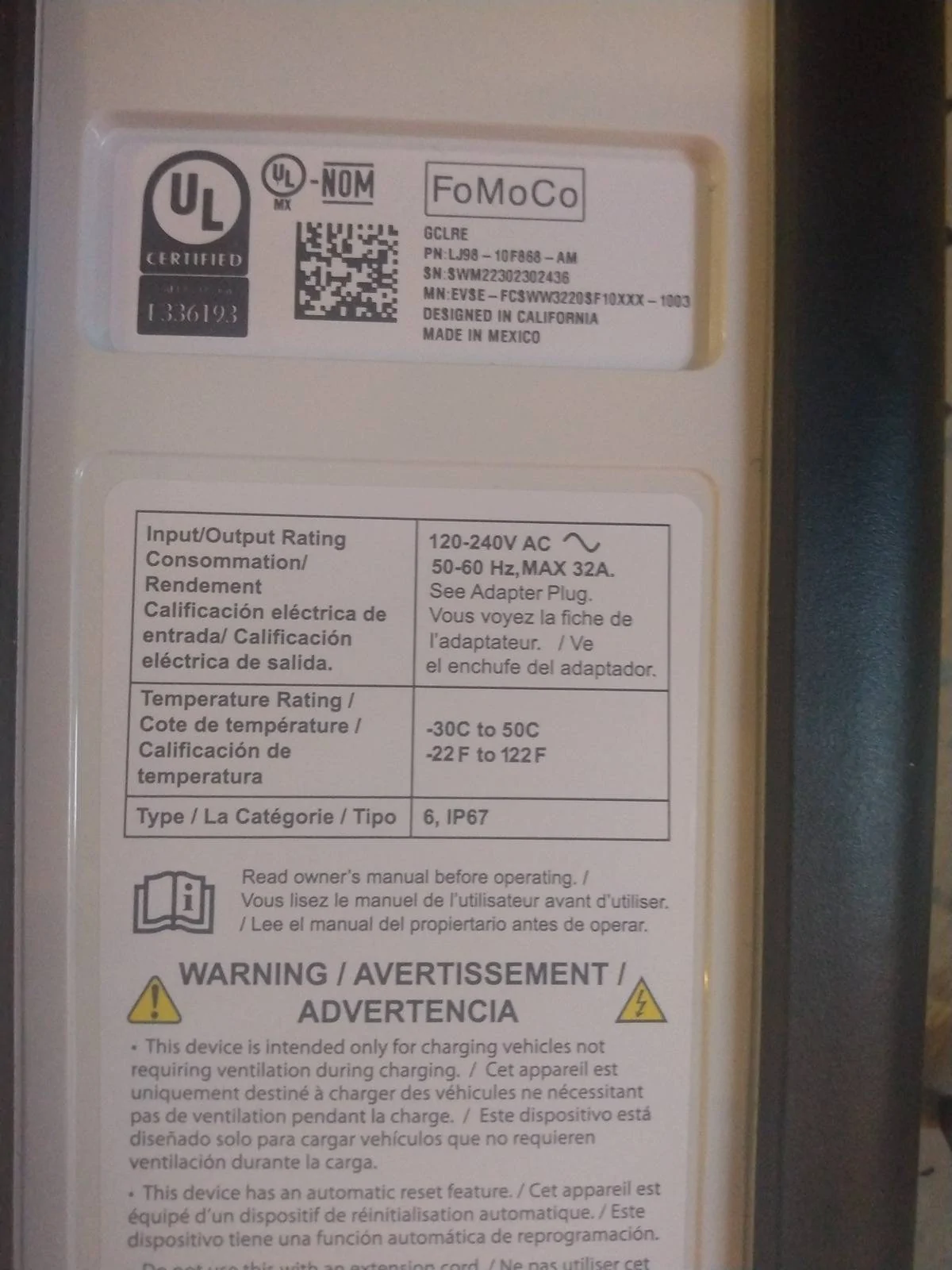
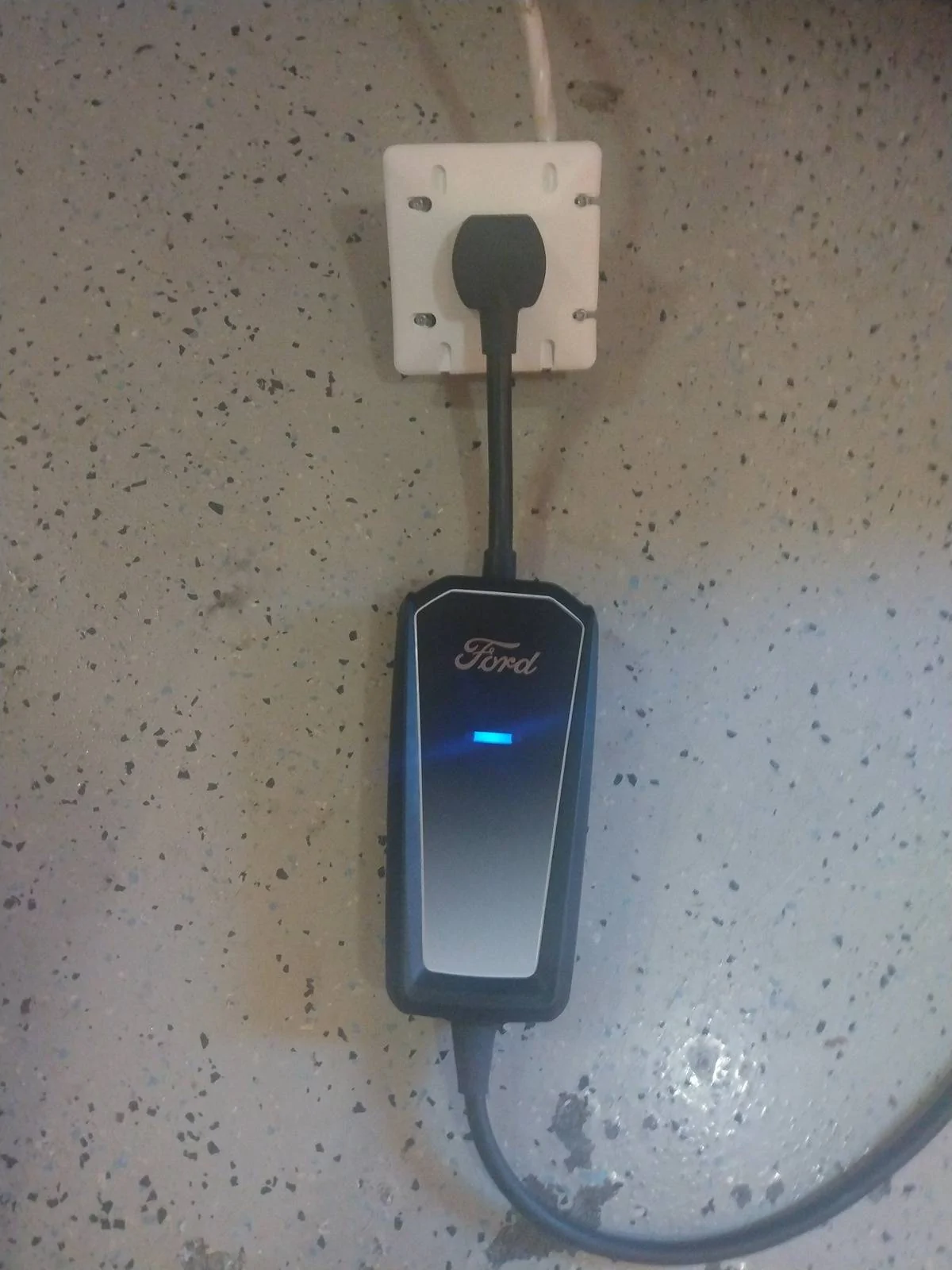
The Mustang-e came with its own Ford charger:

  • Part# LJ98-10F868-AM
  • 120-240V single phase AC. (not 208 three phases)
  • Max load Amp 32A.
  • Charging time 20% to 90%: 6h47
  • Simple:
  • I went to the store and purchased the following:
  • 33 feet of electrical wire AWG 8/3
  • 1 wall outlet 40 AMP
  • 1 Receptacle square box
  • 1 Panel breaker 40 AMP
  • Self-installation 1 hour. All this for less than 150$
  • Note: Breaker 40 AMP for a max load Amp 32A.
    Ford Mustang Mach-E Charging on Dryer Outlet Pic 2
    Ford Mustang Mach-E Charging on Dryer Outlet Pic1
 

Triggerhappy007

Well-Known Member
Joined
Feb 20, 2021
Threads
10
Messages
899
Reaction score
812
Location
TX
Vehicles
23 Premium, 3rd Mach-E
Country flag
The advice posted does *NOT* contradict what's on the website, in my opinion. The website is just a little.... amibiguous? Or .... wrong?

"Plug into any 240V", the website says. Not true --- plug into any 240V you*can* plug into. The Ford charger supports only NEMA 14-50. A 14-50 has to be fused to 50A (and would be better installed as 60A because it could be a continuous load but in either case the 42A charger is safe).

If you get an adapter to a 30A plug, put their 42A charger on a 30A circuit... You'll have a bad time. The breaker should blow. You shouldn't get a fire, because that's what breakers do, but if your breaker malfunctions, then you probably will get some very bad juju (melted wires and shit smoking if not catching fire). As they say, "not recommended". In any case, it won't / shouldn't work - it should trip breakers.

If you're going to use adapters, you really need to know what you're up to. All these plug formats exist for a reason, and an adapter circumvents the physical safety mechanism, which requires you to use the safety mechanism called your brain --- something designers consider a terrible, terrible idea.

You almost certainly need a charger that supports setting the Amperage. I've been looking for one, myself, because if my mobile charger is my "last resort", then I want to be able to set it to a number of values.... Who knows if I'm at my friend's house and they say "wellll..... I know it's a 50A plug but my shady cousin put in low grade wiring...."

But I haven't found a charger that goes all the way from 16A to 42A and is portable enough to replace the Ford unit in the space under the floor in the car.

Looking for recommendations; I haven't searched the last 6 months.

[ I might even say 50A is not unreasonable.... But the cases where 50A are safe is super rare.... SUPER RARE.... 42A would be fine with me ]
42A chargers are super rare.
 

HuntingPudel

Well-Known Member
First Name
Steve
Joined
Mar 23, 2021
Threads
88
Messages
12,932
Reaction score
17,376
Location
Bay Area, CA
Vehicles
2024 MME GT with Performance Upgrade, 1979 Fire-Am, 1972 K/5 Blazer
Occupation
Engineering
Country flag
<SNIP>
But I haven't found a charger that goes all the way from 16A to 42A and is portable enough to replace the Ford unit in the space under the floor in the car.

Looking for recommendations; I haven't searched the last 6 months.
<SNIP>
Just FYI I am looking at the Tesla Mobile unit. It has a variety of mains pigtails and sets its input amperage and voltage based on the pigtail that is connected to it. The only issue is that it requires a Tesla to J1772 AC adapter (which I already have but have never used). The main reason I am looking for one is that there is a 30A dryer plug at the duck club a friend is at. Not sure that using it a few times a year is worth buying a mobile charger for when I can L3 on the way there and on the way back. ?‍♂?


goodguy

Well-Known Member
First Name
j
Joined
Jun 23, 2023
Threads
0
Messages
69
Reaction score
58
Location
utah
Vehicles
ford
Country flag
The Mustang-e came with its own Ford charger:

  • Part# LJ98-10F868-AM
  • 120-240V single phase AC. (not 208 three phases)
  • Max load Amp 32A.
  • Charging time 20% to 90%: 6h47
  • Simple:
  • I went to the store and purchased the following:
  • 33 feet of electrical wire AWG 8/3
    • 1 wall outlet 40 AMP
  • 1 Receptacle square box
  • 1 Panel breaker 40 AMP
  • Self-installation 1 hour. All this for less than 150$
  • Note: Breaker 40 AMP for a max load Amp 32A.
Yep. did the same. The only thing I would add is there really is not a 40 amp wall outlet. Some some think a 14-50 wall outlet implies that 50 amp is being provided because of the rating of the outlet. Some recommending adding a sign stating 40 amp max to avoid any future confusion. Some say it is against code. From what i can gather. it is not against code but a sign seems prudent. but in reality if you moved, you probably would take the setup with you. I know I would.
 

nuMach

Well-Known Member
Joined
May 5, 2023
Threads
17
Messages
240
Reaction score
150
Location
vancouver island
Vehicles
2025 GT
Occupation
eng tech
Country flag
Dryer is 30A, Range is 40A
You can get a controller that flip-flops between the range/L2charger off the same breaker.
When the charger is activated it cuts off the stove (but leaves a trickle voltage to stove to maintain the clock.

This needs some wiring, the controller, and is generally an accepted method for those with no breaker space, or say a 100A panel for EMS purposes.

Personally, if you have room for a 60A (or 50A) breaker, I'd go with the Emporia charger/EMS combo. Proportionately reduced charge over wifi as house loads vary, (as opposed to 1 device off) and least expensive overall setup.

emporia $599us, $824cad
 
Last edited:

ATL

Well-Known Member
Joined
Aug 27, 2022
Threads
1
Messages
210
Reaction score
196
Location
Canada
Vehicles
1979 Trans Am, 2016 Mustang GT
Occupation
Electrical Engineer
Country flag
Just FYI I am looking at the Tesla Mobile unit. It has a variety of mains pigtails and sets its input amperage and voltage based on the pigtail that is connected to it. The only issue is that it requires a Tesla to J1772 AC adapter (which I already have but have never used). The main reason I am looking for one is that there is a 30A dryer plug at the duck club a friend is at. Not sure that using it a few times a year is worth buying a mobile charger for when I can L3 on the way there and on the way back. ?‍♂?
Tesla charging products seem well engineered/constructed. I strongly considered for home install before deciding on ChargePoint.

Hey, I thought the K5 was for shooting trips... You will probably save enough on gas and avoided L3 costs to pay for that charger, though!
 

HuntingPudel

Well-Known Member
First Name
Steve
Joined
Mar 23, 2021
Threads
88
Messages
12,932
Reaction score
17,376
Location
Bay Area, CA
Vehicles
2024 MME GT with Performance Upgrade, 1979 Fire-Am, 1972 K/5 Blazer
Occupation
Engineering
Country flag
Tesla charging products seem well engineered/constructed. I strongly considered for home install before deciding on ChargePoint.

Hey, I thought the K5 was for shooting trips... You will probably save enough on gas and avoided L3 costs to pay for that charger, though!
The K/5 sort of still gets used for hunts. It’s definitely easier to sleep in than the MME. The MME is just so much more comfortable for the drive. ?? Oh, and the fuel for the K/5 is crazy expensive compared to the fuel for the MME. ??
 
  • Like
Reactions: ATL

Dear_OP

Well-Known Member
Joined
Mar 24, 2024
Threads
8
Messages
334
Reaction score
319
Location
Canada
Vehicles
Horse and Wagon
Country flag
I just had an electrician come by to assess my home capability to support EV charging. He determined current service is fine for 40A (32A charge). It is now up to me to decide if I want to hardwire or use the existing 240V plug.
I am deliberating with the move to NACS, should I temporarily use an L2 mobile charger and then later hardwire in a Tesla Wall Charger.

What's gonna happen to CCS and its providers?
 
Last edited:

kodiakng

Well-Known Member
First Name
David
Joined
Oct 1, 2022
Threads
19
Messages
903
Reaction score
1,407
Location
Oregon
Vehicles
2023 Cyber Orange 4X Mach-E
Country flag
I just had a electrician come buy to assess my home capability to support EV charging. He determined current service is fine for 40A (32A charge). It is now up for me to decide if I want to hardwire or use the existing 240V plug.
since your home service is limited and assuming your current 240V wiring is capable of handling the 40A breaker protected usage, i'd just stick with it. there are lots of EVSE options available.

I am deliberating with the move to NACS, should I temporarily use an L2 mobile charger and then later hardwire in a Tesla Wall Charger.

What's gonna happen to CCS and its providers?
unless you're planning on switching to a car with a tesla or NACS inlet in the next couple of years i'd just get the J1772 EVSE capable of 32A and not sweat it.
 

bbulkow

Well-Known Member
First Name
Brian
Joined
Aug 30, 2022
Threads
24
Messages
889
Reaction score
729
Location
menlo park, california
Vehicles
Honda CRV
Country flag
Agreed, although unfortunately a lot of that can be hidden behind walls. The horrors I've found when remodeling houses (all pre-1960s builds) I've lived at would give me pause to use existing wiring for EV charging. I ran brand new wiring for my charger.
Our 1949 house has wiring superior in gauge to recent builds, but use of knob and tube (uses distance for insulation instead of physical insulation) freaks people out.
 

bbulkow

Well-Known Member
First Name
Brian
Joined
Aug 30, 2022
Threads
24
Messages
889
Reaction score
729
Location
menlo park, california
Vehicles
Honda CRV
Country flag
I just had an electrician come by to assess my home capability to support EV charging. He determined current service is fine for 40A (32A charge). It is now up to me to decide if I want to hardwire or use the existing 240V plug.
I am deliberating with the move to NACS, should I temporarily use an L2 mobile charger and then later hardwire in a Tesla Wall Charger.

What's gonna happen to CCS and its providers?
First, CCS is not used in AC charging. CCS is the two monster pins at the bottom of the socket in the car with the little extra flip port (to be pedantic, CCS-1 is the combination of the J1772 [update] and the two extra pins). AC L2 charging is J1772 [update] at the top only.

Second, non-Tesla NACS chargers haven't appeared on the market (much?), but as NACS cars come out in two years, they will. NACS, unlike Tesla plugs, is an ISO standard that anyone can build to (again being slightly pedantic, NACS and Tesla are designed to be very similar and in AC cases the two formats and specs are identical). Likely if Ford ships a travel charger with a 2025-whatever machE (or whatever they're shipping with NACS), there will be an NACS travel charger.

Yes, you may desire to switch to a NACS home charger in 3 or 4 years. Or you may decide to use the J1775 / NACS adapter. They are much smaller than the NACS / CCS adapters. Or you may end up with a J1775 car that you buy used because the prices are cheap. You'll probably need to carry an adapter in the car in 3 to 4 years anyway, NACS and J1775 will co-exist for a long time, there's just so much J1775 in the field. I wouldn't overthink it too hard.
 
Last edited:

HuntingPudel

Well-Known Member
First Name
Steve
Joined
Mar 23, 2021
Threads
88
Messages
12,932
Reaction score
17,376
Location
Bay Area, CA
Vehicles
2024 MME GT with Performance Upgrade, 1979 Fire-Am, 1972 K/5 Blazer
Occupation
Engineering
Country flag
First, CCS is not used in AC charging. CCS is the two monster pins at the bottom of the socket in the car with the little extra flip port (to be pedantic, CCS-1 is the combination of the J1775 and the two extra pins). AC L2 charging is J1775 at the top only.
<SNIP>
CCS-1 is a superset of J1772, plus the DC conductors. It uses the signal and comms pins from the J1772 connector. ??
Sponsored


Top