Mach-E Extended Range Battery buffers and DCFC limits

phidauex

Well-Known Member
First Name
Sam
Joined
Dec 8, 2020
Threads
17
Messages
966
Reaction score
1,843
Location
Colorado
Vehicles
2021 MachE 4EX, 2006 Prius, 1997 Tacoma
Occupation
Renewable Energy Engineer
Country flag
Thanks for your graphs, I like seeing your work.

Regarding the battery buffer, we probably won't know until we start seeing detailed cell voltages, but I had assumed that the allowable range was probably more like 2% to 92% of chemical SOC, rather than 8% to 98%. I design grid-scale storage, and we tend to run buffers biased toward the low SOC range because the higher SOC range is more sensitive to degradation (hours above 90% is one of the key degradation metrics we use).

I didn't realize that was referring to the 10kWh capacity buffer -- I thought it was about the battery's current limitations assuming it's locked at 88kwh.
So in the end, you're saying it's unlikely much additional capacity will be unlocked? Why do other manufacturers have much smaller buffers for the same technology?
You can set any buffer you want, but the larger the buffer, the lower the degradation. Your minimum buffer is probably something like 2-3% if you want to avoid constant voltage charging at the very top end. For systems I work on with 25 year service lives, we might start with upwards of 40% buffer, gradually reducing over time.

So Ford's large buffer is probably related to a conservative view on warranties. The narrower they set the buffer, the more 8 year battery warranties they will pay out. Some manufacturers are way out over their skis on warranty obligations and there will be rude awakenings in the next 5-10 years...
 

RonTCat

Well-Known Member
First Name
Ron
Joined
Jul 21, 2020
Threads
27
Messages
1,135
Reaction score
2,979
Location
USA
Vehicles
Mach-E wannabuy
Country flag
The next move will likely be to something that either doubles the series array to 188 individual cells (94S -> 188S), or takes the current batteries and series two of those. You then go to what will be referred to nominally as "800V" charging. Maybe someone who knows can tell us which way things are leaning.
 
OP
OP
EVmodeler

EVmodeler

Well-Known Member
First Name
Doug
Joined
Oct 30, 2020
Threads
10
Messages
132
Reaction score
291
Location
SW Virginia
Vehicles
Mach-E AWD ER IB Job 1
Occupation
Engr Prof emeritus
Country flag
Thanks for your graphs, I like seeing your work.

Regarding the battery buffer, we probably won't know until we start seeing detailed cell voltages, but I had assumed that the allowable range was probably more like 2% to 92% of chemical SOC, rather than 8% to 98%. I design grid-scale storage, and we tend to run buffers biased toward the low SOC range because the higher SOC range is more sensitive to degradation (hours above 90% is one of the key degradation metrics we use).


You can set any buffer you want, but the larger the buffer, the lower the degradation. Your minimum buffer is probably something like 2-3% if you want to avoid constant voltage charging at the very top end. For systems I work on with 25 year service lives, we might start with upwards of 40% buffer, gradually reducing over time.

So Ford's large buffer is probably related to a conservative view on warranties. The narrower they set the buffer, the more 8 year battery warranties they will pay out. Some manufacturers are way out over their skis on warranty obligations and there will be rude awakenings in the next 5-10 years...
In a vehicle application (high power, dynamic loads), the voltage cliff at the bottom end probably requires the bigger buffer. Also, higher discharge power at lower voltage requires higher current. In the vehicle, the approach to high SOC occurs during charging and/or regen, so the charge rate can be controlled, and (probably) requires less buffer. Charge power limits do not change driveabilty as much as discharge power limits. All of these are just my (hopefully well informed) estimates from some experience.
And - why Ford says every day charge to 80 or 90 % (indicated), to avoid time at high voltage which degrades battery materials.
 

generaltso

Well-Known Member
Joined
Jun 24, 2020
Threads
76
Messages
15,389
Reaction score
28,694
Location
Vermont
Vehicles
2024 Kia EV9 GT-Line
Country flag
You then go to what will be referred to nominally as "800V" charging. Maybe someone who knows can tell us which way things are leaning.
800v charging is already here. That’s how the Taycan gets 270kW.


OP
OP
EVmodeler

EVmodeler

Well-Known Member
First Name
Doug
Joined
Oct 30, 2020
Threads
10
Messages
132
Reaction score
291
Location
SW Virginia
Vehicles
Mach-E AWD ER IB Job 1
Occupation
Engr Prof emeritus
Country flag
The next move will likely be to something that either doubles the series array to 188 individual cells (94S -> 188S), or takes the current batteries and series two of those. You then go to what will be referred to nominally as "800V" charging. Maybe someone who knows can tell us which way things are leaning.
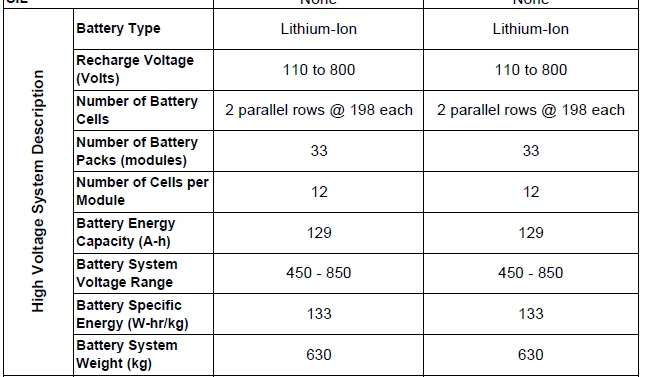
Yes - to get higher charge rates with 400 A current limit (SAE DCFC standard) requires higher voltage batteries; the Audi, and iD4 I think, have ~ 400 V nominal battery packs - 110 cells in series? Rather than 94S / 342 V (ER) or 96S / 350 V (SR) nominal in the MME. The Taycan has 198 cells in series for about 720 V nominal. From the EPA cert data document:

Ford Mustang Mach-E Mach-E Extended Range Battery buffers and DCFC limits 1613842314651


The VW group seems to be the only one exceeding max DC voltage of ~ 400 - 425V so far.
There are good (human) safety reasons and common electrical component rating reasons to stay with ~ 350 V nominal.

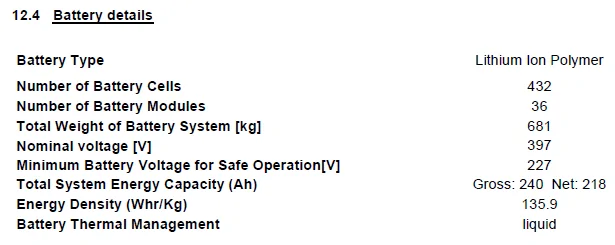
Edit - correction, Audi probably uses 108S. There is a lot of mixing of max vs nominal voltage for battery packs by manufactures. From the EPA cert data: (4 modules in parallel, 9 modules in series, 12 60 Ah cells in series per module)
Ford Mustang Mach-E Mach-E Extended Range Battery buffers and DCFC limits 1613843335425
 
Last edited:

RonTCat

Well-Known Member
First Name
Ron
Joined
Jul 21, 2020
Threads
27
Messages
1,135
Reaction score
2,979
Location
USA
Vehicles
Mach-E wannabuy
Country flag
Yes - to get higher charge rates with 400 A current limit (SAE DCFC standard) requires higher voltage batteries; the Audi, and iD4 I think, have ~ 400 V nominal battery packs - 110 cells in series? Rather than 94S / 342 V nominal in the MME. The Taycan has 198 cells in series for about 720 V nominal. From the EPA cert data document:

1613842314651.png


The VW group seems to be the only one exceeding max DC voltage of ~ 400 - 425V so far.
There are good (human) safety reasons and common electrical component rating reasons to stay with ~ 350 V nominal.
Thanks. Agree with going over present nominal... most standard motor drive power supplies likely won't do more than 500VDC. Once over that, you are getting into low volume "custom" equipment, which costs $$$$. I'm sure it's why the Taycan price is what it is :rolleyes:.
 

EV Lab

Well-Known Member
Joined
Oct 18, 2020
Threads
9
Messages
197
Reaction score
233
Location
San Jose CA
Vehicles
IB MME 4XE, Ford F-150, Honda Civic EV conversion
Occupation
Electrical Engineer
Country flag
I didn't realize that was referring to the 10kWh capacity buffer -- I thought it was about the battery's current limitations assuming it's locked at 88kwh.
So in the end, you're saying it's unlikely much additional capacity will be unlocked? Why do other manufacturers have much smaller buffers for the same technology?
It's really just Tesla that does this, and they also don't design the car for 10 years+ lifespan, which they've openly stated.
 

phidauex

Well-Known Member
First Name
Sam
Joined
Dec 8, 2020
Threads
17
Messages
966
Reaction score
1,843
Location
Colorado
Vehicles
2021 MachE 4EX, 2006 Prius, 1997 Tacoma
Occupation
Renewable Energy Engineer
Country flag
In a vehicle application (high power, dynamic loads), the voltage cliff at the bottom end probably requires the bigger buffer. Also, higher discharge power at lower voltage requires higher current. In the vehicle, the approach to high SOC occurs during charging and/or regen, so the charge rate can be controlled, and (probably) requires less buffer. Charge power limits do not change driveabilty as much as discharge power limits. All of these are just my (hopefully well informed) estimates from some experience.
And - why Ford says every day charge to 80 or 90 % (indicated), to avoid time at high voltage which degrades battery materials.
Thanks, that makes sense, if you aren’t spending much time at high soc, but want full power at the low end, you might leave more buffer in the low end of the range. I’m probably more degradation sensitive in grid applications too, trying to get 20 years of 300+ equivalent cycles per year (at very low c rates, thankfully).

Alex on Autos has a video where he is on the highway at very low soc, and there is no indication of turtle mode so clearly it wasn’t in heavy current limiting yet, which supports your theory.
 

EV Lab

Well-Known Member
Joined
Oct 18, 2020
Threads
9
Messages
197
Reaction score
233
Location
San Jose CA
Vehicles
IB MME 4XE, Ford F-150, Honda Civic EV conversion
Occupation
Electrical Engineer
Country flag
Thanks. Agree with going over present nominal... most standard motor drive power supplies likely won't do more than 500VDC. Once over that, you are getting into low volume "custom" equipment, which costs $$$$. I'm sure it's why the Taycan price is what it is :rolleyes:.
More and more vendors are offering 800V powertrain equipment. From my experience with an EV OEM, the other components such as DC-DC, EPS, HVAC, etc were hard to find in 800V. Plus the powertrain still needs to be designed to handle 400V DCFC, which adds extra complexity. As an example, the Taycan includes a 50kW HV DC-DC (150kW optional) just for 400V voltage DCFC.
 

DBC

Well-Known Member
First Name
Don
Joined
Oct 1, 2020
Threads
8
Messages
1,224
Reaction score
1,430
Location
San Diego
Vehicles
Volt ELR
Country flag
The next move will likely be to something that either doubles the series array to 188 individual cells (94S -> 188S), or takes the current batteries and series two of those. You then go to what will be referred to nominally as "800V" charging. Maybe someone who knows can tell us which way things are leaning.
I think you've explained the GM method of changing the battery configuration to enable 800v charging.
 
OP
OP
EVmodeler

EVmodeler

Well-Known Member
First Name
Doug
Joined
Oct 30, 2020
Threads
10
Messages
132
Reaction score
291
Location
SW Virginia
Vehicles
Mach-E AWD ER IB Job 1
Occupation
Engr Prof emeritus
Country flag
And there are 750V nominal DC systems - trains and subways.

More and more vendors are offering 800V powertrain equipment. From my experience with an EV OEM, the other components such as DC-DC, EPS, HVAC, etc were hard to find in 800V. Plus the powertrain still needs to be designed to handle 400V DCFC, which adds extra complexity. As an example, the Taycan includes a 50kW HV DC-DC (150kW optional) just for 400V voltage DCFC.
Sponsored


Top