AKgrampy

Well-Known Member
First Name
Mike
Joined
Jan 29, 2022
Threads
7
Messages
3,526
Reaction score
3,600
Location
Fairbanks, Alaska
Vehicles
Ford Expedition, Ford F-150, Mach E GT
Occupation
Retired
Country flag
17 is ridiculous, of course. 15 minute increments between 15-60 is perfectly reasonable for a manual "Leaving Soon" use case, like a hotel or other non-routine drive. Select it, hop in the shower, check out, and go. Perfectly normal use case.

And no big deal if it warms up a bit early. The car stays warm enough for a while.
So just take away choice and make it one hour or some thing like that. For instance leaving soon? Yes - set time - min of one hour. Sure this may still cause some complaints but it would also eliminate quite a few.
Sponsored


dbsb3233

Well-Known Member
First Name
TimCO
Joined
Dec 30, 2019
Threads
56
Messages
10,100
Reaction score
11,965
Location
Colorado, USA
Vehicles
2021 Mustang Mach-E FE, 2025 Porche Macan Electric
Occupation
Retired
Country flag
So just take away choice and make it one hour or some thing like that. For instance leaving soon? Yes - set time - min of one hour. Sure this may still cause some complaints but it would also eliminate quite a few.
One hour would be fine, but cabin heating would need to be interspersed rather than just tacked on at the 55th minute, otherwise if you're leaving in 30 minutes, no cabin heat has kicked in yet.

Actually one simple change would take care of most of this. Under DEPARTURE TIMES, DAYS OF THE WEEK, just add a "One Time" option to the days list. If we get up at 6:30am and plan to leave around 7:15am, let us set a ONE TIME 7:15am. If that's not enough time to fully precondition and only gets 75% of the way there, so be it. Still better.
 

Chicago-E

Well-Known Member
First Name
Brad
Joined
Dec 9, 2021
Threads
7
Messages
153
Reaction score
194
Location
Chicago
Vehicles
2021 GTPE Iconic Silver, 2021 GTPE Space White
Occupation
Generator Technician
Country flag
improves range maybe, but not efficiency. this vehicle needs a heat pump stat.
 

PicoR

Well-Known Member
Joined
May 3, 2023
Threads
3
Messages
89
Reaction score
96
Location
SE
Vehicles
23 Premium 4X
Country flag
improves range maybe, but not efficiency. this vehicle needs a heat pump stat.
Researching heat pumps, it seems like Tesla has had major issues with them.

Not sure it is the perfect solution for every case.
 

Chicago-E

Well-Known Member
First Name
Brad
Joined
Dec 9, 2021
Threads
7
Messages
153
Reaction score
194
Location
Chicago
Vehicles
2021 GTPE Iconic Silver, 2021 GTPE Space White
Occupation
Generator Technician
Country flag
Researching heat pumps, it seems like Tesla has had major issues with them.

Not sure it is the perfect solution for every case.
Tesla heat pumps are both more efficient and produce more heat that the mach-e resistive heater. Tesla has millions of cars on the road with these and issues are fairly limited. BMW also has heat pumps that work great. they are by far the best solution right now for EVs


RickMachE

Well-Known Member
Joined
Jul 1, 2021
Threads
267
Messages
17,957
Reaction score
27,994
Location
SE MI
Vehicles
2022 Mach-E Premium 4X, 2022 Lightning Lariat ER
Country flag
improves range maybe, but not efficiency. this vehicle needs a heat pump stat.
Tesla heat pumps are both more efficient and produce more heat that the mach-e resistive heater. Tesla has millions of cars on the road with these and issues are fairly limited. BMW also has heat pumps that work great. they are by far the best solution right now for EVs
Actually, Consumer Reports did a study, and proved that in the dead of winter, it was a bunch of hype - heat pumps provided NO advantage.
 

Chicago-E

Well-Known Member
First Name
Brad
Joined
Dec 9, 2021
Threads
7
Messages
153
Reaction score
194
Location
Chicago
Vehicles
2021 GTPE Iconic Silver, 2021 GTPE Space White
Occupation
Generator Technician
Country flag
Actually, Consumer Reports did a study, and proved that in the dead of winter, it was a bunch of hype - heat pumps provided NO advantage.
Correct at extremes heat pumps are no better. But in most use cases 20f, 30f, 40f etc they are significantly better. They are more expensive than resistive heat and manufactures would not use them If they weren’t better.

my own experience having owned a model 3, i4 and Mach-e the heat pumps were much better and resulted in less range loss.
 

RickMachE

Well-Known Member
Joined
Jul 1, 2021
Threads
267
Messages
17,957
Reaction score
27,994
Location
SE MI
Vehicles
2022 Mach-E Premium 4X, 2022 Lightning Lariat ER
Country flag
Correct at extremes heat pumps are no better. But in most use cases 20f, 30f, 40f etc they are significantly better. They are more expensive than resistive heat and manufactures would not use them If they weren’t better.

my own experience having owned a model 3, i4 and Mach-e the heat pumps were much better and resulted in less range loss.
You need to read the article. Free via most libraries' websites.
 

AKgrampy

Well-Known Member
First Name
Mike
Joined
Jan 29, 2022
Threads
7
Messages
3,526
Reaction score
3,600
Location
Fairbanks, Alaska
Vehicles
Ford Expedition, Ford F-150, Mach E GT
Occupation
Retired
Country flag
Correct at extremes heat pumps are no better. But in most use cases 20f, 30f, 40f etc they are significantly better. They are more expensive than resistive heat and manufactures would not use them If they weren’t better.

my own experience having owned a model 3, i4 and Mach-e the heat pumps were much better and resulted in less range loss.
Who needs heat above 30F anyway!
 

Chicago-E

Well-Known Member
First Name
Brad
Joined
Dec 9, 2021
Threads
7
Messages
153
Reaction score
194
Location
Chicago
Vehicles
2021 GTPE Iconic Silver, 2021 GTPE Space White
Occupation
Generator Technician
Country flag
You need to read the article. Free via most libraries' websites.
there are countless articles and tests proving the opposite of what consumer reports says.


easiest example I can give you is a 2019 Model 3 has resistive heat and a 2021 model 3 has a heat pump. the 2021 model 3 gets far better range in cold months and same range in subzero temps as eventually a heat pump goes 1 to 1 which a resistive heater always is.


hard to argue with the like for like comparison. its not even close.
 

Shayne

Well-Known Member
Joined
Aug 9, 2020
Threads
18
Messages
3,824
Reaction score
2,738
Location
Northern Ontario Canada
Vehicles
2021 MME4x Prem
Occupation
Retired
Country flag
I just looked, and Departure Time does have a cabin temp setting as part of it. So it appears to do both. Or at least is intended to do both.
It does at different times. First it runs the preconditioning this will vary on temp seen half an hour to 1 hour 45 minutes then for the last 15 minutes it runs cabin heat just like you pushed remote start. You can hear the recir pump quit and the blower fan kick in.

If the schedule worked like it should from the app it works great. You can just delete it on your own time through the app if you don't want it to run again. If not you notice it is running again and delete it then (only once check mark would be nice).

I see no logical sense in or need for one button. Telling it you are leaving in xx minutes is the same work as a schedule (if taps are work). It is telling it when you are leaving. No way it can be ready when you are leaving if you never tell it when you are. Fire a schedule off to the car a couple hours before (2 days) and it makes it to the car. When it was working it was easy to control. I kept one running and continuously changing it. Normally only one time on the schedule at any one time. Doesn't work here anymore and 4.2.2 brought no joy. Did work for a full winter and now has not for one so hoping for a software fix some year. Maybe we over loaded their servers and got dumped.
 

MadLaserist

Active Member
Joined
Mar 11, 2022
Threads
0
Messages
41
Reaction score
24
Location
Bensalem, PA
Vehicles
2021 Premium AWD ER Space White
Country flag
If your on a long road trip kind of day and the battery hits 113 deg F, and you use Ford Nav to go to the next charger, will it then cool the battery to get to 77 - 95 deg, or is 113 ok to get a 125kw charging rate? This assumes your in the 20% SOC range.
 

dbsb3233

Well-Known Member
First Name
TimCO
Joined
Dec 30, 2019
Threads
56
Messages
10,100
Reaction score
11,965
Location
Colorado, USA
Vehicles
2021 Mustang Mach-E FE, 2025 Porche Macan Electric
Occupation
Retired
Country flag
Ford just released a very informative brochure detailing things that affect range with test results. It's for the F150 Lightning, but the effects would be very similar and relevant for the Mach-E as well. If you want to jump straight to the full brochure, I've attached the PDF at the bottom. Let me discuss some of the highlights:

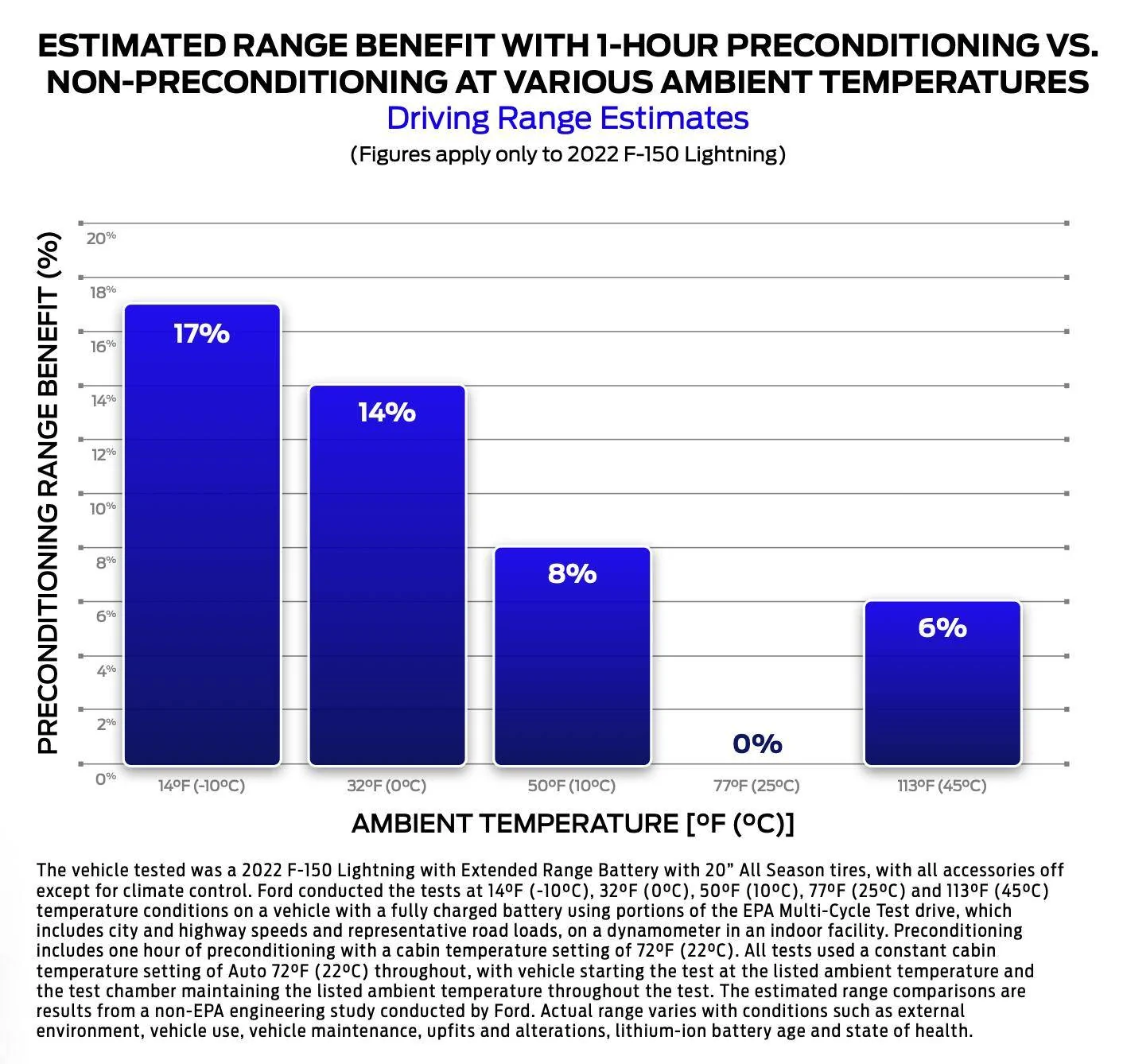
Effect of Preconditioning:

Preconditioning Range.png


As you can see, the colder it is outside, the larger the range improvement from preconditioning (setting a departure time). If we extrapolate with this data, the effect would be +20% improved range at -4ºF(-20ºC). Warmer batteries store more energy, so that's why heating the battery improves range. Preconditioning also has a slight improvement of range when it's very hot outside as well. For more information on how to precondition your battery when you don't have a regular schedule, see my cold weather strategy topic.

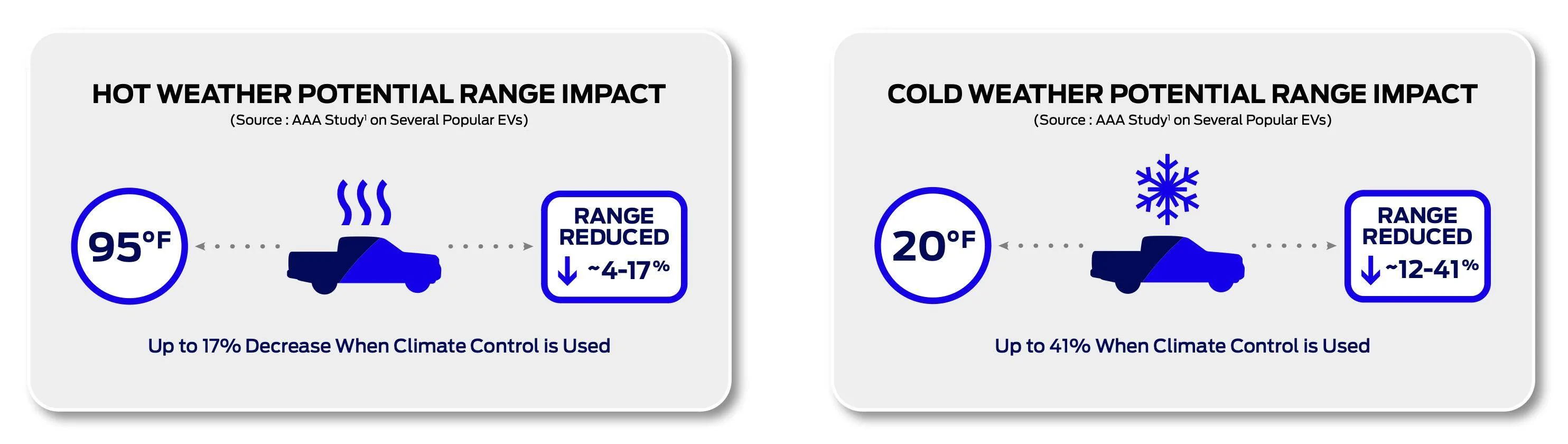
Effect of Outdoor Temperature:

Outdoor Temp.png


This one isn't specific to the F150 Lightning, but we all know range can decrease with climate use in hot or cold conditions.

Effect of Speed:

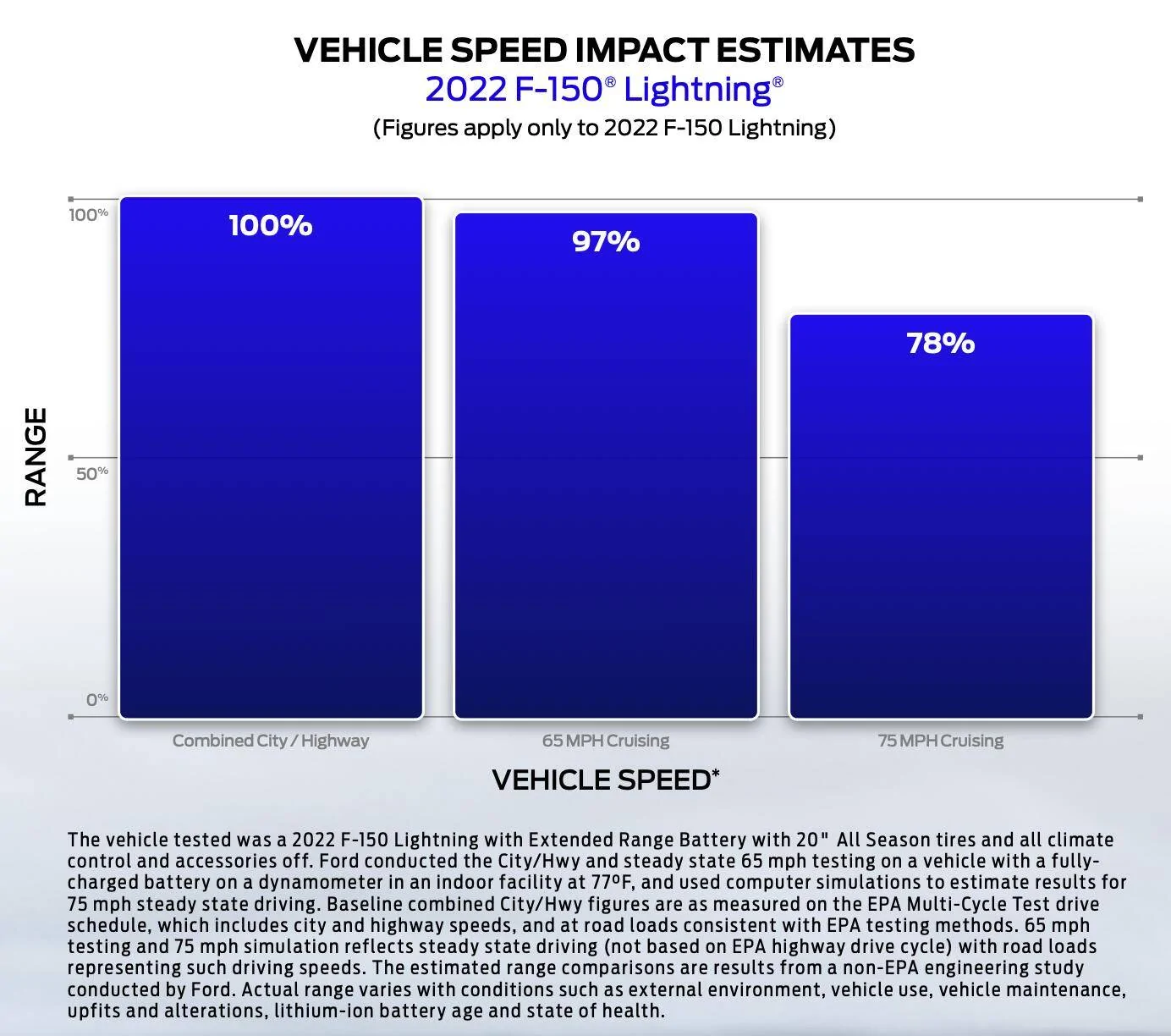
Speed Range.png


If you want EPA range, you have to drive about 65 MPH. If you drive just 10 MPH faster (75 MPH), your range will go down about 20%. This is because drag is proportional to velocity squared (not linear)! Which means if you drive 20 MPH faster (85 MPH), your range will go down about 54%! Driving 65-75 MPH is really the sweet spot for getting decent range in an EV.

Effect of Payload:

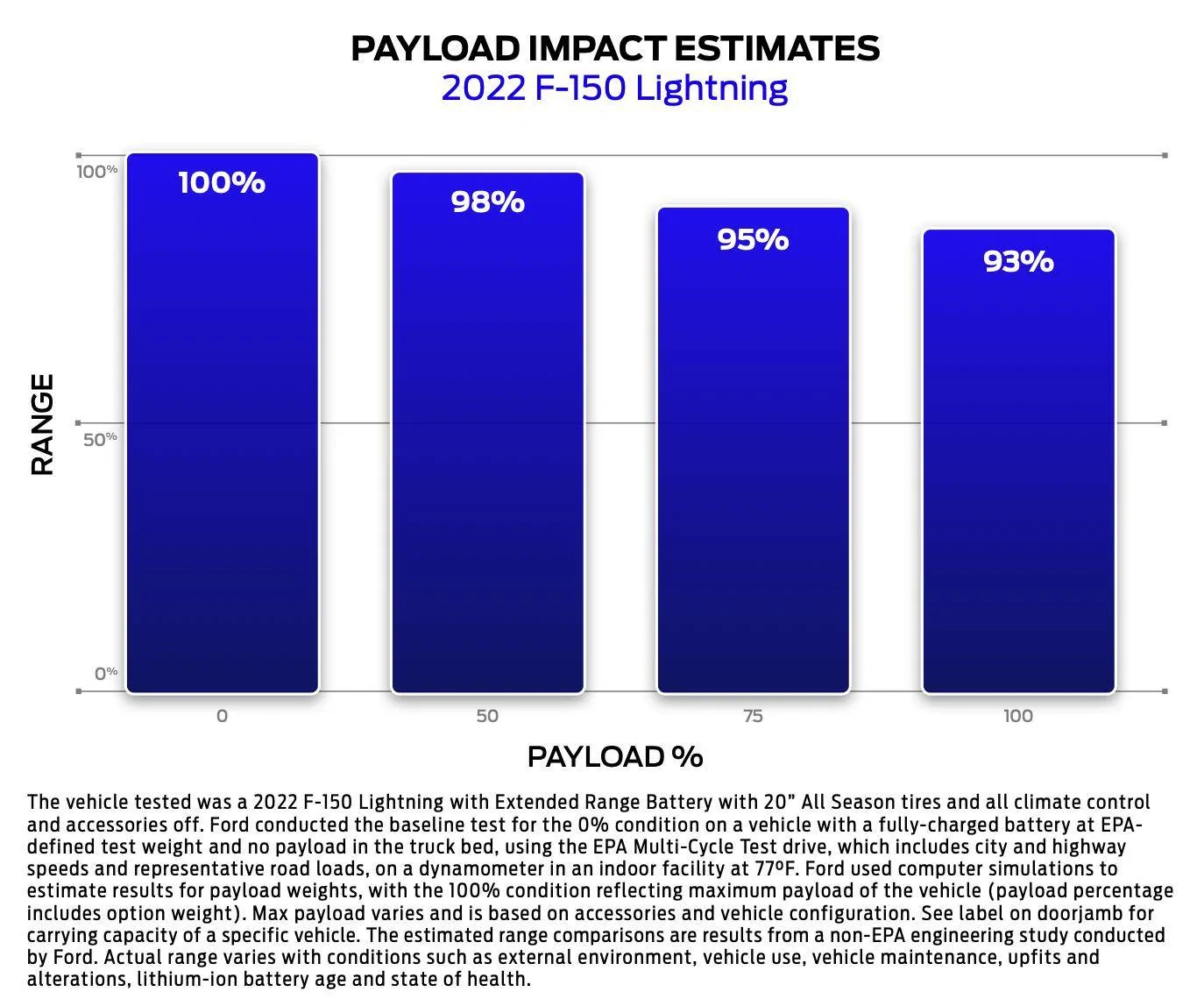
Payload Range.png


The max payload for the Lightning varies depending on trim, but it's around 2,000 lbs here. You can see that even with an extra 2,000 lbs, there is only a 7% decrease in range. It is a common misconception that weight has a much bigger effect on range than it actually does. Speed and aero are much more important. Weight only significantly affects range if you are driving up an incline to a higher elevation. On flat land it's not a big effect. The payload of the Mach-E is roughly half that of the F150 Lightning (~1000 lbs) so a fully loaded Mach-E would only have about a 2% range penalty.

Effect of Trailer:

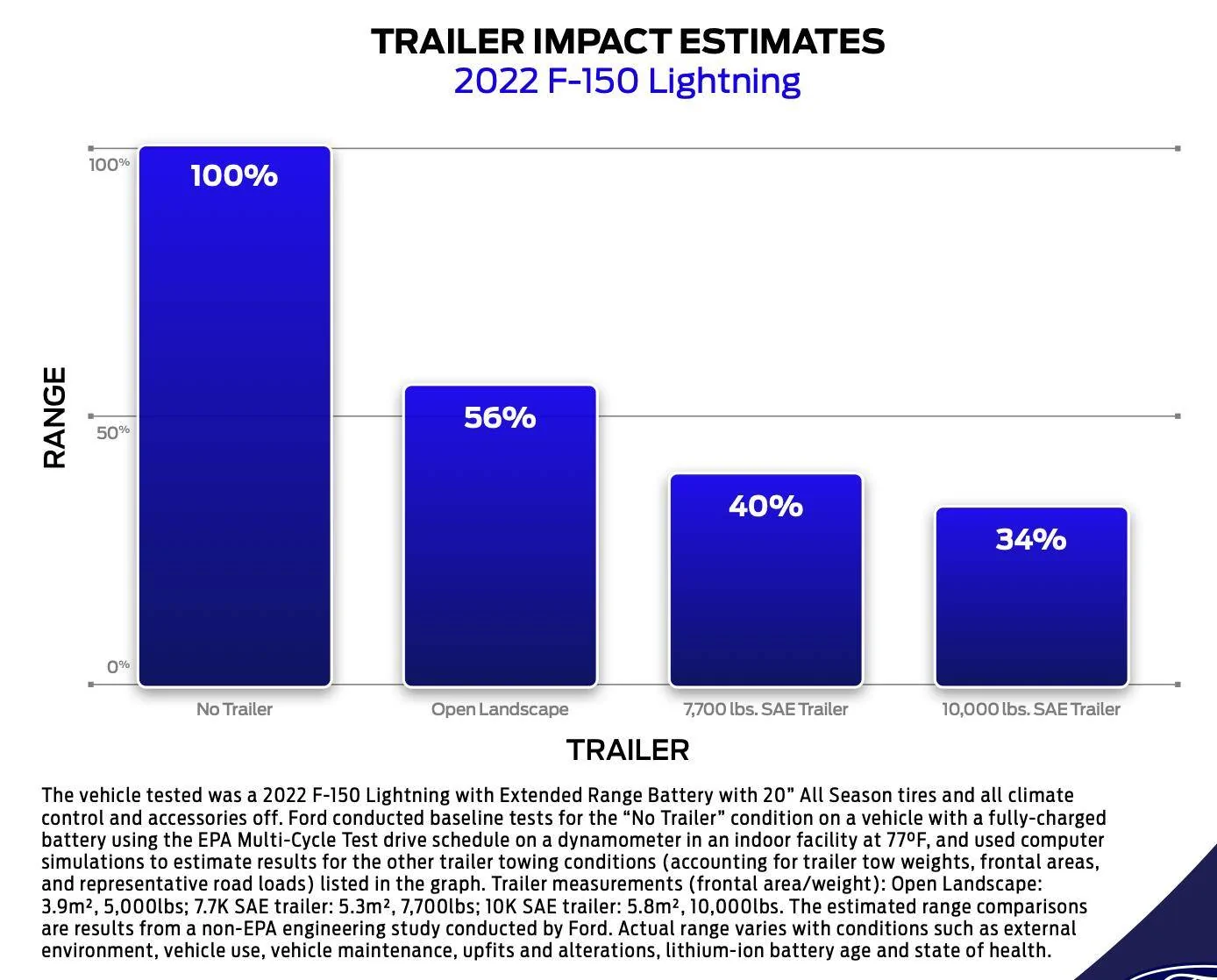
Trailer Range.png


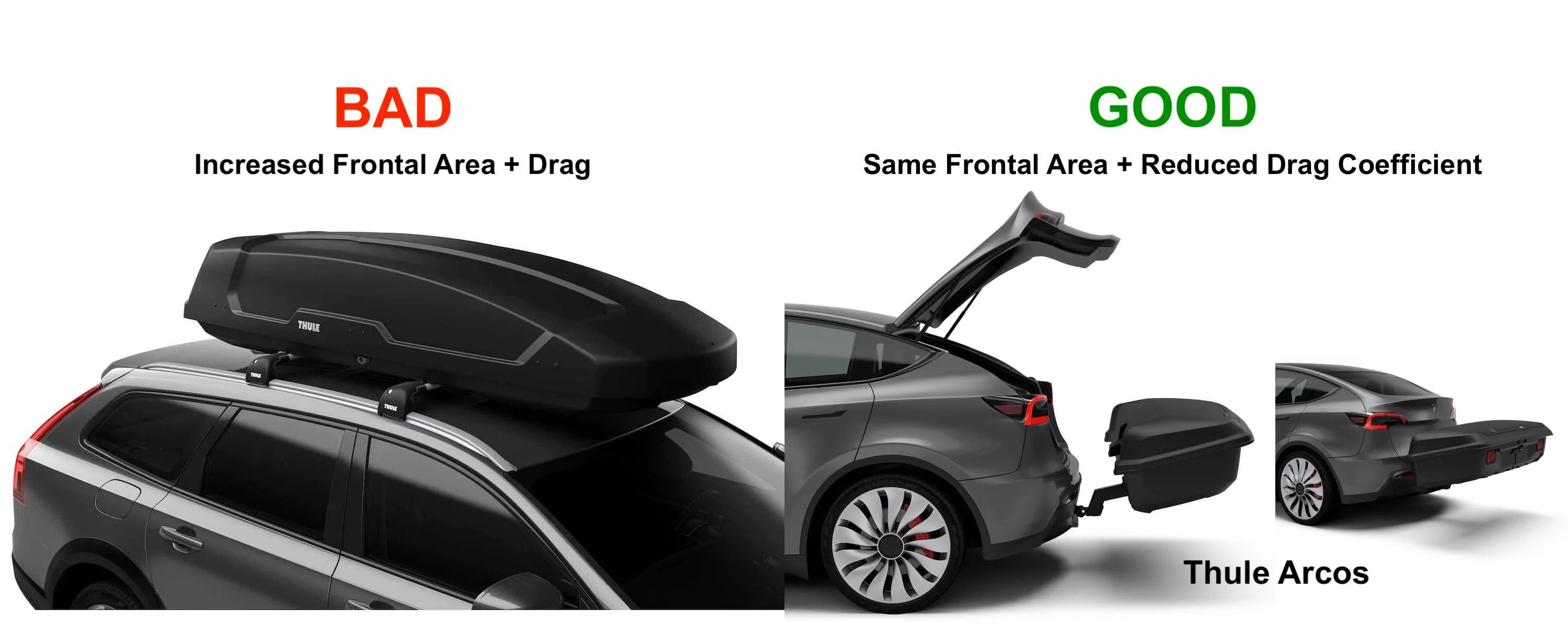
The Mach-E isn't rated to tow, but you can see pulling a trailer has a huge effect on range. I want to emphasize that it's not the weight, it's mostly the aero (frontal area) that saps the range. It takes a tremendous amount of energy to push a large flat box through the air at speed. This is why you want as vertically short and as aerodynamic trailer as possible if towing. If you are adding a cargo box to the Mach-E, you want to put it behind the car in the wake, not on top:

Aero Box.jpg


An aerodynamic box in the back can actually INCREASE the range of an EV (compared to no box) because it makes the overall shape of the vehicle more like a teardrop and improves the drag coefficient. The box must be placed correctly in the wake behind the vehicle as shown above.

Anyway, hopefully you learned something. Read the PDF brochure below for more details:
The more I think about this, the more deceiving I think the conclusion may be. They don't say how LONG they tested it for. If it's the standard EPA test, that's only 765 seconds (12.75 minutes), then extrapolated. If they applied an hour of preconditioning to that and just extrapolated the "savings" to a 3+ hour drive (0-100%), then it's highly deceiving.

Sure, precondition the battery and cabin will use EVSE power instead of battery to warm you up from the start of the drive. If starting cold, you're gonna burn a chunk of power to get it up to speed (17% more sounds plausible for the first 12.75 minutes). However, driving in the cold for 30... 60... 90... 120 minutes is gonna suck that preconditioned heat away and the car battery is gonna have to keep putting it back in. By the 2nd hour of the drive, preconditioning heat is long gone. That 17% savings in the first 12.75 minutes is probably like 5% in the next 12.75 minutes, 2% in the next, and nothing after that.

If they're just extrapolating that first 12.75 minutes to the whole battery, that's gotta be way off for projecting a long road trip leg. But if just doing 15 minute drives to work and preconditioning each time, then sure. Of course, we don't care about range if doing that. We care about range for long road trip drive legs.
 
OP
OP
Mach-Lee

Mach-Lee

Well-Known Member
First Name
Lee
Joined
Jul 16, 2021
Threads
262
Messages
11,381
Reaction score
25,066
Location
Wisconsin
Vehicles
2022 Mach-E Premium AWD
Occupation
Sci/Eng
Country flag
The more I think about this, the more deceiving I think the conclusion may be. They don't say how LONG they tested it for. If it's the standard EPA test, that's only 765 seconds (12.75 minutes), then extrapolated. If they applied an hour of preconditioning to that and just extrapolated the "savings" to a 3+ hour drive (0-100%), then it's highly deceiving.

Sure, precondition the battery and cabin will use EVSE power instead of battery to warm you up from the start of the drive. If starting cold, you're gonna burn a chunk of power to get it up to speed (17% more sounds plausible for the first 12.75 minutes). However, driving in the cold for 30... 60... 90... 120 minutes is gonna suck that preconditioned heat away and the car battery is gonna have to keep putting it back in. By the 2nd hour of the drive, preconditioning heat is long gone. That 17% savings in the first 12.75 minutes is probably like 5% in the next 12.75 minutes, 2% in the next, and nothing after that.

If they're just extrapolating that first 12.75 minutes to the whole battery, that's gotta be way off for projecting a long road trip leg. But if just doing 15 minute drives to work and preconditioning each time, then sure. Of course, we don't care about range if doing that. We care about range for long road trip drive legs.
They said they used portions of the multi-cycle test (MCT), which is actually a very long test (hours) that consists of multiple cycles of city, highway, and 55 mph constant speed. It is defined in the SAE J1634 standard. One cycle of MCT is about 75 minutes long. The results also line up with what I would expect based on battery capacity decline with temperature:

Ford Mustang Mach-E Preconditioning Improves Range up to 20% [Ford Brochure] {filename}


At -10ºC, there's about a 20% capacity decline with a 3.4V cutoff. I don't think they're trying to be deceptive, cold capacity loss is a well-known effect. I think most people would rather have the green line than the red line while driving in cold weather. Notice the voltage is higher too, so you get more acceleration and regen with a warm pack.
 

dbsb3233

Well-Known Member
First Name
TimCO
Joined
Dec 30, 2019
Threads
56
Messages
10,100
Reaction score
11,965
Location
Colorado, USA
Vehicles
2021 Mustang Mach-E FE, 2025 Porche Macan Electric
Occupation
Retired
Country flag
They said they used portions of the multi-cycle test (MCT), which is actually a very long test (hours) that consists of multiple cycles of city, highway, and 55 mph constant speed. It is defined in the SAE J1634 standard. One cycle of MCT is about 75 minutes long. The results also line up with what I would expect based on battery capacity decline with temperature:

Ford Mustang Mach-E Preconditioning Improves Range up to 20% [Ford Brochure] {filename}


At -10ºC, there's about a 20% capacity decline with a 3.4V cutoff. I don't think they're trying to be deceptive, cold capacity loss is a well-known effect. I think most people would rather have the green line than the red line while driving in cold weather. Notice the voltage is higher too, so you get more acceleration and regen with a warm pack.
Looks like I looked up the wrong test initially (that showed just 12.75 minutes). The full multi-cycle test specific to EVs does keep repeating the cycles until the battery runs out, which is good. Although use of the "partial" qualifier here could mean anything, I suppose.

I wasn't thinking "deceiving" as much as just misleading for road trip use (as most everything about the EPA testing is). 17% (or even 14%) difference still sounds high to me for an entire 3+ hour drive leg. For the first half hour, that sounds reasonable. But I've gotta think the preconditioning heat wears off by then, and most of the drive after that is just neutral vs no preconditioning (especially the cabin heat). If so, to end up with a 17% difference over a 3-hour drive, seems like that would make it a massive 70% difference or something in the first 30 minutes.

I must be missing something big in the equation. Just doesn't seem like it would add up to close to that difference for the entire drive. Early in the drive, yes.
Sponsored


Top