Charging Speeds between EVSE Brands

RickMachE

Well-Known Member
Joined
Jul 1, 2021
Threads
267
Messages
17,916
Reaction score
27,895
Location
SE MI
Vehicles
2022 Mach-E Premium 4X, 2022 Lightning Lariat ER
Country flag
Michigan DTE offers 500 dollar rebates for ChargePoint and Juicebox only
Right. My point when people say "buy the cheapest charger". And it's not just those brands, it is specific models in those brands, i.e. the ChargePoint Flex, and the JuiceBox chargers made after a certain date.

People immediately jump to buy the lowest cost, maybe losing money because they didn't spend more and get the rebate, OR see that their utility sells them on their website for less than they can buy them elsewhere.
Sponsored


 

tannerk89

Well-Known Member
First Name
Tanner
Joined
Oct 31, 2021
Threads
17
Messages
691
Reaction score
1,056
Location
Roanoke, VA
Vehicles
Mach-E P4X
Occupation
Project Manager
Country flag
Just to restate this, make sure you check your electric utility company's website for rebates or discounted charger purchasing. Some utilities buy the chargers themselves and resell them at a discount. Others, like mine, tell you that if you buy certain brands/models, which allow them to access the charging data, they'll give you a rebate. Mine happened to be $500, so buying a charger cost me less than $200, minus the 30% tax credit, even less.

Many people don't even go look.

In addition, Ford has a program with some utilities (mine at least) whereby you sign up for a program where you agree they can override your car's charging settings and stop it from charging, or make it charge, during peak demand / excess generation periods. My utility's program gave me $50 back in the summer, and another $50 last week. Since my charger prevents peak period charging, I let them play all they want since it had zero impact on me. And I got $100.
I wish my electric company wasn’t so EV ignorant! They don’t offer anything except a special rate, but that rate required a special meter on the circuit… which no one at the customer service center has any clue about how to get me. So for now I’m stuck with standard rates and no incentives. VA is bad for EVs in general though.. they charge extra to EV owners via pretty ridiculous state taxes for EV specific “highway use”… but that’s another topic.
 

cdale12

Well-Known Member
Joined
Jun 5, 2021
Threads
4
Messages
70
Reaction score
122
Location
PA
Vehicles
68 289 Convertible, 21 GB GTPE MME
Country flag
Do you have a rise of heat indicator in your garage?

Do you like to make s'mores?
And just because your EVSE is UL listed it can't catch fire? Because nothing UL listed has ever failed. I work as an electrical engineer in the industry and have seen plenty of UL listed devices fail/burn/explode.
 

RickMachE

Well-Known Member
Joined
Jul 1, 2021
Threads
267
Messages
17,916
Reaction score
27,895
Location
SE MI
Vehicles
2022 Mach-E Premium 4X, 2022 Lightning Lariat ER
Country flag
I wish my electric company wasn’t so EV ignorant! They don’t offer anything except a special rate, but that rate required a special meter on the circuit… which no one at the customer service center has any clue about how to get me. So for now I’m stuck with standard rates and no incentives. VA is bad for EVs in general though.. they charge extra to EV owners via pretty ridiculous state taxes for EV specific “highway use”… but that’s another topic.
Totally understand the lack of utility company understanding. It extends to electricians who says they are "EV experts". I had two that insisted I had to switch to a separate EV meter for lower rates. Wrong.

My utility company does offer an EV rate that requires a separate meter. They charge 11 cents off-peak and 24 cents peak. Off-peak rate is 11PM - 9AM Mon-Friday (10 hours) and all day on weekends. And I have to pay a monthly charge for the meter, and pay for an electrician to install that meter's wiring.

Or, I can take the Time of Day plan, which is 12 cents off-peak and 20 or 23 cents peak (20 cents Nov - May, 23 cents June-October). It's good from 7PM - 11AM, i.e. 16 hours Mon-Fri, instead of 10. Same meter, which they came and reprogrammed for free.

If one does a breakeven analysis, the monthly meter cost for the second meter kills the deal before you even take into account the reduced charging hours.

I did an analysis in May 2018, months before our PHEV was due to arrive, and determined we should switch to Time of Day regardless of our acquisition of an EV or not, and we did. Except for a handful of days during the summer, we save money every day. We don't run the dishwasher, or the washer or dryer during peak hours, and otherwise do nothing different. Pre-PHEV are usage was like low 70% off-peak, with an EV we're of course much higher. Our bill for October was 86.3% off-peak. July was 74.8%.

In fact, I was told by electricians that if I wanted to utilize the additional amps in my meter box (I have 200amp service, but the box is wired by DTE for 320amps), that I have to do a 2nd meter. False, DTE says there is another set of lugs in the box designed to run off of, simply take that to a separate electrical panel and you're all set. We can install 400 amp service with one meter, on the 80% rule, i.e. using a max of 320 amps. We wouldn't be close even if we add an 80amp F-150 Lightning feed.
 

Maquis

Well-Known Member
First Name
Dave
Joined
Dec 21, 2020
Threads
34
Messages
5,688
Reaction score
8,068
Location
Illinois
Vehicles
2021 Mach E4X, 2023 Lightning Lariat ER
Country flag
And just because your EVSE is UL listed it can't catch fire? Because nothing UL listed has ever failed. I work as an electrical engineer in the industry and have seen plenty of UL listed devices fail/burn/explode.
It could make a difference to your insurance company when it comes time to pay the claim.


Av8tor

Well-Known Member
First Name
Kevin
Joined
Aug 6, 2021
Threads
30
Messages
708
Reaction score
921
Location
Richmond, VA
Vehicles
Fusion Hybrid, MME GTPE
Occupation
Systems Engineer IOT
Country flag
Save Money on Home Charging
There are many rebates, tax credits and other incentives that can save you money on home charging, especially when you get a smart charger like Flex.

Renewed for 2021: The U.S. federal tax credit gives individuals 30% off a ChargePoint Home EV charging station plus installation costs (up to $1,000). Buy and install by December 31, 2021 and claim the credit on your federal tax return.
 

RickMachE

Well-Known Member
Joined
Jul 1, 2021
Threads
267
Messages
17,916
Reaction score
27,895
Location
SE MI
Vehicles
2022 Mach-E Premium 4X, 2022 Lightning Lariat ER
Country flag
Save Money on Home Charging
There are many rebates, tax credits and other incentives that can save you money on home charging, especially when you get a smart charger like Flex.

Renewed for 2021: The U.S. federal tax credit gives individuals 30% off a ChargePoint Home EV charging station plus installation costs (up to $1,000). Buy and install by December 31, 2021 and claim the credit on your federal tax return.
What you posted is ChargePoint's clever way of stating what the federal tax credit does. In fact, the federal tax credit doesn't give a rat's ass about what brand or model charger you buy, you get 30% back in a tax credit (not OFF) for the charger plus installation costs up to $1,000. Your charger can be dumb as hell and you still get that tax credit.

Note - neither that tax credit nor the EV $7,500 tax credit are refundable. If your tax liability, i.e. the actual amount of tax you owe on line 24, before any subtraction of taxes withheld or paid by estimated tax, is not at least the amount of the tax credits (both of them), you lose out.
 
Last edited:

DYohn

Well-Known Member
First Name
David
Joined
Jul 3, 2021
Threads
34
Messages
1,519
Reaction score
2,574
Location
Valley of the Sun
Vehicles
2021 Mach E Premium Ex
Country flag
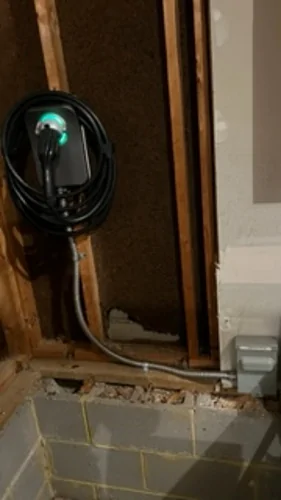
Also, have a conversation with the electrician, I had a long run from my panel in the basement to the garage. He used aluminum wire, like they use when they connect your AC unit to your house, from the panel to a box with a cut off plug, then copper to the unit.

Copper right now is very expensive

$850 to install 50A breaker, plus move a few to make room, about 85 feet of wire to the garage, that cut off box, and copper and conduit to the unit.

1639867808649.png
$850 for that work is a pretty good deal. Congrats.
 

ARK

Well-Known Member
Joined
Aug 21, 2020
Threads
45
Messages
2,938
Reaction score
4,297
Location
Los Angeles
Vehicles
'21 Premium SR AWD
Country flag
Mine is not. They claim they adhere to UL standards, but as of when I purchased mine, not listed yet. I am sure when that changes they will update their web site.

I wonder if there will be a problem with the 48 amp capability. When installing the wire for 48 amp operation, I did not see how the charger can determine it is hardwired or plugged in. So it is possible you can plug in and set the current to 48 amps.

I predict UL will not give approval until they have a way to prevent that from happening. It may be why other 48 amp chargers do not have a plug in option, or their current settings are mechanical, not controlled with software like the emporia one is.

A mechanical switch inside the unit would solve the problem. The electrician would switch it to "hard-wire" from "plug" only after removing the plug. Unless that was done, the unit would be hardware limited to 40 amps.

If you are concerned about this, I guess don't buy it. I am not concerned.
Sort of a side question, do you think it’s a problem to charge at 48 amps on a plug? My electrician says he put in the wiring for 48amps (including a 60amp breaker), he also said the plug he installed was rated to handle 48amps. I had a handyman who was over a few weeks ago also take a look and he said it looked correct, that the plug seemed beefy enough to be able to handle 48amps.

Just can’t wrap my head around why plug in for 48amps is not technically allowed if all the hardware exists for it.

I usually charge at 32amps anyway, only 48amps if I am in a rush, really did this install more for future proofing. I switch the amp setting and the plug in/hardwire setting through the ChargePoint app.
 

Av8tor

Well-Known Member
First Name
Kevin
Joined
Aug 6, 2021
Threads
30
Messages
708
Reaction score
921
Location
Richmond, VA
Vehicles
Fusion Hybrid, MME GTPE
Occupation
Systems Engineer IOT
Country flag
What you posted is ChargePoint's clever way of stating what the federal tax credit does. In fact, the federal tax credit doesn't give a rat's ass about what brand or model charger you buy, you get 30% back in a tax credit (not OFF) for the charger plus installation costs up to $1,000. Your charger can be dumb as hell and you still get that tax credit.

Note - neither that tax credit nor the EV $7,500 tax credit are refundable. If your tax liability, i.e. the actual amount of tax you owe on line 24, before any subtraction of taxes withheld or paid by estimated tax, is not at least the amount of the tax credits (both of them), you lose out.
@RickMachE thanks for the hand slap, we all know about the hackneyed tax credit vs discount. i took the cheap cut/paste route. Stupid me.
 

WWJPD

Well-Known Member
First Name
Jesse
Joined
Aug 20, 2021
Threads
0
Messages
73
Reaction score
75
Location
CT
Vehicles
Mach-E GTPE
Country flag
Sort of a side question, do you think it’s a problem to charge at 48 amps on a plug? My electrician says he put in the wiring for 48amps (including a 60amp breaker), he also said the plug he installed was rated to handle 48amps. I had a handyman who was over a few weeks ago also take a look and he said it looked correct, that the plug seemed beefy enough to be able to handle 48amps.

Just can’t wrap my head around why plug in for 48amps is not technically allowed if all the hardware exists for it.

I usually charge at 32amps anyway, only 48amps if I am in a rush, really did this install more for future proofing. I switch the amp setting and the plug in/hardwire setting through the ChargePoint app.
I'm not exactly sure sure on this, but I believe the code reasoning for not allowing plugs at higher than 32amps with 40amp circuit breaker is the contactors/slots/blades that go into a plug may not be adequate for that high an amperage and could overheat/melt, arc or even catch fire. While code may be different in different areas, I'm pretty sure that a 60amp circuit on a plug would not pass CA inspection.
 
  • Like
Reactions: ARK

RickMachE

Well-Known Member
Joined
Jul 1, 2021
Threads
267
Messages
17,916
Reaction score
27,895
Location
SE MI
Vehicles
2022 Mach-E Premium 4X, 2022 Lightning Lariat ER
Country flag
I'm not exactly sure sure on this, but I believe the code reasoning for not allowing plugs at higher than 32amps with 40amp circuit breaker is the contactors/slots/blades that go into a plug may not be adequate for that high an amperage and could overheat/melt, arc or even catch fire. While code may be different in different areas, I'm pretty sure that a 60amp circuit on a plug would not pass CA inspection.
I believe the max plug-in is a 40amp charger on a 50amp breaker. Numerous posts about buying an INDUSTRIAL socket, not the cheap retail one.
 

ARK

Well-Known Member
Joined
Aug 21, 2020
Threads
45
Messages
2,938
Reaction score
4,297
Location
Los Angeles
Vehicles
'21 Premium SR AWD
Country flag
I'm not exactly sure sure on this, but I believe the code reasoning for not allowing plugs at higher than 32amps with 40amp circuit breaker is the contactors/slots/blades that go into a plug may not be adequate for that high an amperage and could overheat/melt, arc or even catch fire. While code may be different in different areas, I'm pretty sure that a 60amp circuit on a plug would not pass CA inspection.
Got it, so the issue might not be on the house’s end, so to speak, but rather the plug that comes with the ChargePoint or other device might not itself be able to handle 48amps flowing through it, even if the socket was set up to handle that much power.

Still don’t see why they just don’t make a beefier plug, maybe it would be too bulky or cost prohibitive?
 

cdale12

Well-Known Member
Joined
Jun 5, 2021
Threads
4
Messages
70
Reaction score
122
Location
PA
Vehicles
68 289 Convertible, 21 GB GTPE MME
Country flag
Got it, so the issue might not be on the house’s end, so to speak, but rather the plug that comes with the ChargePoint or other device might not itself be able to handle 48amps flowing through it, even if the socket was set up to handle that much power.

Still don’t see why they just don’t make a beefier plug, maybe it would be too bulky or cost prohibitive?
Per NEC 625.42, EVSE loads will be considered to be continuous loads. Since the maximum size plug rating in 625.44(A)(3) is 50A at 250V and NEC puts a maximum continuous current capacity at 80% of its rating, you are reduced to a 40A EVSE allowable using a plug type installation.
 

mkhuffman

Well-Known Member
First Name
Mike
Joined
Nov 19, 2020
Threads
29
Messages
6,875
Reaction score
9,507
Location
Virginia
Vehicles
2025 Rivian R1T Tri-Max, Jeep GC-L, VW Jetta
Country flag
Sort of a side question, do you think it’s a problem to charge at 48 amps on a plug? My electrician says he put in the wiring for 48amps (including a 60amp breaker), he also said the plug he installed was rated to handle 48amps. I had a handyman who was over a few weeks ago also take a look and he said it looked correct, that the plug seemed beefy enough to be able to handle 48amps.

Just can’t wrap my head around why plug in for 48amps is not technically allowed if all the hardware exists for it.

I usually charge at 32amps anyway, only 48amps if I am in a rush, really did this install more for future proofing. I switch the amp setting and the plug in/hardwire setting through the ChargePoint app.
First of all, you need a new electrician. The NEMA 14-50 outlet is rated for 50 amps, not 60 amps. You should replace that 60 amp breaker with a 50 amp breaker ASAP. In fact, your electrician should do it for free. It is a serious fire hazard.

Also, if the wire is only rated for 48 amps, a 60 amp breaker is even worse and definitely you need to get that fixed ASAP. Find out the size of the wire because you should not use wire rated for 48 amps on a NEMA 14-50 plug. The wire should be rated for 125% of the circuit breaker size. So if you have a 50 amp breaker like you should, your wire should be rated at 62.5 amps. If your wire is rated at 48 amps you need a 40 amp breaker instead of a 50 amp breaker.

You may never exceed 48 amps, but if for strange reason you do, you need that breaker to protect you and your home from disaster. You really need to fix this ASAP. I am concerned for your safety. Seriously. What else did that incompetent electrician do incorrectly?

To answer your question about the plug, the plug should be rated at 125% of the expected load on the circuit per the National Electric Code (NEC). If you are following the NEC, the load should not exceed 40 amps, which is why plugged EVs usually only allow 40 amps. Personally I think it should be OK to exceed the 125% rule if you have the proper 50 amp circuit breaker installed. The breaker will protect the circuit. If you try to draw 48 amps for a period of time, the 50 amp breaker will probably throw and break the circuit, because of the 125% rule. But the 60 amp breaker will not. Get it fixed!!!!
Sponsored


Top