
mkhuffman

Well-Known Member
First Name
Mike
Joined
Nov 19, 2020
Threads
29
Messages
6,875
Reaction score
9,507
Location
Virginia
Vehicles
2025 Rivian R1T Tri-Max, Jeep GC-L, VW Jetta
Country flag
120V Departure Time Preconditioning:

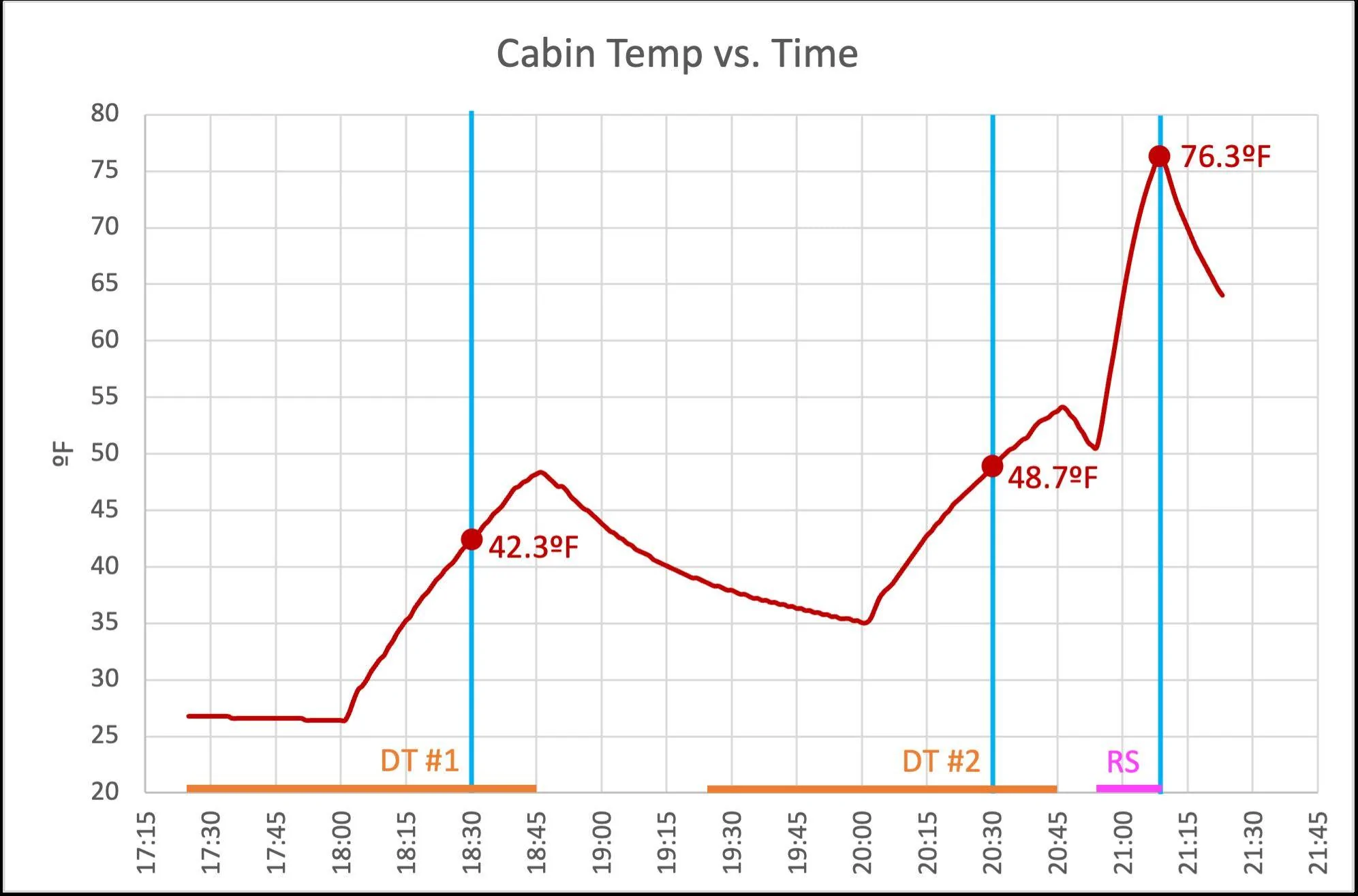
While still plugged into 120V at my 85% charge limit, I ended up setting two departure times (DTs) in a row, one at 18:30 and one at 20:30, cabin temperature Medium. On all the graphs, the light blue vertical lines represent the departure times as a reference mark. During both departure times, heater power was limited to only 1 kW (same as 120V input power) compared to the usual 5-6 kW, so performance was slow. Both departure times lasted a total of 80 minutes. It's clear departure times are meant to only use energy from the wall rather than taking any energy from the pack. The temporal structure of a departure time program is as follows:
  1. Heat battery pack (35 min)
  2. Heat cabin (30 min)
  3. Departure time
  4. Continue to heat cabin (15 min)
The preceding heating times vary depending on how cold it is outside (longer when colder). My garage temp was about 21ÂșF.

First let's look at cabin temperature performance:

Departure Time Temp.png


Remember the battery pack is being heated for the first 35 minutes of the DT, so the cabin temperature does not increase until midway through the DT periods (marked in orange). As you can see, the cabin temperature only reached 42ÂșF at the first 120V departure time, and only 48ÂșF during the second DT. That's not very warm as a result of the 1 kW heater limitation. The cabin continues to heat for 15 minutes after the DT before turning off. For comparison, I performed a 15 min remote start (RS) immediately after DT #2 lapsed. This time full heater power was used, and you can see the difference in the speed of the temp rise, eventually reaching 76ÂșF before timing out. Whereas the departure times did not really deplete the battery, the 15 min remote start drained the battery by 1% to 84%. The remote start required 40 minutes of L1 charging afterwards to return to 85%.

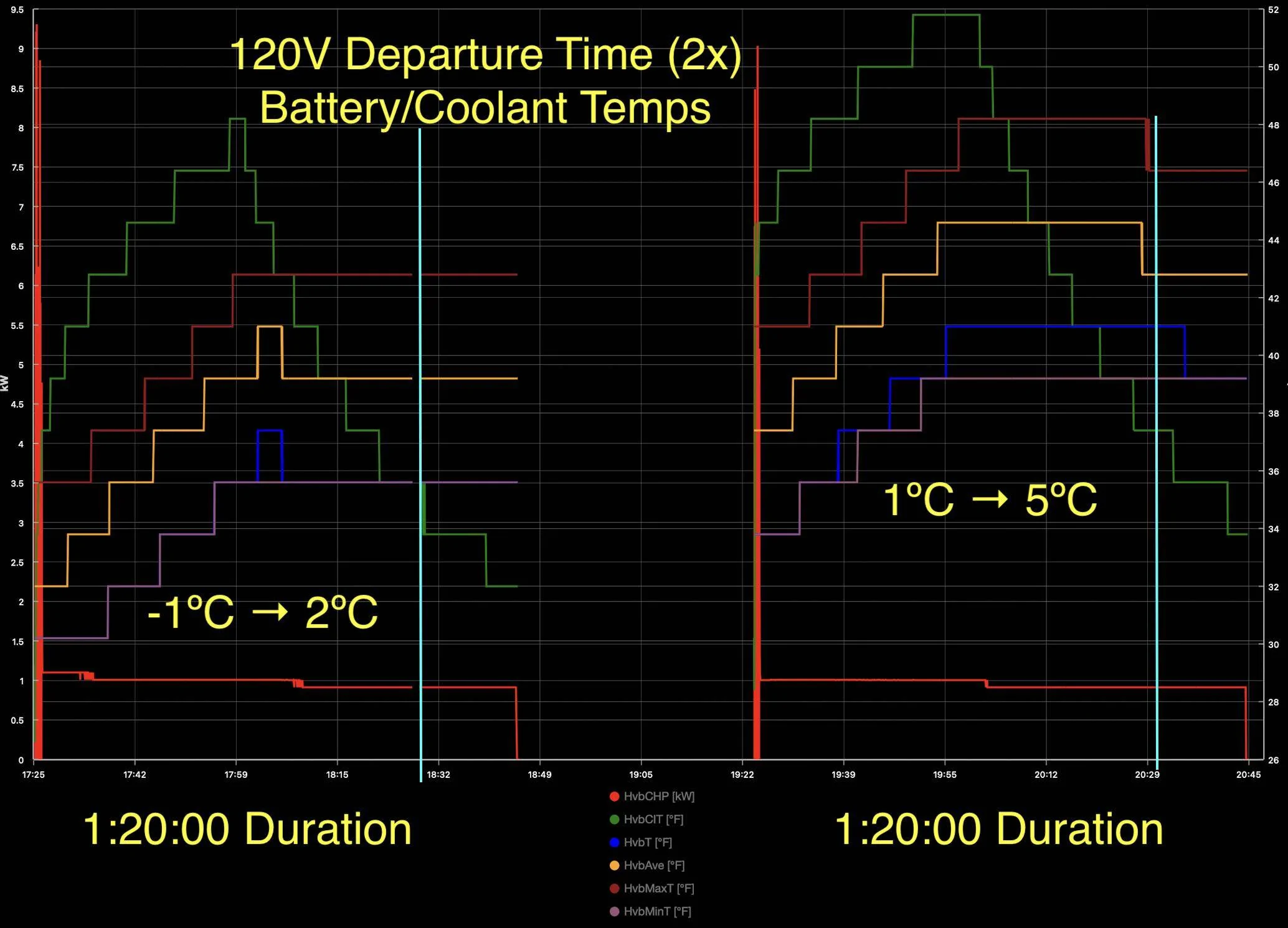
Now let's look at battery heating during 120V DTs:

Screen Shot 2022-12-25 at 12.43.21 AM.png

Again, light blue lines mark the set departure times. Red line is the coolant heater power, you can see that's flat at about 1 kW during the entire DT. The green line is the pack coolant inlet temp (CIT), you can see that rising the first ~30 min of the DT as the pack heats. CIT then starts decreasing when heating switches to to the cabin. Just like the previous test, pack heating performance was very poor at only 1 kW. During the first DT pack temp only increased 3ÂșC, 4ÂșC during the second DT. It seems the first DT wasn't long enough to get the pack warmed to 5ÂșC, so it appears to be running into a maximum time constraint.

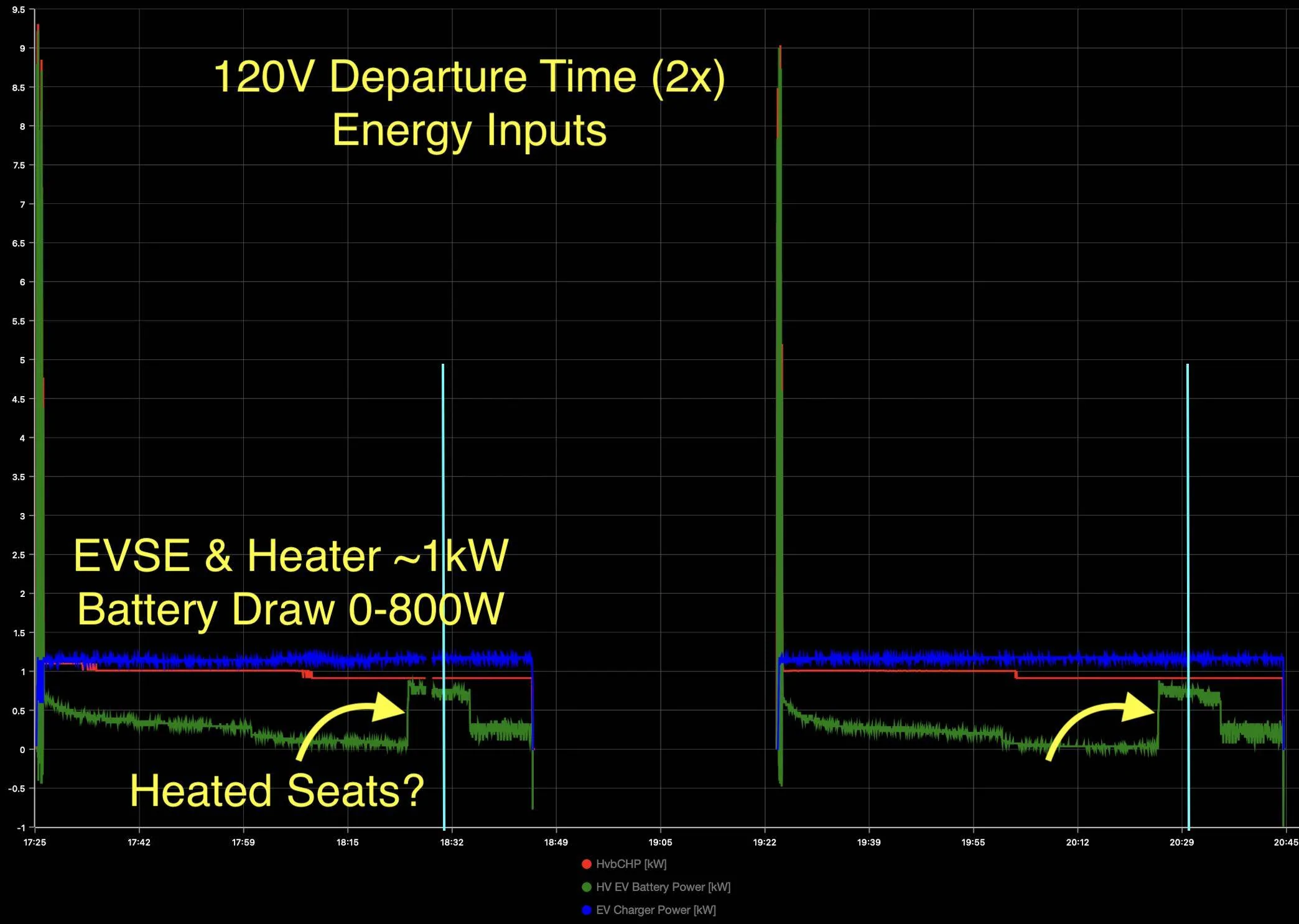
Next let's look at energy use:

Screen Shot 2022-12-25 at 12.46.16 AM.png


Same red line for heater power. EVSE input is the blue line, you can see that's barely higher than the heater power. Green is the battery power, positive values indicate discharge. A small amount of power was being drawn from the pack at times, with a larger peak around the departure time. I think this is the heated seats and steering wheel turning on. There are also some exterior running light loads that come in as well. The heated seats run full blast for 10 minutes, before dropping down to a lower power.

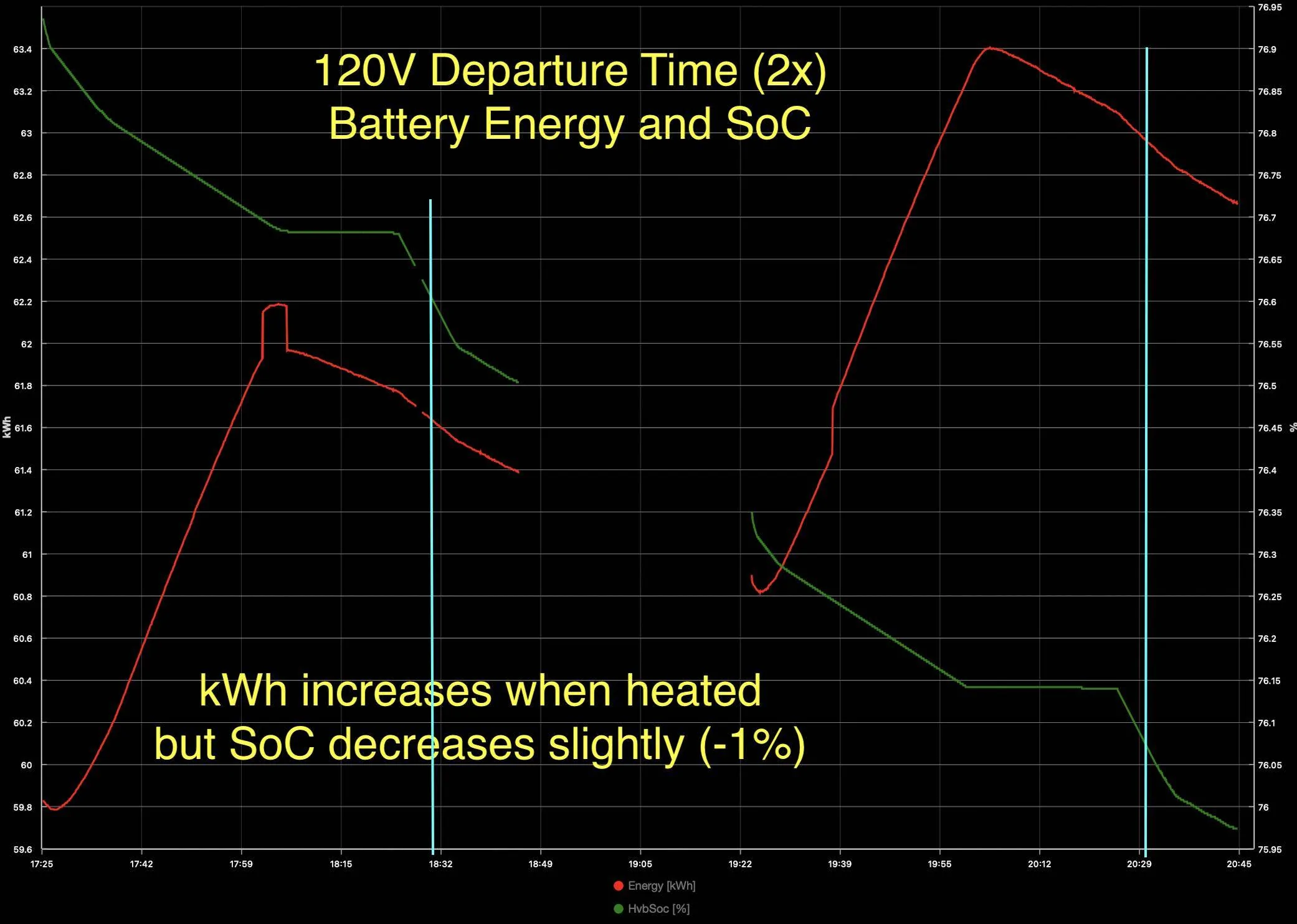
Last let's look at total battery SoC and energy:

Screen Shot 2022-12-25 at 12.47.23 AM.png


This is somewhat interesting and is a good illustration of why heating the pack helps range. The red line is the estimated total pack energy (kWh) from the BMS, the green line is the the exact SoC. You can see that when heating the pack, the SoC actually goes down 1% while the total energy goes up 3.5 kWh. How does the pack energy go up if the SoC is dropping? The pack holds more energy when warm, and more energy can also be extracted while warm, which explains the trends. Heating the pack does not give you free energy, it just unlocks more available energy that's already in the pack.

If I go back and include the data from the previous test:
  • Pack temp increased 11ÂșC (-6Âș C to 5ÂșC)
  • Pack energy increased 6 kWh (57.4 to 63.4 kWh)
  • Range increased 12 miles
If you extrapolate that to a full winter pack warmup (-15ÂșC to 15ÂșC) the effective range increase for warming a cold pack could be up to 40 miles. You will also have a higher power limit (less gray jail bars) and acceleration with a warm pack.

Findings:
  • 120V departure time preconditioning DOES heat the pack, albeit VERY SLOWLY
  • Departure times do not deplete pack energy
  • Heater limited to 1 kW on 120V
  • Battery heats up only 3-4ÂșC per 120V departure time
    • Will not be fully warmed in one cycle
  • Cabin warms up only 15ÂșF per 120V departure time
    • Cabin may not be warm enough
  • Remote start heats up the cabin much faster than 120V departure times
    • Uses full heater power and depletes the pack slightly
    • Does not heat the battery
Conclusions:
  • 120V departure times DO heat the battery, but barely
  • 1kW is not enough power to heat the pack or the cabin in a reasonable amount of time
  • The cabin and pack are not fully warmed up after a 120V DT
  • A remote start (or two) right after a 120V DT seems to be a good strategy to get the cabin fully warm
    • Set the Departure Time 30 mins before you leave, remote start 15 mins before you leave
  • Due to poor 120V heating performance, a 240V EVSE is strongly recommended for winter climates so you get full-power heating.
  • Setting a 120V DT is better than nothing, but not by much.
If you use 120V charging, remember to ALWAYS PLUG IN to keep the battery warm in the cold. You need as much time plugged in as you can get.

? Merry Christmas! ?
Merry Christmas to you also, Lee!

BTW - if I read correctly, all your testing was done with the target charge reached, so no battery charging was happening. If that is correct, if you plug into L1 with a battery that needs to be charged, will the charging process supersede the preconditioning process?

I assume that is why we previously thought no preconditioning would happen on L1. The charging speed is so slow, it really cannot add charge to the battery and precondition at the same time, so it prioritizes charging. That is what most of us would want it to do, I think.
Sponsored

 

louc757

Well-Known Member
First Name
Lou
Joined
Sep 3, 2022
Threads
3
Messages
110
Reaction score
127
Location
Louisville, KY
Vehicles
23 MME GTPE Rapid Red Nite Pony, 2024 Silverado 2500
Occupation
Pilot
Country flag
120V Departure Time Preconditioning:

While still plugged into 120V at my 85% charge limit, I ended up setting two departure times (DTs) in a row, one at 18:30 and one at 20:30, cabin temperature Medium. On all the graphs, the light blue vertical lines represent the departure times as a reference mark. During both departure times, heater power was limited to only 1 kW (same as 120V input power) compared to the usual 5-6 kW, so performance was slow. Both departure times lasted a total of 80 minutes. It's clear departure times are meant to only use energy from the wall rather than taking any energy from the pack.
Merry Christmas to you Lee!

Interesting about 120V charging limiting current but it makes sense. Ford probably figured most 120V circuits are 15A, so they limit power to 1kW so as to not overload the circuit. They could go 1.8kW, to be right at 15A, but then turning on anything else will overload the circuit.

Having left my car plugged in for the past few days and not driving it, it appears it will warm the battery up every 8-9 hours for about 15 min, using about 1.7 kWh, which at my electrical rate of $0.1134/kW is about 20 cents. Outside temps were as follows:
  • Fri - Hi 7 deg F, Low -8
  • Sat - Hi 18, Low 3 (I did drive Sat to see how the car handles in snow covered roads)
  • Sun - 23, low 12
  • Mon - Hi forecast 29, Low 16
While these temps are not as cold as others living up north, it was cold enough to trigger the battery warming. It much harsher climates, it may happen more often. My MME was in a garage, so it was about 20-25 deg warmer that outside. With that said, it appears it will warm the battery twice per day in these temperatures, so it cost me $0.40/day to keep the battery warm. Not bad in these conditions. I had my ICE F150 plugged in as well, so that even had extra cost involved to ensure it would start when needed.

Ford Mustang Mach-E Mach-Lee's Mach-E Cold Weather Testing [Taking Requests] 67068A0B-A4E8-485A-A2BB-8C7094D17DA2
 

Terence Murphy

Well-Known Member
First Name
Terence
Joined
Oct 12, 2022
Threads
1
Messages
65
Reaction score
53
Location
Maryland
Vehicles
2021 Job 2 MME Premium ER AWD
Occupation
Computer scientist
Country flag
Has anyone seen evidence of their MME heating the battery while not plugged in to avoid freezing? I recall I think it was the C&D long term Tesla M3 test where it used 5% of the battery overnight in extreme cold. Will the MME do that?
 

louc757

Well-Known Member
First Name
Lou
Joined
Sep 3, 2022
Threads
3
Messages
110
Reaction score
127
Location
Louisville, KY
Vehicles
23 MME GTPE Rapid Red Nite Pony, 2024 Silverado 2500
Occupation
Pilot
Country flag
This is really a great, timely thread!

So I just completed a 2,100+ mile friends & family road trip Tuesday 20 Dec - yesterday night Saturday 24 Dec. The trip was from Louisville KY thru Buffalo NY to Burlington VT, then southern New Hampshire, eastern Massachusetts and back home to Arlington VA.

I pretty much stayed blade-running just ahead of the idiotic storm road conditions throughout, except for the near-zero Fahrenheit road temperatures the final two days since Friday night.

BLUF: Boy oh Boy how this Winter trip validated my decision to pick up an Extended Range Mach E! VERY VERY GLAD for the ER capacity in diminished Winter range conditions. My usual 80+ MPH driving range of about 250+ limes with the Extended Range battery was consistent at just about 200 miles for the length of this trip, although on the final two super cold days I often did sections at 65 MPH just to ensure I got to the next charging location, and to help with potential road black ice patches. Also very glad for All Wheel Drive.

Departure / preconditioning Lessons Learned for cold & super cold temps: although I usually get out of the car and walk around and browse while DC charging, on this trip that often wasn't a fun thing to do with temps in the low teens and a howling wind. So, I often sat in the cabin while DCFC'ing. I discovered that as nice as it can be to listen to music, news etc on auxiliary car power, there is a better way:

1. For the previous 15 minutes before pulling in to the DC spot, heat the cabin so that is has max residual heat.
2. Right after plugging in, when the car charger gives you an estimate of the likely departure when full (I usually DC charged to 85 - 95% on this trip just to be safe, so 45 - 60+ minutes depending on amps provided), choose SETTINGS / CHARGE / DEPARTURE TIME.
3. Set the DEPARTURE TIME for that day and for the likely departure time, or soon after the car thinks it'll reach 80%+ SOC.
4. SAVE and EXIT.
5. Turn off the car completely and let it drink energy and simultaneously precondition.

On some of my DCFC charging sessions, the pre-heating of the cabin would start immediately concurrently with DC charging. At other session times, cabin pre-heating would start about 20 - 30 minutes before the new "departure time" I had just set. Likely this was dependent on the condition of the car at the moment (just after a long driving time, or just after waking up in the morning, etc etc). Obviously, this pre-heating / cabin conditioning energy came, directly or indirectly, from the DC power cable as the car charged up so that was a good thing.

Although I didn't invest in battery monitoring software and I am aware the big battery heats up naturally during DC charging, I think we can safely assume that if any battery pre-conditioning needed to take place, was happening concurrently.

There were at least two times I DC charged right after leaving a friend's house in a freeing morning, because most friends & family except for one nephew didn't have a driveway 240V plug available for overnight charging. So, I think on those mornings when I needed a big charge after leaving someone's house, this action pre-conditioned the still cold battery as well as pre-heating the cabin.

On some days when I did looong multiple sector hops, I would reset that day's DEPARTURE TIME up to five times, at the start of each of my DC charging sessions.

Again, a key point I literally learned by doing: the car seems to ignore the DEPARTURE TIME if the accessory power is on. It only seems to work when the car is completely off. So, no You-tube thru the big screen, etc. while DC charging.

Hope this is useful for other Winter long-distance travelers.
Great write up!
 

louc757

Well-Known Member
First Name
Lou
Joined
Sep 3, 2022
Threads
3
Messages
110
Reaction score
127
Location
Louisville, KY
Vehicles
23 MME GTPE Rapid Red Nite Pony, 2024 Silverado 2500
Occupation
Pilot
Country flag
Has anyone seen evidence of their MME heating the battery while not plugged in to avoid freezing? I recall I think it was the C&D long term Tesla M3 test where it used 5% of the battery overnight in extreme cold. Will the MME do that?
I had not seen that. After I drove it on Sat, I left the car unplugged to see if that would happen. It did not heat the battery, and on Sun morning, the battery temp (HvbT) was down to 32 deg. It did not warm it up, so I plugged it back in. It warmed the battery, and charged back to 85%.

Ford Mustang Mach-E Mach-Lee's Mach-E Cold Weather Testing [Taking Requests] 39A306A4-621E-4FB3-9A08-C9320DDAF170


OP
OP
Mach-Lee

Mach-Lee

Well-Known Member
First Name
Lee
Joined
Jul 16, 2021
Threads
262
Messages
11,344
Reaction score
24,965
Location
Wisconsin
Vehicles
2022 Mach-E Premium AWD
Occupation
Sci/Eng
Country flag
Merry Christmas to you Lee!

Interesting about 120V charging limiting current but it makes sense. Ford probably figured most 120V circuits are 15A, so they limit power to 1kW so as to not overload the circuit. They could go 1.8kW, to be right at 15A, but then turning on anything else will overload the circuit.

Having left my car plugged in for the past few days and not driving it, it appears it will warm the battery up every 8-9 hours for about 15 min, using about 1.7 kWh, which at my electrical rate of $0.1134/kW is about 20 cents. Outside temps were as follows:
  • Fri - Hi 7 deg F, Low -8
  • Sat - Hi 18, Low 3 (I did drive Sat to see how the car handles in snow covered roads)
  • Sun - 23, low 12
  • Mon - Hi forecast 29, Low 16
While these temps are not as cold as others living up north, it was cold enough to trigger the battery warming. It much harsher climates, it may happen more often. My MME was in a garage, so it was about 20-25 deg warmer that outside. With that said, it appears it will warm the battery twice per day in these temperatures, so it cost me $0.40/day to keep the battery warm. Not bad in these conditions. I had my ICE F150 plugged in as well, so that even had extra cost involved to ensure it would start when needed.

67068A0B-A4E8-485A-A2BB-8C7094D17DA2.jpeg
Ford Mustang Mach-E Mach-Lee's Mach-E Cold Weather Testing [Taking Requests] IMG_1478


Yes, I see similar. 5.7 kWh in about 24 hours, pack heating about 14 hours apart. Garage is about 20ÂșF.

Has anyone seen evidence of their MME heating the battery while not plugged in to avoid freezing? I recall I think it was the C&D long term Tesla M3 test where it used 5% of the battery overnight in extreme cold. Will the MME do that?
Nope, I've never seen it heat while parked unplugged. It wants you to plug it in first. Ford hates phantom drains so they designed it not to use any battery while parked unless the 12V is low. So they differ from Tesla in that regard.
 

Philsky

Active Member
First Name
Philip
Joined
Nov 29, 2022
Threads
2
Messages
30
Reaction score
25
Location
Toronto Ontario Canada
Vehicles
2021 Mach e Premier Edition
Occupation
Engineer
Country flag
I had not seen that. After I drove it on Sat, I left the car unplugged to see if that would happen. It did not heat the battery, and on Sun morning, the battery temp (HvbT) was down to 32 deg. It did not warm it up, so I plugged it back in. It warmed the battery, and charged back to 85%.

39A306A4-621E-4FB3-9A08-C9320DDAF170.jpeg
Hi Lou - this detailed display is really useful - can you direct me to where I can get it ? I am struggling with a repeating "Low 12V Battery error" which the dealership has had 4 tries to fix - Once the 12V did die so I am nervous - especially in Toronto winter.....Thanks - Phil
 

mkhuffman

Well-Known Member
First Name
Mike
Joined
Nov 19, 2020
Threads
29
Messages
6,875
Reaction score
9,507
Location
Virginia
Vehicles
2025 Rivian R1T Tri-Max, Jeep GC-L, VW Jetta
Country flag
Hi Lou - this detailed display is really useful - can you direct me to where I can get it ? I am struggling with a repeating "Low 12V Battery error" which the dealership has had 4 tries to fix - Once the 12V did die so I am nervous - especially in Toronto winter.....Thanks - Phil
I recommend you read through Lee's post about reconditioning the 12V battery.
https://www.macheforum.com/site/threads/how-to-recondition-service-your-12v-battery.11069/

If I were you, I would recondition the LVB following Lee's recommended approach.

As for the display, that is the CarScanner app and you connect your phone to a Bluetooth OBDII scanner to the data from the car. But keep in mind that reading the data when the car is off will drain the LVB, and since you appear to have a weak LVB anyway, I don't think that is a good idea. Reading the data when the car is on won't hurt anything.
 

louc757

Well-Known Member
First Name
Lou
Joined
Sep 3, 2022
Threads
3
Messages
110
Reaction score
127
Location
Louisville, KY
Vehicles
23 MME GTPE Rapid Red Nite Pony, 2024 Silverado 2500
Occupation
Pilot
Country flag
I recommend you read through Lee's post about reconditioning the 12V battery.
https://www.macheforum.com/site/threads/how-to-recondition-service-your-12v-battery.11069/

If I were you, I would recondition the LVB following Lee's recommended approach.

As for the display, that is the CarScanner app and you connect your phone to a Bluetooth OBDII scanner to the data from the car. But keep in mind that reading the data when the car is off will drain the LVB, and since you appear to have a weak LVB anyway, I don't think that is a good idea. Reading the data when the car is on won't hurt anything.
+1 on Mike’s post.

I use the VGate FD+ BLE + Bluetooth OBD2 adapter for my iPad and iPhone. It works well with Car Scanner. I also have a USB OBD2 adapter to use with my laptop that I use with FORScan. Car scanner has a list of OBD2 adapters that work well with it. I did get a caution when I leave the OBD2 plugged in, and the car was off, so as advised above, unplug it when not in use.
 
Last edited:

Philsky

Active Member
First Name
Philip
Joined
Nov 29, 2022
Threads
2
Messages
30
Reaction score
25
Location
Toronto Ontario Canada
Vehicles
2021 Mach e Premier Edition
Occupation
Engineer
Country flag
+1 on Mike’s post.

I use the VGate FD+ BLE + Bluetooth OBD2 adapter for my iPad and iPhone. It works well with Car Scanner. I also have a USB OBD2 adapter to use with my laptop That I use with FORScan. Car scanner has a list of OBD2 adapters that work well with it. I did get cautions when I leave the OBD2 plugged in, and the car was off, so so as advised above, unplug it when not in use.
L
Thanks for your advice - I have ordeeed and look forward to ha Inv more insight into the guts of the Mach e !!
 

nmope

Well-Known Member
Joined
Nov 3, 2022
Threads
25
Messages
211
Reaction score
111
Location
Dallas, TX
Vehicles
22 MME GTPE, 17 MX5 Club
Country flag
Merry Christmas to you Lee!

Interesting about 120V charging limiting current but it makes sense. Ford probably figured most 120V circuits are 15A, so they limit power to 1kW so as to not overload the circuit. They could go 1.8kW, to be right at 15A, but then turning on anything else will overload the circuit.

Having left my car plugged in for the past few days and not driving it, it appears it will warm the battery up every 8-9 hours for about 15 min, using about 1.7 kWh, which at my electrical rate of $0.1134/kW is about 20 cents. Outside temps were as follows:
  • Fri - Hi 7 deg F, Low -8
  • Sat - Hi 18, Low 3 (I did drive Sat to see how the car handles in snow covered roads)
  • Sun - 23, low 12
  • Mon - Hi forecast 29, Low 16
While these temps are not as cold as others living up north, it was cold enough to trigger the battery warming. It much harsher climates, it may happen more often. My MME was in a garage, so it was about 20-25 deg warmer that outside. With that said, it appears it will warm the battery twice per day in these temperatures, so it cost me $0.40/day to keep the battery warm. Not bad in these conditions. I had my ICE F150 plugged in as well, so that even had extra cost involved to ensure it would start when needed.

67068A0B-A4E8-485A-A2BB-8C7094D17DA2.jpeg
dumb question but how do you have it plugged in but not charging? I have departure times set on mine and don’t want to charge daily
 

awp0

Well-Known Member
First Name
Aaron
Joined
Jul 23, 2022
Threads
13
Messages
973
Reaction score
1,216
Location
boston, ma
Vehicles
MME Premium AWD ER
Country flag
I used Car Scanner for the first time today, on a 2-hour drive through cool weather. The drive started at 33F and finished around 22F, and was mostly highway at 70-75mph. I preconditioned before the drive, had 2 other passengers and a 60 pound dog and maybe 100 pounds of luggage and was reasonably satisfied to end up at about 2.4 miles/kWh.

Question: I'm just getting my feet wet with Car Scanner, but one thing I noticed is that HvbT only changed twice during the whole 2 hours. It stayed at 53.6F for about the first hour, then stepped down to 51.9 for maybe 20 minutes, and then down to 50.0 for the remainder of the drive. I love that the preconditioned battery stays warm during the drive, but it seemed strange (almost suspicious) that the value has "tenth of a degree" resolution and changed only twice over two hours, jumping by more than a degree each time.
 

mkhuffman

Well-Known Member
First Name
Mike
Joined
Nov 19, 2020
Threads
29
Messages
6,875
Reaction score
9,507
Location
Virginia
Vehicles
2025 Rivian R1T Tri-Max, Jeep GC-L, VW Jetta
Country flag
dumb question but how do you have it plugged in but not charging? I have departure times set on mine and don’t want to charge daily
I have not tried it, but I believe you can press the "Stop Charging" button after plugging in. Otherwise, it automatically charges to your target charge level.
 
OP
OP
Mach-Lee

Mach-Lee

Well-Known Member
First Name
Lee
Joined
Jul 16, 2021
Threads
262
Messages
11,344
Reaction score
24,965
Location
Wisconsin
Vehicles
2022 Mach-E Premium AWD
Occupation
Sci/Eng
Country flag
dumb question but how do you have it plugged in but not charging? I have departure times set on mine and don’t want to charge daily
When the car is charged to its target percentage, it will no longer charge while plugged in.

Question: I'm just getting my feet wet with Car Scanner, but one thing I noticed is that HvbT only changed twice during the whole 2 hours. It stayed at 53.6F for about the first hour, then stepped down to 51.9 for maybe 20 minutes, and then down to 50.0 for the remainder of the drive. I love that the preconditioned battery stays warm during the drive, but it seemed strange (almost suspicious) that the value has "tenth of a degree" resolution and changed only twice over two hours, jumping by more than a degree each time.
The resolution for the battery temperature is 1°C. Car scanner is converting Celsius to Fahrenheit. 1°C change is 1.8°F, so that’s the interval difference you will see between steps.
Sponsored


Top