Glen Boise

Well-Known Member
First Name
Glen
Joined
Aug 1, 2021
Threads
23
Messages
316
Reaction score
317
Location
Kokomo, IN
Vehicles
Mustang Mach-E
Occupation
Retired
Country flag
What's the story on the entire auto industry worldwide not having done some standards on this? Was it deliberate, or just a matter of bumbling? The needed engineering seems obvious in retrospect.
There is no world standard because the companies could not agree. This nothing new. Just look at all the adapters world travelers get for their electrical devices so they can operate in other countries. Look at Japan with two different electrical grids (50 khz and 60 khz). Look up the history of the EU when they adopted a common charging plug standard (J-1772/CCS2). Tesla sued to continue using their private plug plug. The courts denied their challenge. Government regulation has benefited BEV drivers in Europe by providing greater numbers of chargers especially as Tesla slowly opens the Tesla network in the EU to non-Tesla cars.
This is not to say that a government sponsored committee like the SAE will provide a better design. Isn't written that "a camel is a horse designed by committee". Just look at the committee designed J-1772/CCS plug used by non-Tesla's today. They started with the J-1772 plug for AC charging and later added the CCS pins for DCFC as that technology became availble.
Tesla had the advantage that their design was done when no one had a competitive design that really worked. Even Tesla went through a couple of designs before coming up the NACS design they use today.
So the answer to the question is it was competition and the need to address the changing needs of a rapidly changing technology.
Sponsored

 

hartmms

Well-Known Member
First Name
Michael
Joined
Mar 20, 2023
Threads
18
Messages
413
Reaction score
344
Location
Phoenix, AZ
Vehicles
Mach-e GT-PE, Ram 2500
Occupation
engineer
Country flag
When triggered, the temperature sensor switch in the circuit would trigger in resistor in line with the proximity, interrupting the charging process.
I'm not even sure what that means. How does a resistor interrupt the charging process? You have 2 options:
1) Physically separate either the power or ground wire (must be a contactor at these levels). I highly doubt this will be on the car side or charger side of this extension cord since contactors to support this level of voltage and current are about the size of your fist.
2) Communicate back to the super charger to stop sending current. Maybe this is what you meant. Like I said before, that requires a micro controller to sit in between the car and the charger on the communication wire. That would be the only way to send the proper commands to the charger to stop. Physically moving a lock pin will not interrupt the charge session unless you tell the super charger to stop over the communication channel.

We have invested in some heavy equipments allowing us to test our products in house. We are able to study/test temperature rise by exposing them to over 700A.
We are talking about the 9' DC tesla extension cord, not the NACS to CCS adapter. The image posted has the adapter. My statements refer to the extension cord.

Another thing I just noticed. The product page states "FCC certification under application". FCC stands for Federal Communications Commission and they regulate RF emissions (radios, wifi, etc). They don't certify DC or AC extension cords.
 

kodiakng

Well-Known Member
First Name
David
Joined
Oct 1, 2022
Threads
19
Messages
903
Reaction score
1,408
Location
Oregon
Vehicles
2023 Cyber Orange 4X Mach-E
Country flag
Retrofitting V3s with longer cables seems easier than replacing them all with V4s. So potentially a stop gap until everything is switched to V4, which I see taking 5+ years to complete.
5+ years easily - they still have ~800 v2 stations. unfortunately, i can't find data on how many stations they've converted from v2 to v3; it seems they are still in expansion mode and not retooling past installs given the number of mixed v2/v3 sites.
 

dbsb3233

Well-Known Member
First Name
TimCO
Joined
Dec 30, 2019
Threads
56
Messages
10,100
Reaction score
11,965
Location
Colorado, USA
Vehicles
2021 Mustang Mach-E FE, 2025 Porche Macan Electric
Occupation
Retired
Country flag
Even if there's a small slider/switch that is designed to break the CCS1 communications proximity contact, the size of the DC cables has to be massive. And I mean that literally.

Without active cooling, you're looking at something between about 5-10 kg/meter just for the DC portion of the extension, and that doesn't include the connectors. All of that weight will be hanging off the car connector, not off the charger connector. I cannot imaging my Mustang's charge port lasting very long with a 25-pound weight hanging off it.
No doubt it needs to be a heavy cable, but depending on the max amp rating, it doesn't seem like it should be much worse for the car port than an EA handle+cord, or a V2 handle+cord. V2 cables are 150kw and not liquid cooled. I think they're roughly as heavy as EA cables. And EA has a heavier handle.

Still heavy and unwieldy to carry around as an extension, but not sure it'll be a lot worse for the car port.
 

SpaceEVDriver

Well-Known Member
Joined
Aug 26, 2021
Threads
71
Messages
2,654
Reaction score
4,780
Location
Arizona
Vehicles
2022 CA Route 1 AWD, ER; 2023 Lightning Lariat ER
Occupation
Planetary Science
Country flag
No doubt it needs to be a heavy cable, but depending on the max amp rating, it doesn't seem like it should be much worse for the car port than an EA handle+cord, or a V2 handle+cord. V2 cables are 150kw and not liquid cooled.

Still heavy and unwieldy to carry around as an extension, but not sure it'll be a lot worse for the car port.
The difference is that the weight of the EA cords is supported by the EA chargers. An extension cord will not be supported by the chargers. It will be supported at the car and at the charger plug. Two attachment points that we already know aren't exactly the most resilient. I'm not about to put an additional heavy weight on my vehicle's charge port.


dbsb3233

Well-Known Member
First Name
TimCO
Joined
Dec 30, 2019
Threads
56
Messages
10,100
Reaction score
11,965
Location
Colorado, USA
Vehicles
2021 Mustang Mach-E FE, 2025 Porche Macan Electric
Occupation
Retired
Country flag
The difference is that the weight of the EA cords is supported by the EA chargers. An extension cord will not be supported by the chargers. It will be supported at the car and at the charger plug. Two attachment points that we already know aren't exactly the most resilient. I'm not about to put an additional heavy weight on my vehicle's charge port.
I guess it depends on how long it is and whether it reaches the ground to take much of the weight off. If it's stretched with no ground (or hood) support in the middle, yes, that's a lot of pressure.

Although I believe the V3 cables are significantly thinner/lighter than the EA cables, so in total it might not be worse than EA. Hard to say for sure until we see the length, weight, and connector bulk.
 

A2ZEV

Member
Gold Sponsor
First Name
A2ZEV
Joined
Oct 21, 2023
Threads
0
Messages
9
Reaction score
107
Location
Montreal, Canada
Vehicles
MACH E GT
Country flag
I'm not even sure what that means. How does a resistor interrupt the charging process? You have 2 options:
1) Physically separate either the power or ground wire (must be a contactor at these levels). I highly doubt this will be on the car side or charger side of this extension cord since contactors to support this level of voltage and current are about the size of your fist.
2) Communicate back to the super charger to stop sending current. Maybe this is what you meant. Like I said before, that requires a micro controller to sit in between the car and the charger on the communication wire. That would be the only way to send the proper commands to the charger to stop. Physically moving a lock pin will not interrupt the charge session unless you tell the super charger to stop over the communication channel.


We are talking about the 9' DC tesla extension cord, not the NACS to CCS adapter. The image posted has the adapter. My statements refer to the extension cord.

Another thing I just noticed. The product page states "FCC certification under application". FCC stands for Federal Communications Commission and they regulate RF emissions (radios, wifi, etc). They don't certify DC or AC extension cords.
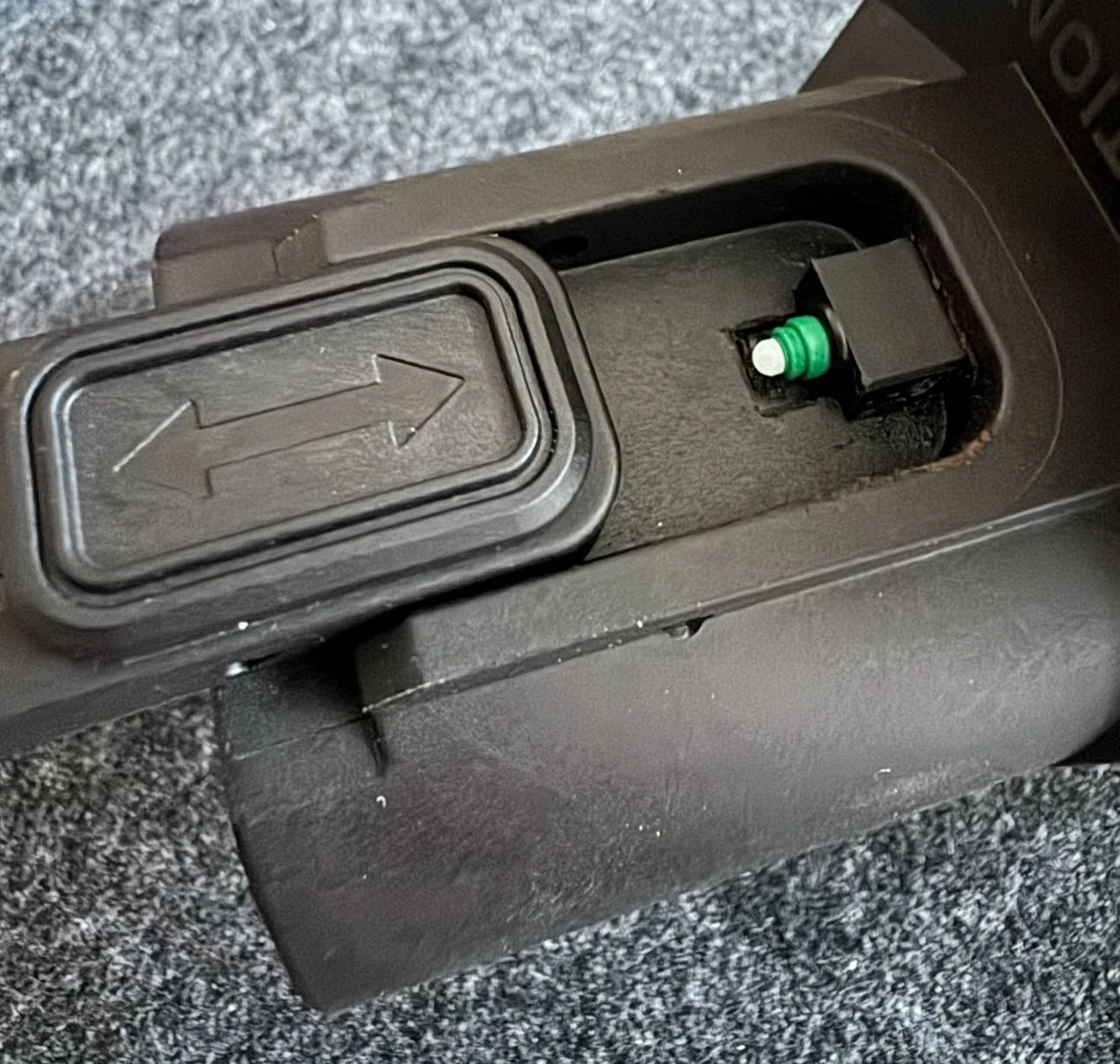
The same way the top latch of the adapter, the EVSE connector (for instance the Tesla connector) works. When pressed, the alteration of a resistance serves as a signal to indicate an action, in this case : stop.

The switch would look like this :
Ford Mustang Mach-E NACS Extension Cable Coming From Tesla IMG_0807


This is directly from one of our engineers :

“Latched (both):
EV Prox <-> EVSE Prox
Straight connect. 0 ohm.

Either side pressed, or thermal switch event (any "adapter is not safe" state):
EV Prox <-> EVSE Prox
................|--> 330 ohm -> ground

Modifies the in-path prox resistance to look like switch was pressed.”

I know you are not talking about the adapter, but we are explaining how we are integrating such locking mechanism + how we develop products.

Regarding FCC :
FCC certifies power adapters as well not only based on radio frequency transmission but also for electromagnetic compatibility and safety standards. Power adapters can impact electronic devices through electromagnetic interference (EMI) and compatibility issues. If not properly designed or shielded EV charging adapters can emit EMI due to high currents and voltages involved in the charging process which can affect nearby electronic devices and communication systems.

I hope this answers your questions.

As a measure of respect, we will back off from this thread as it was meant to talk about the Tesla extension cord. Any question, please reach out to us.
 
Last edited:

kodiakng

Well-Known Member
First Name
David
Joined
Oct 1, 2022
Threads
19
Messages
903
Reaction score
1,408
Location
Oregon
Vehicles
2023 Cyber Orange 4X Mach-E
Country flag
I'm not even sure what that means. How does a resistor interrupt the charging process? You have 2 options:
1) Physically separate either the power or ground wire (must be a contactor at these levels). I highly doubt this will be on the car side or charger side of this extension cord since contactors to support this level of voltage and current are about the size of your fist.
2) Communicate back to the super charger to stop sending current. Maybe this is what you meant. Like I said before, that requires a micro controller to sit in between the car and the charger on the communication wire. That would be the only way to send the proper commands to the charger to stop. Physically moving a lock pin will not interrupt the charge session unless you tell the super charger to stop over the communication channel.
the design of the signaling (using proximity pilot and control pilot) satisfies your option 2 but without a "microcontroller." as @A2ZEV noted, the temperature sensor has an integrated switch that adds a resistor to the proximity pilot to trigger a controlled shutoff - similar to the latch switch to disconnect the handle from the vehicle.
 

SpaceEVDriver

Well-Known Member
Joined
Aug 26, 2021
Threads
71
Messages
2,654
Reaction score
4,780
Location
Arizona
Vehicles
2022 CA Route 1 AWD, ER; 2023 Lightning Lariat ER
Occupation
Planetary Science
Country flag
I guess it depends on how long it is and whether it reaches the ground to take much of the weight off. If it's stretched with no ground (or hood) support in the middle, yes, that's a lot of pressure.

Although I believe the V3 cables are significantly thinner/lighter than the EA cables, so in total it might not be worse than EA. Hard to say for sure until we see the length, weight, and connector bulk.
If it's long enough to lay its bulk on the ground, then the are all kinds of environmental considerations that will add cost--is it even possible to make the NACS plug water tight ? It will also be heavier, so even more unwieldy for removing from and returning to the vehicle.
If it's thin and designed for lower than maximum amps, then it needs to include a microcontroller to bypass the vehicle's charge rate request and substitute its own. I don't know enough about the communications to know if that's a thing that can be done generically or if it needs to be done per vehicle brand. And it can't be a simple replacement, it needs to have logic to know when to pass through a request for a lower amperage as the battery reaches higher SoC.
I'll be fascinated to see the end product. I'll let someone else test it for a good long time first
 

kodiakng

Well-Known Member
First Name
David
Joined
Oct 1, 2022
Threads
19
Messages
903
Reaction score
1,408
Location
Oregon
Vehicles
2023 Cyber Orange 4X Mach-E
Country flag
just tremendous content folks - 4 pages about an accessory product for a niche market that doesn't exist.
 

Timelessblur

Well-Known Member
First Name
Tyler
Joined
Oct 6, 2020
Threads
2
Messages
456
Reaction score
542
Location
Austin
Vehicles
Mach E AWD Premium Extend Range RR
Occupation
Software Developer
Country flag
Fully agree with you. Though retrofitting 15,000 cables (or whatever the number is) would require a lot of Tesla's $$$.
Maybe but it more what is the increase cost of the longer cable vs the current length of cable as all that it really would be is you put on the long cable during the next maintenance cycle. Basically when a site planned cable replacements happen you upgrade them to the longer length. Then really the cost is the delta from the previous length of code to the new length.
Now they might spend some money to advance some maintenance timelines but still can be slip in under a maintenance plan.
I know when I was cycling I would do upgrades on my bike when I was replacing parts at the end of their life. A few things I brought forward a little but still put them threw quit a bit of use.
 

Fixbear

Well-Known Member
First Name
Frank
Joined
Jun 15, 2022
Threads
5
Messages
642
Reaction score
276
Location
ADK. foothills, NY
Vehicles
2001 SelectMachE4 SR , Mini SE
Occupation
retired, Construction Mechanic, Refrigeration tech, Ford, GMC, Chevy tech,
Country flag

AKgrampy

Well-Known Member
First Name
Mike
Joined
Jan 29, 2022
Threads
7
Messages
3,525
Reaction score
3,599
Location
Fairbanks, Alaska
Vehicles
Ford Expedition, Ford F-150, Mach E GT
Occupation
Retired
Country flag
We do not have a Tesla network here in Alaska so not really an issue for me. But as a retired engineer I do find the topic and the challenges interesting. As a side note we are getting quite a few NEVI sites along our main corridor between Fairbanks and Anchorage such that charging certainly will not be an issue. I wonder how many sites will be built in the lower 48 this year and how that will affect the need to use the existing Tesla network? Just noticed they built 4 on Maui where there were a dearth of charging available.
 

azerik

Well-Known Member
First Name
Erik
Joined
Jan 8, 2023
Threads
79
Messages
4,545
Reaction score
4,558
Location
Chandler/Flagstaff, AZ
Vehicles
'21 Spacey Prem4x, '21 RX450H, 13 Focus EV
Occupation
DevSecNetOps, General PITA
Country flag
What's the story on the entire auto industry worldwide not having done some standards on this? Was it deliberate, or just a matter of bumbling? The needed engineering seems obvious in retrospect.
EV’s are a fad. Mr. Fusion is where it’s at. All money and effort should go there.
 

Fixbear

Well-Known Member
First Name
Frank
Joined
Jun 15, 2022
Threads
5
Messages
642
Reaction score
276
Location
ADK. foothills, NY
Vehicles
2001 SelectMachE4 SR , Mini SE
Occupation
retired, Construction Mechanic, Refrigeration tech, Ford, GMC, Chevy tech,
Country flag
Therefore they should keep their noses out of the free market and let us decide what we want. But they don't, and they screw up just about everything they try to "fix".


I doubt that. Rivian didn't with the R2 or R3, and both have a NACS port.

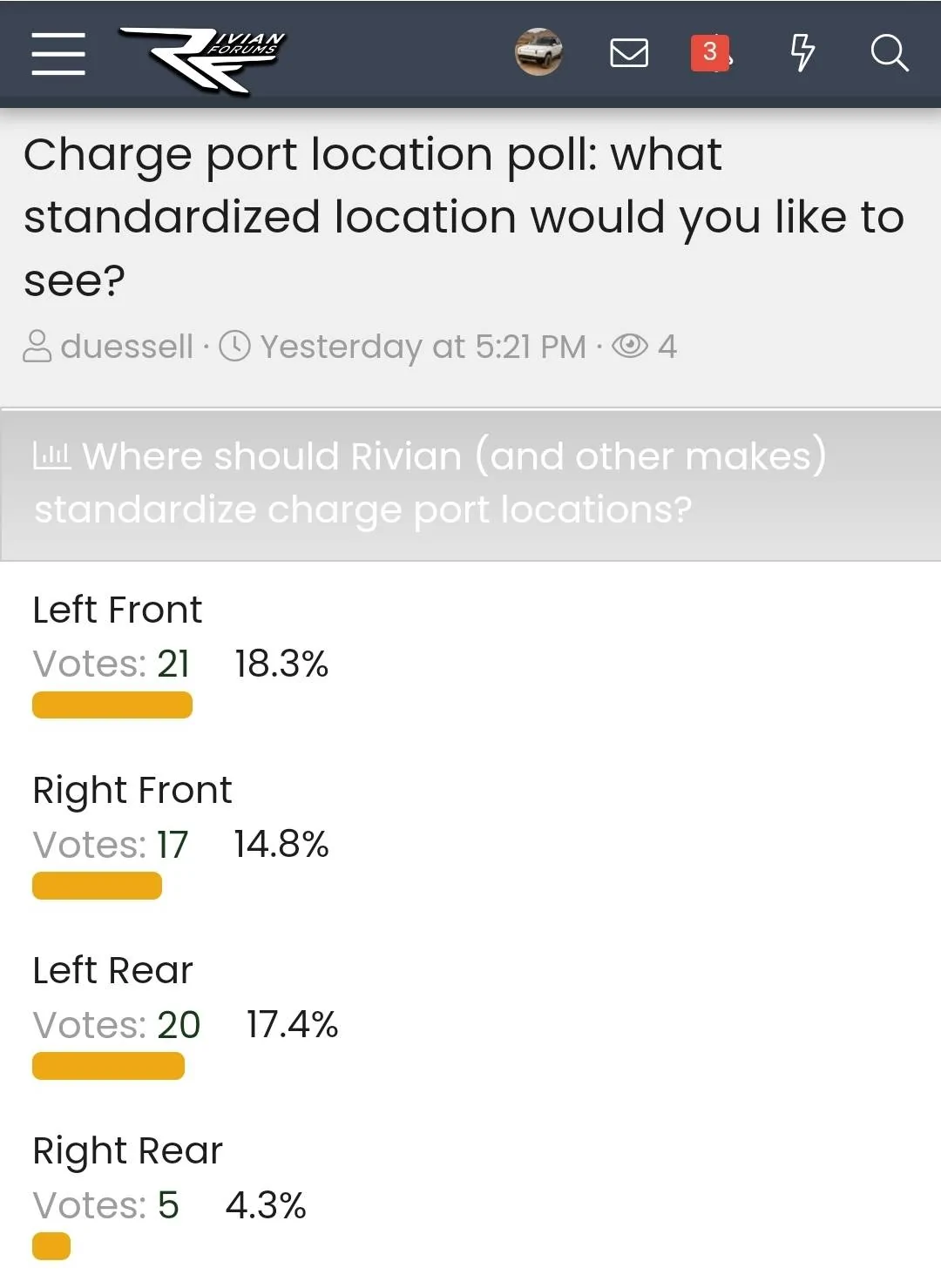
By the way, nobody can agree on the best place to put the port. Some want it in the front, others the rear. Some passenger side, some driver side. Manufacturers should be free to decide the best placement of the charging port, and the buyers can decide if we want it or not.

1000009121.jpg


And of course Rivian put it in the right rear position. Why? RJ says it is less expensive to put it there. And they definitely need to make their vehicles as cheaply as possible or they will not survive as a company.
Let's not forget center front like the "E" series vans and most other commercial vehicles.
Sponsored


Top