Tips or thoughts on fire mitigation strategies

Mach1E

Well-Known Member
Joined
Sep 5, 2021
Threads
93
Messages
10,509
Reaction score
13,295
Location
Florida
Vehicles
69 Mach 1, 11 GT, 21 GTPE- sold, 24 Taycan 4S, 20 F type R
Country flag
I believe this is a myth as this is really the best suppression technique first responders use in an EV fire. There is confusion about Li fires getting worse with water, but my understanding is that is with Li metal, whereas these batters are not made of Li metal. Water is used on these battery fires to cool the battery during the fire until it extinguishes.
That quote was a response to the suggestion of fire sprinklers to put out the electrical outlet fire, which is a very bad idea.

As far as “water on an EV fire,” I believe the water is to extinguish the rest of the car that is on fire, not necessarily the battery. It also is used to “cool the battery to prevent thermal runaway,” something fire sprinklers would be ineffective in doing.

Either way, I question the fire sprinklers effectiveness for an EV fire in a garage. The volume of water that is needed would far exceed the fire sprinkler capacity.


Let it burn…..

Sponsored

 
Last edited:

RickMachE

Well-Known Member
Joined
Jul 1, 2021
Threads
267
Messages
17,919
Reaction score
27,903
Location
SE MI
Vehicles
2022 Mach-E Premium 4X, 2022 Lightning Lariat ER
Country flag
I appreciate your feedback here. One comment I'll remind is that I was looking for 'reasonable' safety mitigation tips. But I agree with you that a fire blanket probably isn't reasonable for a non-professional because it would be too dangerous to use in a garage.

Please understand that I'm not being fearful of EV ownership, but still want to be as prepared as possible in the event something did occur. And I think we can all agree that while statistically less likely to occur with EV batteries vs ICE, if it did happen, the extent of damage to family and property would probably exceed that of an ICE fire.
While a fire may burn hotter with the battery as the root cause, once the fire is ignited in the garage it won't take too long until it spreads upwards, then the roof of the house is gone.

To be clear, no one should attempt to fight an EV (or any other fire). PERIOD. Your job is to get you, your family, and possibly pets OUT and summon the fire department. Any "mitigation" would be to alert you sooner, i.e. a detection system in the garage.

There used to be (may still be) a few fire professionals on this forum. Myself, I was a volunteer many, many years ago in PA, hundreds of hours of training. One day, the smoke detectors in our apartment building went off. I ran into the hall, noted it was coming from the basement, and ran down there. A storage bin had a fire going. I grabbed a fire extinguisher and put it out. Then, I went upstairs and called the station - no one there. I then called dispatch (landline, no cell phones back then), and told them to ask the chief to come, non-emergency. He didn't respond, so I tried again. Dispatch triggered the alarm for a structure fire, apartment building, which triggered 3 fire companies. When a senior officer arrived, after verifying the fire was out, he reamed me out for 10 minutes. Why didn't I call 911 immediately? Why didn't I ensure the building was evacuated? Why was I stupid enough to go down and put it out myself, not in my gear, and before doing the first two things? I was 22, young and stupid. Lesson learned.

Your job is to GET THE HELL OUT and call 911. Any steps you take should be to alert you quicker. That's it.

I have a fire extinguisher in the laundry room, the garage, under the kitchen sink, and in the master bedroom closet. I suspect they never will be used.
 

McQueen

Well-Known Member
Joined
Sep 20, 2024
Threads
5
Messages
130
Reaction score
94
Location
Florida
Vehicles
2023 Ford Mustang Mach-E Premium AWD (11/23 build), Vapor Blue Metallic
Country flag
I think its still fair to have a discussion of what mitigations are reasonable. As far as i know, there was one report of a fire, in gdansk in 2023, and it really looks like a fire on the bottom of the car that didn't involve the hvb, thus likely not the hvb at all. Reported as put of rapidly by firefighters, so maybe brakes or wiring? This includes damaged batteries and after accidents....

Am i mistaken? Has there been even a single fire "in the wild" of a mache? Not true of bolts or teslas....

Given 4ish years and probably over 100,00 ? On the road at this point, 0 is a pretty small number, and it's hard to consider any mitigation to be reasonable? If there haven't been any, how would you categorize reasonable mitigations?

This isn't ev vs non ev, this is different manufacturers. Engineering is a thing....

I park mine next to my house and change it there, just where i parked my prior cars.... So i don't have any reasonable mitigations.

Ps i also have a 23 premium x. 40k miles. Pretty trouble free. I hope you enjoy it!
On a somewhat related matter: It's "Hurricane Season" here in South Florida, the lightning-strike capital. I only charge my '23 Mach-e Premium AWD Std. Range ("11/23" build) at 120 volts inside my garage. A week or so ago after charging it up to 90%, the charge port showed an amber warning light. I unplugged it, and it disappeared (and there was no "Charging Error" on the App).
I suspect that while leaving it plugged-in after it reached 90% a lightning strike that knocked-out the kitchen and bedroom clocks and, briefly, the cable TV (all of which needed resetting) may have triggered the amber port warning. So: As a rule going forward, I no longer leave the car plugged-in overnight after it reaches 90%, and if it's storming I don't plug in. "Hurricane Season" is fully six (6) months down here; in advance of which temps already had reached 116 degrees showing on the touchscreen!
 

bbulkow

Well-Known Member
First Name
Brian
Joined
Aug 30, 2022
Threads
24
Messages
889
Reaction score
729
Location
menlo park, california
Vehicles
Honda CRV
Country flag
While a fire may burn hotter with the battery as the root cause, once the fire is ignited in the garage it won't take too long until it spreads upwards, then the roof of the house is gone.

To be clear, no one should attempt to fight an EV (or any other fire). PERIOD. Your job is to get you, your family, and possibly pets OUT and summon the fire department. Any "mitigation" would be to alert you sooner, i.e. a detection system in the garage.

There used to be (may still be) a few fire professionals on this forum. Myself, I was a volunteer many, many years ago in PA, hundreds of hours of training. One day, the smoke detectors in our apartment building went off. I ran into the hall, noted it was coming from the basement, and ran down there. A storage bin had a fire going. I grabbed a fire extinguisher and put it out. Then, I went upstairs and called the station - no one there. I then called dispatch (landline, no cell phones back then), and told them to ask the chief to come, non-emergency. He didn't respond, so I tried again. Dispatch triggered the alarm for a structure fire, apartment building, which triggered 3 fire companies. When a senior officer arrived, after verifying the fire was out, he reamed me out for 10 minutes. Why didn't I call 911 immediately? Why didn't I ensure the building was evacuated? Why was I stupid enough to go down and put it out myself, not in my gear, and before doing the first two things? I was 22, young and stupid. Lesson learned.

Your job is to GET THE HELL OUT and call 911. Any steps you take should be to alert you quicker. That's it.

I have a fire extinguisher in the laundry room, the garage, under the kitchen sink, and in the master bedroom closet. I suspect they never will be used.
Sounds like your stupidity may have saved lives. It's possible not everyone could have gotten out, and possible that after spending minutes doing that, the spread would have been too much and lost the structure. Not sure I agree with the senior officer - recon while calling 911 before acting wouldn't have been wrong (which you didn't exactly do). Especially if you had volunteer level training at the time.

What you are saying now *is* correct. GTFO, get everyone out, call for help, consider acting. It is the answer. But had you done that, people might have died.

Moments like that sometimes are a bit of guess and a bit of luck and a bit of bravery (foolishness). I'm glad it turned out well, that's what you should tell yourself after telling mr senior officer "yessir" and hopefully still do.
 
Last edited:

bbulkow

Well-Known Member
First Name
Brian
Joined
Aug 30, 2022
Threads
24
Messages
889
Reaction score
729
Location
menlo park, california
Vehicles
Honda CRV
Country flag
It was this one I’ve seen posted here.

THAT WAS NOT A MAIN BATTERY FIRE. That's the case in Gdansk, and was widely understood not to have been main battery, but something under the car that caught fire. It was put out by fire personnel with usual stuff, so very clear the main battery didn't go up. The fact that the main battery *didn't* catch fire when parts around it did, also speaks well.


ChrisO

Well-Known Member
Joined
Jan 11, 2025
Threads
9
Messages
998
Reaction score
992
Location
US
Vehicles
.
I want to clarify something that I said. Whereas a person should never try to fight an electrical fire with water, that wasn’t the statement I made. The statement was based on automatic sprinklers. They certainly can help with electric fire in a house. If nothing more, then giving people more time to get out. The main threat to somebody trying to fight an electrical fire with water is getting electrocuted.

So if this was to happen, one should never go to the garage where they might get electrocuted. They should escape by another exit.

There is also a possibility that the water may spread electricity to another place and spread the fire. For a small electrical fire like an outlet that’s actually very unlikely especially since you are at the same time putting water on all the flammable material in the area.

Would I install sprinklers for this kind of threat? No, do I believe the fact that my house has sprinklers would help in most cases, yes. I live in a townhouse and it is mandatory for them to be there and to be checked every year..
 

Mach1E

Well-Known Member
Joined
Sep 5, 2021
Threads
93
Messages
10,509
Reaction score
13,295
Location
Florida
Vehicles
69 Mach 1, 11 GT, 21 GTPE- sold, 24 Taycan 4S, 20 F type R
Country flag
THAT WAS NOT A MAIN BATTERY FIRE. That's the case in Gdansk, and was widely understood not to have been main battery, but something under the car that caught fire. It was put out by fire personnel with usual stuff, so very clear the main battery didn't go up. The fact that the main battery *didn't* catch fire when parts around it did, also speaks well.
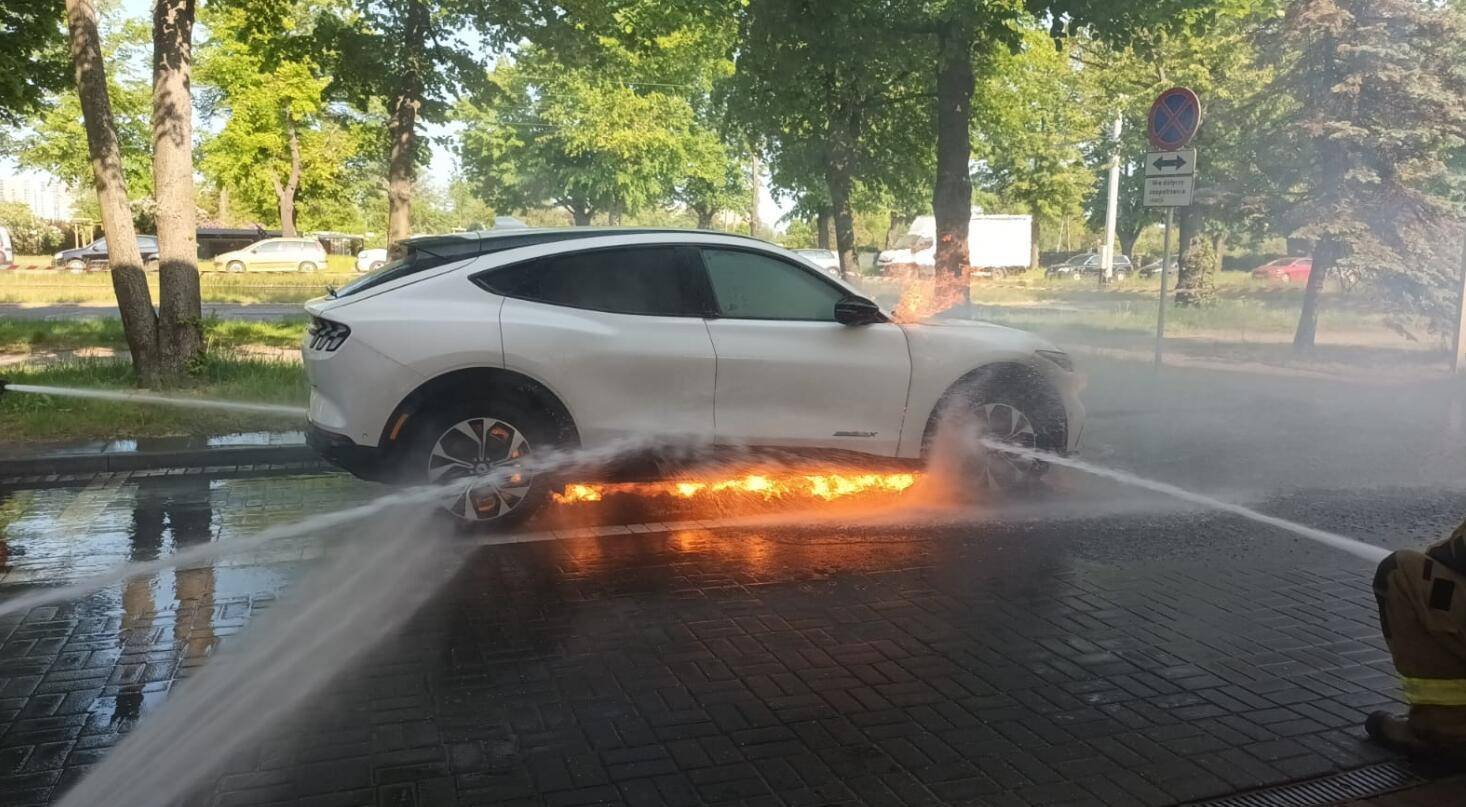
It was a battery fire and took 2 hours to put it out. Tons of pictures, news story etc on this thread:

https://www.macheforum.com/site/threads/mach-e-caught-fire-in-gdańsk-poland.28340/

Do you have some other evidence that proves otherwise?

Regular fires go out when you put water on them…… battery fires on the other hand:
Ford Mustang Mach-E Tips or thoughts on fire mitigation strategies IMG_2565
 

bbulkow

Well-Known Member
First Name
Brian
Joined
Aug 30, 2022
Threads
24
Messages
889
Reaction score
729
Location
menlo park, california
Vehicles
Honda CRV
Country flag
It was a battery fire and took 2 hours to put it out. Tons of pictures, news story etc on this thread:

https://www.macheforum.com/site/threads/mach-e-caught-fire-in-gdańsk-poland.28340/

Do you have some other evidence that proves otherwise?

Regular fires go out when you put water on them…… battery fires on the other hand:
IMG_2565.jpeg
That thread. 2 hours *of water* for cooling isn't much at all, and wouldn't have normally been used if it was a main battery fire.

Look on the second page of the thread, where the fire is out. The battery is intact. I found believable the people commenting on that thread said if it was a true thermal runaway main battery event, the car wouldn't have remained, nor would water have extinguished it, nor would the battery pack have been intact afterward.

It even looks possible to me that the water put out the fire, or it was a plastic / electrical fire in some component, and they kept water on the battery for two hours out of caution. The picture when the fire is out doesn't look like 2 hours of fire damage.

On the other hand, word from the Gdansk people was that is *was* a main battery fire. But if so.... it sure didn't behave like main battery fires on other cars. Doing some quick research, the inital active burning stage is usually considered a 2-8 hour events (notice the Gdansk car was an ER, so likely not on the short end), with then days of reignition risk, for 24 to 72 hours. The Gdansk people said it "wasn't necessary" to submerge or isolate the car... a bit of evidence that on reflection if it was a main battery fire, it wasn't a thermal runaway like we've seen on other cars.

I'd say that thread gives no evidence it was the main battery other than the guys in gdansk saying it was, and significant evidenct it wasn't, because we have a picture the car was intact, and the battery was intact.

If you'd like to claim it was a main battery fire because there's a picture of fire near the main battery, OK. "battery involved" was used in that thread, but that's not what people think of when they think EV main battery fire - a thermal runaway that consumes the car and can't be put out with normal means.

here are some pictures of what people think of with an EV main battery fire, rightfully so:

https://www.ndtv.com/world-news/tes...ighway-photos-show-unrecognisable-car-3539969

https://insideevs.com/news/687302/tesla-model-3-destroyed-fire/

https://www.washingtonpost.com/nation/2022/06/22/tesla-fire-sacramento/

https://arstechnica.com/cars/2016/08/tesla-model-s-france-battery-fire/

The two cases we know about, Gdansk and america, the car was intact . The US one was road damage and fire while driving, person pulled over, got out of the car safely, the car never fully caught fire. We don't seem to know as much about the Gdansk one, but it wasn't sitting in a garage. Looks like it was out on the road, and it would be reasonable to presume road damage.
 
Last edited:

Mach1E

Well-Known Member
Joined
Sep 5, 2021
Threads
93
Messages
10,509
Reaction score
13,295
Location
Florida
Vehicles
69 Mach 1, 11 GT, 21 GTPE- sold, 24 Taycan 4S, 20 F type R
Country flag
That thread. 2 hours *of water* for cooling isn't much at all, and wouldn't have normally been used if it was a main battery fire.

Look on the second page of the thread, where the fire is out. The battery is intact. I found believable the people commenting on that thread said if it was a true thermal runaway main battery event, the car wouldn't have remained, nor would water have extinguished it, nor would the battery pack have been intact afterward.

It even looks possible to me that the water put out the fire, or it was a plastic / electrical fire in some component, and they kept water on the battery for two hours out of caution. The picture when the fire is out doesn't look like 2 hours of fire damage.

On the other hand, word from the Gdansk people was that is *was* a main battery fire. But if so.... it sure didn't behave like main battery fires on other cars. Doing some quick research, the inital active burning stage is usually considered a 2-8 hour events (notice the Gdansk car was an ER, so likely not on the short end), with then days of reignition risk, for 24 to 72 hours. The Gdansk people said it "wasn't necessary" to submerge or isolate the car... a bit of evidence that on reflection if it was a main battery fire, it wasn't a thermal runaway like we've seen on other cars.

I'd say that thread gives no evidence it was the main battery other than the guys in gdansk saying it was, and significant evidenct it wasn't, because we have a picture the car was intact, and the battery was intact.

If you'd like to claim it was a main battery fire because there's a picture of fire near the main battery, OK. "battery involved" was used in that thread, but that's not what people think of when they think EV main battery fire - a thermal runaway that consumes the car and can't be put out with normal means.

here are some pictures of what people think of with an EV main battery fire, rightfully so:

https://www.ndtv.com/world-news/tes...ighway-photos-show-unrecognisable-car-3539969

https://insideevs.com/news/687302/tesla-model-3-destroyed-fire/

https://www.washingtonpost.com/nation/2022/06/22/tesla-fire-sacramento/

https://arstechnica.com/cars/2016/08/tesla-model-s-france-battery-fire/

The two cases we know about, Gdansk and america, the car was intact . The US one was road damage and fire while driving, person pulled over, got out of the car safely, the car never fully caught fire. We don't seem to know as much about the Gdansk one, but it wasn't sitting in a garage. Looks like it was out on the road, and it would be reasonable to presume road damage.
So, just to be clear, your position is that it took 2 hours to put out a fire that WASN’T a battery fire?

Those 3 fire hoses in the photo pouring water on the “not battery fire” must be deceptively small then. ?

When you put 3 fire hoses (or even just one) on a normal car fire, it goes out in seconds not hours. ?‍♂
 

Tomm

Well-Known Member
First Name
Tom
Joined
Apr 20, 2024
Threads
5
Messages
248
Reaction score
221
Location
Davis Ca
Vehicles
2023 Premium
Occupation
Surgeon
Country flag
Seal the garage and put in a HALON system like they have in ship’s engine rooms?
 

4sallypat

Well-Known Member
First Name
Pat
Joined
Mar 30, 2022
Threads
103
Messages
2,806
Reaction score
2,463
Location
Southern California
Website
www.kudo-ume-farms.com
Vehicles
'23 MME delivered May '23 + '22 Lightning July '22
Occupation
Network Tech
Country flag
Seal the garage and put in a HALON system like they have in ship’s engine rooms?
100% what I have.

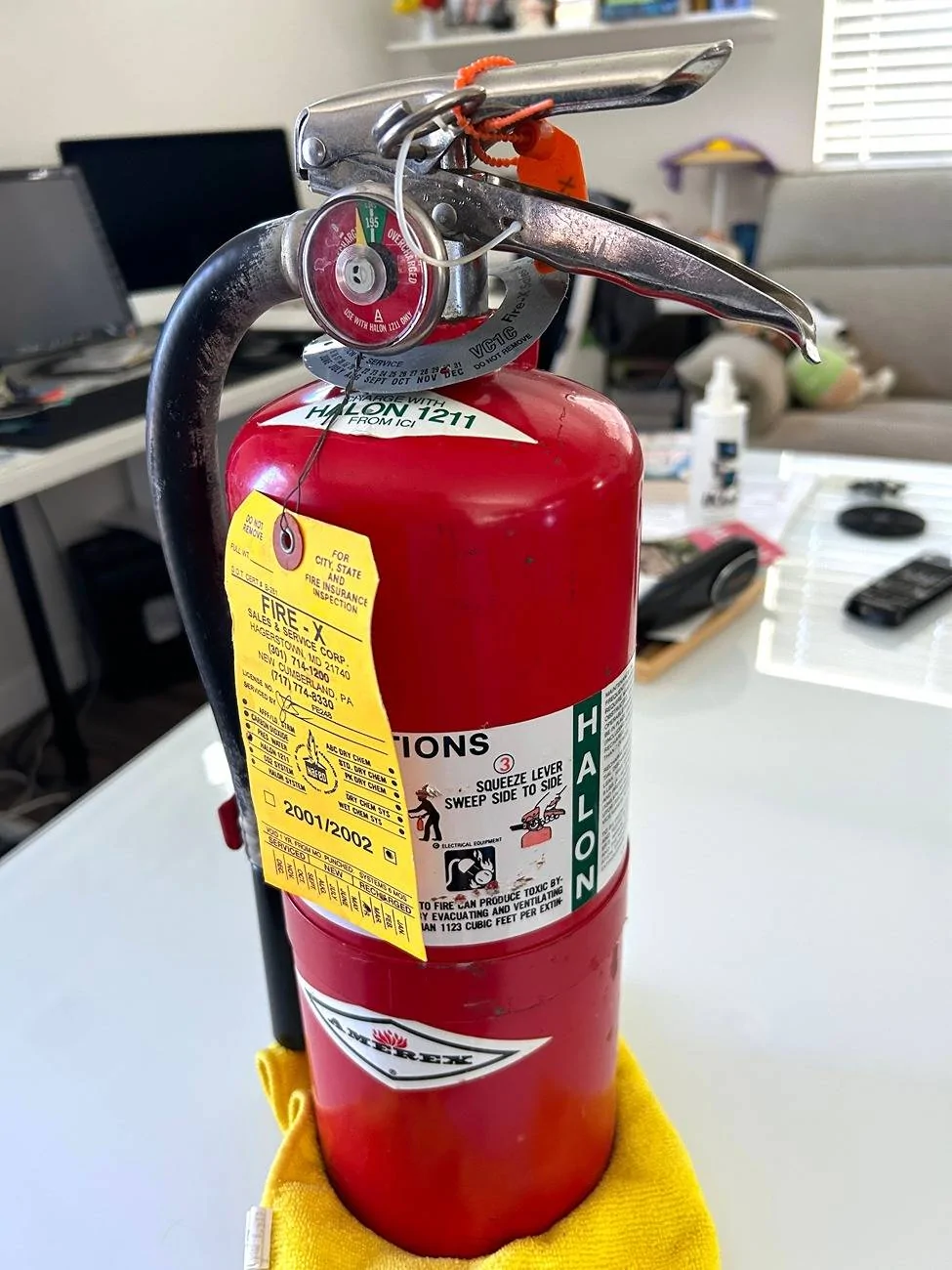
Halon extinguishers - automatic heat sensor built in my computer/server room in the event of a fire without leaving a residue and safe for electronics.

2x 10lb Halon manual extinguishers on hand in other parts of the house.

Here's one next to my Macs that I noticed needs re-cert and re-pressurization - not cheap to maintain Halon...

Ford Mustang Mach-E Tips or thoughts on fire mitigation strategies IMG_2636 2
 

Mach1E

Well-Known Member
Joined
Sep 5, 2021
Threads
93
Messages
10,509
Reaction score
13,295
Location
Florida
Vehicles
69 Mach 1, 11 GT, 21 GTPE- sold, 24 Taycan 4S, 20 F type R
Country flag
Seal the garage and put in a HALON system like they have in ship’s engine rooms?
Even if you could, would it even do anything?

Lithium battery fires create their own oxygen, it’s how they can burn even under water.
 

rhougey

Well-Known Member
First Name
Rich
Joined
Apr 29, 2021
Threads
4
Messages
445
Reaction score
526
Location
North California
Vehicles
2021 Mach-E Prem RWD, 1968 Mustang, 2014 Ram 1500
Occupation
Retired
Country flag
Appreciate the feedback so far.

Does anyone have experience with heat detectors? Consumer Reports was recommending these for garages over smoke detectors (general car fire prevention measure). But reading more, there are detectors now that pick up on battery gases--anyone familiar with these?
I’ve had an extensive security system in our home for years. Included in the system are smoke sensors inside the living space and heat sensors in the attic and in the garage. The heat sensors in the garage are located directly above the hood area of the cars. These sensors exist to provide early warning of a fire to allow for evacuation and automatic notification to the fire department. This all was installed long before I could have anticipated an electric powered car being a viable form of transportation, but if either my 2021 MachE or my 1968 Mustang Coupe were to catch fire, we will get out of the house safely.
 
Last edited:

B177y

Well-Known Member
First Name
Bill
Joined
Sep 17, 2023
Threads
16
Messages
417
Reaction score
630
Location
Olympic Peninsula, WA
Vehicles
'23 J2 MME Premium, '24 Lightning Pro ER, '20 Bolt
Country flag
While a fire may burn hotter with the battery as the root cause, once the fire is ignited in the garage it won't take too long until it spreads upwards, then the roof of the house is gone.

To be clear, no one should attempt to fight an EV (or any other fire). PERIOD. Your job is to get you, your family, and possibly pets OUT and summon the fire department. Any "mitigation" would be to alert you sooner, i.e. a detection system in the garage.

There used to be (may still be) a few fire professionals on this forum. Myself, I was a volunteer many, many years ago in PA, hundreds of hours of training. One day, the smoke detectors in our apartment building went off. I ran into the hall, noted it was coming from the basement, and ran down there. A storage bin had a fire going. I grabbed a fire extinguisher and put it out. Then, I went upstairs and called the station - no one there. I then called dispatch (landline, no cell phones back then), and told them to ask the chief to come, non-emergency. He didn't respond, so I tried again. Dispatch triggered the alarm for a structure fire, apartment building, which triggered 3 fire companies. When a senior officer arrived, after verifying the fire was out, he reamed me out for 10 minutes. Why didn't I call 911 immediately? Why didn't I ensure the building was evacuated? Why was I stupid enough to go down and put it out myself, not in my gear, and before doing the first two things? I was 22, young and stupid. Lesson learned.

Your job is to GET THE HELL OUT and call 911. Any steps you take should be to alert you quicker. That's it.

I have a fire extinguisher in the laundry room, the garage, under the kitchen sink, and in the master bedroom closet. I suspect they never will be used.
Retired firefighter here. I agree with everything you wrote. I even had a similar apartment fire story in my late 20's/early 30's, except I was driving home from a shift around 0800 on a weekend morning. Called it in, ran around the building knocking on doors, woke up a few occupants that got out. One guy from the involved apartment got out with a burned head of hair, his roommate died. Had gear in my car because I was moving stations for my next shift but it wouldn't have helped me as I didn't have a SCBA and I likely would have been another dead rescuer. Do what you can, but don't be a dead hero.

As to the OP @Exodus D 's question, I think you are posing a cool thought experiment, but in reality if you park any car inside your attached garage, whether its an EV or ICE, early detection from a combination of high quality heat and smoke detectors so that you can get out is the best option and the most practical. Any sort of mitigation is crazy expensive and impractical. Modern building codes already require a fire rating on attached garages - double layer drywall that is completely finished (taped and mudded). In reality there are all sorts of plumbing, electrical, and HVAC intrusions through that drywall added after the final inspection due to repairs, upgrades, DIY projects, etc... These will carry the fire into the living space if given enough time.

Before EV's were a thing, I responded to plenty of garage fires that extended into the house. Most started from ICE car fires, motorcycles, battery charging equipment, overloaded electrical circuits or extension cords, yard equipment, etc... EV's are just another thing in your garage that can start a fire, albeit less likely than most of the other stuff in an average garage.

Depending on your lifestyle and your house, a fire can start inside your house too. That's just the physics of modern living. Building codes are created to minimize the risk of fires, and they work. People making poor choices usually is the root cause of any fire. People overload circuits, people use cheap battery chargers, people install devices or remodels without proper inspections or permits, people put heaters next to drapes, people store oily rags in a covered plastic trash bin... catch my drift?

Park your EV in your garage, but be smart. Don't use some random EV charger off of Amazon with a name like "Wjhqinfgggj" because it's the cheapest. Get a good charger installed by someone that knows what they are doing and gets their work inspected. Personally I wouldn't use a 120-volt charger for an EV unless I could guarantee that it was the only thing being used on that circuit since it is pulling near the max recommended amperage for a long time charging your EV.

I parked and charged my Mach-e in my attached garage, and I now park and charge my Lightning in my attached garage. My wife parks her ICE car in the same garage. I parked my ICE cars in the garage before I had the EV's. I don't really worry about it. The chance is extremely low that there will be a fire, period. I have a high quality smoke detector in my garage just in case a fire does start to let me know that I need to get out. I live in a rural area, if it starts to burn in my garage, the whole house is likely to become involved before any serious suppression arrives unless I am super lucky.
 

ChrisO

Well-Known Member
Joined
Jan 11, 2025
Threads
9
Messages
998
Reaction score
992
Location
US
Vehicles
.
@B177y Your statement about not using 120-volt charger unless you can guarantee that it is the only thing on that circuit strikes a chord with me. When we first got our Mach-E was using the 120-volt charger and it was slow, but all we really needed until I realized that the garage door was on the same circuit! Then it became very much a "no go". And since a new circuit had to be put in, we went with a 240-volt circuit for that only purpose.

I'm sure there are others might look and see an outlet with nothing plugged into and make the wrong assumption that nothing else is on the circuit.
Sponsored


Top