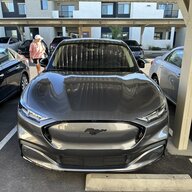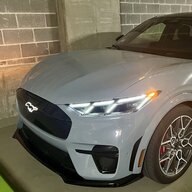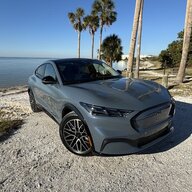

For EVs to become “No-Brainers” over ICE.

4sallypat

Well-Known Member
First Name
Pat
Joined
Mar 30, 2022
Threads
103
Messages
2,806
Reaction score
2,463
Location
Southern California
Website
www.kudo-ume-farms.com
Vehicles
'23 MME delivered May '23 + '22 Lightning July '22
Occupation
Network Tech
Country flag
.......
I don't have a 400/500 mile bladder.
......
^^^ This is 100% correct.

Gotten older and now I have to stop every hour or 2 for bathroom, snack, coffee, stretch legs, back ache relief, etc...

So for me range is fine with 100 miles to get to a fast charger...
Sponsored
 

AKgrampy

Well-Known Member
First Name
Mike
Joined
Jan 29, 2022
Threads
7
Messages
3,525
Reaction score
3,600
Location
Fairbanks, Alaska
Vehicles
Ford Expedition, Ford F-150, Mach E GT
Occupation
Retired
Country flag
^^^ This is 100% correct.

Gotten older and now I have to stop every hour or 2 for bathroom, snack, coffee, stretch legs, back ache relief, etc...

So for me range is fine with 100 miles to get to a fast charger...
Same here for bladder; however, I can make an outhouse stop in two minutes and there is no electricity along the 90 mile section I stop anyways! Some day I will give the 350 mile run to Anchorage a go but it only one short stop with my ICE and most likely two long stops with Mach.
 
OP
OP
Jferrari427

Jferrari427

Banned
Banned
First Name
John
Joined
Jul 11, 2023
Threads
15
Messages
112
Reaction score
130
Location
USA
Vehicles
2023 Mach-E Premium Extended Range RWD
Country flag
But a BEV is different than an ICEV. You can quickly refill an ICEV, so a lower range is easier to manage.

A 500 mile BEV isn't just a benefit for those who travel 500 miles in a day, it reduces the number of times you need to charge. Sure a bigger battery will take longer to charge, but fewer stops to charge means you don't have to plug in every day. Maybe if you are only doing a short local commute you can go an entire month without plugging in.

The reduced stress and improved flexibility is hugely beneficial, IMO. And lots of people live in shared housing without easy access to a charger on a daily basis. 500 miles mean they don't have to look for a charger as often.

It is all opinion, and certainly the market will decide, but I think long range BEVs are the key to making BEVs on par with ICE regarding refueling pain. Refueling pain is a huge mass market barrier right now.
Exactly my point. The benefit of a much longer range is less frequent charging for everyone in general.
 

GreaseMonkey

Well-Known Member
First Name
Steve
Joined
Oct 3, 2021
Threads
21
Messages
3,275
Reaction score
5,255
Location
Chicago, IL
Vehicles
24 Mach-E GT
Country flag
High rise condo owner here: mme is our only car w/ two young kids and a puppy. I dcfc the crap out of it and travel everywhere with the gang. Zero issues.

300 mile range is adequate. I wish winter range wouldn’t be impacted as much, especially in the city where trips are super short (most energy spent heating and reheating and reheating, not moving). I also wish charging was a bit faster.

I would never go for a 500 mile battery. The car would be so heavy and not fun. The lighter the better. Just my personal opinion.


Teslaeata

Well-Known Member
First Name
Mark
Joined
Sep 28, 2022
Threads
9
Messages
3,470
Reaction score
4,210
Location
Nottingham, England, UK
Vehicles
Red June ‘21 RWD ER Premium MME
Occupation
Forensic vehicle examiner, motor insurance assessor, expert witness
Country flag
Everyone’s needs are different but the majority (just my guess of course) of people don’t need an EV that’s gets 500 miles. I am talking about people that have private homes And can charge as they want to. It does take a mind reset though.

my brother for example said he will buy an EV when they get 500 miles. The last time he has taken a trip of more than 250 miles is 10 years ago.

the same with many of my friends. Some do but most don’t travel that far, ever. If you travel 30k miles a year as I used to do when working , if would have been a real hassle to DCFC, which is why I didn’t buy a Tesla at the time.

I look at my 3 kids and their families. They take long trips 1 time a year, doable but with kids in the car could be nerve racking to pull up to a DCFC and find broken chargers or a long wait.

of course for those that constantly make long trips it is useful to have a longer range.

my personal target was 300 and the MME fit the bill, over time the health of the battery will decrease and I will see how much that happens, by then I hope they come up with a higher level octane of electricity to make up for it?
It’s always interesting, the conversations with people who enforce on me when I really don’t give a flying fig about their uneducated and unjustifiable ICE-prejudiced arguments on why they can’t/shouldn’t/couldn’t ever go EV and nor can any body else!

I find the people who know the least about EVs & charge infrastructure try to tell me the most, one even said ooooooh, those EV tyres, even they have to be fireproof. FIREPROOF…..rubber & oil I ask you?

The questions:
What if you run out of charge? I don’t, I never ran out of fuel in an ICE, not that stupid and negligent so won’t run out of fuel [charge] in an EV.

How often does it need charging? Exactly the same frequency an ICE needs refuelling; when it needs it.

What if the battery fails? Renew it or actually parts [cells] of it just like I’d have to replace an ICE engine if it failed, or the clutch, or the dodgy DPF technology, or the dodgy dual mass flywheels that fail due to unnecessary and dodgy technology, change timing belts etc etc

Ah yes but the charge infrastructure is not good enough they state; absolute BS, show ‘em the Zap Map, charge stations are like rats, you’re never more than 3 metres away from one, well, not exactly but you get the gist from somebody who just bought 4,979kWh of charge over 2 years from the “infrastructure” in addition to the 14,480kWh leccy during home charging on trips ranging between c200 to 925miles averaging 300miles per trip.

Thing is, if people want or don’t want something, human nature is such that they make any excuse, justification or other to justify their position.

I do it, and find myself doing it here, as a pro EV especially as I believe we just have to do something about climate change - don’t burn fossil fuel anymore with an EV, fully insulated home now heated by air source heat pump!

Loving the new technology, not bad for an old fart?
 

bp99

Well-Known Member
Joined
Jul 28, 2021
Threads
1
Messages
290
Reaction score
453
Location
Oregon
Vehicles
22 MME eAWD, 21 MME CA Route 1 (sold)
Country flag
But a BEV is different than an ICEV. You can quickly refill an ICEV, so a lower range is easier to manage.

A 500 mile BEV isn't just a benefit for those who travel 500 miles in a day, it reduces the number of times you need to charge. Sure a bigger battery will take longer to charge, but fewer stops to charge means you don't have to plug in every day. Maybe if you are only doing a short local commute you can go an entire month without plugging in.

The reduced stress and improved flexibility is hugely beneficial, IMO. And lots of people live in shared housing without easy access to a charger on a daily basis. 500 miles mean they don't have to look for a charger as often.

It is all opinion, and certainly the market will decide, but I think long range BEVs are the key to making BEVs on par with ICE regarding refueling pain. Refueling pain is a huge mass market barrier right now.
There's also the need to keep the battery between 15% and 90% charge. You lose 1/4 of your range just to properly maintain the battery. Add in the cold weather loss of range, and you're down to 50% range. 300 miles doesn't look so good now. Then consider most households with EVs right now have a single EV (I do have two). Many older homes do not have 200A service. So, even those with single family houses with driveways/garages, may not be able to plug in nightly once they become multiple EV households (or may be limited to split power between cars at slower charge rates). Add in the political push to ban all natural gas appliances (municipalities and states are already banning gas hookups on new construction), and there's going to be more things competing with the car for panel capacity.

300 miles was my minimal threshold. I got that with my original RWD Rt1 during the Summer. I've dipped below with my flip upgrade to my eAWD Premium. I do feel the pinch on occasion with range. All our road trips are with my wife's MY -- more cargo space, more range, and the Super Charger network -- and we've pushed it on occasion with making it to a charger. Our next BEV will both be larger (R1S sized suv) and need to have longer range.
 

Wdecter

New Member
First Name
Walter
Joined
Jun 25, 2023
Threads
0
Messages
1
Reaction score
1
Location
Illinois
Vehicles
GTI
Occupation
product manager
Country flag
Replace #2 with chargers every 50 miles on the interstates and I’d agree. Don’t need more than 300 miles of range if charging is plentiful.

On our long road trips we’ve found that we have max 250 mile bladders.
More than the interstate. Lots of places are 100+ miles from an interstate, or located such that the interstate is not the best route by far.
 
OP
OP
Jferrari427

Jferrari427

Banned
Banned
First Name
John
Joined
Jul 11, 2023
Threads
15
Messages
112
Reaction score
130
Location
USA
Vehicles
2023 Mach-E Premium Extended Range RWD
Country flag
There's also the need to keep the battery between 15% and 90% charge. You lose 1/4 of your range just to properly maintain the battery. Add in the cold weather loss of range, and you're down to 50% range. 300 miles doesn't look so good now. Then consider most households with EVs right now have a single EV (I do have two). Many older homes do not have 200A service. So, even those with single family houses with driveways/garages, may not be able to plug in nightly once they become multiple EV households (or may be limited to split power between cars at slower charge rates). Add in the political push to ban all natural gas appliances (municipalities and states are already banning gas hookups on new construction), and there's going to be more things competing with the car for panel capacity.

300 miles was my minimal threshold. I got that with my original RWD Rt1 during the Summer. I've dipped below with my flip upgrade to my eAWD Premium. I do feel the pinch on occasion with range. All our road trips are with my wife's MY -- more cargo space, more range, and the Super Charger network -- and we've pushed it on occasion with making it to a charger. Our next BEV will both be larger (R1S sized suv) and need to have longer range.
100% agree with this and exactly my point. 500 mi range on a full charge is key because all of the aforementioned reasons.
 

Tampamike

Well-Known Member
First Name
Mike
Joined
Feb 19, 2021
Threads
25
Messages
2,076
Reaction score
2,813
Location
Tampa, FL
Vehicles
‘24 Mach E Premium RWD
Country flag
I don't have a 400/500 mile bladder. Besides, driving more than a few hours results in road-weariness and reduced attention. The issue isn't more range than ICE cars. The issue is having enough chargers to not worry about finding one. The infrastructure law is bringing $5B to the table to solve this issue.
My 25 year-old former self would disagree when he had a hot date on the other end - drive as fast as you can as long as you can. I’ve evolved but there are plenty of those other drivers still out there. THEY still want range and fast charges while I’m now content with 2 1/2 hour legs with a leisurely 35 minute stroll to the bathroom and WalMart parking lot.
 

mkhuffman

Well-Known Member
First Name
Mike
Joined
Nov 19, 2020
Threads
29
Messages
6,878
Reaction score
9,514
Location
Virginia
Vehicles
2025 Rivian R1T Tri-Max, Jeep GC-L, VW Jetta
Country flag
My 25 year-old former self would disagree when he had a hot date on the other end - drive as fast as you can as long as you can. I’ve evolved but there are plenty of those other drivers still out there. THEY still want range and fast charges while I’m now content with 2 1/2 hour legs with a leisurely 35 minute stroll to the bathroom and WalMart parking lot.
I am growing tired of spending time in a Walmart parking lot. Or any parking lot for that matter.

Public charging sucks.
 

bbulkow

Well-Known Member
First Name
Brian
Joined
Aug 30, 2022
Threads
24
Messages
889
Reaction score
729
Location
menlo park, california
Vehicles
Honda CRV
Country flag
But when they tell us NYC will be under water by the year 2000 due to global warming if we don't do anything, and we don't do anything, and does it does not flood, I KNOW they are liars. And that is just one example. Every time a prediction is wrong, they change the time frame.
There's another true fact. A great deal of excellent modeling science was done by Exxon through the 70's, and published. Their prediction for amount of warming through 2020 was *spot on*. They used an innovative dataset: they put sensors on their tankers that criss crossed the global - and the state of the ocean is the state of our climate.

Guess what? Since there wasn't a solution, and Exxon knew the answer (it's happening and we're causing it), Exxon went out and funded the wrong answer, to discredit "science". Which of course gets amplified by the news media. There is absolutely nothing illegal about this - you think scientists are liars. It's a natural conclusion.

This is not some fantasy fever dream, the story has been told repeatedly in outlets like Scientific American, the Harvard Review. Here's one link, which tells more about what they knew when. https://www.scientificamerican.com/article/exxon-knew-about-climate-change-almost-40-years-ago/

More recent articles show what we've learned about the attempt to deceive.

The UN's ICCC reports are reputable, and are published on about 5 year boundaries. They're turning out to be fairly conservative. Go back and read their older reports, output and see if it agrees with what has happened so far, then maybe read this year's.
 

dtbaker61

Well-Known Member
First Name
Dan
Joined
May 11, 2020
Threads
126
Messages
4,822
Reaction score
4,525
Location
santa fe,nm
Website
www.envirokarma.org
Vehicles
MME (delivered 2/26/21), DIY eMiata BEV
Occupation
Solar Sales/install
Country flag
EVs need a slam dunk reason for ICE buyers to convert over. IMO 3 things need to happen for EVs to become no-brainers over ICE vehicles for mass adoption.

1. 0-90% SOC in under 10 min on public charging networks.

2. Much greater range than ICE vehicles…think 400/500+ miles on a full charge.

3. Lower price of entry.

Competition is a great thing, I could see this happening in 5 years (maybe).

what are your thoughts?
I think the existing state of BEV development is already a slam dunk over ICE for *most households* as long as:
- your daily commute is <200 miles
- you have or can install level 2 charging at home
- you are willing to stop every 150 miles on a long trip to rest and re-fuel, or
take a plane, train, bus or rent an ICE for long road trips in areas that don't have charging network yet
- are able to pay about $10k more initially because there is no real 'base model' BEV offered.

my thoughts on your thoughts are:

1r: The last DOT report I read was that 90+% of private transportation daily range needs can be met with range less than 50 miles/day. My max daily work miles are trips less than 150 miles, easily recharged at home on 32amp level 2 charger. I do not consider 0-90% in 10 minutes to be a 'need', or holding back adoption of EVs. Education regarding daily range, and available chargers every 50 miles would help trip planning, but considering the technical issues with cooling and battery chemistry, I don't think 200+kW charging should be considered a minimum.

2r: again.... how many people really need more than 200 mile range.... and how often? The extra resources it takes to make bigger batteries, extra weight reducing efficiency and adding to road wear, and added cost for seldom used capacity seem to be a poor choice catering to 'range anxiety' rather than reality.

3r: absolutely, we need simple 'entry level' BEV with minimal 'extras', and minimum battery capacity to keep costs down. 200 mile range is PLENTY for urban/suburban use. auto-drive, driver-assist, power-everything, giant infotainment screens, etc, etc are NOT needed for entry level vehicles.

....the big disconnect is expectations and that many people have been encouraged to think they HAVE to have long range and instant re-fueling to survive. Really, we will all just have to adapt and change expectations in the shift from ICE to BEV.
 
Last edited:

phil

Well-Known Member
Joined
Jun 6, 2021
Threads
13
Messages
3,172
Reaction score
4,218
Location
USA
Vehicles
LS400
Country flag
....the big disconnect is expectations and that many people have been encouraged to think they HAVE to have long range and instant re-fueling to survive. Really, we will all just have to adapt and change expectations in the shift from ICE to BEV.
Reminds me of a very similar disconnect. Many people have been encouraged to think they HAVE to have beef, pork, fish, and poultry to survive. Really, we will all just have to adapt and change expectations in the shift from eating beef to eating bugs.
 

dtbaker61

Well-Known Member
First Name
Dan
Joined
May 11, 2020
Threads
126
Messages
4,822
Reaction score
4,525
Location
santa fe,nm
Website
www.envirokarma.org
Vehicles
MME (delivered 2/26/21), DIY eMiata BEV
Occupation
Solar Sales/install
Country flag
More than the interstate. Lots of places are 100+ miles from an interstate, or located such that the interstate is not the best route by far.

a big challenge with fast charging in rural areas is the lack of 3-phase power needed for the typical fast charger. The L3 chargers in the US all are designed around 3-phase 480v input.

fortunately, there are now (a few) L3 'boost' chargers that integrate batteries and take 'regular' single phase 240v input at a moderate 20kw, store energy in a battery,and spit it out at 150kW from the battery until 'empty' and then pass thru 20kW as a minimum charge rate. These 'boost chargers' are a great solution in rural areas where 3-phase is not available, and a local business can add a 20kw load without bouncing them into a bigger load rateclass where utilities change from a consumption rate to consumption plus peak load 'demand' billing.
Sponsored


Top