Edmunds Massive Charging Comparison - MME is second to last.

dtbaker61

Well-Known Member
First Name
Dan
Joined
May 11, 2020
Threads
126
Messages
4,822
Reaction score
4,525
Location
santa fe,nm
Website
www.envirokarma.org
Vehicles
MME (delivered 2/26/21), DIY eMiata BEV
Occupation
Solar Sales/install
Country flag
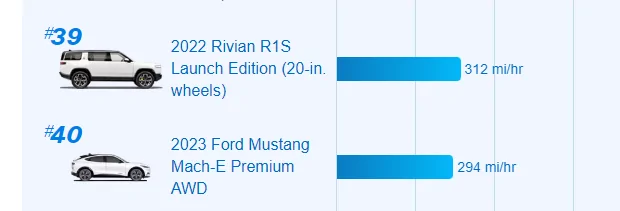
Edmunds did a comprehensive charging speed test on dozens of EVs in the US market.

Out of 43 tested vehicles the MME 4X and GTPE came in #40 and #41, respectively. Only the Bolt EV and EUV were slower to add miles.

https://www.edmunds.com/car-news/electric-car-charging.html
so what ?

charging faster is harder on battery life.... How often would it matter to you if it takes you 30 minutes or 20 while on a long road trip ? How often do you road-trip versus charge at home ?

I would bet that *most* (90% ?) of us charge 90% of the time at home, and are not in a huge hurry when on a road trip requiring a road-side DCFC.

I'd be more interesting in knowing the average driver's accessibility to fast charge *at all* on non-interstate routes no matter what kind of car you have. For instance, there are NO 150kw stations between santa fe and Denver on US285, none between Santa Fe and Pagosa Springs, or Durango, or anywhere in the NW corner of the state.
Sponsored

 

Mirak

Banned
Banned
Joined
Oct 8, 2020
Threads
111
Messages
3,754
Reaction score
6,166
Location
Kansas
Vehicles
"Sonic" 2021 MME Grabber Blue First Edition
Country flag
Ho Hum, I guess I'd rather drive a good looking EV that's fun and has the features I like. This has minimal impact on the majority of EV use. It will sort itself out in time as more experience with battery usage and charging focuses the charging infrastructure in all vehicles.
Wouldn’t you rather have both?
 

Mirak

Banned
Banned
Joined
Oct 8, 2020
Threads
111
Messages
3,754
Reaction score
6,166
Location
Kansas
Vehicles
"Sonic" 2021 MME Grabber Blue First Edition
Country flag
so what ?

charging faster is harder on battery life.... How often would it matter to you if it takes you 30 minutes or 20 while on a long road trip ? How often do you road-trip versus charge at home ?

I would bet that *most* (90% ?) of us charge 90% of the time at home, and are not in a huge hurry when on a road trip requiring a road-side DCFC.

I'd be more interesting in knowing the average driver's accessibility to fast charge *at all* on non-interstate routes no matter what kind of car you have. For instance, there are NO 150kw stations between santa fe and Denver on US285, none between Santa Fe and Pagosa Springs, or Durango, or anywhere in the NW corner of the state.
If folks road-trip as infrequently as you say, then how much harm would loosening up the curve do? Somehow other 400v cars find a way…

I guess my annoyance is why the apologists and the defenders just assume that a choice had to be made.

And yes, 20 minutes versus 30 minutes matters to me and many others. Glad it doesn’t matter to you.
 
Last edited:

kdonnel

Well-Known Member
Joined
Oct 31, 2021
Threads
35
Messages
1,147
Reaction score
1,665
Location
Metro Atlanta
Vehicles
2022 CA Route 1, 2020 Bolt EV
Country flag
I have taken about a dozen road trips that included one or more DCFC stops.

I can remember two times where I was waiting on the car to charge. The other 30 or so DCFC sessions the car was beyond where I wanted to be by the time I returned to the car.
 

voxel

Well-Known Member
First Name
Nelson
Joined
Sep 6, 2021
Threads
27
Messages
2,032
Reaction score
1,858
Location
Altamonte Springs, FL
Vehicles
22 Mach-E 4X, 23 GC Limited
Occupation
Software Engineer
Country flag
Hooray I own the slowest charging EVs as measured by miles per hour charge rate.

Honestly... the R1S is worse on road trips than the MME. The MME drawing 130-150 kW will get me 50% more miles than on the R1S.

Ford Mustang Mach-E Edmunds Massive Charging Comparison - MME is second to last. 1700163748894


kodiakng

Well-Known Member
First Name
David
Joined
Oct 1, 2022
Threads
19
Messages
903
Reaction score
1,408
Location
Oregon
Vehicles
2023 Cyber Orange 4X Mach-E
Country flag
those charging losses are interesting. i would have thought the 800V architecture/high charge rate vehicles wouldn't have 9% or more in losses while many of the 400V cars are only at 1%. i guess stuffing a lot of charge into the battery cells does have some spillover but that energy goes somewhere and probably in heat that needs to be dissipated.

then there is the outlier: polestar 2 (400V) at 17.7% - yikes.

i do like their attempt at establishing MPH in charging numbers. useful discussion.
 

Mirak

Banned
Banned
Joined
Oct 8, 2020
Threads
111
Messages
3,754
Reaction score
6,166
Location
Kansas
Vehicles
"Sonic" 2021 MME Grabber Blue First Edition
Country flag
I have taken about a dozen road trips that included one or more DCFC stops.

I can remember two times where I was waiting on the car to charge. The other 30 or so DCFC sessions the car was beyond where I wanted to be by the time I returned to the car.
I'm curious what you folks do during fueling stops where this is true. See, in a gas car, I stop for about 5 minutes, during which I start the pump, use the head, grab a drink and a snack for the road, disconnect the pump, and then get on my way with a full tank.
 

nvabill

Well-Known Member
First Name
Bill
Joined
Jan 11, 2021
Threads
57
Messages
2,375
Reaction score
1,907
Location
Virginia Beach, Va.
Vehicles
F-150, '22 California Route 1
Country flag
Sure, but they get different efficiencies when driven, just as the CR1 had a different efficiency than the GT, hence the different ranking. They may add the same. Number of kW, but that doesn't mean they add the same number of miles, and these are comparing cars based on how long it took to add 100 miles.
But, miles gained from a charge is real world, I could care less about %, tell me how far I can go!
 

kdonnel

Well-Known Member
Joined
Oct 31, 2021
Threads
35
Messages
1,147
Reaction score
1,665
Location
Metro Atlanta
Vehicles
2022 CA Route 1, 2020 Bolt EV
Country flag
I'm curious what you folks do during fueling stops where this is true. See, in a gas car, I stop for about 5 minutes, during which I start the pump, use the head, grab a drink and a snack for the road, disconnect the pump, and then get on my way with a full tank.
I plan my DCFC stops around dining or shopping for the trip. My road trips are generally two DCFC stops max.
 

DevSecOps

Well-Known Member
First Name
Todd
Joined
Sep 22, 2021
Threads
69
Messages
4,764
Reaction score
11,624
Location
Sacramento, CA
Vehicles
'21 Audi SQ5 / '23 Rivian R1T / '23 M3P
Occupation
CISO
Country flag
For some time matters and for other's it doesn't. In my opinion, time matters, but time on a long road trip equates to fewer stops, not shorter stops. I hate dealing with rude/ignorant people at chargers or simply finding chargers that actually work. Therefore, the fewer stops to charge, the happier I am.

The MME, unfortunately, is slow to charge and has terrible range, especially with the GT trims. It deserves it's place at the bottom of that list.
 

voxel

Well-Known Member
First Name
Nelson
Joined
Sep 6, 2021
Threads
27
Messages
2,032
Reaction score
1,858
Location
Altamonte Springs, FL
Vehicles
22 Mach-E 4X, 23 GC Limited
Occupation
Software Engineer
Country flag
those charging losses are interesting. i would have thought the 800V architecture/high charge rate vehicles wouldn't have 9% or more in losses while many of the 400V cars are only at 1%. i guess stuffing a lot of charge into the battery cells does have some spillover but that energy goes somewhere and probably in heat that needs to be dissipated.

then there is the outlier: polestar 2 (400V) at 17.7% - yikes.

i do like their attempt at establishing MPH in charging numbers. useful discussion.
"How does Edmunds measure charging losses?
Edmunds measures charging losses based on the amount of energy used to charge a vehicle from 10% to 80% and compares that figure to what would equal 70% (80% minus 10%) of the total net capacity (the usable battery capacity) of a vehicle. For example, if your battery has a total net capacity of 100 kWh, it should take only 71 kWh to charge it from 10% to 80% (there are 71 increments between 10 and 80). If we measure that it took 80 kWh to charge the battery from 10% to 80%, then charging losses would equal 11.3%."

I think the manufacturers cap battery capacity. Public numbers show Rivians with a 135 kWh battery capacity but others have said it is lower... from 125-130 kWh (128 kWh is the best guess).
 

bbulkow

Well-Known Member
First Name
Brian
Joined
Aug 30, 2022
Threads
24
Messages
889
Reaction score
729
Location
menlo park, california
Vehicles
Honda CRV
Country flag
Edmunds did a comprehensive charging speed test on dozens of EVs in the US market.

Out of 43 tested vehicles the MME 4X and GTPE came in #40 and #41, respectively. Only the Bolt EV and EUV were slower to add miles.

https://www.edmunds.com/car-news/electric-car-charging.html
I had to dig through a little on that page. They could have organized the page better.

And, the headline is "miles per hour" which is pretty ... not useful. The actual useful number is time per 10% to 80% imho.

Reading down page a little, they did actually do a 10% to 80%, and the average number they got on an ER battery was 96kw. This is not out of range of my experience, so it wasn't obviously charger limited or overtly stupid. I don't do enough public charging to know if they're off by a little. I certainly see more like 110 and 100, but I tend to charge enough to get home and not all the way to 80. It's in range.

They then took some kind of efficiency metric. They stated my car is 29.2 kwh per 100m. This is annoying because only Tesla uses kw/m. We're all used, by ICE, to "mpg" so "mpkwh" is more natural. Anyway, that comes out to 3.42 m / kwa, which is a bit low for my driving but fairly in-line. I think I can generally - if I'm trying - get closer to 3.6.

Therefore, looks like a fair test.

I would like the MachE charge time to be faster. I like the fact that I've got 100% battery health 10k miles in even better.
 
OP
OP
silverelan

silverelan

Well-Known Member
Joined
Nov 25, 2019
Threads
131
Messages
3,692
Reaction score
5,404
Location
Seattle
Vehicles
2021 Mustang Mach-E GT, 2019 Bolt EV
Country flag
I like this test because it looks at the AVERAGE charging power from 10-80%. So it's a measure of the whole charging curve, not just the peak part. I like the attempt at standardizing charging speed data.

I'm also a fan of MPH charging rate because it accounts for the efficiency of the vehicle. A less efficient vehicle needs to charge faster to be done in the same timeframe as a more efficient vehicle. And since charging time is all about adding range, the faster you can add miles, the shorter you need to be at the charger. Making a vehicle more efficient is an often forgotten strategy to increase effective charging speed.

As a whole, this does reflect on the Mach-E's slower charging curve. Average Mach-E charge power was only 96 kW, second slowest behind the Bolt. All the other EVs had averages above 100 kW. The Rivians also did not do well, mainly because they are not very efficient.
Edmunds has historically been positive to the MME and portrays the car both fairly and accurately. Their range tests highlight the over performance of the car vs EPA figures which the forum universally praised.
This is very funny.

So, when you buy a vehicle made in 2021, as it becomes slower to charge than vehicles made after it, we should what - dispose of it? Or ban it from public charging?
You are quite silly. I like you.

Maybe the 2021 MME should charge faster because it absolutely has the hardware capability. I don’t doubt it could sit between 280A - 300A after 20 mins all the way to 80%.

It’s great that you have the ability to suffer through charging speeds that amount to subpar mediocrity, at best. I just expect more from this vehicle because it’s got margin to give.
 

SWO

Well-Known Member
Joined
Aug 28, 2021
Threads
21
Messages
2,223
Reaction score
2,803
Location
MD, USA
Vehicles
2022 Mach E GT, 2021 Escape PHEV, 2019 F-150
Country flag
I like this test because it looks at the AVERAGE charging power from 10-80%. So it's a measure of the whole charging curve, not just the peak part. I like the attempt at standardizing charging speed data.

I'm also a fan of MPH charging rate because it accounts for the efficiency of the vehicle. A less efficient vehicle needs to charge faster to be done in the same timeframe as a more efficient vehicle. And since charging time is all about adding range, the faster you can add miles, the shorter you need to be at the charger. Making a vehicle more efficient is an often forgotten strategy to increase effective charging speed.

As a whole, this does reflect on the Mach-E's slower charging curve. Average Mach-E charge power was only 96 kW, second slowest behind the Bolt. All the other EVs had averages above 100 kW. The Rivians also did not do well, mainly because they are not very efficient.
I agree it's a good test and I'm glad they did it.

That said, I think people get too wound up in the specs though admittedly that type are attracted to EVs. I've done 2k+ mile trips and when you have a good charger it's honestly decent. When you have a busted charger, it doesn't matter what you're driving. Normally my trips are just over 200 highway miles which the ER Mach-E does easily even in the winter whereas an Ioniq 5 would have to stop.

Also, as you point out, the Rivian does worse than the ER Mach-Es....and I don't see any Rivian owners complaining about charging speed.

One last thing: Everyone is harping about NACS rollout and lower voltage cars like the Mach-E are going to charge significantly faster than the 800v cars until the V4 chargers are fully implemented.
 

Shayne

Well-Known Member
Joined
Aug 9, 2020
Threads
18
Messages
3,824
Reaction score
2,738
Location
Northern Ontario Canada
Vehicles
2021 MME4x Prem
Occupation
Retired
Country flag
I agree it's a good test and I'm glad they did it.

That said, I think people get too wound up in the specs though admittedly that type are attracted to EVs. I've done 2k+ mile trips and when you have a good charger it's honestly decent. When you have a busted charger, it doesn't matter what you're driving. Normally my trips are just over 200 highway miles which the ER Mach-E does easily even in the winter whereas an Ioniq 5 would have to stop.

Also, as you point out, the Rivian does worse than the ER Mach-Es....and I don't see any Rivian owners complaining about charging speed.

One last thing: Everyone is harping about NACS rollout and lower voltage cars like the Mach-E are going to charge significantly faster than the 800v cars until the V4 chargers are fully implemented.
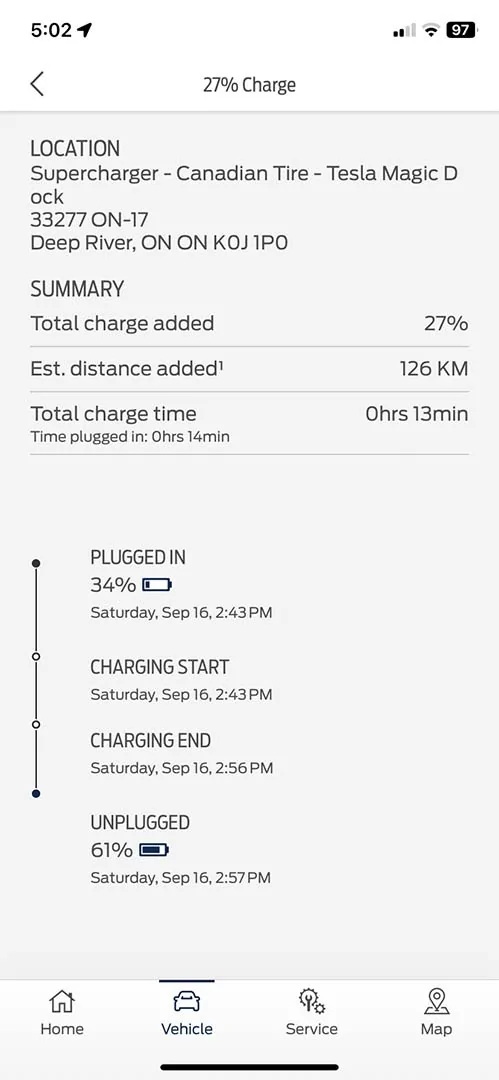
It is fast enough I do not even have time to pee anymore ;)

Ford Mustang Mach-E Edmunds Massive Charging Comparison - MME is second to last. IMG_4325
Sponsored

 
  • Like
Reactions: SWO


Top