Home Level 2 Charger Issues

louibluey

Well-Known Member
First Name
Joe
Joined
Dec 21, 2020
Threads
60
Messages
888
Reaction score
1,127
Location
NY
Vehicles
FE "Louibluey" GB
Occupation
retired
Country flag
This is exactly what he was talking about. I'm at 257V, so his thought is that it will drop it below 250V. I suppose I should read into this some more.
That also won't help if the problem is power line distortion (no filtering), and especially not if it turns out that over voltage is not the problem.
Sponsored


malba2366

Well-Known Member
Joined
Dec 7, 2019
Threads
7
Messages
448
Reaction score
427
Location
NY
Vehicles
911 C2S
Country flag
I am completely at a loss. ComEd has already come out and said they’re within the limits. Ford has a very conservative threshold for voltage. Neither seems to be willing to do anything to address my issue. My electrician has found a step-down solution that’s going to cost me at least $500. I’m irritated that I have to do this because other manufacturers’ EVs are tolerant of ComEd’s supply voltage.
Has an Engineer from Ford told you what the charging threshold is, and that they won't change it - or is this something the dealer said?
 
OP
OP
jparduhn70

jparduhn70

Well-Known Member
Joined
Dec 27, 2019
Threads
16
Messages
517
Reaction score
702
Location
Knoxville, TN
Vehicles
2021 Mach-E First Edition
Country flag
I'm in Florida and am at 248V and have never been able to charge. I would see what the Ford engineering team comes up with because this isn't geographic/provider specific and given the range of voltages on the tracking spreadsheet I'm not convinced that's the issue either.
I'm not convinced that this is a location services issue either. If you saw my earlier post, I can't charge the vehicle in Illinois at 257V, but in my house in Tennessee, it's working at 248V. I disabled location services in FordPass a few days ago, but still couldn't charge in Illinois. After successful charging in Tennessee, I re-enabled location services and it still works. I'm hoping I get lucky like @Brademcee and am able to charge when I return to Illinois tomorrow, but I'm doubtful.
 
OP
OP
jparduhn70

jparduhn70

Well-Known Member
Joined
Dec 27, 2019
Threads
16
Messages
517
Reaction score
702
Location
Knoxville, TN
Vehicles
2021 Mach-E First Edition
Country flag
Has an Engineer from Ford told you what the charging threshold is, and that they won't change it - or is this something the dealer said?
The dealer stated that there was an overvoltage error in the OBD logs. Ford engineers have not looked at my vehicle specifically.
 
OP
OP
jparduhn70

jparduhn70

Well-Known Member
Joined
Dec 27, 2019
Threads
16
Messages
517
Reaction score
702
Location
Knoxville, TN
Vehicles
2021 Mach-E First Edition
Country flag
That also won't help if the problem is power line distortion (no filtering), and especially not if it turns out that over voltage is not the problem.
I haven't committed to putting in the buck/boost device yet, so it's just an option at this point. I don't know what to do, anyway. If Ford was more receptive to my concerns, at least providing me with some dialog, I probably would just let it sort out. The utility isn't going to do anything, so I'm counting on them, but so far am very disappointed with the progress, or lack of it.


Sweetwater

Well-Known Member
Joined
Feb 5, 2020
Threads
14
Messages
500
Reaction score
347
Location
Ohio
Vehicles
Jeep
Occupation
Retired Electrician
Country flag
This is exactly what he was talking about. I'm at 257V, so his thought is that it will drop it below 250V. I suppose I should read into this some more.
Sure you could Buck it down to 240 volts but if your incoming 257 volts
changes so does 240 volts
The secondary voltage (240) is in direct proportionally to the incoming
voltage. If he Bucks 9 volts off the 257 it will always Buck 9 volts off the
incoming voltage. If you on a few days have 240 v incoming then the
transformer will still Buck off 9 volts giving you 231 volts.
 

prdude

Well-Known Member
First Name
Bill
Joined
Feb 15, 2021
Threads
0
Messages
274
Reaction score
231
Location
pleasant ridge, MI
Vehicles
Space White w/Gray MME Prem ER RWD, 01 Miata
Occupation
engineer
Country flag
Not to hijack this thread, but this is convenient to post here, since so many folks who understand electrical stuff are following this thread (I always struggled visualizing the moving around of electrons).

Anyway, I'm seeing issues with the Ford mobile charger, when hooked up to the 115V outlets in my detached garage. Basically, I get an amber light from garage outlets, but a blue light from an outlet in my back porch (different circuit). When checked with my multimeter both the garage and porch outlets read ~126V.

What else should I check on the garage outlets? Note that I was able to use the mobile charger for my Fusion Energi on a garage outlet.
 

Sweetwater

Well-Known Member
Joined
Feb 5, 2020
Threads
14
Messages
500
Reaction score
347
Location
Ohio
Vehicles
Jeep
Occupation
Retired Electrician
Country flag
Not to hijack this thread, but this is convenient to post here, since so many folks who understand electrical stuff are following this thread (I always struggled visualizing the moving around of electrons).

Anyway, I'm seeing issues with the Ford mobile charger, when hooked up to the 115V outlets in my detached garage. Basically, I get an amber light from garage outlets, but a blue light from an outlet in my back porch (different circuit). When checked with my multimeter both the garage and porch outlets read ~126V.

What else should I check on the garage outlets? Note that I was able to use the mobile charger for my Fusion Energi on a garage outlet.
Check the polarity of the recp. Hot and neutral correctly wired and also
the ground is there. The recp short slot is Hot The long slot is neutral.
 

Maquis

Well-Known Member
First Name
Dave
Joined
Dec 21, 2020
Threads
34
Messages
5,689
Reaction score
8,068
Location
Illinois
Vehicles
2021 Mach E4X, 2023 Lightning Lariat ER
Country flag
I posted this earlier in this thread, but it's worth repeating:
ANSI C84.1 is the standard utilities in North America are supposed to adhere to for voltage tolerances. There are two ranges: Range 'A' and Range 'B".
Range A is what the voltage should be during normal operation. That range is 228-252V.
Range B is looser and is only supposed to occur infrequently due to abnormal operating parameters. That range is 220-254V. If Com-Ed is saying 257 is normal, either they don't follow ANSI C84.1 or the person who told you that doesn't know what they're talking about.

Here's a link to the standard, if you want all the gory details.
 

DaveQ

Well-Known Member
First Name
Dave
Joined
Jul 6, 2020
Threads
21
Messages
363
Reaction score
494
Location
Fernandina Beach, FL
Vehicles
Mach-E4X, HR-V, Insight, Maserati Levante S
Country flag
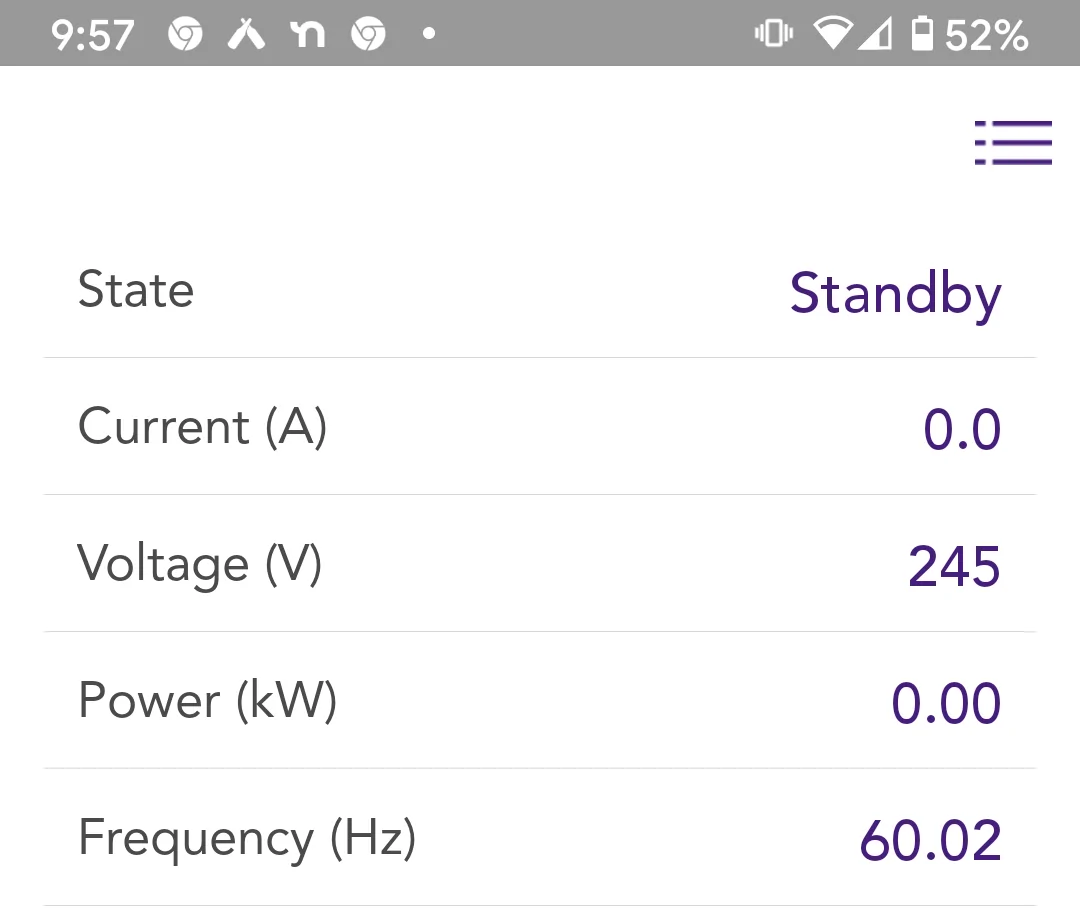
Is this going to be a problem? I take delivery this week!

Ford Mustang Mach-E Home Level 2 Charger Issues Screenshot_20210322-215725~2
 

malba2366

Well-Known Member
Joined
Dec 7, 2019
Threads
7
Messages
448
Reaction score
427
Location
NY
Vehicles
911 C2S
Country flag
Sure you could Buck it down to 240 volts but if your incoming 257 volts
changes so does 240 volts
The secondary voltage (240) is in direct proportionally to the incoming
voltage. If he Bucks 9 volts off the 257 it will always Buck 9 volts off the
incoming voltage. If you on a few days have 240 v incoming then the
transformer will still Buck off 9 volts giving you 231 volts.
Yeah but the car will charge fine at 231 (just a bit slower) - it has to accept lower voltages because it has to work with 208 as well.
 

prius2pony

Well-Known Member
First Name
Jeff
Joined
Jun 30, 2020
Threads
18
Messages
134
Reaction score
153
Location
Illinois
Vehicles
Mach-e Premium First Edition
Country flag
When it was working, was it overnight? The more power a solar inverter is inverting, the more EMI noise it can put out. For example, my wife's garage door opener remote (closest in the garage to the inverter) rarely works at high noon but works fine at night.
The successful charge was mid day, when panels were producing well.
 

bruceski88

Well-Known Member
First Name
Bruce
Joined
Aug 12, 2020
Threads
6
Messages
279
Reaction score
321
Location
CA
Vehicles
Mach e
Occupation
Retired Engineer
Country flag
I posted this earlier in this thread, but it's worth repeating:
ANSI C84.1 is the standard utilities in North America are supposed to adhere to for voltage tolerances. There are two ranges: Range 'A' and Range 'B".
Range A is what the voltage should be during normal operation. That range is 228-252V.
Range B is looser and is only supposed to occur infrequently due to abnormal operating parameters. That range is 220-254V. If Com-Ed is saying 257 is normal, either they don't follow ANSI C84.1 or the person who told you that doesn't know what they're talking about.Here's a link to the standard, if you want all the gory details.
Another EE here with his 2 cents. Most of you do not have a voltmeter that really measures AC voltage. Your meter rectifies the ac signal and measures the peak voltage. Then it assumes a perfect sine wave and multiples the reading by .707 to give you an approximation of the AC RMS voltage which should be 240V. If you have nasty harmonics or a DC component it won’t tell you that. An Oscilloscope and a true RMS voltmeter is the best way to see what’s going on. A $200 meter will make the true RMS meaurement. https://www.amazon.com/Fluke-117-El...t=&hvlocphy=9031936&hvtargid=pla-434797909169

It is possible that there is a damaged transformer messing up your power, but the whole state of Illinois? I speculate a software problem.
 

Maquis

Well-Known Member
First Name
Dave
Joined
Dec 21, 2020
Threads
34
Messages
5,689
Reaction score
8,068
Location
Illinois
Vehicles
2021 Mach E4X, 2023 Lightning Lariat ER
Country flag
Another EE here with his 2 cents. Most of you do not have a voltmeter that really measures AC voltage. Your meter rectifies the ac signal and measures the peak voltage. Then it assumes a perfect sine wave and multiples the reading by .707 to give you an approximation of the AC RMS voltage which should be 240V. If you have nasty harmonics or a DC component it won’t tell you that. An Oscilloscope and a true RMS voltmeter is the best way to see what’s going on. A $200 meter will make the true RMS meaurement. https://www.amazon.com/Fluke-117-El...t=&hvlocphy=9031936&hvtargid=pla-434797909169

It is possible that there is a damaged transformer messing up your power, but the whole state of Illinois? I speculate a software problem.
Good points.

I was presuming the voltage measurement was verified by ComEd, which one would hope would be accurate. And I also agree about how widespread this is or is not. I could see maybe one substation being set too high, but not all of NE Illinois or all of ComEd. Some utilities will hook up a power quality monitor for a couple of days at a service when requested by a licensed electrician who suspects power problems.

A true RMS meter is definitely the way to go. An untrained individual should not try to hook a scope up to measure powerline voltage. A saw a technician try to hook up a Tektronix scope to measure 208V from a generator. The probe lead melted in his hand when he tried to attach the grounded lead to one of the 208V busbars!
Sponsored


Top