
OP
OP
scoopman

scoopman

Well-Known Member
Joined
Jan 30, 2021
Threads
60
Messages
2,771
Reaction score
5,816
Location
Bay Area
Vehicles
2023 KIA EV6 GT, 20214 Hyundai Ioniq 5 Ltd AWD
Occupation
former electric pony jockey, flatbed towing expert
Country flag
Thanks! You must have your dividers in. I have a job 2.
No I have the same frunk as you -- take off the top piece of plastic above your frunk tub and you'll find a place to zip tie a key in a faraday bag.
Sponsored


ZuleMME

Well-Known Member
First Name
Zule
Joined
Apr 23, 2021
Threads
10
Messages
1,018
Reaction score
1,487
Location
Denver, CO
Vehicles
21' Job1 P4X MME, 22' MYP
Occupation
Implementation Engineer
Country flag
It certainly has to be designed to deliver those currents plus a margin and resistivity and thermal stress of materials isn't some new fangled science.

Further, there's no chance in hell a shop like FoMoCo doesn't run everything through design tools, review processes, FMEAs etc.

Sure shit happens, but it's more likely to be in a plant run by someone from Danny Ocean's crew.
Understood, I was looking for numbers like what @Mach-Lee has now provided. And while theoretical, they make this add up a lot better.
 

Addos

Well-Known Member
First Name
Bradley
Joined
Mar 15, 2021
Threads
3
Messages
133
Reaction score
140
Location
Raleigh, NC
Vehicles
2021 Grabber Blue First Edition Mustang Mach E AWD
Country flag
For most manufactures a production viable ICE engine will need to pass a test that has them held at WOT for 300 to 400 hours. If Ford does not have an equivalent test for an EV then there engineering and testing department are an utter failure.

You are not exactly going to get much range at 125mph but that is cruising speed for some drivers on the autobahn and they would expect the vehicle to be able to delivery that day after day.
^ THIS 100%. These cars should have stress tested to hell and back before releasing them to the public. There is no way if they had, this issue wouldn't have been caught. Unless it was caught, and they pushed it out the door, regardless of the consequences.
 
Last edited:

Fordmaybe

Well-Known Member
First Name
Joel
Joined
Nov 1, 2021
Threads
4
Messages
158
Reaction score
84
Location
NH
Vehicles
No ford yet
Occupation
Manufacturing
Country flag
Looks like I will be trading in asap after get min in a few weeks


Electric Goat

Well-Known Member
Joined
May 31, 2021
Threads
14
Messages
925
Reaction score
1,898
Location
Twin Cities, MN
Vehicles
'21 Mach-E GT & '24 BRZ
Country flag
^ THIS 100%. These cars should have stress tested to hell and back before releasing them to the public. There is no way if they had, this issue wouldn't have been caught. Unless it was caught, and they pushed it out the door, regardless of the consequences.
In regards to the GT & GTPE,

A few big red flags that I ignored were that automotive journalists couldn't get their hands on one early to do testing. Then, when the did get the GT/GTPEs, they were limited by when, where and how they could drive them.

???

It would have also been nice to see some lap times at known tracks. NΓΌrburgring times, anyone?
 

mkhuffman

Well-Known Member
First Name
Mike
Joined
Nov 19, 2020
Threads
29
Messages
6,880
Reaction score
9,519
Location
Virginia
Vehicles
2025 Rivian R1T Tri-Max, Jeep GC-L, VW Jetta
Country flag
If the car is pulling a continuous current of 250 Amps with accelerations that crank it over 500 Amps periodically, and that goes on for 20 or 30 minutes, why do we think the contactor rating of 500 Amps for 7.5 minutes is sufficient?

I know we are taking educated guesses about the current load when driving at 80 mph up a long climb, but it seems to me you could easily exceed the capacity of the contactor doing that, causing it to overheat and melt internal stuff.
 

ZuleMME

Well-Known Member
First Name
Zule
Joined
Apr 23, 2021
Threads
10
Messages
1,018
Reaction score
1,487
Location
Denver, CO
Vehicles
21' Job1 P4X MME, 22' MYP
Occupation
Implementation Engineer
Country flag
If the car is pulling a continuous current of 250 Amps with accelerations that crank it over 500 Amps periodically, and that goes on for 20 or 30 minutes, why do we think the contactor rating of 500 Amps for 7.5 minutes is sufficient?

I know we are taking educated guesses about the current load when driving at 80 mph up a long climb, but it seems to me you could easily exceed the capacity of the contactor doing that, causing it to overheat and melt internal stuff.
I was going that way to; but per the spec sheet these details then stand out:

"Maximum allowed terminal temperatures are: 150Β°C continuous; 175Β°C for 2h; 200Β°C for 2min"

I can't really argue that it seems on paper to be a reasonable design. Maybe not for a GT/GTPE though as those by design should be expected to at any given time have one of the two pedals floored.
 

Addos

Well-Known Member
First Name
Bradley
Joined
Mar 15, 2021
Threads
3
Messages
133
Reaction score
140
Location
Raleigh, NC
Vehicles
2021 Grabber Blue First Edition Mustang Mach E AWD
Country flag
If the car is pulling a continuous current of 250 Amps with accelerations that crank it over 500 Amps periodically, and that goes on for 20 or 30 minutes, why do we think the contactor rating of 500 Amps for 7.5 minutes is sufficient?

I know we are taking educated guesses about the current load when driving at 80 mph up a long climb, but it seems to me you could easily exceed the capacity of the contactor doing that, causing it to overheat and melt internal stuff.
I'm sure the software update will fix everything. :rolleyes:
 

Blue highway

Well-Known Member
First Name
Steve
Joined
Oct 15, 2021
Threads
5
Messages
2,708
Reaction score
4,257
Location
Oregon
Vehicles
Mach E Premium SR RWD
Country flag
Okay, so for a little perspective here. The MME top end is supposed to be 124 mph, so let's call it 125 mph for convenience.

That means the system needs to be designed to deliver current to support that speed in nominal, i.e. flat, wind neutral conditions, call that I_pk.

In nominal freeway driving conditions, the power needed to over come wind resistance goes as speed cubed, or to the 3rd power, and in electrical terms, that means the product of voltage and current must track this. Assuming fixed voltage that means the current required will go as speed cubed.

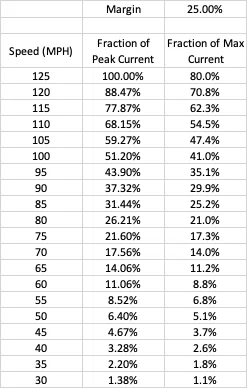
If we look at the amount of current required as a function of speed below the max speed, we see the table below.

Driving at 80 MPH, means that the motors are drawing 1/4 of the current need to support the max speed of the vehicle and 1/5 that of a 25% design margin.

1656707810667.png


Not knowing the circuit, I'd be hard pressed to make an intelligent guess as to the true issue, but it seems unlikely that any of the issues we've been reading about here are due to running the vehicle too hard.

I'd be more inclined to believe FoMoCo have a QA issue at the site of manufacture of the HVBJB.
In the case of the GT the motors put out 358KW max power. With 400v input, the draw for 358KW is 895A. For perspective, a MIG welder needs what... 200A to weld 1/2 inch steel. The relay that is getting welded is good for 500A.
 

gpgrim

Well-Known Member
First Name
Gary
Joined
May 17, 2021
Threads
11
Messages
233
Reaction score
213
Location
Danville, CA
Vehicles
RR 4XP, MB E-350, Exp. EB, Subaru XTrek
Occupation
Physicist
Country flag
125 MPH continuous would take about 100 kW from my modeling, or about 290 amps. Getting there will use way more than that though depending on how fast you accelerate. So maybe 800 amps average to get to 125 MPH and then down to 300A to maintain? Either way using top speed as a durability test for EVs is not really the best way since the acceleration loads are much bigger/harder on the hardware.
I agree. Failure modes are definitely not an exact science, and they come in different categories, so it's worth putting each into their own perspective.

I hadn't considered the transient/impulse loads, but again I have to believe the design engineers had to have run finite element analyses on these critical current elements, and demonstrated in reviews their performance.

Resistive heating, which does go as the current squared, is also dissipated pretty quickly in metals, so if you survive the acceleration, i.e. you're transient event is over, then it seems odd to me to fail in a constant draw state. Certainly aging can be an issue here, but the DC heating from the DCFC and the constant speed just don't add up for me, unless either there was a QA problem in the HVBJB materials or assembly.

Now all that said, none of really know, and yes, FoMoCo could have pulled a Boeing and managers under pressure rammed an insufficiently reviewed design through to make a schedule. I sure hope not, but regardless, I smell a class action suit on the horizon.
 

Kamuelaflyer

Well-Known Member
First Name
Bill
Joined
Feb 18, 2020
Threads
11
Messages
11,457
Reaction score
23,216
Location
Hawaii
Vehicles
2021 Premium Infinite Blue. ER AWD. 2020 Raptor, 2021 Ranger.
Country flag
We're not going to know anything, other than I'll hopefully be testing the new redesigned part on the same route home in a week!

I doubt the dealer or Ford will tell me what they missed in developing this software, or whether it worked as intended and this is actually what more folks should expect.
I was being far more general. We will never know exactly what the issue was. I was thinking along the lines of, "Yes, you need a new junction box. We're confident ..." or "Your HVBJB is fine. The problem was your car's flux capacitor simply needed to have the Higgs Field reset and flushed."


BTW, if you can actually do the latter (and prove it), there's a committee in Sweden that would like to award you a prize in physics.

Try to enjoy the vacation.
 

ARK

Well-Known Member
Joined
Aug 21, 2020
Threads
45
Messages
2,940
Reaction score
4,297
Location
Los Angeles
Vehicles
'21 Premium SR AWD
Country flag
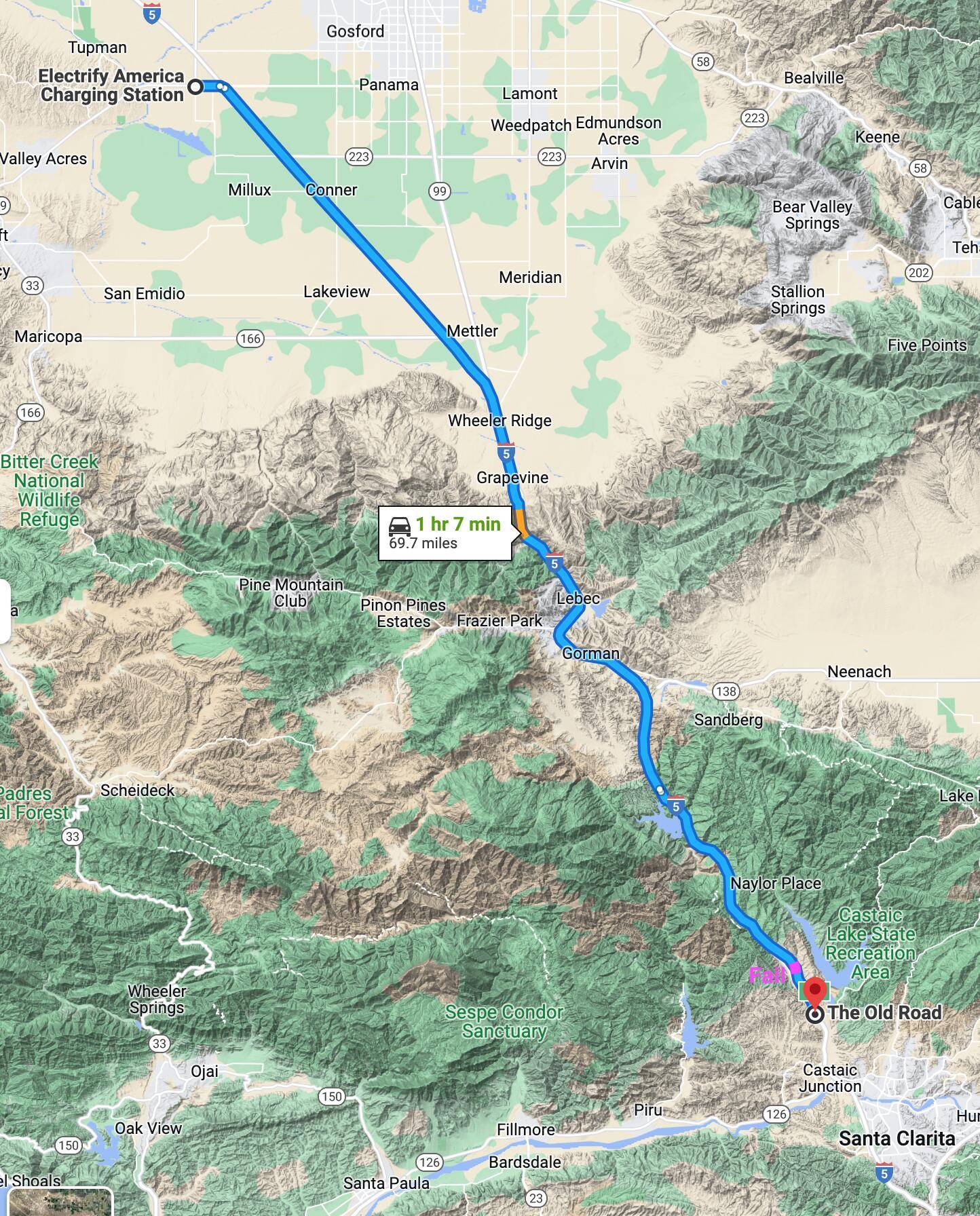
Here's some analysis, I believe this was scoopman's route. He started the last leg with a 44% to 81% DCFC at an average rate of about 87 kW, which is about 250A into the pack. The continued driving on I-5 South towards Los Angles, passing over a mountainous area locally called "The Grapevine". The "Service vehicle soon" message appeared near the end of the downhill side, shortly before Castaic, CA.

Screen Shot 2022-07-01 at 2.18.41 PM.png


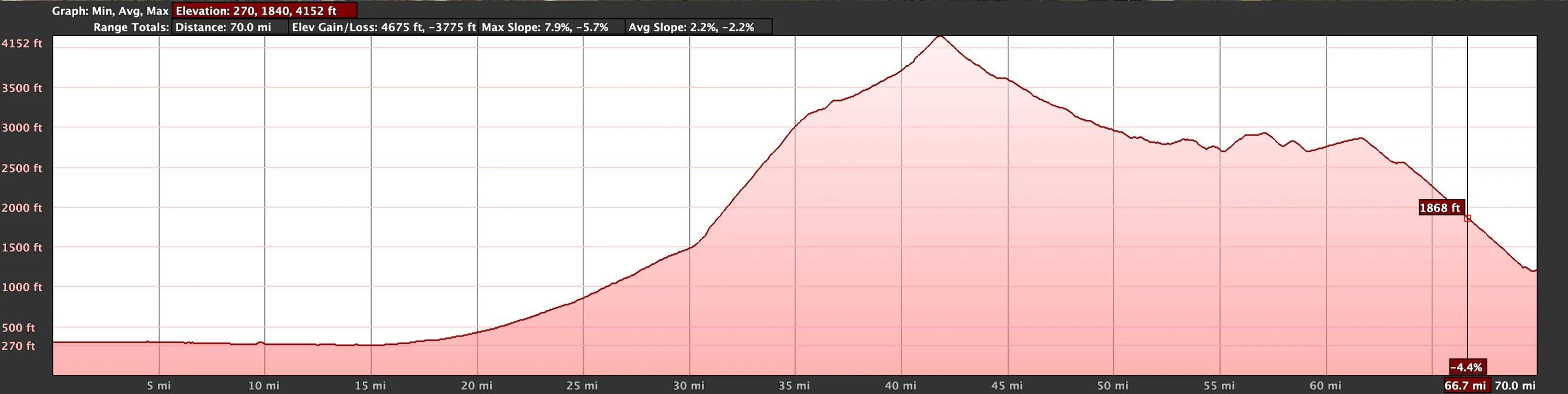
Failure point is marked in magenta on the map above. Here is the elevation profile of the leg:

Screen Shot 2022-07-01 at 2.31.20 PM.png


The cursor is at the failure point, approx. coordinates 34.53535 -118.64553. It occurred on a -4.4% downhill slope shortly after a brief lane change acceleration. Random thought: perhaps the contactor monitoring does not work during regen, if so it wouldn't notice overheating on long downhill stretches until power is used?

The maximum slope on the uphill side is 6.0%. Assuming the vehicle is fully loaded (GVWR), the power required to go up that hill at a constant 80 MPH would be: 2713 kg x 36 m/s x 6% = 5860 kgfβ‹…m/s or 57 kW of power to increase elevation, plus the normal aero and RR for 80 MPH of about 32 kW, so 89 kW total or about 250A (about the same power as the DCFC). This had the effect of basically two DCFC sessions in the course of an hour. The contactors rated for 500A should be able to handle 250A continuous just fine without overheating, so the contactors were likely faulty or damaged previously to overheat there. Shouldn't happen.

The other interesting point here is the 250A to go uphill is less than the ~350A power limit applied with the fault, so in theory you could still go over the Grapevine just fine with the power limit in effect, you just won't be able to pass anyone. Moving over and following a semi over the hill would be safe, pretend you are one.

If you have to drive up mountains in hot weather, it's probably wise to just use BlueCruise and avoid hitting the pedal to pass. Maybe you'd want to do a cool down period before and after DCFC, but I'm not sure how fast the contactors cool down? Meh. Either way, some people have bad parts and they are going to fail eventually no matter what you do. If you do have a good part, then you'd just be needlessly waiting, worrying, and babying the car. IDK, get the updates, live your life, take your trips, use the forum for catharsis, and just deal with the car problems if you happen to be the unlucky 1%. On the bright side, once you have a failure you'll get the new part so you can stop worrying.
Good data and thoughts, it looks like he also lost 2,000 feet of elevation on the way down from what you posted. I assume the regen sends power through the same place, just in reverse? If that's right then he (1) DCFCed, (2) climbed about 4,000 feet, and (3) descended about 2,000 feet before the service soon message appeared, all within a relatively short time.

Again, totally normal/expected usage by an owner on a road trip like this.
 

RWG

Well-Known Member
First Name
Randal
Joined
Jan 16, 2022
Threads
0
Messages
169
Reaction score
231
Location
Chaska Minnesota
Vehicles
2021 Mach E
Occupation
Retired
Country flag
Here is a post a made a couple of days ago related to another conversation thread.


It's good to know there is a fix, albeit just software. Does anyone know what the root cause of the issue was/is? i.e. how did software cause a heavy duty, DC voltage, hermetically sealed contactor to overheat?

I have concerns.

The end symptom, result of this problem is an overheated contactor but what I want to know is Why, How? My experience with over heated contractors in other electrical equipment applications are, many times their was collateral damage to the contactor, related to the times it was overheating. As a result, in some situations I have experienced, a compromised contactor would eventually fail prematurely as collateral/cumulative overheating episodes kept on occurring. So if we are lead to believe the fix is software, then it means there was a software problem that lead to overheating that took out some contactors over time. On one hand, software fix to correct a software problem seems perfectly logical and I can accept that but on the other hand are my contactors now compromised after 5,000 miles of operation? And therefore maybe going to fail prematurely sometime in the future, most likely after the warranty runs out?

Furthermore, if these contactors got hot enough to sometimes weld together, that means sometimes there maybe collateral damage to the wire connections and wires attached to the contactor. Theoretically, an overheated contactor can do lots of collateral damage to other components.

A software fix may cure the problem from happening again on a new contactor and new production. What about a contactor that has been in use for nearly 6 months? Software cannot undo mechanical contactor overheating collateral damage that has already occured. How can I tell if a contactor has been compromised? Especially since it is hermetically sealed and probably cannot be taken apart or inspected.

If there is any logic to my concerns, than I would expect Ford to extend the warranty on any future failure related to that part, beyond the traditional 36,000 miles or 3 years. Also, if compromised contactors are a contingent liability, perhaps they should just be replaced. ?

Opinion from a former corporate warranty manager: Why wouldn't Ford choose to do software AND to replace parts? Perhaps because a software warranty upgrade on 50,000 vehicles is relatively cheap, but replacing 100,000 contactors and software is not, ( I believe there are at least 2 contactors in every vehicle) especially since the problem appears to be Fords software and not the component. Therefore there is no warranty cost recovery opportunity for the failed part. As such, Ford would be left bearing the total cost of this warranty/recall campaign with no assistance from the contactor supplier.

Curious . . . .
Sponsored


Top