louc757

Well-Known Member
First Name
Lou
Joined
Sep 3, 2022
Threads
3
Messages
110
Reaction score
127
Location
Louisville, KY
Vehicles
23 MME GTPE Rapid Red Nite Pony, 2024 Silverado 2500
Occupation
Pilot
Country flag
En-Route Battery Preconditioning for DCFC

Today's test is the new en-route battery preconditioning feature introduced in Power-Up 3.6.2. The idea is to heat the battery while you drive to the charger so it can accept charge at a higher rate. You must select a DC charger in the Ford Nav and be within 30 km (19 mi) of it before preconditioning will occur.

To set the stage here, it's a below 0ÂșF day here. I Level 2 charged all day at work, and even though I was charging the battery still cooled off to -8ÂșC (18ÂșF) by quitting time. I input the local EA station into the nav, and I heard the battery heating start. However it shut off shortly after taking off. Because it's so cold, the cabin heater was taking too much power and preconditioning was cancelled. Bummer. Until I had the bright idea of turning OFF HVAC. Well, that worked, fired the battery heating right up.

Now a normal person probably would have called it quits after a few minutes of no cabin heat in these pleasant -19ÂșC (-2ÂșF) temps, but I'm not normal. Yes, I suffered for science ? in order to see how long it would take to heat the battery up for DCFC, and how high it would go. The short answer is it took AN HOUR AT FULL HEATER OUTPUT to reach the 26ÂșC target temp for DCFC. An hour seems much longer when you're freezing. To get around the 30 km geofence limitation, I drove in circles on the highways surrounding the charger. I could have parked it and went inside, but I wanted the airflow under the pack to simulate real-world cooling effects on a highway. BTW, to avoid the windows fogging up, you need some air movement, so I ended up setting the cabin temp on LO with the fan on speed 1. That disables cabin heat and blows raw outside air at you. That helped make a pretty graph that wasn't disrupted by repeated defrost cycles, and it also helped the cabin cool down to 15ÂșF while I was driving. I was very happy to see the heater finally shut off, and immediately switched the cabin heat back on as I made my way to the EA station for DCFC.

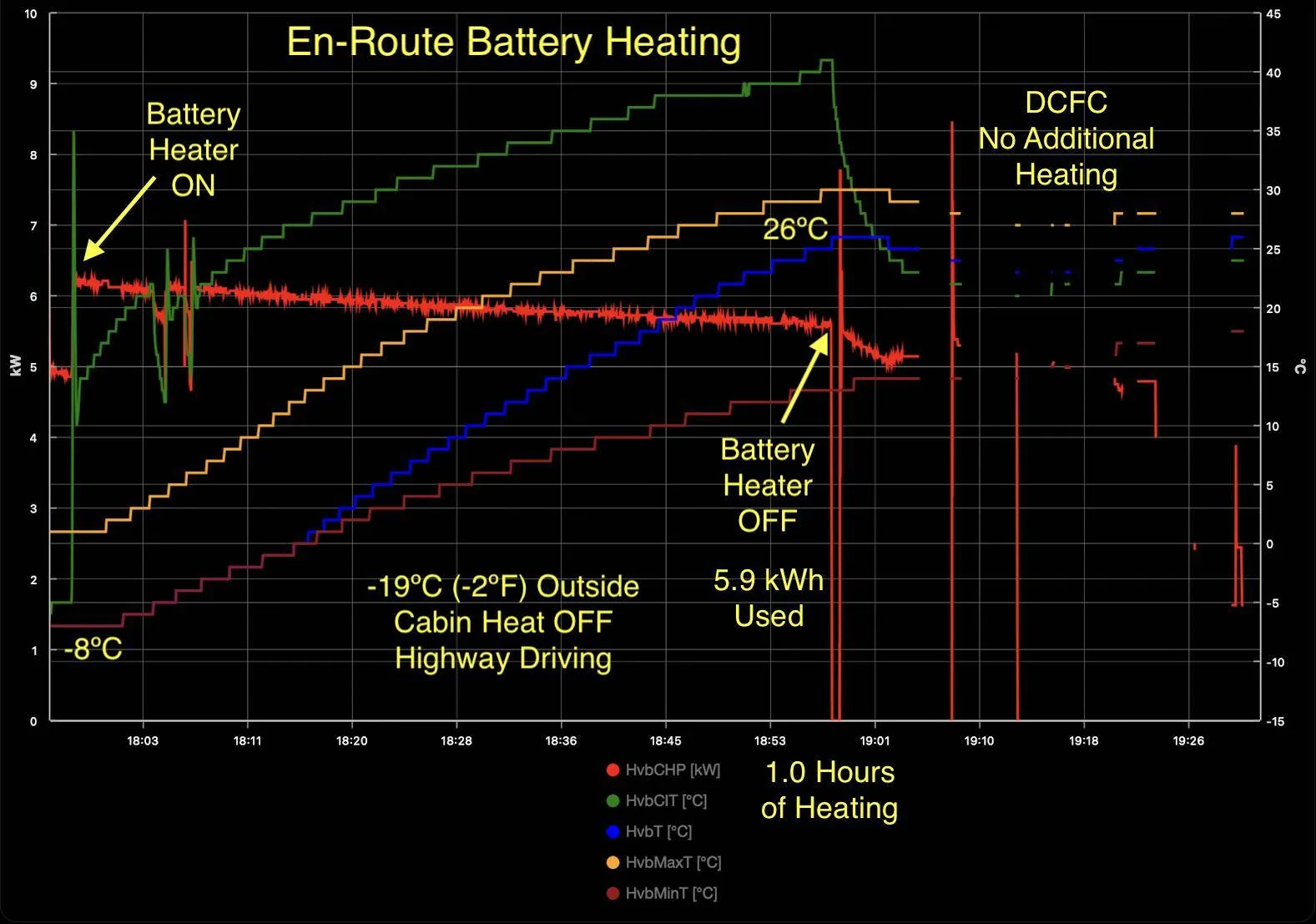
So let's take a look at the temperature graph:

En-route Battery Preconditioning.png


Focus on the blue line which is the main pack temp. In 61 minutes it went from -8ÂșC (18ÂșF) to 26ÂșC (79ÂșF). The heater output started at 6.2 kW and gradually declined to 5.6 kW (this is the PTC effect as the coolant return temp increases). Keep in mind this graph really represents the fastest you could possibly heat the battery in these conditions, the amount of heat available with the HVAC on simultaneously will be quite a bit less. If the HVAC was on at the same time, pack heating likely would have taken two hours and would have run into a wall before reaching 26ÂșC. Perhaps it would have only reached 5ÂșC. This is why it was disabled due to limited heat reserve. I will need to wait for a warmer day to test battery preconditioning while the cabin heat is still active, but the rate of heating will be significantly less.

Now let's look at the DCFC session at a 150 kW EA station I reached shortly after battery heating finished:

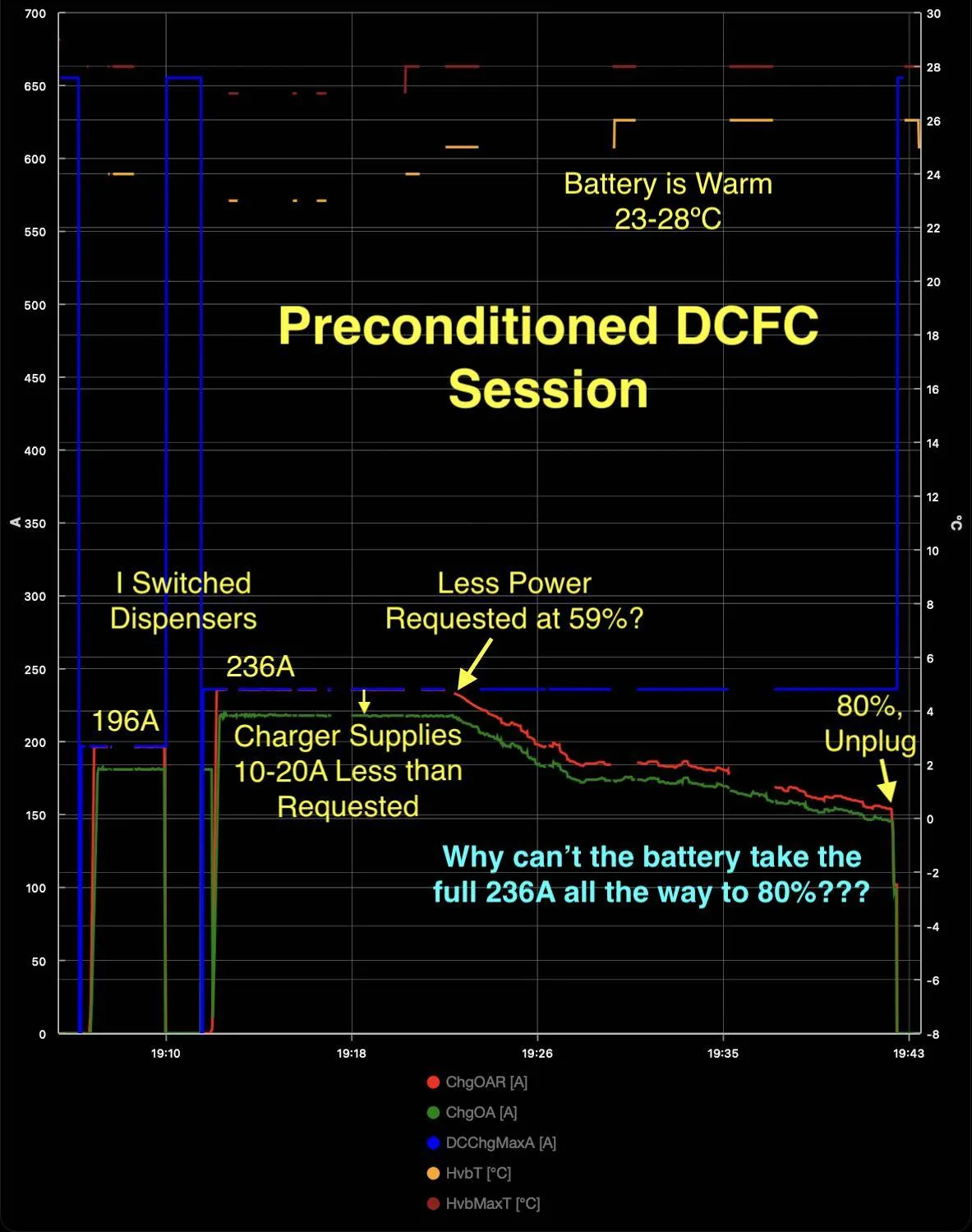
Preconditioned DCFC Session.png


Temp was down to about -20ÂșC/-4ÂșF when I pulled in. A lot of the chargers were displaying a "power reduced" message. I chose one not displaying the message, and activated with Plug & Charge. However I immediately noticed a 196A max current limitation (blue line), much less than the 350A these stations should be capable of. I wasn't happy with only 62 kW, so I decided to try a different dispenser. This one allowed up to 236A which was an improvement, but still slower than it should be. Not sure how much the cold affects these things. The car was correctly asking for full amperage (red line) at first, but the stations always supply (green line) 10-20 amps less than requested for some reason.

After reaching about 59%, the car decided to start requesting less current from the charger, you can see the red request line start decreasing. This is frustrating because the battery is warm enough and perfectly capable of handling the full 236A all the way up to at least 75-80% SoC. Ford has this weird charging strategy where they set the remainder of the charge curve based on the initial rate. Almost like it's a percentage of the initial rate. This means if you use a slower charging station, it will slow you down that much more for the rest of the curve based on the initial speed. This is totally not necessary, there should be a calculated maximum rate at each % SoC based on the battery temps. When using a slower DCFC station (<80 kW), it should be pegged at maximum output the whole way to 75-80%. At only 218A, no part of the battery should be getting that hot so I just don't see the need to throttle it. Ford should work on this strategy because they are needlessly reducing the charging speeds at lower power DCFC stations.

During the DCFC session, the battery was not heated any more by the PTC heater. I shut HVAC off to make sure, nothing happened. I've seen some cases where it heats more than 26ÂșC after starting a session, the decision to heat more must be tied to the charging power available. In this case heating more wasn't necessary for the speeds I was charging at. Temp increased from 23ÂșC to 26ÂșC on its own during the session (yellow trace at the top).

Findings:
  • Battery took 1 hour to heat from -8ÂșC to 26ÂșC using full 6 kW heater output (34ÂșC/hr)
  • Battery heat capacity is 0.18 kWh/ÂșC or 630 kJ/ÂșC
  • Preconditioning starts as soon as a DC station within 30 km is selected in the Ford nav
  • There is no time limit on battery heating as long as you remain within 30 km of the station
  • There is a 26ÂșC upper temp limit
  • En-route preconditioning will not occur at extreme cold temps unless you turn off HVAC
  • Many EA stations operate with significantly degraded performance
  • EA stations output 10-20 amps less than requested by the car
  • Additional heating above 26ÂșC while DCFCing is not always commanded
  • Ford throttles back the charge rate unnecessarily at lower-amperage DC stations
Conclusions:
  • The Mach-E needs a dedicated 5 kW battery heater that is not shared with the cabin.
  • Battery temp increase will be limited with only a 30 km range limit.
    • I think this limit should be increased to 60-120 km to give enough time.
  • EA stations are in varying states of disrepair
  • Ford should fix unnecessary throttling of low-amp DC stations and allow full current up to 75-80%. The current limit at 50-75% should not be affected by the initial station amperage unless using a high amperage (300+) station.
Thanks for doing this test. I have a 23 MME, and have not received any OTA updates, so I wasn't sure if i had preconditioning or not. My car was built on 11/9/22, Sync Rev 592, Ver 22280 or 10/7/22. I wasn't able to find the exact charger I wanted to go to in the Ford Nav app because there are many in Cincinatti, so I picked one that looked close. It was a cold day (for Kentucky anyway) at about 25 deg F. Battery was about 40 deg F driving from Louisville to Cincy. As I got within 20 miles, battery started heating. I had the heat off since it was a sunny day, and wanted to see how fast a warm battery will charge at.

As I went past the station enroute to the EA station on in Harper's Station, it kept warming. Since I was going on a loop (I-275) and I remained withing 20 miles of the station in the Ford Nav, it kept heating and warmed up to 80.6 deg F. So those with a 23, it looks like battery preconditioning was delivered with the vehicle.
Sponsored
 

hawkeye3point1

Well-Known Member
Joined
Nov 13, 2021
Threads
0
Messages
480
Reaction score
460
Location
NH
Vehicles
Space White ER RWD, Born on 12 Aug. '21
Country flag
Question: I think I understand that the MME won't precondition (with "scheduled departure") if it's connected to Level 1 charging. But when it's sitting overnight on L1 charging and the temps drop to extreme levels, will it try to warm the battery to protect it? Does it need to?
L1 will provide HVB thermal management to keep it above freezing (34F) as long as HVB SOC is above max. charge setting. The lowest max. charge setting is 50%. The PTC will only see 1 kW of power so it can take a while if the HVB temp. gets too low.

Does it need to? That is a personal call. If my HVB is below 30F, I just keep regen below 10 kWh by driving in Whisper and braking in neutral.
 

awp0

Well-Known Member
First Name
Aaron
Joined
Jul 23, 2022
Threads
13
Messages
973
Reaction score
1,216
Location
boston, ma
Vehicles
MME Premium AWD ER
Country flag
L1 will provide HVB thermal management to keep it above freezing (34F) as long as HVB SOC is above max. charge setting. The lowest max. charge setting is 50%. The PTC will only see 1 kW of power so it can take a while if the HVB temp. gets too low.

Does it need to? That is a personal call. If my HVB is below 30F, I just keep regen below 10 kWh by driving in Whisper and braking in neutral.
This is great information. Thank you!
 
OP
OP
Mach-Lee

Mach-Lee

Well-Known Member
First Name
Lee
Joined
Jul 16, 2021
Threads
262
Messages
11,344
Reaction score
24,965
Location
Wisconsin
Vehicles
2022 Mach-E Premium AWD
Occupation
Sci/Eng
Country flag
Question: I think I understand that the MME won't precondition (with "scheduled departure") if it's connected to Level 1 charging. But when it's sitting overnight on L1 charging and the temps drop to extreme levels, will it try to warm the battery to protect it? Does it need to?
See posts #99 and #128 for details.

Thanks for doing this test. I have a 23 MME, and have not received any OTA updates, so I wasn't sure if i had preconditioning or not. My car was built on 11/9/22, Sync Rev 592, Ver 22280 or 10/7/22. I wasn't able to find the exact charger I wanted to go to in the Ford Nav app because there are many in Cincinatti, so I picked one that looked close. It was a cold day (for Kentucky anyway) at about 25 deg F. Battery was about 40 deg F driving from Louisville to Cincy. As I got within 20 miles, battery started heating. I had the heat off since it was a sunny day, and wanted to see how fast a warm battery will charge at.

As I went past the station enroute to the EA station on in Harper's Station, it kept warming. Since I was going on a loop (I-275) and I remained withing 20 miles of the station in the Ford Nav, it kept heating and warmed up to 80.6 deg F. So those with a 23, it looks like battery preconditioning was delivered with the vehicle.
Thank you for testing that, I’ve long suspected the ‘23s have had en-route preconditioning already but you’re the first person to actually test it on one.
 

awp0

Well-Known Member
First Name
Aaron
Joined
Jul 23, 2022
Threads
13
Messages
973
Reaction score
1,216
Location
boston, ma
Vehicles
MME Premium AWD ER
Country flag
See posts #99 and #128 for details.
Thank you! And sorry, I thought I had kept current on this thread, but somehow I missed or forgotten that you had reported this. Much appreciated!


One5ame

New Member
First Name
J
Joined
Feb 23, 2023
Threads
0
Messages
4
Reaction score
1
Location
Finland
Vehicles
Mach-e 2021
Country flag
Is there still no fix for the periodical sudden fogging of windows due to the automatic closing of the "fresh air vent" or something similar?

I seem to have to do several max defrost sessions on my 20-minute ride to work.
Heat in itself is no problem for me, only fogging windows.

I have tried automatic 1, 2 and 3 settings + manual in different settings.
Temperatures have been between 0 and -15 celsius / (32 - 5 Fahrenheit)

Wish I could tweak the automation a little bit myself. I am getting tired of defrost spam :)
 
OP
OP
Mach-Lee

Mach-Lee

Well-Known Member
First Name
Lee
Joined
Jul 16, 2021
Threads
262
Messages
11,344
Reaction score
24,965
Location
Wisconsin
Vehicles
2022 Mach-E Premium AWD
Occupation
Sci/Eng
Country flag
Warmer En-Route Preconditioning Test

Exterior temp: 5ÂșC (41ÂșF)
Starting battery temp: 10ÂșC (50ÂșF)

I've been waiting for warmer temps to do another preconditioning test. Unlike previous tests, this time there should be an adequate heat reserve, so I wanted to test it with HVAC on, which is more typical of how most people would use it. Also the battery was somewhat warm to begin with, which again is more typical.

Test 1 result: +8ÂșC battery temp increase (10ÂșC to 18ÂșC). FAIL. Not warm enough for proper DCFC.
75 MPH / 15 minutes

For test 1, I drove towards the DCFC station on the interstate at 75 MPH, set in the Ford nav. At first I had my HVAC set to my usual 68ÂșF AUTO 2 setting. However I had trouble getting the heating to initiate, so I had to drop my HVAC to 60ÂșF. Heating starts 18.6 miles out, so total preconditioning time was only 15 minutes. The temp only reached 18ÂșC when I arrived at the charger, which failed to meet the target of 26ÂșC. In other words, I only made it 50% of the way to the temperature target. I've said this many times now, but the 30 km geofence before heating starts is too short. It needs to start at least 80 km out from the charger to get good results.

Another thing I observed is the battery heating shut off upon arrival. If there is a delay plugging in (such as waiting in line or finding a working charger) your battery will no longer be heating. It should keep heating the battery until you plug in or leave. This is really annoying because you'd have to park far away from the charger if you wanted to keep heating the battery while waiting.

Graph was pretty boring for this one, heater pegged at 5.5 kW the whole time.

Test 2 result: +6ÂșC battery temp increase (18ÂșC to 24ÂșC). FAIL. Close, but even slower warming.
60 MPH / 19 minutes

For test 2, I drove outside the 30 km geofence then turned around. This time I took a route with slower highways with 55 MPH speed limits. The first test was a "fast" test, this should be a "slow" test to simulate driving on smaller highways to a DCFC. I also left the HVAC on at 68ÂșF this time to see what it could do while still providing adequate cabin heat. This time, even though it had about 20% more time, it heated the battery 25% less than the first test because of the higher climate setting of 68ÂșF. I also consider this a fail. I would need a 80 km geofence to have enough time to heat 10ÂșC to 26ÂșC in these conditions with cabin heat on.

Ford Mustang Mach-E Mach-Lee's Mach-E Cold Weather Testing [Taking Requests] IMG_1832


Looking at this graph, we can see the coolant temps at the top. The battery diverter valve is opening and closing to switch the battery in and out of the heater loop. The battery is switched out to recover the coolant temp going to the heater core (green) so the cabin stays warm enough. This lasts about 90 seconds before the battery is switched back in (loop temp drops due to large thermal load). The duty cycle for battery heating was about 75%, the other 25% of the time was spent exclusively heating the cabin. Last we can see there is about a 13ÂșC coolant temp drop after passing through the heater core.

Summary:
  • Even with reasonable above-freezing temps, enroute preconditioning failed to bring the battery up to an adequate minimum temperature for DCFC in time.
  • The 30 km geofence is still much too short! Suggest 80-100 km.
    • Going longer is not a concern because the heater will shut off when warm enough. Won't cause excess range depletion.
  • The 26ÂșC target temp is also a little low, I would like to see 30ÂșC minimum on arrival.
  • Battery heating shut off upon arrival. It should keep going until you plug in or leave.
  • New HVAC software did well, maintained cabin humidity around 31% and no fogging observed.
 
Last edited:

buzzz

Member
Joined
Jan 22, 2022
Threads
2
Messages
17
Reaction score
16
Location
Mountain West
Vehicles
21 Prem AWD ER, Jeep 4xe (Rubi and GC)
Country flag
Love these posts, Mach-Lee. What a service they are to the community. Thank you.

I typically drive from Sacramento, CA to Reno, NV through the Donner Pass :eek: and am a bit concerned about the MME's ability to make it on a single trip during the winter ('21 Prem ER AWD, stock 19" wheels & CrossClimate tires). Thus far I've used my ICE vehicle for the trip but am keen to give the MME a shot next season.

The distance is 140 miles total.

Route goes from sea level to +7000 feet over 100 miles, then (thankfully) descends to 4600 feet for the remaining 40 miles, all on I-80. Temperatures in the harshest part of the season are 10-20 degrees Fahrenheit with snow falling. I'd like to run the cabin heater at 70 degrees.

When there are chain controls (only required on big rigs and 2WD cars), speeds drop to sub 35 mph for a chunk of the climb but let's assume 72 mph for the drive.

There are two typical scenarios:
  • Scenario 1: no chain controls, 72 mph for the drive.
  • Scenario 2: chain controls (only required on big rigs and 2WD cars), speeds drop to sub 35 mph for a chunk of the climb. Drive can take 4-5 hours, meaning the cabin heater will be on much longer but the car will be going much slower.
Do these conditions in either of these scenarios stretch the car's ability to make it?

Ford Mustang Mach-E Mach-Lee's Mach-E Cold Weather Testing [Taking Requests] Screenshot 2023-04-30 at 4.58.46 AM
 
Last edited:

21st Century Pony

Well-Known Member
First Name
Martin
Joined
May 21, 2022
Threads
36
Messages
1,976
Reaction score
2,243
Location
Arlington, Virginia
Vehicles
formerly Ford Mustang Mach E 2022 Premium AWD ER, now a li'l bit of Lightning ER
Country flag
Love these posts, Mach-Lee. What a service they are to the community. Thank you.

I typically drive from Sacramento, CA to Reno, NV through the Donner Pass :eek: and am a bit concerned about the MME's ability to make it on a single trip during the winter ('21 Prem ER AWD, stock 19" wheels & CrossClimate tires). Thus far I've used my ICE vehicle for the trip but am keen to give the MME a shot next season.

The distance is 140 miles total.

Route goes from sea level to +7000 feet over 100 miles, then (thankfully) descends to 4600 feet for the remaining 40 miles, all on I-80. Temperatures in the harshest part of the season are 10-20 degrees Fahrenheit with snow falling. I'd like to run the cabin heater at 70 degrees.

When there are chain controls (only required on big rigs and 2WD cars), speeds drop to sub 35 mph for a chunk of the climb but let's assume 72 mph for the drive.

There are two typical scenarios:
  • Scenario 1: no chain controls, 72 mph for the drive.
  • Scenario 2: chain controls (only required on big rigs and 2WD cars), speeds drop to sub 35 mph for a chunk of the climb. Drive can take 4-5 hours, meaning the cabin heater will be on much longer but the car will be going much slower.
Do these conditions in either of these scenarios stretch the car's ability to make it?

Screenshot 2023-04-30 at 4.58.46 AM.png
Nice elevation graph.
 

AKgrampy

Well-Known Member
First Name
Mike
Joined
Jan 29, 2022
Threads
7
Messages
3,521
Reaction score
3,592
Location
Fairbanks, Alaska
Vehicles
Ford Expedition, Ford F-150, Mach E GT
Occupation
Retired
Country flag
Is there still no fix for the periodical sudden fogging of windows due to the automatic closing of the "fresh air vent" or something similar?

I seem to have to do several max defrost sessions on my 20-minute ride to work.
Heat in itself is no problem for me, only fogging windows.

I have tried automatic 1, 2 and 3 settings + manual in different settings.
Temperatures have been between 0 and -15 celsius / (32 - 5 Fahrenheit)

Wish I could tweak the automation a little bit myself. I am getting tired of defrost spam :)
My experience here in Alaska matches yours. Heat works OK to about -20F (never gone out with it colder) but wish there was some additional balance between defrost and floor/defrost. As soon as I get a bit of fogging I can clear it up instantly by switching to defrost but then the car cools a bit. Then I switch back. Auto mode never works well and always fogs up massively. I am not an instrumentation tech but I wonder what Ford uses to determine humidity and if it does not work as well in northern climates.
 
OP
OP
Mach-Lee

Mach-Lee

Well-Known Member
First Name
Lee
Joined
Jul 16, 2021
Threads
262
Messages
11,344
Reaction score
24,965
Location
Wisconsin
Vehicles
2022 Mach-E Premium AWD
Occupation
Sci/Eng
Country flag
Love these posts, Mach-Lee. What a service they are to the community. Thank you.

I typically drive from Sacramento, CA to Reno, NV through the Donner Pass :eek: and am a bit concerned about the MME's ability to make it on a single trip during the winter ('21 Prem ER AWD, stock 19" wheels & CrossClimate tires). Thus far I've used my ICE vehicle for the trip but am keen to give the MME a shot next season.

The distance is 140 miles total.

Route goes from sea level to +7000 feet over 100 miles, then (thankfully) descends to 4600 feet for the remaining 40 miles, all on I-80. Temperatures in the harshest part of the season are 10-20 degrees Fahrenheit with snow falling. I'd like to run the cabin heater at 70 degrees.

When there are chain controls (only required on big rigs and 2WD cars), speeds drop to sub 35 mph for a chunk of the climb but let's assume 72 mph for the drive.

There are two typical scenarios:
  • Scenario 1: no chain controls, 72 mph for the drive.
  • Scenario 2: chain controls (only required on big rigs and 2WD cars), speeds drop to sub 35 mph for a chunk of the climb. Drive can take 4-5 hours, meaning the cabin heater will be on much longer but the car will be going much slower.
Do these conditions in either of these scenarios stretch the car's ability to make it?

Screenshot 2023-04-30 at 4.58.46 AM.webp
Alright, no guarantees here but I'll do some calculations. The height increase alone will take 8.7 kWh or about 10% battery. And I'll assume you want to arrive with about 10% left so that means you have 80% battery to drive 140 miles. In Scenario #1 I think you can go about 150 miles with 80%, so it's possible.

In Scenario #2 it will take an extra 3 hours, which will use an about an extra 8% battery. Chains and snow also hurt your rolling resistance and efficiency. This will be cutting it very close.

In summary, I think you can do #1 but not #2. #2 would require a charging stop to not be reckless. If #1 gets close, you'll have to reduce vehicle speed and cabin heat.

My experience here in Alaska matches yours. Heat works OK to about -20F (never gone out with it colder) but wish there was some additional balance between defrost and floor/defrost. As soon as I get a bit of fogging I can clear it up instantly by switching to defrost but then the car cools a bit. Then I switch back. Auto mode never works well and always fogs up massively. I am not an instrumentation tech but I wonder what Ford uses to determine humidity and if it does not work as well in northern climates.
Hopefully 4.2.5 HVAC update fixes that for you. You shouldn't have to use defrost as much anymore and can just leave it on AUTO. There is a humidity sensor above the rear mirror that is used to determine humidity.
 

Toy_collector

Well-Known Member
First Name
Chris
Joined
Aug 14, 2022
Threads
4
Messages
81
Reaction score
103
Location
Wisconsin
Vehicles
Mach E Tesla model Y Chevy bolt
Occupation
Engineer
Country flag
Alright, no guarantees here but I'll do some calculations. The height increase alone will take 8.7 kWh or about 10% battery. And I'll assume you want to arrive with about 10% left so that means you have 80% battery to drive 140 miles. In Scenario #1 I think you can go about 150 miles with 80%, so it's possible.

In Scenario #2 it will take an extra 3 hours, which will use an about an extra 8% battery. Chains and snow also hurt your rolling resistance and efficiency. This will be cutting it very close.

In summary, I think you can do #1 but not #2. #2 would require a charging stop to not be reckless. If #1 gets close, you'll have to reduce vehicle speed and cabin heat.


Hopefully 4.2.5 HVAC update fixes that for you. You shouldn't have to use defrost as much anymore and can just leave it on AUTO. There is a humidity sensor above the rear mirror that is used to determine humidity.
I would think the lower speed would more than offset the longer time for scenario 2 and he'd be fine.
 

21st Century Pony

Well-Known Member
First Name
Martin
Joined
May 21, 2022
Threads
36
Messages
1,976
Reaction score
2,243
Location
Arlington, Virginia
Vehicles
formerly Ford Mustang Mach E 2022 Premium AWD ER, now a li'l bit of Lightning ER
Country flag
Love these posts, Mach-Lee. What a service they are to the community. Thank you.

I typically drive from Sacramento, CA to Reno, NV through the Donner Pass :eek: and am a bit concerned about the MME's ability to make it on a single trip during the winter ('21 Prem ER AWD, stock 19" wheels & CrossClimate tires). Thus far I've used my ICE vehicle for the trip but am keen to give the MME a shot next season.

The distance is 140 miles total.

Route goes from sea level to +7000 feet over 100 miles, then (thankfully) descends to 4600 feet for the remaining 40 miles, all on I-80. Temperatures in the harshest part of the season are 10-20 degrees Fahrenheit with snow falling. I'd like to run the cabin heater at 70 degrees.

When there are chain controls (only required on big rigs and 2WD cars), speeds drop to sub 35 mph for a chunk of the climb but let's assume 72 mph for the drive.

There are two typical scenarios:
  • Scenario 1: no chain controls, 72 mph for the drive.
  • Scenario 2: chain controls (only required on big rigs and 2WD cars), speeds drop to sub 35 mph for a chunk of the climb. Drive can take 4-5 hours, meaning the cabin heater will be on much longer but the car will be going much slower.
Do these conditions in either of these scenarios stretch the car's ability to make it?

Screenshot 2023-04-30 at 4.58.46 AM.png
A hat, a sweatshirt and lowering my speed, especially on uphills has gotten me everywhere I planned on getting this really cold December while driving across the West Virginia and New England mountains. Ditto traveling in northern Wisconsin this February, including in a major snowstorm.

I sense that we often forget how strongly we are conditioned to never vary our speeds or to never adapt our clothing... a somewhat rigid point of view which our predecessor generations likely had been more flexible about. After all, the goal is really to "get there" and adapting our routines to accomplish the identified goal is reasonable. I think the cost of such adaptation is really inconsequential and centers on a perceived behavioral disruption to a habit or two.

Good Luck testing Option #2!


Top