One5ame

New Member
First Name
J
Joined
Feb 23, 2023
Threads
0
Messages
4
Reaction score
1
Location
Finland
Vehicles
Mach-e 2021
Country flag
Well this is not good :(. I have a new issue that started from these updates too. Randomly either ac or heat just does nothing. Not looking forward to this winter.
I had the same problem once or twice. Must be because of some update, because I never had them before.
 
OP
OP
Mach-Lee

Mach-Lee

Well-Known Member
First Name
Lee
Joined
Jul 16, 2021
Threads
262
Messages
11,344
Reaction score
24,965
Location
Wisconsin
Vehicles
2022 Mach-E Premium AWD
Occupation
Sci/Eng
Country flag
Overnight Unplugged Test

Decided to test what happens to the battery temperature and heat if you park outside overnight in very cold conditions. Overnight temps were below 0ÂșF, but when I started the test everything had warmed up to about 0ÂșF/-18ÂșC.

Starting conditions:
Wind: NW 11 mph
Outdoor temp: 0ÂșF/-18ÂșC
Battery temp: 0ÂșF/-18ÂșC
Cabin temp: 14ÂșF/-10ÂșC

I manually started the car (no remote start) with my normal HVAC settings (68ÂșF/20ÂșC AUTO 2), disabled auto shutdown timer, and let it sit for 90 minutes to see how the cabin and battery would warm up.

The cabin reached set point after about 35 minutes. The heater throttled back at that point, afterwards using an average of about 2 kW. The battery was not heated whatsoever and remained at -18ÂșC with HVAC on. Vent temps were about 110ÂșF (warm).

Ford Mustang Mach-E Mach-Lee's Mach-E Cold Weather Testing [Taking Requests] IMG_1986


Next I decided to drive the car to see if anything would happen to the battery temp. At -18ÂșC battery temp, the regen limit is 30 kW (less than half of normal), which is shockingly high. I'm surprised they even allow any regen at these extreme battery temps. It will use up the whole 30 kW and blend friction braking so you still stop at the same rate with 1PD. I saw some pretty crazy voltage drops, I got the battery all the way down to 300V under 400A load at 75% SoC. That's like a 50 volt drop. Battery isn't happy. The battery temp increased a couple degrees from ohmic heating, but again no battery heating was observed. There was a jump in regen limit of 43 kW once -15ÂșC was reached. I ended the drive with -14ÂșC battery temp.

Ford Mustang Mach-E Mach-Lee's Mach-E Cold Weather Testing [Taking Requests] IMG_2559


As you can see at the top, cabin temp was maintained at 20ÂșC with ~100ÂșF vent temps. Heater output was close to full power (4-5 kW).

Next I parked the car and turned off HVAC, which finally allowed battery heating to initiate! That went for 35 mins, and battery heating was terminated at -7ÂșC. The battery eventually topped out at -5ÂșC, which brought the regen limit up to 68 kW.

Ford Mustang Mach-E Mach-Lee's Mach-E Cold Weather Testing [Taking Requests] IMG_2560


Another interesting finding is the 12V battery only gained 3% SoC with the car on for an hour:

Ford Mustang Mach-E Mach-Lee's Mach-E Cold Weather Testing [Taking Requests] IMG_2561


I decided to do another 75 MPH drive to see if the battery would cool off or heat more. In short, not much happened. Again, the battery was not heated and increased only a couple degrees from the amp draw. Went from -5ÂșC to -3ÂșC. Cabin temp was still good, heater operating at max 5 kW output, exterior temp still around 0ÂșF.

Now I haven't mentioned the fogging much, but it was mostly okay. Most of the fogging episodes resolved in less than a minute without user intervention. Which shows the HVAC strategy is conserving maximum heat. When I'm on the interstate at high speed I don't really get any fogging, it's all outside air. However when you slow down and exit the interstate or make a turn at an intersection, that's when you suddenly get fogging shortly afterwards. Clearly it's related to vehicle speed. But during one of these fogging episodes, something interesting happened and the battery actually heated for a short time:

Ford Mustang Mach-E Mach-Lee's Mach-E Cold Weather Testing [Taking Requests] IMG_2562


The top green line is the coolant output temp before the heater core. You can see it was stable, but then started increasing, this was when the fresh air damper was closed (warmer return air allowed the loop temps to rise). When 64ÂșC was reached, the diverter valve opened to send coolant to the battery, but only for a brief moment. Coincidentally, at this same time I felt a sudden burst of cabin heat, which must have been because the outside air had closed. I also happened to place a phone call at this same time (17:22), which drops the blower speed. The coolant temp began to rise again, hit 64ÂșC, and the diverter valve opened again. This one lasted for a couple seconds and dropped the loop temp before switching back. The battery did not increase in temperature from these short bursts.

All this tells me the PCM still wanted to heat the battery pack warmer than -3ÂșC while driving, but it couldn't because there wasn't enough heater output available.

At this point I ended my tests, and was greeted with some pretty hilarious efficiency displays for my trouble (the car sat a long time with the heater running):

Ford Mustang Mach-E Mach-Lee's Mach-E Cold Weather Testing [Taking Requests] IMG_2556


Next key cycle the GOM tanked:
Ford Mustang Mach-E Mach-Lee's Mach-E Cold Weather Testing [Taking Requests] IMG_2557


Findings:
  • An extremely cold battery will not heat unplugged until HVAC is turned off (at least at these temps)
    • This may be a strategy change from last year, I saw more aggressive heating and loss of heat previously (currently 6.6.0 software)
    • Forced battery heating may still occur at colder temps if the battery is less than -20ÂșC
  • Blended friction braking is used when the battery is too cold to support full regen, no noticeable difference in 1PD deceleration observed
  • The regen limit is shockingly high for a cold battery. At -18ÂșC I would expect zero regen, but it still pumped 30 kW into the pack!
  • Some crazy voltage drops happening due to the cold cells. The battery may become unstable at lower SoC with these voltage drops, with potential for severe power limits.
  • -5ÂșC seems to be the minimum acceptable battery operating temperature.
  • BlueCruise 1.0 really doesn't like random snow and salt covering the lines. Got several cancelled dings per minute.
  • Heat levels were good still at 0ÂșF, but heater was pretty much maxed out. Will start to lose heat with colder temps.
  • Some fogging but was manageable. Only one bad episode required defrost.
  • 12V battery takes an extremely long time to gain charge in these temps.
Conclusions:
  • Results reaffirm that a 5 kW PTC heater isn't enough, and is undersized for these temps. Much greater output (>10 kW) is required to keep both battery and cabin warm.
  • Overall the thermal management of the battery in cold temps is still very poor, and there's not much you can do about it if you have to park outside unplugged.
    • If you have time, manually start the vehicle with HVAC off so the battery can heat up to -5ÂșC for 20 minutes. Then turn cabin heat on.
    • Unplugged departure time needs to exist for these situations.
  • HVAC strategy is maintaining adequate heat down to 0ÂșF at the expense of battery temps. Fogging managed decently.
  • I would like to see slightly more aggressive battery temperature management. There is some heater output being left on the table that still isn't being utilized. Perhaps a mode where the heater is locked into full output, blower speed reduced, and the battery heated until the cabin cools down a couple degrees.
  • 12V BMS has some difficulties at low temperatures. Parking in a heated garage and using an external overnight battery charger may be required to reach SoC levels required for some OTAs.
 

luckie

Well-Known Member
First Name
Doug
Joined
Apr 6, 2022
Threads
18
Messages
421
Reaction score
456
Location
Michigan, USA
Vehicles
2021 Mach-E Silver AWD Select SR, traded for, 2025 Mach-E Green AWD Premium ER
Occupation
Professor
Country flag
Hmmm this reminds me, since LFP batteries need better BMS support than NCM batteries to perform optimally in cold weather, I am curious how well are they doing for new Mach-E owners?
 

Murse-In-Airy

Well-Known Member
First Name
Rod
Joined
Mar 5, 2021
Threads
82
Messages
3,678
Reaction score
8,297
Location
Chaumont, NY
Vehicles
Mach-E ER AWD
Occupation
Nurse
Country flag
@Mach-Lee Not sure how I missed this thread all this time but I was searching for the proper OBD parameters to monitor for preconditioning on the way to a DCFC. Good read through. My test at 30 degrees F, confirmed that I can either heat the battery or the cabin. And even if I forgo Cabin heat the battery won’t heat enough to make a real appreciable difference in how fast I can charge when I get there. Pretty much your numbers dead on a year later. Sigh.


kltye

Well-Known Member
Joined
May 21, 2021
Threads
19
Messages
1,100
Reaction score
1,733
Location
Chicago
Vehicles
IB MME Premium RWD
Country flag
@Mach-Lee Not sure how I missed this thread all this time but I was searching for the proper OBD parameters to monitor for preconditioning on the way to a DCFC. Good read through. My test at 30 degrees F, confirmed that I can either heat the battery or the cabin. And even if I forgo Cabin heat the battery won’t heat enough to make a real appreciable difference in how fast I can charge when I get there. Pretty much your numbers dead on a year later. Sigh.
I'd like to beg to differ. It enables the battery to reach proper much better charging temperatures much more quickly than if it only started the heating during charging. It might not hit 150+kW, but it certainly has helped it go >105kW during cold weather and a relatively low SoC when pulling into a DC charger.
 
OP
OP
Mach-Lee

Mach-Lee

Well-Known Member
First Name
Lee
Joined
Jul 16, 2021
Threads
262
Messages
11,344
Reaction score
24,965
Location
Wisconsin
Vehicles
2022 Mach-E Premium AWD
Occupation
Sci/Eng
Country flag
I'd like to beg to differ. It enables the battery to reach proper much better charging temperatures much more quickly than if it only started the heating during charging. It might not hit 150+kW, but it certainly has helped it go >105kW during cold weather and a relatively low SoC when pulling into a DC charger.
It really depends on the battery, ambient temp, and how many miles in advance the charger is entered in the nav. If it's 30's or 40's outside, then yes the pack will probably warm up a decent amount before DCFC if it's still somewhat warm from a departure time. But if it's below zero, it just takes too much heat to even move the needle on the pack temp because of how much heat get sucked out the bottom while driving. It's like trying to fill a cup with holes in it.
 

Murse-In-Airy

Well-Known Member
First Name
Rod
Joined
Mar 5, 2021
Threads
82
Messages
3,678
Reaction score
8,297
Location
Chaumont, NY
Vehicles
Mach-E ER AWD
Occupation
Nurse
Country flag
I'd like to beg to differ. It enables the battery to reach proper much better charging temperatures much more quickly than if it only started the heating during charging. It might not hit 150+kW, but it certainly has helped it go >105kW during cold weather and a relatively low SoC when pulling into a DC charger.
That assumes a low State of charge and needing to charge up high. If you need to add less than 40% battery, even from a low state of charge, the difference between starting at 105KW speed versus starting at 72KW speed is going to be 10 minutes or so. I’m not sacrificing my cabin heat to save 10 minutes. It’s a judgement call for each of us to make independently and will require evaluating current SOC, Needed SOC, and ambient temps, as well as how well you dressed, and the comfort of anyone else in the vehicle with you.
When it gets down to it, Mach-Lee is correct, we shouldn’t have to choose between cabin heat and battery heat.
 

kltye

Well-Known Member
Joined
May 21, 2021
Threads
19
Messages
1,100
Reaction score
1,733
Location
Chicago
Vehicles
IB MME Premium RWD
Country flag
It really depends on the battery, ambient temp, and how many miles in advance the charger is entered in the nav. If it's 30's or 40's outside, then yes the pack will probably warm up a decent amount before DCFC if it's still somewhat warm from a departure time. But if it's below zero, it just takes too much heat to even move the needle on the pack temp because of how much heat get sucked out the bottom while driving. It's like trying to fill a cup with holes in it.
I was in Wisconsin during the cold snap, and preheating definitely helped a ton. Granted, I wasn't driving 80 mph, but it wasn't city driving either.

That assumes a low State of charge and needing to charge up high. If you need to add less than 40% battery, even from a low state of charge, the difference between starting at 105KW speed versus starting at 72KW speed is going to be 10 minutes or so. I’m not sacrificing my cabin heat to save 10 minutes. It’s a judgement call for each of us to make independently and will require evaluating current SOC, Needed SOC, and ambient temps, as well as how well you dressed, and the comfort of anyone else in the vehicle with you.
When it gets down to it, Mach-Lee is correct, we shouldn’t have to choose between cabin heat and battery heat.
I agree we shouldn't have to choose, because there's really no reason to most of the time. Setting the temp to 60F in the car is much warmer than needed most of the time, and I see the PTC heater only consuming 1-2kW for a minute or two before going to zero. During this time, the heater could be used to heat the battery, but it doesn't - which is stupid. I dress appropriately for the weather because... I dunno, I have to get out of the car and walk around outdoors in winter? I guess I'm just used to doing that since I've lived in a city forever and walking is just ingrained in me.

I guess I'm just saying preheating the battery is not as useless as some make it out to be. Saving 10 minutes per charging stop on a longer journey makes a huge difference, and saving 10 minutes at busy stations helps others get back on the road faster as well.
 

Murse-In-Airy

Well-Known Member
First Name
Rod
Joined
Mar 5, 2021
Threads
82
Messages
3,678
Reaction score
8,297
Location
Chaumont, NY
Vehicles
Mach-E ER AWD
Occupation
Nurse
Country flag
Tried again this morning on the way home. Surprised preconditioning still happened even at only 13% SOC. But still, only with the cabin heat off.
 

21st Century Pony

Well-Known Member
First Name
Martin
Joined
May 21, 2022
Threads
36
Messages
1,976
Reaction score
2,243
Location
Arlington, Virginia
Vehicles
formerly Ford Mustang Mach E 2022 Premium AWD ER, now a li'l bit of Lightning ER
Country flag
I was in Wisconsin during the cold snap, and preheating definitely helped a ton. Granted, I wasn't driving 80 mph, but it wasn't city driving either.


I agree we shouldn't have to choose, because there's really no reason to most of the time. Setting the temp to 60F in the car is much warmer than needed most of the time, and I see the PTC heater only consuming 1-2kW for a minute or two before going to zero. During this time, the heater could be used to heat the battery, but it doesn't - which is stupid. I dress appropriately for the weather because... I dunno, I have to get out of the car and walk around outdoors in winter? I guess I'm just used to doing that since I've lived in a city forever and walking is just ingrained in me.

I guess I'm just saying preheating the battery is not as useless as some make it out to be. Saving 10 minutes per charging stop on a longer journey makes a huge difference, and saving 10 minutes at busy stations helps others get back on the road faster as well.
Kitye, I fully agree with all your points based on my travels and experience with this car.
 

ArthurDOB

Well-Known Member
First Name
Arthur
Joined
Dec 16, 2022
Threads
24
Messages
1,303
Reaction score
1,359
Location
Twin Cities West Metro, Minnesota
Vehicles
Mach-e Premium AWD STD Range (Delivered 5/22/23)
Occupation
High School Teacher
Country flag
Tried again this morning on the way home. Surprised preconditioning still happened even at only 13% SOC. But still, only with the cabin heat off.
When it gets colder (which it will), I'm going to try pre-conditioning with no cabin heat. I don't "OBD," but I do experiment a bit with things. I don't feel like I need data to inform my observations.
 
OP
OP
Mach-Lee

Mach-Lee

Well-Known Member
First Name
Lee
Joined
Jul 16, 2021
Threads
262
Messages
11,344
Reaction score
24,965
Location
Wisconsin
Vehicles
2022 Mach-E Premium AWD
Occupation
Sci/Eng
Country flag
2025 Update/Insulated Heater Hoses

We had some more very cold weather here (-20ÂșF or about -30ÂșC), so I decided to do another test to see where things stand with latest software in 2025. I also insulated all the heater hoses to see how that worked.

Starting conditions:
Wind: NW 5 mph
Outdoor temp: -17ÂșF/-27ÂșC
Battery temp: 55ÂșF/13ÂșC
Cabin temp: 68ÂșF/20ÂșC
Battery SoC: 80%

I started with a departure time, so the battery and cabin was warmed up. The battery had already cooled off to about 8ÂșC at the departure time, so I had to manually warm it up again to 13ÂșC. I wish Ford's strategy would heat the battery up more during departure times (to at least 15ÂșC), we need all the heat we can get. I remember older software targeting 15ÂșC instead of 12ÂșC.

Outside temp varied, but was about -16 to -22ÂșF (-27 to -30ÂșC). I did my usual loop, about 90 miles with mostly interstate speeds (75 MPH).

Ford Mustang Mach-E Mach-Lee's Mach-E Cold Weather Testing [Taking Requests] IMG_0491


Battery Heating

The latest software will automatically try to heat the battery to keep it warm in extreme cold temps, which is an improvement over older software. The battery was being heated basically the entire drive, but as you can see from the graph, despite the heating the battery temp still cooled off. As I've written about in the past, there is extreme heat loss through the bottom of the battery pack (probably approaching 4 kW or 12,000 BTU/hr of heat loss) due to lack of insulation. The battery temp went from +13ÂșC to -1ÂșC in little more than an hour. Insulating the heater hoses did not have much of an effect on the rate of battery heat loss, most of the heat is lost through bottom surface of the battery pack, and to some extent the sides and top of the pack. There just isn't enough total heat output available to keep both the cabin and battery fully warm at -20ÂșF, which would require more like 9 kW of total heat output.

A critical battery temp of 2ÂșC was reached in less than an hour of driving, which I'll discuss in the next section.

Cabin Temperature

Setting: 68ÂșF/20ÂșF AUTO 1

The cabin started out nice and warm from the departure time before the trek into the frozen tundra. Vent temps were 90ÂșF or more. During the drive the cabin temp gradually cooled off, but there was an increased rate of cooling at the end of the drive, and things started to get a little cold towards the second half of the drive. I was wearing a parka, but you start to feel just cold air blowing around. In particular, I've found that the feeling of warmth in the cabin is closely related to a Car Scanner parameter called Engine coolant temperature (B). This is the temperature of the coolant as it exits the PTC heater right before the cabin heater core. So the warmer that is, the more heat you will have. In particular, when ECT B drops below about 50ÂșC, that's when I start to feel cabin heat becoming more limited. By 45ÂșC, you feel only a little heat, and by 40ÂșC, you have essentially no heat output anymore. At the end, vent temps were less than 65ÂșF and the cabin was about 57ÂșF.

Cabin heat is related to battery temperature, since the battery pack is switched into the heating loop at these temps. I have noticed that when the battery pack temperature drops below 3ÂșC, battery heating becomes more prioritized. This means the vent temps will start to drop to less than 80ÂșF once the pack cools off to 2ÂșC. If the battery pack is not warmed up above 2ÂșC for your drive, you will be cold.

Overall with the insulated heater hoses, ceramic tint, and insulated roof glass, I'd say the car has enough heat and is comfortable down to about -15ÂșF (-26ÂșC), whereas with no mods it lost heat around -4ÂșF (-20ÂșC), provided the battery starts out warm.

Fogging

Fogging at extreme cold temps has been a problem in the past. Despite the cold temps, my drive was mostly fog free with the latest HVAC software. For whatever reasons, the strategy likes to close off the outside air when you slow down below about 40 MPH, which can generate some fogging. You'll notice the fogging when you get off the interstate or after slowing down to make a turn. Usually it's pretty brief and will clear itself after about 30 seconds if you wait. I did not have to use defrost at all (beware, using defrost can cool down the cabin). Other than the odd vehicle speed dependency, I'd say the latest HVAC software is doing the best it can to prevent and manage fogging.

Turtle Mode

Ford Mustang Mach-E Mach-Lee's Mach-E Cold Weather Testing [Taking Requests] IMG_0486


As expected yellow turtle mode kicked in with around 13% battery left with 0ÂșC battery temperature. Red turtle followed shortly after with 10% battery left. As discussed in the turtle mode topic, motor power is extremely limited (less than 25 horsepower) and the vehicle could not accelerate to highway speeds anymore. With red turtle active, I tried my mitigation strategy of shutting off HVAC for 15 minutes. This used about 2% battery, but the motor power output significantly improved from 25 horsepower to 120 horsepower afterwards. The battery warmed up from -1ÂșC to 5ÂșC during the HVAC off period. The mitigation strategy was successful at restoring motor power and will allow you to continue to your designation with only 2% less battery.

Ford Mustang Mach-E Mach-Lee's Mach-E Cold Weather Testing [Taking Requests] IMG_0492


I've discussed this in the other topic, but turtle mode is excessive overkill battery protection. Battery science does not say discharge needs to be limited to the degree it is. They are keeping battery voltage in a very narrow tunnel around 320V or about 3.4V per cell with 10-15% SoC, which is extremely conservative. Discharge should be allowed down to 300V (3.2V/cell) or less at low SoC to provide a safe power output. A tweak to the software could still accomplish their goal of limiting voltage sag while still providing a safe amount of motor power. Turtle mode needs an engineering review that should balance occupant safety concerns with battery lifespan concerns. NHTSA/CCMTA may need to get involved here. Other EVs don't do this to the extent Ford does.

Findings
  • Average efficiency was 1.8 mi/kWh, extrapolated range of about 130 miles at 100%
  • Battery was not fully warmed with a departure time, cools during cabin heating before vehicle is driven.
  • The latest software does a good job optimizing cabin heat and fogging.
  • Battery is switched into the heater loop at cold temps to minimize battery cooling off.
  • Cabin heat is related to battery temperature, heat becomes less when battery gets colder.
  • Insulating the heater hoses has a small effect on warmth, probably only a couple extra degrees of heat. May not be worth the time it takes.
  • Cabin will not stay warm when the temp is -20ÂșF.
  • Turtle mode is still in the software and drastically reduces power output for seemingly no good reason.
  • Shutting off HVAC for 15 minutes in turtle mode allows the battery to warm up and power to be restored (turtle mode goes away)
    • Uses only 2% battery
Conclusions
  • Warming up the battery in extreme cold conditions becomes critical for heat and safe operation. Plugging in to 240V and using departure times is necessary.
  • Departure times may not adequately heat the battery in extreme cold conditions, more time should be given to reach a higher temperature of >15ÂșC (or overshoot) due to greater heat loss before vehicle is driven.
  • Keeping the battery above 2ÂșC is critical for cabin heat and avoiding turtle mode.
  • Operation below -13ÂșF/-25ÂșC is not recommended, heat will be limited and cabin will gradually become colder.
  • Insulating heater hoses only prove a slight improvement in cabin heat and battery temperature. The battery itself is more important.
  • Turtle mode is an aggressively unsafe battery protection strategy and needs to be changed
  • Plan stops for 20% battery or more in extreme cold and always use a departure time to avoid turtle mode problems
  • Shutting HVAC off for 15 minutes is a successful turtle mode mitigation strategy that restores motor power and acceleration with minimal battery loss.
I should note that 2023.5 models and later have the added ability to keep the battery warm using motor waste heat while driving. I feel this would dramatically reduce battery temperature loss, but may not completely eliminate it. Cabin heat output would be better as a result. There would still be a lot of heat loss through the pack. Battery insulation would be highly desirable in these conditions.
 
Last edited:

kltye

Well-Known Member
Joined
May 21, 2021
Threads
19
Messages
1,100
Reaction score
1,733
Location
Chicago
Vehicles
IB MME Premium RWD
Country flag
I should note that 2023.5 models and later have the added ability to keep the battery warm using motor waste heat while driving. I feel this would dramatically reduce battery temperature loss, but may not completely eliminate it. Cabin heat output would be better as a result. There would still be a lot of heat loss through the pack. Battery insulation would be highly desirable in these conditions.
How much waste heat is there from the motor? Because it would seem to me that getting rid of a couple of kW of heat in the relatively small space of the motor would be difficult in general, plus it doesn't sound very efficient during regular operations.
 

silverelan

Well-Known Member
Joined
Nov 25, 2019
Threads
131
Messages
3,687
Reaction score
5,392
Location
Seattle
Vehicles
2021 Mustang Mach-E GT, 2019 Bolt EV
Country flag
En-Route Battery Preconditioning for DCFC

Today's test is the new en-route battery preconditioning feature introduced in Power-Up 3.6.2. The idea is to heat the battery while you drive to the charger so it can accept charge at a higher rate. You must select a DC charger in the Ford Nav and be within 30 km (19 mi) of it before preconditioning will occur.

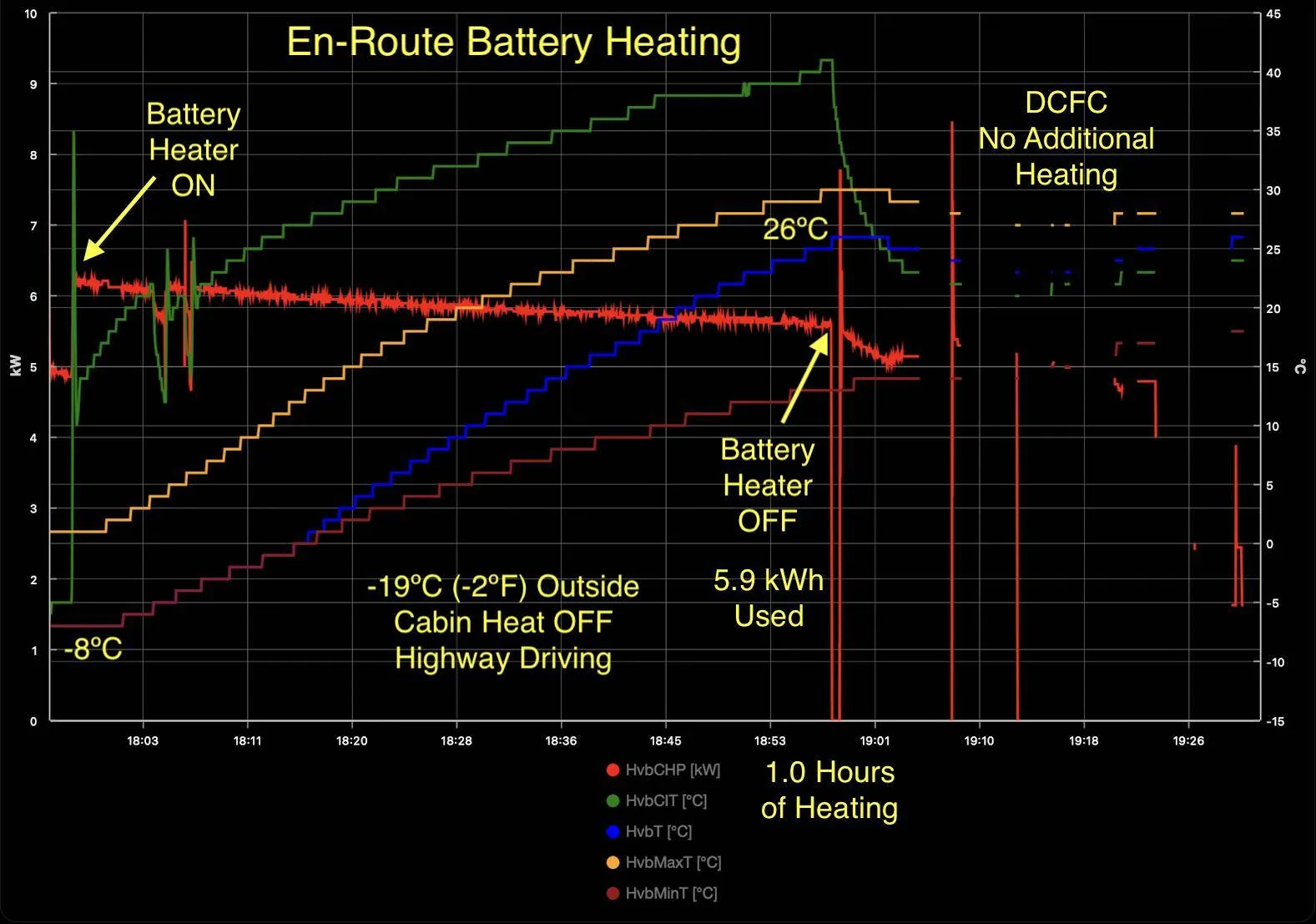
To set the stage here, it's a below 0ÂșF day here. I Level 2 charged all day at work, and even though I was charging the battery still cooled off to -8ÂșC (18ÂșF) by quitting time. I input the local EA station into the nav, and I heard the battery heating start. However it shut off shortly after taking off. Because it's so cold, the cabin heater was taking too much power and preconditioning was cancelled. Bummer. Until I had the bright idea of turning OFF HVAC. Well, that worked, fired the battery heating right up.

Now a normal person probably would have called it quits after a few minutes of no cabin heat in these pleasant -19ÂșC (-2ÂșF) temps, but I'm not normal. Yes, I suffered for science ? in order to see how long it would take to heat the battery up for DCFC, and how high it would go. The short answer is it took AN HOUR AT FULL HEATER OUTPUT to reach the 26ÂșC target temp for DCFC. An hour seems much longer when you're freezing. To get around the 30 km geofence limitation, I drove in circles on the highways surrounding the charger. I could have parked it and went inside, but I wanted the airflow under the pack to simulate real-world cooling effects on a highway. BTW, to avoid the windows fogging up, you need some air movement, so I ended up setting the cabin temp on LO with the fan on speed 1. That disables cabin heat and blows raw outside air at you. That helped make a pretty graph that wasn't disrupted by repeated defrost cycles, and it also helped the cabin cool down to 15ÂșF while I was driving. I was very happy to see the heater finally shut off, and immediately switched the cabin heat back on as I made my way to the EA station for DCFC.

So let's take a look at the temperature graph:

En-route Battery Preconditioning.png


Focus on the blue line which is the main pack temp. In 61 minutes it went from -8ÂșC (18ÂșF) to 26ÂșC (79ÂșF). The heater output started at 6.2 kW and gradually declined to 5.6 kW (this is the PTC effect as the coolant return temp increases). Keep in mind this graph really represents the fastest you could possibly heat the battery in these conditions, the amount of heat available with the HVAC on simultaneously will be quite a bit less. If the HVAC was on at the same time, pack heating likely would have taken two hours and would have run into a wall before reaching 26ÂșC. Perhaps it would have only reached 5ÂșC. This is why it was disabled due to limited heat reserve. I will need to wait for a warmer day to test battery preconditioning while the cabin heat is still active, but the rate of heating will be significantly less.

Now let's look at the DCFC session at a 150 kW EA station I reached shortly after battery heating finished:

Preconditioned DCFC Session.png


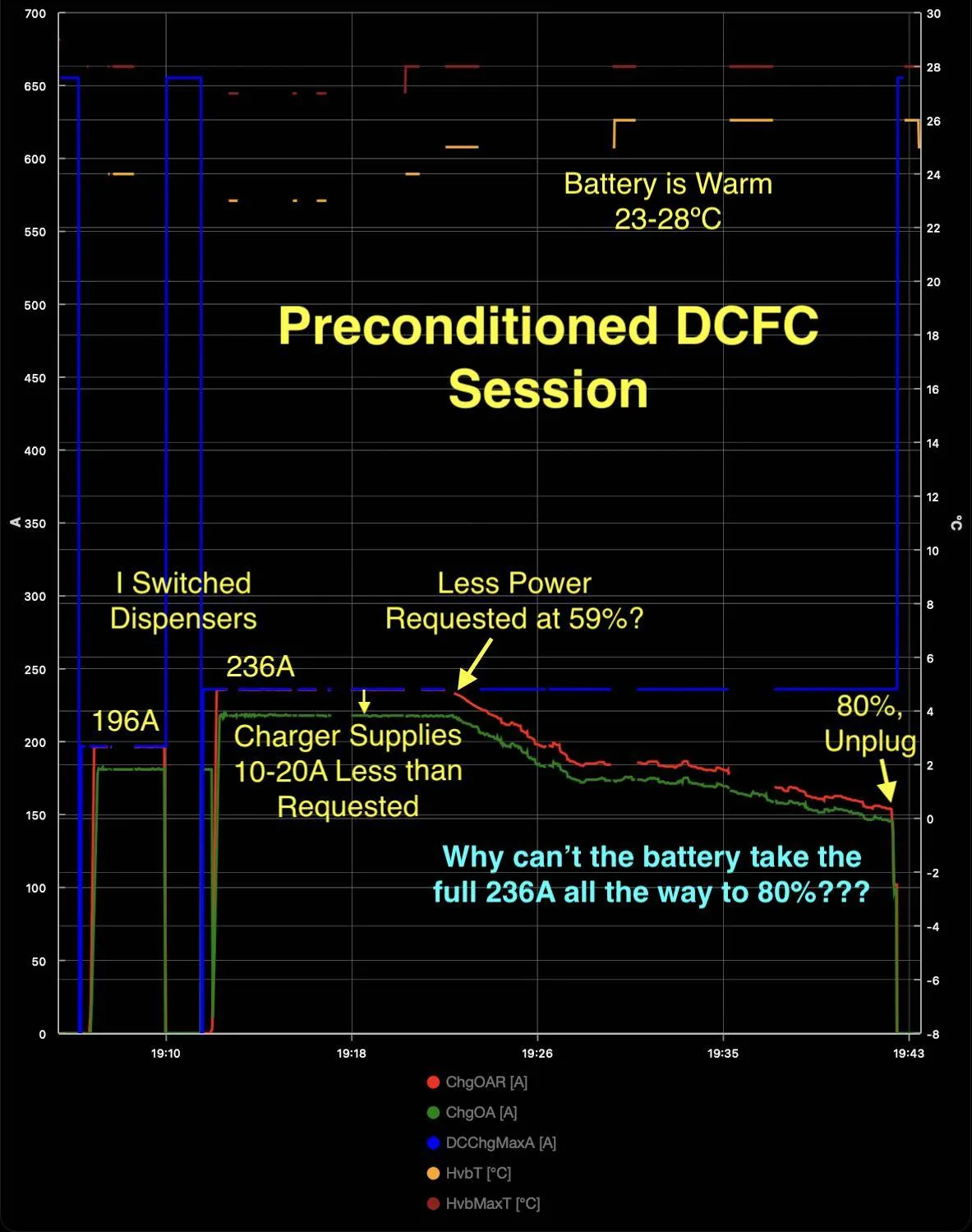
Temp was down to about -20ÂșC/-4ÂșF when I pulled in. A lot of the chargers were displaying a "power reduced" message. I chose one not displaying the message, and activated with Plug & Charge. However I immediately noticed a 196A max current limitation (blue line), much less than the 350A these stations should be capable of. I wasn't happy with only 62 kW, so I decided to try a different dispenser. This one allowed up to 236A which was an improvement, but still slower than it should be. Not sure how much the cold affects these things. The car was correctly asking for full amperage (red line) at first, but the stations always supply (green line) 10-20 amps less than requested for some reason.

After reaching about 59%, the car decided to start requesting less current from the charger, you can see the red request line start decreasing. This is frustrating because the battery is warm enough and perfectly capable of handling the full 236A all the way up to at least 75-80% SoC. Ford has this weird charging strategy where they set the remainder of the charge curve based on the initial rate. Almost like it's a percentage of the initial rate. This means if you use a slower charging station, it will slow you down that much more for the rest of the curve based on the initial speed. This is totally not necessary, there should be a calculated maximum rate at each % SoC based on the battery temps. When using a slower DCFC station (<80 kW), it should be pegged at maximum output the whole way to 75-80%. At only 218A, no part of the battery should be getting that hot so I just don't see the need to throttle it. Ford should work on this strategy because they are needlessly reducing the charging speeds at lower power DCFC stations.

During the DCFC session, the battery was not heated any more by the PTC heater. I shut HVAC off to make sure, nothing happened. I've seen some cases where it heats more than 26ÂșC after starting a session, the decision to heat more must be tied to the charging power available. In this case heating more wasn't necessary for the speeds I was charging at. Temp increased from 23ÂșC to 26ÂșC on its own during the session (yellow trace at the top).

Findings:
  • Battery took 1 hour to heat from -8ÂșC to 26ÂșC using full 6 kW heater output (34ÂșC/hr)
  • Battery heat capacity is 0.18 kWh/ÂșC or 630 kJ/ÂșC
  • Preconditioning starts as soon as a DC station within 30 km is selected in the Ford nav
  • There is no time limit on battery heating as long as you remain within 30 km of the station
  • There is a 26ÂșC upper temp limit
  • En-route preconditioning will not occur at extreme cold temps unless you turn off HVAC
  • Many EA stations operate with significantly degraded performance
  • EA stations output 10-20 amps less than requested by the car
  • Additional heating above 26ÂșC while DCFCing is not always commanded
  • Ford throttles back the charge rate unnecessarily at lower-amperage DC stations
Conclusions:
  • The Mach-E needs a dedicated 5 kW battery heater that is not shared with the cabin.
  • Battery temp increase will be limited with only a 30 km range limit.
    • I think this limit should be increased to 60-120 km to give enough time.
  • EA stations are in varying states of disrepair
  • Ford should fix unnecessary throttling of low-amp DC stations and allow full current up to 75-80%. The current limit at 50-75% should not be affected by the initial station amperage unless using a high amperage (300+) station.
Lee, I'd have you as my HS science teacher anytime. You rock.
Sponsored


Top