
Real condition winter test Mach-E vs Tesla vs Audi E-Tron
RonTCat
Well-Known Member
- First Name
- Ron
- Joined
- Jul 21, 2020
- Threads
- 27
- Messages
- 1,138
- Reaction score
- 2,984
- Location
- USA
- Vehicles
- Mach-E wannabuy

I agree, and add another BS statement: Tesla is the most efficient EV.I have exactly the same reaction to both statements - "Ford has 100 years of experience of building cars, hence - it is way better than Tesla" and "Tesla is light years ahead of any BEV manufacturer". Both these statements is total BS... The truth, as always, somewhere in between.
If you say Tesla has the most aerodynamic EV, then YES.
Most efficient? Clearly the data says no.
Take the Tesla drivetrain and put it in the Mach-E. The Mach-E now has less range.
Take the Mach-E drivetrain, put it in the Model Y. The Model Y now has more range.
Tesla can't win this argument. The Mach-E uses permanent magnet motors for both front and rear. The Tesla use perm back, induction front. The induction motor is inherently less efficiency.
This is why everyone reacts when there is a post about Tesla "efficiency".
Why doesn't everyone use a heat pump, but Tesla does? Why does Tesla not use a heat pump on some models? No one but Tesla knows exactly for sure.
Original Tesla's use induction motors, and newer ones use perm magnet, at least for the primary drive motor. So what, you say? Well, induction motors generate a lot of heat, and permanent magnet motors don't, since perm magnet motors are so much smaller and efficient. Heat pumps make sense on an induction motor BEV. More heat to get, more heat needed to be dissipated. They don't seem to make sense on a perm magnet motor. The heat is just not really there to capture. It must be the non-heat pump vehicles just don't have enough battery/perm motor heat to make the heat pump worthwhile. Again, only Tesla knows for sure, and they have no reason to set the record straight. Why would they... people will continue to ride the efficiency train, and why stop the party, even if it's not true?
Blinkin
Well-Known Member
- First Name
- James
- Joined
- Sep 14, 2020
- Threads
- 0
- Messages
- 223
- Reaction score
- 579
- Location
- Zip Code: 48124
- Vehicles
- 16 FoST
If you move the goalposts enough, you never lose.
silverelan
Well-Known Member
- Joined
- Nov 25, 2019
- Threads
- 132
- Messages
- 3,704
- Reaction score
- 5,431
- Location
- Seattle
- Vehicles
- 2021 Mustang Mach-E GT, 2019 Bolt EV
Right, that's why I think the DC fast charging component is so important to the Mach-E's success against competitors. Some code updates to enable fault-free charging at a quicker pace and a slightly less dramatic nose dive at 80% would solve some of those concerns.Efficiency does matter for some, especially during long trips, since you essentially have the equivalent of 2-2.5 gallons of gas. There less room for aggressive driving in an EV. Drive aggressive in a gas car for a small stretch. No problem, you still have 12-14+ gallons of fuel and a gas station nearby. Do that in an EV and you might be bricked on the side of a road in Arkansas.
OP
OP
Wildthing
Well-Known Member
- Joined
- Feb 23, 2020
- Threads
- 17
- Messages
- 273
- Reaction score
- 435
- Location
- Canada
- Vehicles
- Mach-E Premium SR AWD

- Thread starter
- #50
That is not relevent. You can achieve the exact same results in every mode if you drive correctly. 1PD is not magic, if you let the car slow down too quickly then push the accelerator again, it's not good.What was the driving mode the MME was in?
Where they using one pedal drive?
dwadj
Well-Known Member
- First Name
- Davy
- Joined
- Feb 3, 2021
- Threads
- 2
- Messages
- 74
- Reaction score
- 29
- Location
- Belgium
- Vehicles
- MME 2021 J2 Awd ER, Transit Custom Lim aut
- Occupation
- Self employed

I thought regen is only working in 1PD mode and also dependent on the drive mode, wasn't it like that on the MME?That is not relevent. You can achieve the exact same results in every mode if you drive correctly. 1PD is not magic, if you let the car slow down too quickly then push the accelerator again, it's not good.
ajmartineau
Well-Known Member
- Joined
- Jun 23, 2020
- Threads
- 33
- Messages
- 1,392
- Reaction score
- 1,979
- Location
- Washington
- Vehicles
- 2021 Mach-E
The regen is the same in all modes. The brake pedal always uses max regen (should be the same amount unless the car limits it for other reasons) before friction. How much regen and how quickly it happens from movement of the accelerator is what is different in different modes.I thought regen is only working in 1PD mode and also dependent on the drive mode, wasn't it like that on the MME?
pt19713
Well-Known Member
Yeah, they'll be collecting and analyzing data and will make adjustments accordingly.Right, that's why I think the DC fast charging component is so important to the Mach-E's success against competitors. Some code updates to enable fault-free charging at a quicker pace and a slightly less dramatic nose dive at 80% would solve some of those concerns.
It would be interesting to know if Ford has a new design in the pipeline and when they expect to release the next gen battery hardware. Lots of other manufacturers will have their next gen batteries released in the next 1-2 years.
pt19713
Well-Known Member
I don't follow your reasoning why the Tesla Model Y isn't more efficient in this particular dataset. 3.36 miles per kWh > 2.59 miles per kWh.Most efficient? Clearly the data says no.
Take the Tesla drivetrain and put it in the Mach-E. The Mach-E now has less range.
Take the Mach-E drivetrain, put it in the Model Y. The Model Y now has more range.
Tesla can't win this argument. The Mach-E uses permanent magnet motors for both front and rear. The Tesla use perm back, induction front. The induction motor is inherently less efficiency.
This is why everyone reacts when there is a post about Tesla "efficiency".
Why doesn't everyone use a heat pump, but Tesla does? Why does Tesla not use a heat pump on some models? No one but Tesla knows exactly for sure.
Original Tesla's use induction motors, and newer ones use perm magnet, at least for the primary drive motor. So what, you say? Well, induction motors generate a lot of heat, and permanent magnet motors don't, since perm magnet motors are so much smaller and efficient. Heat pumps make sense on an induction motor BEV. More heat to get, more heat needed to be dissipated. They don't seem to make sense on a perm magnet motor. The heat is just not really there to capture. It must be the non-heat pump vehicles just don't have enough battery/perm motor heat to make the heat pump worthwhile. Again, only Tesla knows for sure, and they have no reason to set the record straight. Why would they... people will continue to ride the efficiency train, and why stop the party, even if it's not true?
The front induction motor on the Y is irrelevant when you're doing a range test where you're driving efficiently. The front motor only kicks in when there's a loss of traction and/or the throttle is over 20-30%. The car is 100% RWD in all other normal conditions. One note, the front induction motor does a great job for pre-conditioning to warm up the battery, one thing the Mach-E currently has issues with. This is probably why Tesla designed the 3 and Y to have an induction and not a permanent magnet motor in the front (since they don't have dedicated battery heaters like they do in the S and X).
None of us can answer the heat pump question. We can only assume it was not used originally due to cost & weight. With the 2021 Model 3 also having it, 2 of the 4 models will have the heat pump. Will the S and X get it with the recent refresh? We'll find out soon.
Your points on the induction motor are correct, but you also have to look at the big picture to determine how Tesla is using the inefficiency of the front motor to their system.
DBC
Well-Known Member
- First Name
- Don
- Joined
- Oct 1, 2020
- Threads
- 8
- Messages
- 1,224
- Reaction score
- 1,430
- Location
- San Diego
- Vehicles
- Volt ELR
It's an aspirational amenity like a workout room in an apartment complex. No one uses it but everyone thinks it's important when signing the lease. Of the ten to fifteen Tesla owners I know, I don't think a single one has ever visited a supercharger, but they all know they could. (That could have changed in the last year, haven't seen them).Right, that's why I think the DC fast charging component is so important to the Mach-E's success against competitors. Some code updates to enable fault-free charging at a quicker pace and a slightly less dramatic nose dive at 80% would solve some of those concerns.
Ford's message is that the MME will charge 10%-80% in 45 minutes and will add an average of 52 miles every ten minutes. Not all that different and seems fine if you aren't likely to use it anyway.
The bigger issue is the availability of chargers. That seems well on its way to being resolved. CA is really the number one market for BEVs, and CA has CCS chargers more or less everywhere. There isn't anywhere that I couldn't go.
People on this forum worrying about how fast charging drops off after 80% represent the fringe buyer. People on this forum who intended to use the MME mostly for road trips are the fringe of the fringe. (I may do a road trip in a few weeks for the adventure of it but it's as much doing the trip to drive the MME rather than having to drive the MME).
On the other hand, pretty much everyone pays attention to design. What's amusing to me is how those claiming that "Ford needs to do this" or "Ford needs to do that" completely gloss over how mundane the Tesla designs are. The S is nice but the rest are just shapeless lumps.
Blanked
Well-Known Member
- First Name
- James
- Joined
- Jan 10, 2021
- Threads
- 32
- Messages
- 386
- Reaction score
- 373
- Location
- Bluffton, SC
- Vehicles
- 2021 MME FE , 2003 Ford Excursion EB 4x4
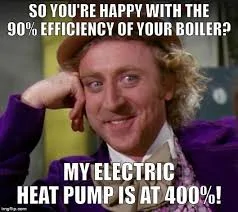
Too bad they just have an aero advantage and their electric drive is marginal. We need a good heat pump meme.
PeeCee
Well-Known Member
- Joined
- Oct 26, 2020
- Threads
- 9
- Messages
- 120
- Reaction score
- 127
- Location
- Canada
- Vehicles
- First Edition Red Mustang MachE
People are freaked out because you started your first reply with questionning that the MachE won, when clearly it did - your first reply was : "The machE won?"My "conclusion" is math that OP did.
We say "Tesla inflates EPA" or whatever, so ignore EPA, look at a real-world test.
Tesla's bigger, heavier, brick-ier, SUV was more efficient than their sedan. Since they've got the same battery, same motors, what is on a Y that could help overcome the aero and weight penalty? Only thing I thought of was heat pump.
I was commenting solely on how the Y in this test beat the 3 in this test and everyone's freaking out. I don't get it.
The point of the video and the test was not to question the efficiency of the body design or how much energy was used by KM/Mile, but which car will take you the farthest in cold weather, and the video showed that the MachE won - and the first thing you did was say it wasn't the case.
If the video was about : "Is the MachE an efficient car?" then no, it's not efficient, it uses a lot of energy to go a distance other cars can do with less energy and yes the Tesla is more efficient.
But the video is about : "Which car can go the furthest in a cold climate" and you cannot deny that the MachE won the numbers are there.
But at the same time, I agree that people are also overreacting to your reply. We were talking Apples, you mixed in some Oranges you're still talking about Oranges while we're trying to talk about Apples.
PeeCee
Well-Known Member
- Joined
- Oct 26, 2020
- Threads
- 9
- Messages
- 120
- Reaction score
- 127
- Location
- Canada
- Vehicles
- First Edition Red Mustang MachE
What they did in the test is the following:ut Model Y travelled a little less and didn't use almost 20% of its b
They all drove the same distance. Then at the end of the distances, looked at how much battery % was left. Using the % left in the car, they made the math to say how far the car would actually have went.
So when the Tesla Y finished the 255km or so range, it had 20% of it's battery left. So they made the math and that meant if they kept on going till 0%, the car would of had about 350~ km. When the MME ended at the same distance 255km, it had 22% of the battery left which ended up giving it about 2-3 km more at the end.
So they didn't do the full distance, just a certain distance and then mathed the rest to get the total potential distance.
Edit: For Info, I didn't take their actual numbers 255 + 20% would not give it 100. The numbers are there for example.
PeeCee
Well-Known Member
- Joined
- Oct 26, 2020
- Threads
- 9
- Messages
- 120
- Reaction score
- 127
- Location
- Canada
- Vehicles
- First Edition Red Mustang MachE
Something they mentioned in the video is that their Model 3 is a 2019 model and they said that the difference would be explained by battery degradation and their Model 3 does not have the heatpump while the Y did have it.Test course: Trois-Riviéres to Montmagny to Neuville, total distance 285 km
Audi e-tron: they did not let it run through the entire course without recharging because it was cutting too close. Actual distance travelled was 253 km when SOC was 12%. Energy consumption was 28.2 kWh per 100 km (or 2.20 mile/kWh)
Tesla Model Y: SOC was 20% after 285 km, energy consumption was 18.5 kWh per 100 km (or 3.36 mile/kWh)
Tesla Model 3: SOC was 20% after 285 km, energy consumption was 17.5 kWh per 100 km (or 3.55 mile/kWh)
Ford Mach-E: SOC was 22% after 285 km, energy consumption was 24 kWh per 100 km (or 2.59 mile/kWh)
Something is wrong with the SOC at the end of the course for either Model Y or Model 3, they cannot possibly have exactly the same percentage of battery charge left and yet have a 5-6% difference in efficiency, unless their actual usable battery capacities were off by exactly the same amount.
One thing is clear though: it does not demonstrate that heat pump is the greatest invention in history.
pt19713
Well-Known Member
I didn't watch the video. Did the original poster do incorrect translation, or did the content creator do bad math? Supertramp's numbers are correct and show that if all cars were fully drained, assuming zero battery degradation, that the Y and 3 have longer distance in the test conditions.What they did in the test is the following:
They all drove the same distance. Then at the end of the distances, looked at how much battery % was left. Using the % left in the car, they made the math to say how far the car would actually have went.
So when the Tesla Y finished the 255km or so range, it had 20% of it's battery left. So they made the math and that meant if they kept on going till 0%, the car would of had about 350~ km. When the MME ended at the same distance 255km, it had 22% of the battery left which ended up giving it about 2-3 km more at the end.
So they didn't do the full distance, just a certain distance and then mathed the rest to get the total potential distance.
Edit: For Info, I didn't take their actual numbers 255 + 20% would not give it 100. The numbers are there for example.
Mach-E: 2.59 mi/kWh x 88 kWh = 228 miles
Model Y: 3.55 mi/kWh x 75 kWh = 266 miles
Model 3: 3.36 mi/kWh x 75 kWh = 252 miles
E-Tron: 2.20 mi/kWh x 99 kWh = 218 miles
Sponsored


