bbulkow
Well-Known Member
- First Name
- Brian
- Joined
- Aug 30, 2022
- Threads
- 24
- Messages
- 889
- Reaction score
- 729
- Location
- menlo park, california
- Vehicles
- Honda CRV

- Thread starter
- #1
I was on a site with no power a few days ago, trying to run some tools, like a sawzall and an angle grinder, that have a lot of startup power.
My power station thing, despite claiming high starting power, was having none of it.
My small 400W inverter into the 12v port (which should approximately match the 2.5A 12V fuse, at least I think it's fused around there), was also having none of it - not even close.
(It's possible that my power station plugged into the 12v port would work, I'm going to try that today)
And I'm sitting there with a HONKING big battery.
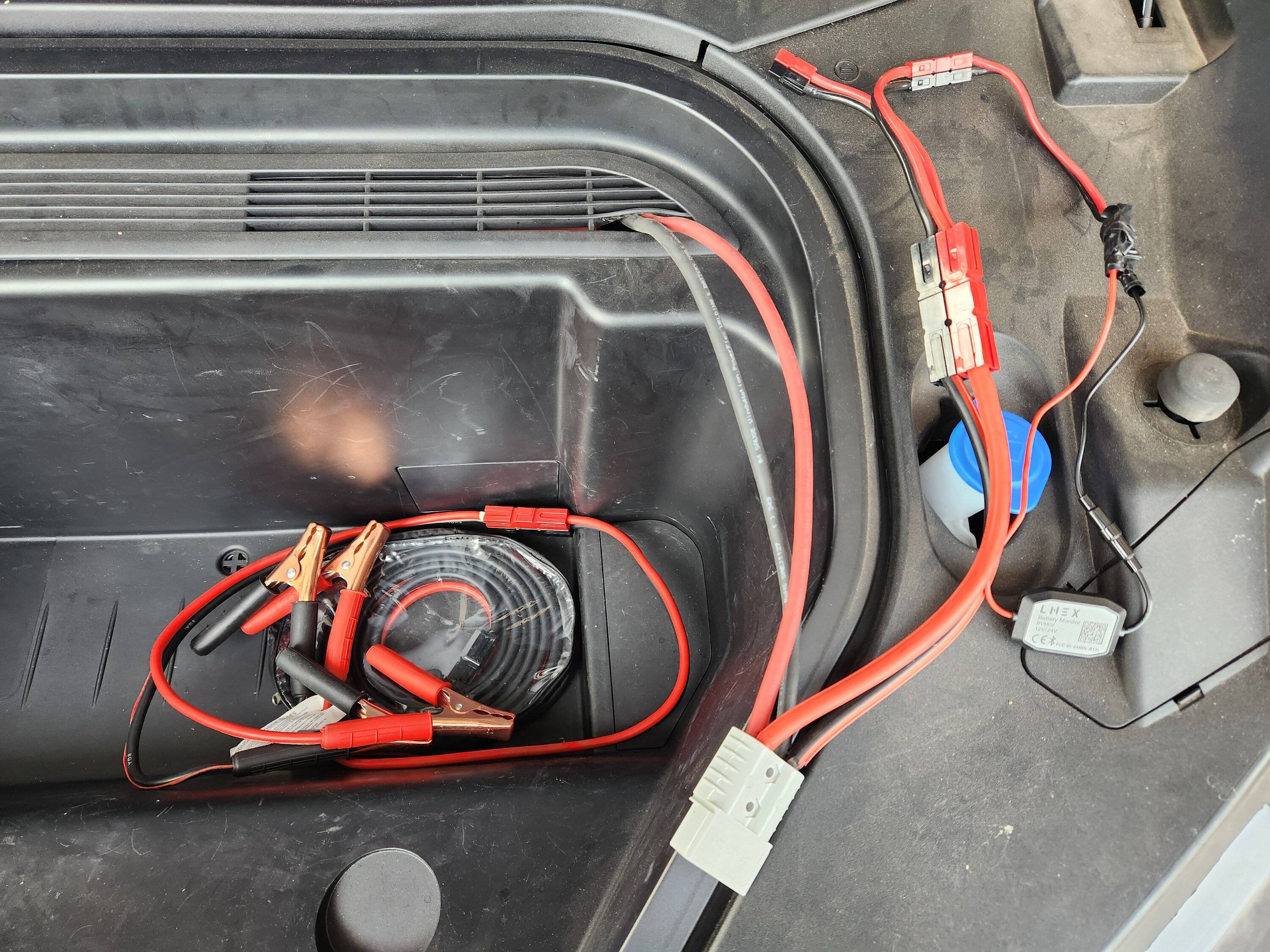
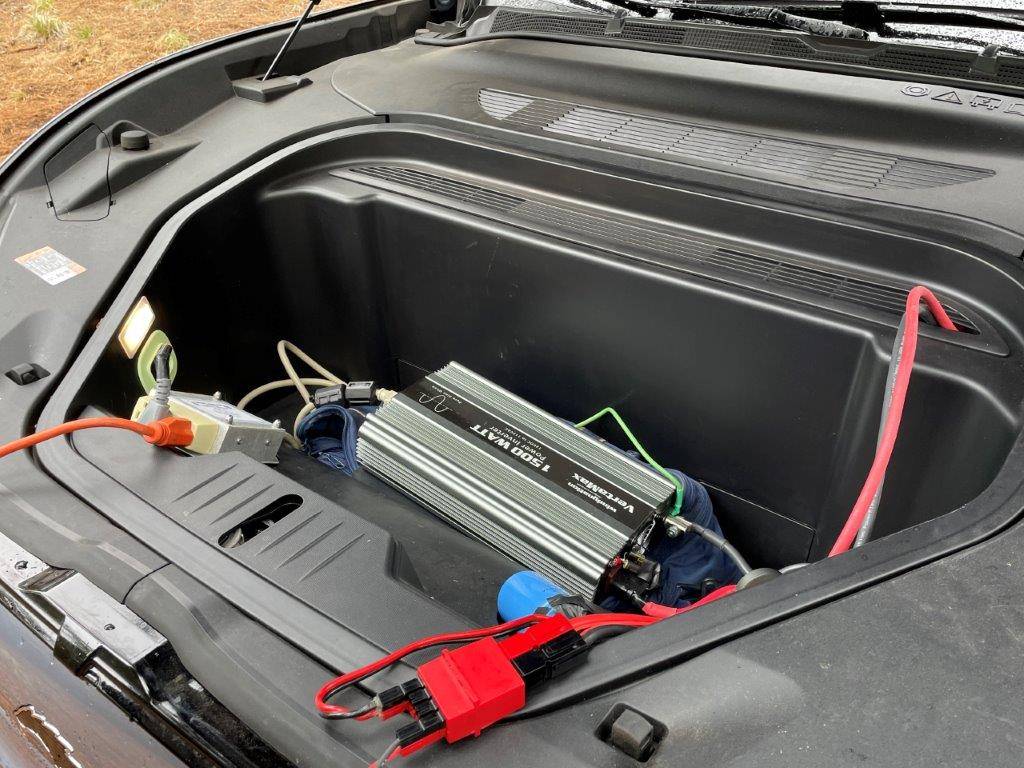
The appropriate solution would seem to be an inverter with a lot of overhead (like 2000W), and wire it directly to the 12v. There's a nice little compartment - the frunk - where I can store the inverter (nicely in a bag or something). Tools like that have a high startup power, then settle down to something reasonable (like 110v 5 to 10A draw, aka 500W to 700W, it's generally the startup current that gets you). That's greater than the fuses that should be on the 12v "lighter" ports, but not seriously out of range (there are 2 12V lighter ports, I would strongly guess given how far away they are, they run on separate fuses, which climbs up to 500W max draw, so 500W to 700W would be within range of the 12V bus)
I would believe that with recent firmware ('23 model currently at 6.7), if the system sees a decent draw on the 12v, or the 12v going down rapidly, it would kick in the charging system from the HVB to the LVB. While that system might not keep up with steady 1kw / 1.5kw draw (and not be a suitable V2L solution for your house), powering a few tools for half an hour seems very plausible?
Here's the questions:
1) does anyone know how much power that HVB -> LVB system will deliver? I can find out experimentally (at home so I can recharge the puny 12v, and reading out various parts of the OBD2 stats), but it would be nice if someone has a strongly informed opinion. [ If I had to guess, the charging of a lead-acid typically tops out at 150w or so, which means I can pull some amount from the small lead acid, then I'll get supplemented from the HVB, then I'll have a dead brick of a car, just be careful.] If I know the amount of power, I can work out a rule of thumb safe amount. Backed up by looking at the OBD2 port.
2) Is there any better way of wiring besides right at the battery terminals (I haven't popped off the plastic yet, but there are always screw leads near a battery of that type), like is wiring negative to the frame better or different in any way? Eg, there should be a 12v bus that's more central and not right at the battery; the battery typically has isolation electronics that prevent charging it too hard which might be different from the limits on the general 12v bus?
3) While there are *possible* problems with the car software getting upset about a draw like this (blah blah not design for higher shorter loads, fuses between those systems, software triggers faults), I wonder if anyone has either tried this, or knows of a specific issue?
It also seems there should be "buffer devices" for this problem, which would allow my "power station" (Jackery equivalent) to handle this kind of tool. Basically a capacitor and a power regulator, inline, probably kinda chunky. That allows me to not fool with my car electronics... A far better solution... Doing some searches on that....
Thanks in advance
My power station thing, despite claiming high starting power, was having none of it.
My small 400W inverter into the 12v port (which should approximately match the 2.5A 12V fuse, at least I think it's fused around there), was also having none of it - not even close.
(It's possible that my power station plugged into the 12v port would work, I'm going to try that today)
And I'm sitting there with a HONKING big battery.
The appropriate solution would seem to be an inverter with a lot of overhead (like 2000W), and wire it directly to the 12v. There's a nice little compartment - the frunk - where I can store the inverter (nicely in a bag or something). Tools like that have a high startup power, then settle down to something reasonable (like 110v 5 to 10A draw, aka 500W to 700W, it's generally the startup current that gets you). That's greater than the fuses that should be on the 12v "lighter" ports, but not seriously out of range (there are 2 12V lighter ports, I would strongly guess given how far away they are, they run on separate fuses, which climbs up to 500W max draw, so 500W to 700W would be within range of the 12V bus)
I would believe that with recent firmware ('23 model currently at 6.7), if the system sees a decent draw on the 12v, or the 12v going down rapidly, it would kick in the charging system from the HVB to the LVB. While that system might not keep up with steady 1kw / 1.5kw draw (and not be a suitable V2L solution for your house), powering a few tools for half an hour seems very plausible?
Here's the questions:
1) does anyone know how much power that HVB -> LVB system will deliver? I can find out experimentally (at home so I can recharge the puny 12v, and reading out various parts of the OBD2 stats), but it would be nice if someone has a strongly informed opinion. [ If I had to guess, the charging of a lead-acid typically tops out at 150w or so, which means I can pull some amount from the small lead acid, then I'll get supplemented from the HVB, then I'll have a dead brick of a car, just be careful.] If I know the amount of power, I can work out a rule of thumb safe amount. Backed up by looking at the OBD2 port.
2) Is there any better way of wiring besides right at the battery terminals (I haven't popped off the plastic yet, but there are always screw leads near a battery of that type), like is wiring negative to the frame better or different in any way? Eg, there should be a 12v bus that's more central and not right at the battery; the battery typically has isolation electronics that prevent charging it too hard which might be different from the limits on the general 12v bus?
3) While there are *possible* problems with the car software getting upset about a draw like this (blah blah not design for higher shorter loads, fuses between those systems, software triggers faults), I wonder if anyone has either tried this, or knows of a specific issue?
It also seems there should be "buffer devices" for this problem, which would allow my "power station" (Jackery equivalent) to handle this kind of tool. Basically a capacitor and a power regulator, inline, probably kinda chunky. That allows me to not fool with my car electronics... A far better solution... Doing some searches on that....
Thanks in advance
Sponsored
Last edited: