Wire a large inverter?

bbulkow

Well-Known Member
First Name
Brian
Joined
Aug 30, 2022
Threads
24
Messages
889
Reaction score
729
Location
menlo park, california
Vehicles
Honda CRV
Country flag
I was on a site with no power a few days ago, trying to run some tools, like a sawzall and an angle grinder, that have a lot of startup power.

My power station thing, despite claiming high starting power, was having none of it.

My small 400W inverter into the 12v port (which should approximately match the 2.5A 12V fuse, at least I think it's fused around there), was also having none of it - not even close.

(It's possible that my power station plugged into the 12v port would work, I'm going to try that today)

And I'm sitting there with a HONKING big battery.

The appropriate solution would seem to be an inverter with a lot of overhead (like 2000W), and wire it directly to the 12v. There's a nice little compartment - the frunk - where I can store the inverter (nicely in a bag or something). Tools like that have a high startup power, then settle down to something reasonable (like 110v 5 to 10A draw, aka 500W to 700W, it's generally the startup current that gets you). That's greater than the fuses that should be on the 12v "lighter" ports, but not seriously out of range (there are 2 12V lighter ports, I would strongly guess given how far away they are, they run on separate fuses, which climbs up to 500W max draw, so 500W to 700W would be within range of the 12V bus)

I would believe that with recent firmware ('23 model currently at 6.7), if the system sees a decent draw on the 12v, or the 12v going down rapidly, it would kick in the charging system from the HVB to the LVB. While that system might not keep up with steady 1kw / 1.5kw draw (and not be a suitable V2L solution for your house), powering a few tools for half an hour seems very plausible?

Here's the questions:

1) does anyone know how much power that HVB -> LVB system will deliver? I can find out experimentally (at home so I can recharge the puny 12v, and reading out various parts of the OBD2 stats), but it would be nice if someone has a strongly informed opinion. [ If I had to guess, the charging of a lead-acid typically tops out at 150w or so, which means I can pull some amount from the small lead acid, then I'll get supplemented from the HVB, then I'll have a dead brick of a car, just be careful.] If I know the amount of power, I can work out a rule of thumb safe amount. Backed up by looking at the OBD2 port.

2) Is there any better way of wiring besides right at the battery terminals (I haven't popped off the plastic yet, but there are always screw leads near a battery of that type), like is wiring negative to the frame better or different in any way? Eg, there should be a 12v bus that's more central and not right at the battery; the battery typically has isolation electronics that prevent charging it too hard which might be different from the limits on the general 12v bus?

3) While there are *possible* problems with the car software getting upset about a draw like this (blah blah not design for higher shorter loads, fuses between those systems, software triggers faults), I wonder if anyone has either tried this, or knows of a specific issue?

It also seems there should be "buffer devices" for this problem, which would allow my "power station" (Jackery equivalent) to handle this kind of tool. Basically a capacitor and a power regulator, inline, probably kinda chunky. That allows me to not fool with my car electronics... A far better solution... Doing some searches on that....

Thanks in advance
Sponsored

 
Last edited:
OP
OP

bbulkow

Well-Known Member
First Name
Brian
Joined
Aug 30, 2022
Threads
24
Messages
889
Reaction score
729
Location
menlo park, california
Vehicles
Honda CRV
Country flag
Hey, thanks for the pointer. I am not interested in going after the heater port using a big solar inverter, the complexity level did look high, I just want 1kw to 1.5kw style load.

But due to your pointing out the thread, I read the whole thing. I noticed about mid-way through the thread a discussion of wiring in a large inverter. Another person (basically) said they could keep their home battery system charged well using 1.5kw off the MME, avoiding the complexity of connectors and switch over from the heater port. So it's possible, it seems, with about 1500W as a limit, one can do just that. The person said they used this at work sites, my more likely use.

The only missing element is the best connect points for 12v for that kind of load. The person's post said "standard 12v connection points". I've followed up in that thread and will go searching..... Any pointers to the "standard 12v connection points" are appreciated.
 
OP
OP

bbulkow

Well-Known Member
First Name
Brian
Joined
Aug 30, 2022
Threads
24
Messages
889
Reaction score
729
Location
menlo park, california
Vehicles
Honda CRV
Country flag
It was @HuntingPudel (and some others) that built in direct access for camping. Here is a thread with pictures.

https://www.macheforum.com/site/threads/frunk-tub-removed-pics.12094/page-3
Yeah, I'm crawling through a few posts now.

dtbaker61 has a really excellent post, with some good updates, which I found a minute ago and can't find again. There's a discussion about whether the 160A rated charge system was continuous or not.... exactly what I'm looking for. Dagnabbit.

This post has the most complete information:

https://www.macheforum.com/site/thr...120vac-power-from-lvb-connection-points.7317/

and points to ideas about the connection points.

These cover similar situations:

https://www.macheforum.com/site/thr...ly-thru-12v-connections-from-hv-battery.6078/

https://www.macheforum.com/site/thr...mping-or-home-emergency-battery-backup.20644/
 
Last edited:


HuntingPudel

Well-Known Member
First Name
Steve
Joined
Mar 23, 2021
Threads
88
Messages
12,927
Reaction score
17,366
Location
Bay Area, CA
Vehicles
2024 MME GT with Performance Upgrade, 1979 Fire-Am, 1972 K/5 Blazer
Occupation
Engineering
Country flag

Mach-Lee

Well-Known Member
First Name
Lee
Joined
Jul 16, 2021
Threads
262
Messages
11,344
Reaction score
24,963
Location
Wisconsin
Vehicles
2022 Mach-E Premium AWD
Occupation
Sci/Eng
Country flag
The biggest you can safely do is about a 1500W inverter, more than 1500W continuous load and you can overload the DC/DC converter and overheat the cables.

You'll want to connect directly to the jump posts with large gauge (#2?) cables.

Vehicle must be ON to use the inverter (disable auto power down). Don't try to use it while off because you could drain the battery which is bad for it. If you do it right, the battery stays charged the whole time using it.

It was really @dtbaker61 who's done work on this. I just did my 12V jump panel. ??
FYI I also made a 1500W inverter setup to power critical loads in my house, maybe should post about that...
 

dtbaker61

Well-Known Member
First Name
Dan
Joined
May 11, 2020
Threads
126
Messages
4,822
Reaction score
4,524
Location
santa fe,nm
Website
www.envirokarma.org
Vehicles
MME (delivered 2/26/21), DIY eMiata BEV
Occupation
Solar Sales/install
Country flag
Yeah, I'm crawling through a few posts now.

dtbaker61 has a really excellent post, with some good updates, which I found a minute ago and can't find again. There's a discussion about whether the 160A rated charge system was continuous or not.... exactly what I'm looking for. Dagnabbit.

This post has the most complete information:

https://www.macheforum.com/site/thr...120vac-power-from-lvb-connection-points.7317/

and points to ideas about the connection points.

These cover similar situations:

https://www.macheforum.com/site/thr...ly-thru-12v-connections-from-hv-battery.6078/

https://www.macheforum.com/site/thr...mping-or-home-emergency-battery-backup.20644/

looking at the wiring to the connection points, the breaker, and knowing that the HV-LV converter has to run all the 12v stuff 'continuously' when driving normally, I'd say that the DC-DC should be ok pulling up to 160a for quite a while as long as your connection wire is heavy enough. given that this would be 'free air' (not in conduit), and if you use fine strand welding wire..... I'd use 2AWG .

In a 'back up' or 'camping' situation, I'd doubt you'd be pulling more than 1000watts for very long. just long enough to boil water, or cook food on an inductive cooktop.

I'd say as long as you don't run the car a/c or Heat at the same time as heavy external load export, should be fine.
 

Teslaeata

Well-Known Member
First Name
Mark
Joined
Sep 28, 2022
Threads
9
Messages
3,435
Reaction score
4,157
Location
Nottingham, England, UK
Vehicles
Red June ‘21 RWD ER Premium MME
Occupation
Forensic vehicle examiner, motor insurance assessor, expert witness
Country flag
The attached provides specifications for attaching aftermarket equipment to 12V system, where & how to do this and the DC/DC converter 12V charge specification and working conditions.
 

Attachments

averyintucson

Active Member
First Name
Avery
Joined
Jun 17, 2022
Threads
0
Messages
28
Reaction score
14
Location
Tucson, Arizona
Vehicles
2022 Ford Mustang Mach E, 2016 Nissan Leaf
Occupation
Engineer
Country flag
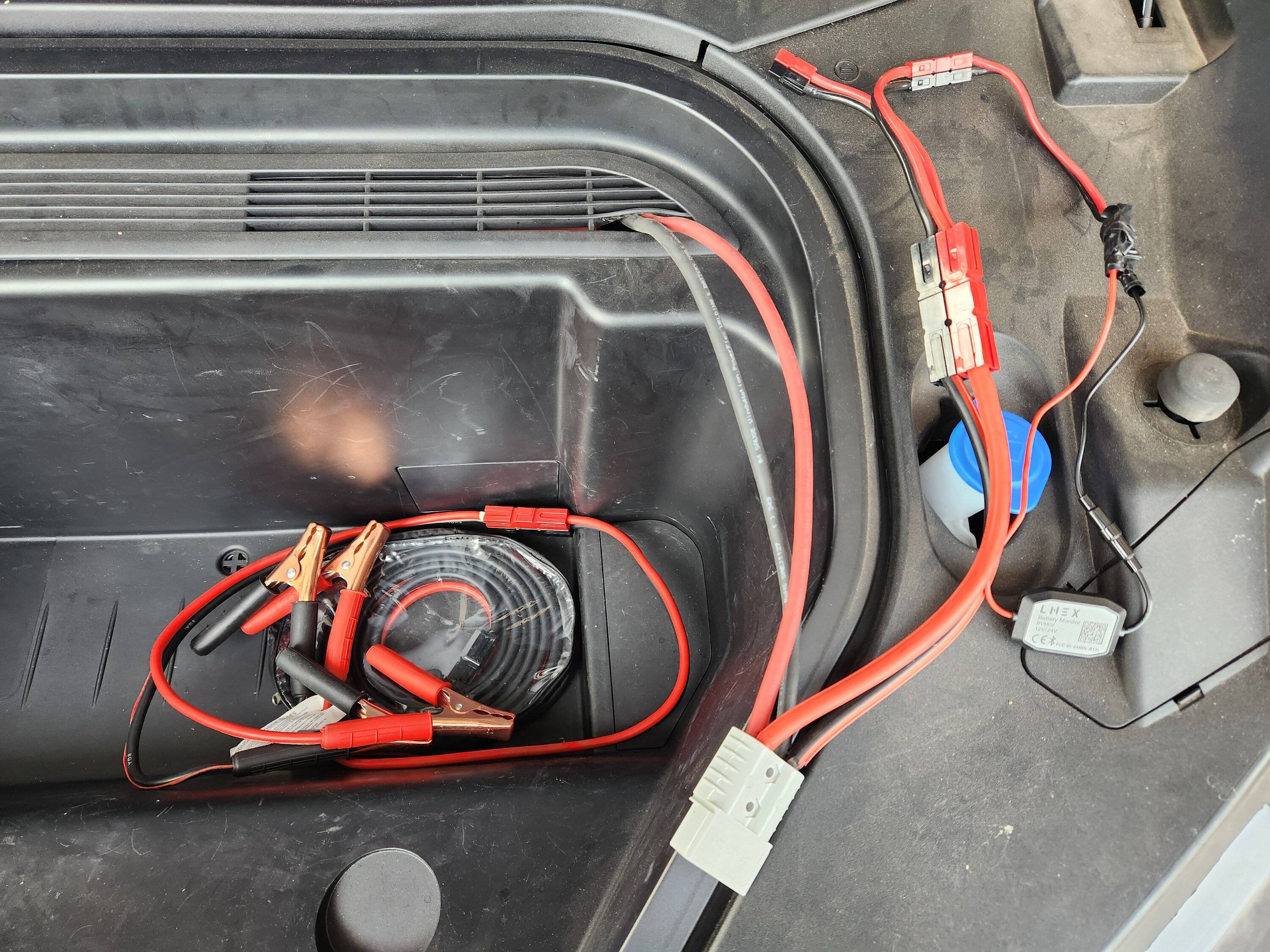
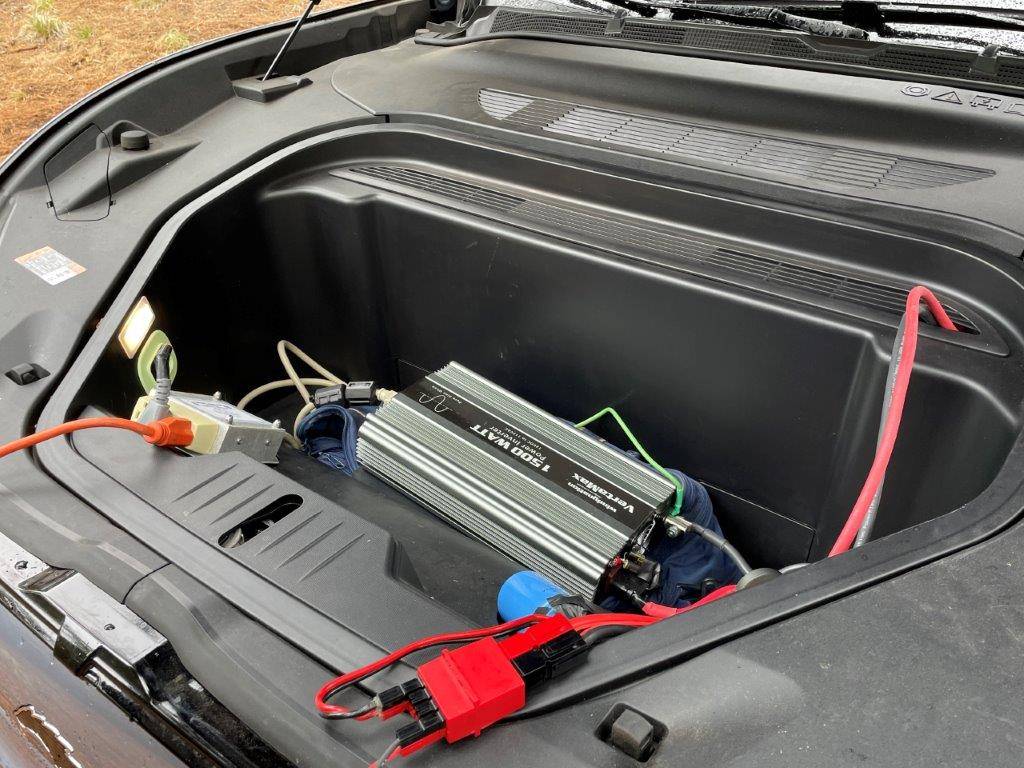
I attached two 4AWG wires, black and red, sold for audio accessory power, to the jump points, and ran them through the air vents into the frunk. I also installed a marine cube fuse at the positive jump point. I connected a 120A Powerpole (PP120) connector, and daisy chained to a 75A Powerpole (PP75) I have a matching PP120 on a pigtail for my 1,500W inverter. I tested this with a space heater at about 1200W, and the DC voltage held up well enough while the car was on. I bought this inverter from evextend.com along with a wiring harness for a Nissan Leaf, which car I have since sold.
I use the PP75 on a distribution block for smaller Powerpoles for other devices. I put PP75 Powerpoles on an 8AWG cheap jumper cable so I could use it with the PP75 for jumping the battery, or as a 12VDC extension cord. The first photo also shows a BT battery monitor connected. The bottom photo shows the connections I used for my ham radio Field Day camping trip. The "outlet strip" is actually an RFI filter which I upgraded because my 1500W inverter puts RF noise on the AC cable. The gray plug with the short cable is a neutral-ground shorting plug so I could use the inverter with devices that have ground fault detection. Elsewhere in my setup, I did drive in a ground rod and connected it to the safety ground. Hope this helps!

Ford Mustang Mach-E Wire a large inverter? 20231219_141045
Ford Mustang Mach-E Wire a large inverter? IMG_1065
 

Mach-Lee

Well-Known Member
First Name
Lee
Joined
Jul 16, 2021
Threads
262
Messages
11,344
Reaction score
24,963
Location
Wisconsin
Vehicles
2022 Mach-E Premium AWD
Occupation
Sci/Eng
Country flag
I attached two 4AWG wires, black and red, sold for audio accessory power, to the jump points, and ran them through the air vents into the frunk. I also installed a marine cube fuse at the positive jump point. I connected a 120A Powerpole (PP120) connector, and daisy chained to a 75A Powerpole (PP75) I have a matching PP120 on a pigtail for my 1,500W inverter. I tested this with a space heater at about 1200W, and the DC voltage held up well enough while the car was on. I bought this inverter from evextend.com along with a wiring harness for a Nissan Leaf, which car I have since sold.
I use the PP75 on a distribution block for smaller Powerpoles for other devices. I put PP75 Powerpoles on an 8AWG cheap jumper cable so I could use it with the PP75 for jumping the battery, or as a 12VDC extension cord. The first photo also shows a BT battery monitor connected. The bottom photo shows the connections I used for my ham radio Field Day camping trip. The "outlet strip" is actually an RFI filter which I upgraded because my 1500W inverter puts RF noise on the AC cable. The gray plug with the short cable is a neutral-ground shorting plug so I could use the inverter with devices that have ground fault detection. Elsewhere in my setup, I did drive in a ground rod and connected it to the safety ground. Hope this helps!

20231219_141045.jpg
IMG_1065.jpg
I hope you have a 120A fuse under there somewhere...
 

Teslaeata

Well-Known Member
First Name
Mark
Joined
Sep 28, 2022
Threads
9
Messages
3,435
Reaction score
4,157
Location
Nottingham, England, UK
Vehicles
Red June ‘21 RWD ER Premium MME
Occupation
Forensic vehicle examiner, motor insurance assessor, expert witness
Country flag
Not where the Manufacturer recommends connections are made to power aftermarket equipment ?
 
OP
OP

bbulkow

Well-Known Member
First Name
Brian
Joined
Aug 30, 2022
Threads
24
Messages
889
Reaction score
729
Location
menlo park, california
Vehicles
Honda CRV
Country flag
looking at the wiring to the connection points, the breaker, and knowing that the HV-LV converter has to run all the 12v stuff 'continuously' when driving normally, I'd say that the DC-DC should be ok pulling up to 160a for quite a while as long as your connection wire is heavy enough. given that this would be 'free air' (not in conduit), and if you use fine strand welding wire..... I'd use 2AWG .
I'm dithering a little between a 1500 and 2000W inverter. as 160 * 12 = 1960, 2000W seems fine, but if you want to derate by 25% for continuous load, then 1500 is right. The 1500 is a little safer and supplies 13A @ 110V. OTOH, if there's any case where a tool can't start and I'd really rather have the 2k, I'll be very cross with myself. Realistically a good 1500 with good 3 second surge power rating should be just fine.... idk. Looking at Redarc, they seem to make good stuff, and make a 1500 where lots of others just make 1000 and 2000.
 

averyintucson

Active Member
First Name
Avery
Joined
Jun 17, 2022
Threads
0
Messages
28
Reaction score
14
Location
Tucson, Arizona
Vehicles
2022 Ford Mustang Mach E, 2016 Nissan Leaf
Occupation
Engineer
Country flag
I hope you have a 120A fuse under there somewhere...
I installed a Blue Sea Systems 5191 fuse block terminal at the positive jumper point, and I seem to recall I installed a 120A fuse, but I am not positive it wasn't a 150A fuse. I will double check soon.
 

Mach-Lee

Well-Known Member
First Name
Lee
Joined
Jul 16, 2021
Threads
262
Messages
11,344
Reaction score
24,963
Location
Wisconsin
Vehicles
2022 Mach-E Premium AWD
Occupation
Sci/Eng
Country flag
I'm dithering a little between a 1500 and 2000W inverter. as 160 * 12 = 1960, 2000W seems fine, but if you want to derate by 25% for continuous load, then 1500 is right. The 1500 is a little safer and supplies 13A @ 110V. OTOH, if there's any case where a tool can't start and I'd really rather have the 2k, I'll be very cross with myself. Realistically a good 1500 with good 3 second surge power rating should be just fine.... idk. Looking at Redarc, they seem to make good stuff, and make a 1500 where lots of others just make 1000 and 2000.
Keep in mind inverter efficiency is less than 100%, so it will draw more power than it outputs. If you have a 1500W inverter that's 80% efficient, it will draw 156 amps at 1500W output continuous. Some cheaper inverters are only 70% efficient, more expensive ones are 90%+. That's why I would limit things to 1500W continuous or less.

Also you don't need to derate inverters. A good quality 1500W inverter will output 1500W all day long. Cheap China crap may not do so well.

I like the idea of a 1500W inverter because it will shut down on overload before the Mach-E's electrical system is maxed out. Kinda makes it almost impossible to overload.
Sponsored


Top