gordonf238

Well-Known Member
First Name
Gordon
Joined
Aug 26, 2021
Threads
39
Messages
217
Reaction score
264
Location
NYC
Vehicles
Mach-E AWD, Ext. range
Country flag
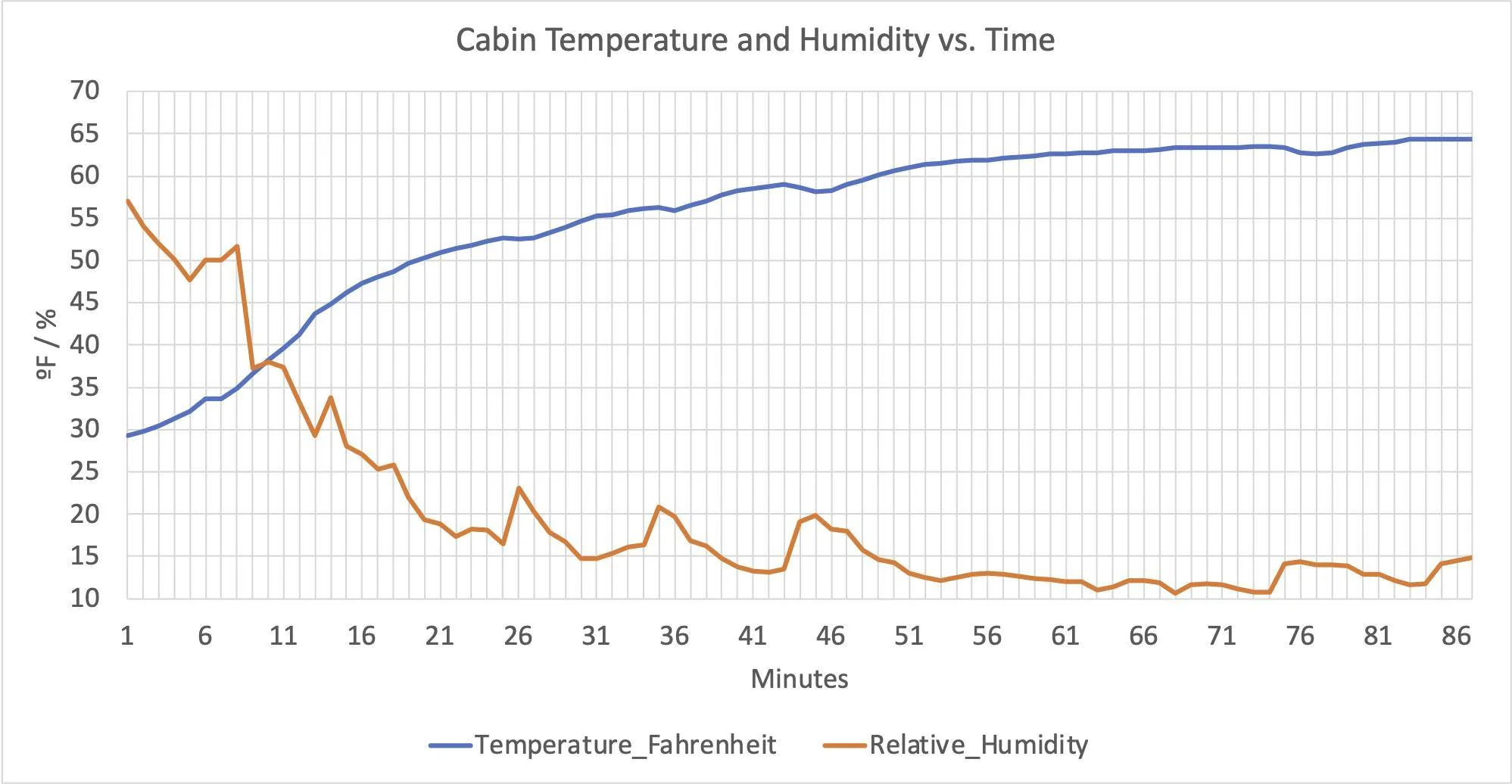
Based on your graph, it looks like it took 90 minutes to get the cabin temperature up to 65 degrees? I just blast heat on full with thermostat set to HI, full fan on feet, and the cabin feels warm in about 5-6 minutes.
Sponsored
 

RickMachE

Well-Known Member
Joined
Jul 1, 2021
Threads
267
Messages
17,906
Reaction score
27,877
Location
SE MI
Vehicles
2022 Mach-E Premium 4X, 2022 Lightning Lariat ER
Country flag
Based on your graph, it looks like it took 90 minutes to get the cabin temperature up to 65 degrees? I just blast heat on full with thermostat set to HI, full fan on feet, and the cabin feels warm in about 5-6 minutes.
If you read Ford's guidance, you're better setting the it to Auto, the temp you want, and low speed and it will produce warm air faster.
 

sockmeister

Well-Known Member
Joined
Sep 24, 2020
Threads
6
Messages
1,932
Reaction score
3,046
Location
Pennsylvania
Vehicles
2023 Mach-E GTPE
Occupation
SW Engineer
Country flag
Preconditioning and night heating consumes about 4.5 kWh per my testing. So if you gain 130-157 miles of range (highway), that’s 27/4.5 or 6 Mi/kWh or more. To me it’s worth it….. in warmer conditions, 10F or better and non highway the gain can be 10 mi/kWh as a 26F battery can get 170-190 miles of range. But it all depends on your commute distance and what you pay for power.
No -- I was not talking about the range gain. I'm referring to the warmer battery more safely accepting braking regen (without plating side effects) when preconditioned, as per the OP's 75kW brake regen power delivery on a cold battery discovery.
 

Nklem

Well-Known Member
First Name
Norm
Joined
May 20, 2021
Threads
105
Messages
1,318
Reaction score
1,699
Location
Coast of Maine
Vehicles
Subaru Solterra
Occupation
Mechanical Engineer
Country flag
Based on your graph, it looks like it took 90 minutes to get the cabin temperature up to 65 degrees? I just blast heat on full with thermostat set to HI, full fan on feet, and the cabin feels warm in about 5-6 minutes.
Feeling heat and heating the cabin are certainly different. Mine was 36 minutes to 68F in testing from -1F "Auto 68F" for preconditioning time, then Heat only (not auto), Fan level 3 or 2 for the drive. with No preconditioning. I went 1 hour and never reached 68 in all AUTO 68F on a 50 mile trip at -2F.. thank goodness for layers. with 80F air, it's very slow to heat the cabin in extreme cold weather.
 
Last edited:


mateo

Well-Known Member
Joined
Jul 28, 2022
Threads
7
Messages
243
Reaction score
365
Location
Chicago
Vehicles
2022 MME GT
Country flag
Thanks for the write-up. I'm getting similar numbers in my early winter driving.

I'm interested in how fast charging speeds are in 0F weather after driving for a while. I sometimes make day trips where I'm not going to make it back in the winter without a charge.

In some cases, I may need to reclaim 60%-70%. These are really the only types of trips I dread with an EV because there's no convenient charger at the destination so I literally have to wait in an uninteresting strip mall until I'm recharged.

If you read Ford's guidance, you're better setting the it to Auto, the temp you want, and low speed and it will produce warm air faster.
If I do that, it just feels like it's blowing cold air all the time... I have scheduled departures set in the morning, which makes that trip fine, but all others are like an adventure in randomness to get it to feel hot.

I don't actually mind a lot; unless a trip is like 1+ hour, I won't even feel very cold with a heated seat. (Anything other than level 1 is just burning my skin off!) A certain passenger of mine complains a lot though about cold feet.

I feel like I've came across posts that say some updates have improved the heater performance. If I'm not making that up, would cars built in Oct '22 still benefit from updates to improve heater efficiency? Is the upcoming update to SYNC going to help?
 

RickMachE

Well-Known Member
Joined
Jul 1, 2021
Threads
267
Messages
17,906
Reaction score
27,877
Location
SE MI
Vehicles
2022 Mach-E Premium 4X, 2022 Lightning Lariat ER
Country flag
Thanks for the write-up. I'm getting similar numbers in my early winter driving.

I'm interested in how fast charging speeds are in 0F weather after driving for a while. I sometimes make day trips where I'm not going to make it back in the winter without a charge.

In some cases, I may need to reclaim 60%-70%. These are really the only types of trips I dread with an EV because there's no convenient charger at the destination so I literally have to wait in an uninteresting strip mall until I'm recharged.


If I do that, it just feels like it's blowing cold air all the time... I have scheduled departures set in the morning, which makes that trip fine, but all others are like an adventure in randomness to get it to feel hot.

I don't actually mind a lot; unless a trip is like 1+ hour, I won't even feel very cold with a heated seat. (Anything other than level 1 is just burning my skin off!) A certain passenger of mine complains a lot though about cold feet.

I feel like I've came across posts that say some updates have improved the heater performance. If I'm not making that up, would cars built in Oct '22 still benefit from updates to improve heater efficiency? Is the upcoming update to SYNC going to help?
I believe that the upcoming Sync update is UI only, so no.

And, I'd expect that given when the HVAC update came (10/28 for EA), an October 22 car already had it.
 

Blue highway

Well-Known Member
First Name
Steve
Joined
Oct 15, 2021
Threads
5
Messages
2,694
Reaction score
4,238
Location
Oregon
Vehicles
Mach E Premium SR RWD
Country flag
This data makes me wonder if there *is* a real benefit to actual preconditioning for daily use, even if you're not going on a long trip -- if simply because heating the battery makes regen charging a little safer for its long-term health.
Warmer batteries store more energy. More energy = more range. How much?

According to these guys https://batteryuniversity.com/article/bu-502-discharging-at-high-and-low-temperatures

"A battery that provides 100 percent capacity at 27°C (80°F) will typically deliver only 50 percent at –18°C (0°F). The momentary capacity-decrease differs with battery chemistry. "


Ford Mustang Mach-E Mach-Lee's Mach-E Cold Weather Testing [Taking Requests] 1671469700315
 

sockmeister

Well-Known Member
Joined
Sep 24, 2020
Threads
6
Messages
1,932
Reaction score
3,046
Location
Pennsylvania
Vehicles
2023 Mach-E GTPE
Occupation
SW Engineer
Country flag
Preconditioning and night heating consumes about 4.5 kWh per my testing. So if you gain 130-157 miles of range (highway), that’s 27/4.5 or 6 Mi/kWh or more. To me it’s worth it….. in warmer conditions, 10F or better and non highway the gain can be 10 mi/kWh as a 26F battery can get 170-190 miles of range. But it all depends on your commute distance and what you pay for power.
Warmer batteries store more energy. More energy = more range. How much?

According to these guys https://batteryuniversity.com/article/bu-502-discharging-at-high-and-low-temperatures

"A battery that provides 100 percent capacity at 27°C (80°F) will typically deliver only 50 percent at –18°C (0°F). The momentary capacity-decrease differs with battery chemistry. "

Thanks, but I think I'm being consistently misunderstood here.
I know very well the benefits of preconditioning for maximizing range :)

This is not related.

My post was about whether or not preconditioning is safer for the battery during regenerative braking recharge in cold weather.
 

Blue highway

Well-Known Member
First Name
Steve
Joined
Oct 15, 2021
Threads
5
Messages
2,694
Reaction score
4,238
Location
Oregon
Vehicles
Mach E Premium SR RWD
Country flag
Thanks, but I think I'm being consistently misunderstood here.
I know very well the benefits of preconditioning for maximizing range :)

This is not related.

My post was about whether or not preconditioning is safer for the battery during regenerative braking recharge in cold weather.
Well you asked if there is a benefit. I responded with a benefit.

The earlier post about charging at high rates when the battery is cold is bad for the battery is not really in dispute... so again, warmer batteries hold more charge and are less susceptible to plating when being charged. So there are two benefits.
 

sockmeister

Well-Known Member
Joined
Sep 24, 2020
Threads
6
Messages
1,932
Reaction score
3,046
Location
Pennsylvania
Vehicles
2023 Mach-E GTPE
Occupation
SW Engineer
Country flag
Well you asked if there is a benefit. I responded with a benefit.

The earlier post about charging at high rates when the battery is cold is bad for the battery is not really in dispute... so again, warmer batteries hold more charge and are less susceptible to plating when being charged. So there are two benefits.
Right. So I was suggesting that there's a real benefit to all of us in using preconditioning for run-of-the mill 30 mile daily commuting, in cold weather, for the sole reason that battery plating risks are reduced (maximum range benefits aside).

I suppose this confirms that yes, we should probably precondition to heat the battery in daily driving, because the car doesn't seem to care to restrict regen power generation when it's cold, which is disappointing.
 

AKgrampy

Well-Known Member
First Name
Mike
Joined
Jan 29, 2022
Threads
7
Messages
3,523
Reaction score
3,592
Location
Fairbanks, Alaska
Vehicles
Ford Expedition, Ford F-150, Mach E GT
Occupation
Retired
Country flag
I am interested in the data but more so after preconditioning and also what is the state of battery temp if then parked for an hour or two in -20F. I only drive mine around town and do some shopping, etc but start from a 55F garage.

Now for my long range drive yesterday - 350 miles non stop in 10F to -37F through the Alaska Range in my Expedition. Would have taken two DCFC if I drove my Mach (original HVBJB so no way!) which would have taken an hour or more. One would have been at -25 and the the other at -35F. Total trip would have been over 9 hours versus 6. So for now I will stick with my ICE rig for winter distance driving and will take a look at your data to decide about local driving in my Mach. No problem with cabin temp so far but I have only driven down to -10F. Today it is -31F. No complaints - just reality for those of us who choose to live in the frozen north!
 

kltye

Well-Known Member
Joined
May 21, 2021
Threads
19
Messages
1,100
Reaction score
1,733
Location
Chicago
Vehicles
IB MME Premium RWD
Country flag
I think it will heat it to about 15°C/59°F from past experience, but I’ll log it.

The heater isn’t big enough to also heat the pack while driving. 100% is going to the cabin with no heat to spare.
That'll be interesting - I've never seen the car actively heat the pack unless it's DCFC-ing. I drive with zero cabin heat most of the time as well.
 

Nklem

Well-Known Member
First Name
Norm
Joined
May 20, 2021
Threads
105
Messages
1,318
Reaction score
1,699
Location
Coast of Maine
Vehicles
Subaru Solterra
Occupation
Mechanical Engineer
Country flag
Well you asked if there is a benefit. I responded with a benefit.

The earlier post about charging at high rates when the battery is cold is bad for the battery is not really in dispute... so again, warmer batteries hold more charge and are less susceptible to plating when being charged. So there are two benefits.
The regen back is such a brief “transitory” instance that I wonder if it’s any harm true harm to the battery. Many Hyundais have no heating and I have not heard of any concerns…
 

Dracarys

Member
Joined
May 13, 2022
Threads
1
Messages
13
Reaction score
13
Location
Montana
Vehicles
2021 MME Premium AWD ER
Country flag
Figured I'd make this topic to share my cold weather testing data this winter. It's going to be below zero Fahrenheit here on several days this week, and I'm sure there will be much more this winter (lowest we get is about -25ºF). But I wanted to offer to test things that people are interested in with the cold weather and share the results. So if there's something you wanted me to test in cold weather, let me know and I'll see what I can do.

Current conditions:
IMG_1417.jpeg


Here's a trip I took last night to look at cabin temps. I started with a cold car in my garage, no preconditioning whatsoever. I drove a loop with mixed highway and interstate driving. 2022 ER AWD.

12/19 Trip Summary:
Outdoor temp: -2ºF/-19ºC
Wind: calm
Distance: 90.3 mi
Duration: 83 min
Displayed efficiency: 1.9 mi/kWh
Average speed: 65 MPH

Starting conditions:
Cabin temp: 29.3ºF
Battery temp: 30.2ºF
Displayed SoC: 70.5%
kWh to empty: 48.956

Ending conditions:
Cabin temp: 64.4ºF
Battery temp: 33.8ºF
Displayed SoC: 8.5%
kWh to empty: 8.226

Calculated stats:
Battery used: 62%
Energy used: 40.73 kWh
Calculated efficiency: 2.2 mi/kWh
100% range at -2ºF: 146 miles (52.7% of EPA)
100% energy available: 65.7 kWh

HVAC set to 68ºF AUTO 1
12:19 Cabin Temp.png


FYI my temperature sensor was placed on the passenger seat just under the headrest. It wasn't the best placement so it probably had a bit more thermal lag due to the seat in close proximity. So in reality the air temp was a bit warmer than the temp sensor showed. I will work on a better sensor solution for future drives.

IMG_1430.jpeg


Notes:

I drove an out and back leg from my home to the interstate, so there's a mix of highway and interstate driving. No wind, almost no traffic, perfect test conditions. Temps variable from -4º to 0ºF. BlueCruise at 75 MPH on the interstate.

The whole car/battery started at about 29ºF in my garage, I got in and drove with minimum idle time beforehand. Within several minutes the windows were already fogging up badly, I had to use MAX Defrost to clear them, which worked well. The initial humidity in the cabin was very high for some reason which caused fogging, even though I had dry feet and mats. Potentially there was some moisture in the A/C core that took about 30 minutes to purge. It took about 30 minutes before I felt "warm enough" while driving, the rest of the time I was slightly chilly but acceptable (wearing a jacket). Throughout the drive, the windows periodically fogged up a little bit for only a couple minutes at a time before clearing up. It was obvious the fresh air damper was opening and closing, when closed the fog would form very quickly. You can see the humidity spikes on the graph when the damper closed.

On the interstate the pack actually cooled down a few degrees to a low of 28.4ºF. Interestingly, the split between minimum cell temp and maximum cell temp increased with time. The coldest cell was 26.6º while the warmest was 39.2º, a difference of 12.6º. At the end of the drive I saw 32/50ºF, a difference of 18ºF or 10ºC.

Slowing down with 1PD I was shocked at how much regen the car allowed with a pack below 0ºC, I saw up to 75 kW. That's crazy high and really not good for the pack because of the lithium plating risk. The regen limit was adjusting with pack temp, but I'm very skeptical that this is an acceptable amount for pack longevity. Teslas will have almost no regen when the pack is below 0ºC but I was getting almost the full amount here. Maybe the battery engineers know something I don't, but this was my biggest concern/finding of the drive. The battery temp also rapidly increased after regen events, the cells don't want to accept all that power so a lot of it gets turned into heat. Regen is why the pack temps went up at the end of the drive.

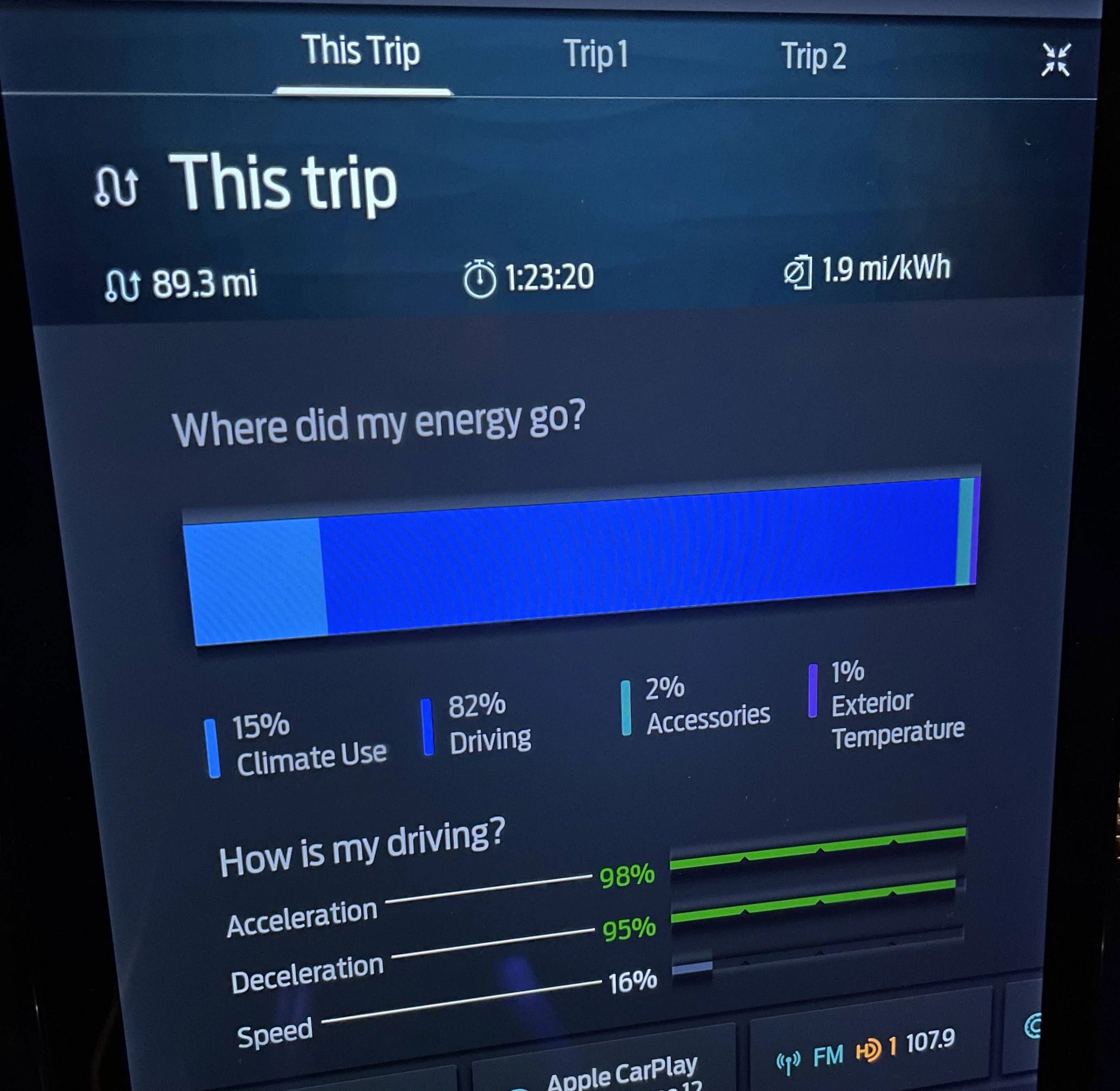
The navigation said I wasn't going to make it back home and wanted to add a charging stop, but I made it back with 9%. I was targeting 10% arrival, so I was close. The recorded mileage was also slightly less than what Google Maps got, that's probably nominal. There is also an efficiency discrepancy with the "This Trip" screen for some reason. I get 2.2 mi/kWh from the raw battery data but the screen said my trip was 1.9 mi/kWh. Not sure what's up with that. The overall efficiency and range performance was about what I expect for these temps (getting about half of the EPA rated range). With a full battery my actual range would be less than 150 miles with the extended pack.

Findings:
  • The heater was pegged at maximum output the entire drive (about 5.4 kW)
  • The battery was never heated the entire drive
  • The battery didn't really warm up while driving (except from regen), it actually got a couple degrees colder on the interstate.
  • Regen limit with a freezing battery was astonishingly high at 75 kW!
  • Significant cell temperature variations can occur in the pack after driving, this is also not very desirable.
  • The HVAC system closes the fresh air damper periodically to increase heat, but the cabin humidity spikes and windows fog.
  • Initial humidity in the car can be an issue, it took about 30 minutes for the cabin to dry out.
  • Cabin temperature was very slow to rise, takes at least 30 minutes for the cabin to warm to an acceptable temperature with no preheat.
  • The navigation estimate for arrival percentage is off, about 10% error in the conservative direction.
  • The efficiency calculated by the trip computer does not match the energy used data from the pack (1.9 vs. 2.2 mi/kWh).
  • The actual range and efficiency is about what I would expect in sub-zero temps.
  • The trip mileage is slightly low compared to Google Maps.
Conclusions:
  • The cabin heat is pretty much at its limit around 0ºF. Window fogging and cabin comfort will likely go downhill from here as it gets colder.
  • Wet feet and/or snow on the floor mats will increase fogging considerably.
  • The new HVAC calibration helps improve heat but is still a bit chilly when below 0ºF.
  • Trying to use recirc is out of the question at these temps, the windows will fog up almost immediately.
  • I'm very concerned about the regen limit being so high with a cold pack. This could permanently damage it. Tesla does not allow virtually any regen at the same battery temps. It should be limited to 20 kW or less with a freezing pack IMO.
  • Preconditioning to warm up the battery is highly recommended to prevent pack damage during regen.
  • The trip computer and navigation seem to contain moderate errors in the conservative direction.
I plan on repeating the same trip after Preconditioning to see the difference.
That’s about what I am getting here in Montana range wise right now with preconditioning. I am a little less, but I run studded tires in the winter. I am curious how that will change when our high is -23F this week. I know this sounds weird, but if my hair is wet in the mornings, it will fog my windows?.
Sponsored


Top